

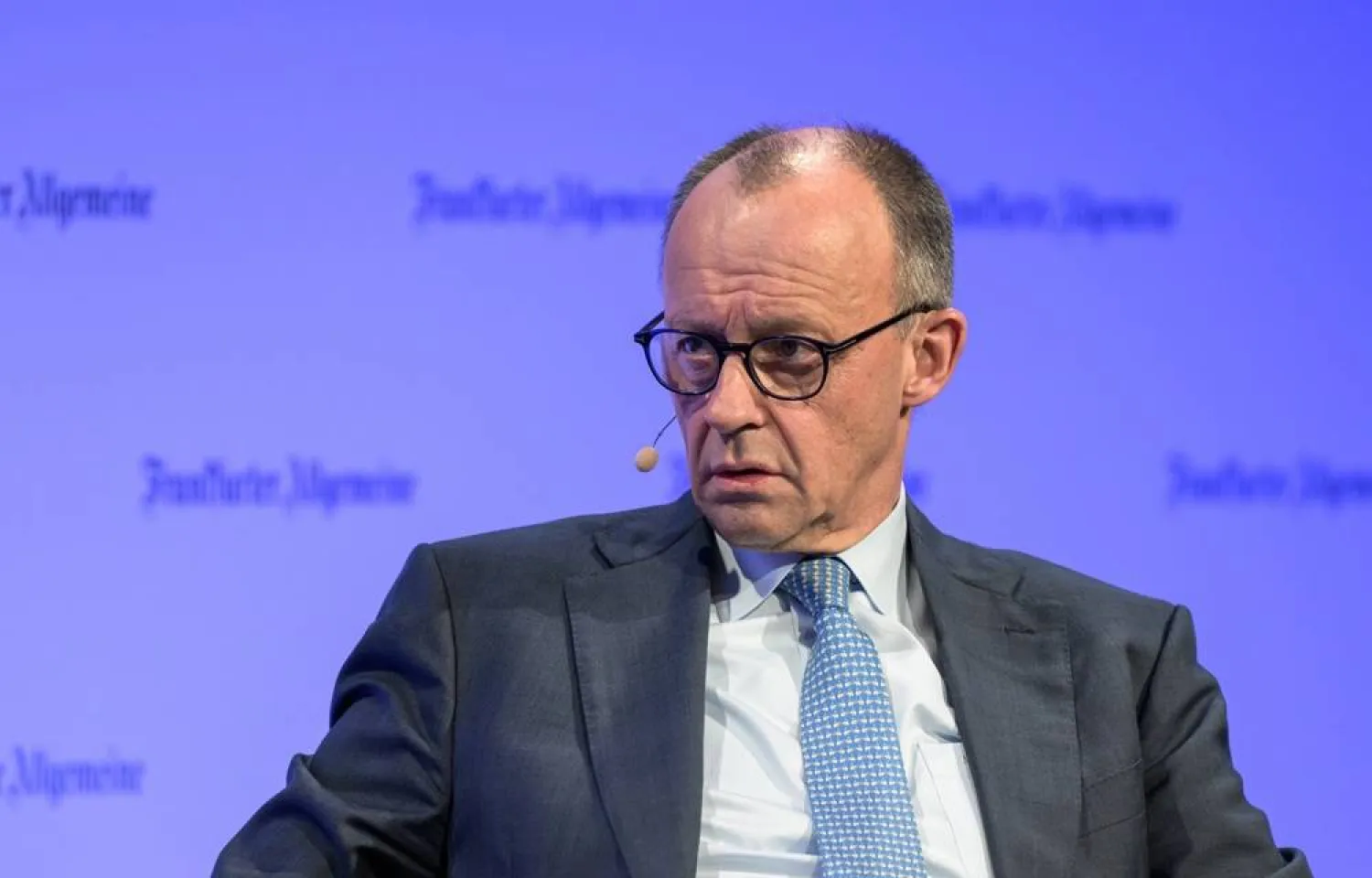

US, Israel Unlikely to Achieve ‘Regime Change’ in Iran, Says Merz

 27 March 2026, Hesse, Frankfurt/Main: Germany's Chancellor Friedrich Merz speaks at the "FAZ" Congress. (dpa)
27 March 2026, Hesse, Frankfurt/Main: Germany's Chancellor Friedrich Merz speaks at the "FAZ" Congress. (dpa)
TT

US, Israel Unlikely to Achieve ‘Regime Change’ in Iran, Says Merz

 27 March 2026, Hesse, Frankfurt/Main: Germany's Chancellor Friedrich Merz speaks at the "FAZ" Congress. (dpa)
27 March 2026, Hesse, Frankfurt/Main: Germany's Chancellor Friedrich Merz speaks at the "FAZ" Congress. (dpa)

The US-Israeli war against Iran is unlikely to lead to "regime change", German Chancellor Friedrich Merz said Friday, as the month-long conflict showed no signs of abating.

"Is regime change really the goal?" he said at a forum in Frankfurt organized by the FAZ newspaper.

"If that's the goal, I don't think you'll achieve it. It's mostly gone wrong" in past conflicts, he said, pointing to the Afghanistan war.

"I have serious doubts as to whether there is a strategy and whether that strategy is being successfully implemented," he added. "In that respect, it could take even longer."

Germany has pushed back at US President Donald Trump's criticisms of NATO members for failing to join the attacks on Iran, insisting that it is not their war.

Merz however said Friday he believed that Trump had accepted this stance.

He also said Germany would be open to helping provide military protection in the Strait of Hormuz, a key route for oil and gas, which has been nearly totally blocked, in the event of a ceasefire.

"This requires an international mandate, it requires approval from the German parliament and, prior to that, a cabinet decision. And we are far from that."



WHO Chief Says 'Work not Over' after Hantavirus Evacuation

This video grab from AFP TV video shows a view of Director-General Tedros Adhanom Ghebreyesus speaking during a virtual press conference on the hantavirus cluster linked to a cruise ship travel, in Geneva, on May 7, 2026. (Photo by AFP)
TT

WHO Chief Says 'Work not Over' after Hantavirus Evacuation

This video grab from AFP TV video shows a view of Director-General Tedros Adhanom Ghebreyesus speaking during a virtual press conference on the hantavirus cluster linked to a cruise ship travel, in Geneva, on May 7, 2026. (Photo by AFP)

World Health Organization chief Tedros Adhanom Ghebreyesus said on Tuesday "our work is not over" to contain hantavirus after evacuations from a cruise ship hit by a deadly outbreak of the illness.

The fate of the MV Hondius has sparked international alarm after three passengers died in an outbreak of the rare virus, for which no vaccines or specific treatments exist.

Yet health officials have stressed that the global public health risk is low and rejected comparisons to the start of the Covid-19 pandemic, reported AFP.

"There is no sign that we are seeing the start of a larger outbreak," Tedros told a joint news conference with Spanish Prime Minister Pedro Sanchez in Madrid after overseeing the evacuation in Spain's Canary Islands.

"But of course the situation could change, and given the long incubation period of the virus, it's possible we might see more cases in the coming weeks," Tedros said of the Andes variant, which is transmissible between humans.

Among living patients, all of whom are passengers or crew of the ship, seven cases have been confirmed and an eighth is listed as "probable", according to an AFP tally of official figures.

The affected nationalities include the United States, Britain, France, Spain, Switzerland and the Netherlands.

More than 120 passengers and crew on the MV Hondius were flown out from Spain's Canary Islands on Sunday and Monday, and countries have adopted different health measures for their returning evacuees.

Most have followed the WHO's guidelines, which include a 42-day quarantine and constant monitoring of high-risk contacts because the incubation period can take six weeks.

- 'Follow the advice' -

Tedros said he hoped countries would "follow the advice and recommendations we are making," acknowledging that nations were free to decide their own health protocols.

French Prime Minister Sebastien Lecornu called on Tuesday for "closer coordination" on health protocols within the European Union.

The MV Hondius presented diplomatic challenges as different countries negotiated over who would receive it and treat its passengers.

Cape Verde refused to receive the ship, which remained anchored offshore the capital Praia as three people were evacuated to Europe by air last week.

Spain allowed the vessel to anchor off the Canary Islands for the evacuation of passengers and crew on Sunday and Monday, but the Atlantic archipelago's regional government fiercely opposed the measure.

Defending his government's policy, Sanchez said the "world does not need more selfishness or more fear. What it needs are countries that show solidarity and want to step forward."

The MV Hondius left the island of Tenerife with a skeleton crew on Monday and will be disinfected upon arrival in the Netherlands on Sunday.

Hantavirus spreads from the urine, faeces and saliva of infected rodents and is endemic in Argentina, where the MV Hondius set sail on April 1 for a cruise across the Atlantic Ocean to Cape Verde.


Kremlin Says Preparations for Putin Visit to China are in Final Stages

FILED - 26 July 2023, Russia, Saint Petersburg: FILE PHOTO - Kremlin spokesman Dmitry Peskov attends a meeting at the Konstantinovsky Palace. Photo: Vladimir Smirnov/KREMLIN/dpa
TT

Kremlin Says Preparations for Putin Visit to China are in Final Stages

FILED - 26 July 2023, Russia, Saint Petersburg: FILE PHOTO - Kremlin spokesman Dmitry Peskov attends a meeting at the Konstantinovsky Palace. Photo: Vladimir Smirnov/KREMLIN/dpa

The Kremlin said on Tuesday that preparations ‌were ‌in the ‌final ⁠stages for a visit ⁠by President Vladimir Putin ⁠to ‌China.

Kremlin spokesman ‌Dmitry Peskov ‌said ‌the timing of the ‌visit would be announced ⁠in due ⁠course.

Relations between Russia and China have deepened significantly in recent years, with the two countries expanding cooperation in trade, energy, defense, and diplomacy while presenting their partnership as a counterbalance to Western influence.


Iran Chief Negotiator Says US Must Accept Proposal or Face ‘Failure’

A person rides a motorcycle over a US flag painted on a street, in Tehran, Iran, May 12, 2026. Majid Asgaripour/WANA (West Asia News Agency) via Reuters
TT

Iran Chief Negotiator Says US Must Accept Proposal or Face ‘Failure’

A person rides a motorcycle over a US flag painted on a street, in Tehran, Iran, May 12, 2026. Majid Asgaripour/WANA (West Asia News Agency) via Reuters

Iran's chief negotiator on Tuesday issued an ultimatum to the United States to accept the conditions in Tehran's 14-point proposal for peace in the Middle East war or face "failure".

The defiant message came after US President Donald Trump rejected the latest counteroffer from Iran and said that a fragile ceasefire in place since April 8 was on "life support".

But Mohammad Bagher Ghalibaf said Washington had to accept Tehran's "rights" if it wanted to end more than two months of conflict, as peace talks remain deadlocked after an initial round failed to produce a breakthrough last month.

"There is no alternative but to accept the rights of the Iranian people as laid out in the 14-point proposal. Any other approach will be completely inconclusive; nothing but one failure after another," said Ghalibaf in a post on X.

"The longer they drag their feet, the more American taxpayers will pay for it."

Iran has refused to back down in its war with Washington, with military officials warning they are prepared to respond to any renewed US attack.

It has choked traffic through the key Strait of Hormuz trade route, rattling global markets and giving it vital leverage, while the US has imposed its own naval blockade on Iranian ports.

Details of the latest US proposal remain limited, though media reports say it involves a one-page memorandum of understanding aimed at ending the fighting and establishing a framework for negotiations on Iran's nuclear program.

Iran's foreign ministry said its response called for ending the war on all fronts, including Lebanon, halting the US naval blockade on Iranian ports and securing the release of Iranian assets frozen abroad under longstanding sanctions.

It did not elaborate on what Iran would offer in return.

On Tuesday, the spokesman for Iran's parliamentary national security commission said lawmakers would consider the possibility of enriching uranium to weapons-grade levels if conflict resumed.

"One of Iran's options in the event of another attack could be 90 percent enrichment. We will examine it in parliament," Ebrahim Rezaei wrote in a post on X.

Tehran possesses a significant stockpile of uranium enriched to 60 percent purity, with roughly 90 percent required for a nuclear weapon.

Iran's stockpile of highly enriched uranium remains a key sticking point in negotiations with the United States, which insists the material must be transferred out of the country.

Iran has so far refused to move its enriched uranium stockpile abroad and insists on its right to the peaceful use of nuclear energy, though it has said the level of enrichment remains "negotiable".