
Middle East Power Struggle Faces Defining Moment

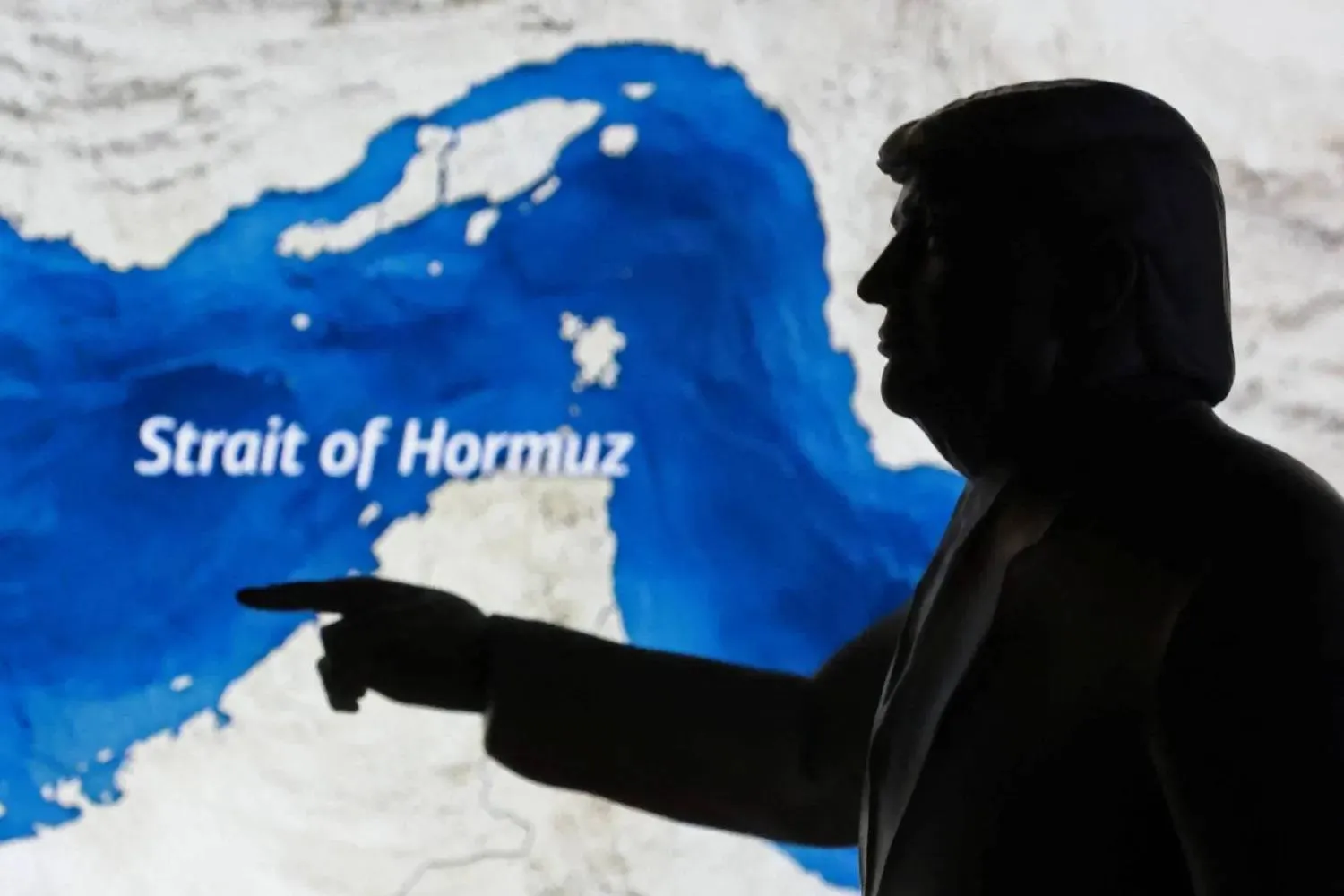
Map showing the Strait of Hormuz, alongside a 3D-printed model of US President Donald Trump (Reuters)
TT

Middle East Power Struggle Faces Defining Moment

Map showing the Strait of Hormuz, alongside a 3D-printed model of US President Donald Trump (Reuters)

Perhaps the worst-case scenario long feared in decision-making circles has come true. With the assassination of Supreme Leader Ali Khamenei, Washington and Tel Aviv used the same “shock and awe” approach Israel has relied on in recent years, one that delivers rapid gains before losing momentum by the end of a campaign.

This time, however, US President Donald Trump broke a taboo and opened a Pandora’s box, pushing the region into war on shaky grounds and with no clear end. He forced a confrontation of mutual deterrence with an Iranian system that has lost its regional deterrent image.

The expansion of these rival projects in the Middle East, shifting between confrontation and coexistence, has reached a breaking point.

The Khamenei project, which dominated four Arab capitals for decades, has suffered repeated setbacks over the past ten years after peaking in the wake of the Arab Spring. It drained its limited resources and drew the attention of Washington, and Israel’s determination to confront it.

The failure of coexistence made a clash inevitable, one the current US administration has not handled with the patience of a major power.

In the first US military intervention of its kind since 2003, Trump’s war on Iran has lacked a clear endgame. His rhetoric mixed shifting goals with flexible timelines to pressure Tehran. Over time, his administration lost control of the war’s narrative and psychological edge, while hesitating to escalate militarily. The failure to quickly weaken Iran led Washington to conclude that following Israel’s pace would deepen US involvement.

Who decides in Tehran?

Uncertainty also surrounds decision-making in Tehran. The system appears to be paying the price of successive assassinations, from Qassem Soleimani to Ismail Haniyeh and Hassan Nasrallah.

Now it faces a new deterrence phase after Khamenei’s killing, a leader who balanced conservatives and reformists, and the Revolutionary Guard with negotiators.

The new Supreme Leader, Mojtaba Khamenei, deepens concerns over hereditary rule and strengthens the security establishment over the religious one. The transition remains unclear, including loyalties and decision-making centers.

Will power be collective and contested, or will Mojtaba consolidate control, if he is not targeted? His legitimacy depends on the continuation of the war in the near term. Ending it would raise questions about his authority and force decisions on dealing with Washington, including easing the air blockade and rebuilding after war and sanctions.

A fragile deterrence balance

Washington believed the cost of confronting Iran was low, concluding with Israel that military action offered better results than diplomacy. That calculation proved wrong.

The United States destroyed much of Iran’s conventional capabilities but has not stopped its ballistic missile launches or its ability to disrupt shipping in the Strait of Hormuz. Tehran has used the strait as economic leverage, linking pressure on the regime to damage to the global economy.

The result has been the biggest supply disruption since the 1970s energy crisis, forcing the Trump administration to temporarily ease sanctions on Iranian oil.

Iran’s strategy unfolded in three phases. First, survival, preventing collapse and internal unrest. In a leadership vacuum, Tehran’s security system escalated deterrence sharply. As US rhetoric hinted at regime change, Iran treated the war as existential, despite knowing it could not win a conventional fight.

Second, raising the cost of war for Washington and the global economy. Credibility of deterrence became central. Without a response to a strike as major as Khamenei’s assassination, Iran risks appearing defeated, weakening its regional deterrence and internal stability.

Both sides turned to what Thomas Schelling called the “diplomacy of violence,” using constant military threats as pressure.

Another goal for Tehran has been internal cohesion, using external war to limit divisions and strengthen hardliners.

The past week marked a peak in tensions over Hormuz and energy infrastructure. Both sides stepped back from full escalation after recognizing the cost of retaliation would be too high. Signals of restraint emerged, along with a need for communication and clear red lines.

Trump moved first by announcing negotiations, surprising both Iran and Israel. The fight shifted from the battlefield to diplomacy, where the side that moves first shapes the outcome.

Mediation on three tracks

Arab diplomatic sources told Asharq Al-Awsat that mediation is underway, led by Pakistan, Egypt and Türkiye through three channels in Iran: the Revolutionary Guard, the foreign ministry and parliament speaker Mohammad Qalibaf.

Each country is using its own channels. No other states are currently positioned to mediate, especially as these three have not been targeted by Iranian missiles. The sources also point to advanced US proposals seeking a middle ground.

The challenge is timing. Washington wants a quick deal, while Tehran says time is tight, especially with communication risks under Israeli surveillance.

Iran’s proxies under strain

Iran’s regional proxies form the second pillar of deterrence. The idea of unified, simultaneous fronts proved largely unrealistic. It materialized only once after the 2023 “Al-Aqsa Flood” operation before the axis suffered repeated blows.

In the 2025 Iran-Israel war, these groups stayed neutral. Now, after Khamenei’s assassination, they have entered the conflict.

Assassinations by Israel and the United States weakened the network, while sanctions since 2019 cut resources. Supply routes through Iraq and Syria have also been strained.

Iran now leads from the front as its proxy network narrows. Its strategy focuses on expanding battlefields, not unifying them, with centralized control in Tehran. The Revolutionary Guard is now coordinating directly with Hezbollah and Iraq’s Popular Mobilization Forces.

Hezbollah is fighting with depleted resources and a strained base. The Popular Mobilization Forces, long avoiding direct confrontation with US troops, have now targeted American forces and interests in Iraq and beyond, potentially reshaping deterrence and boosting Iran’s influence.

But the group is divided. Some factions continue attacks, others prioritize political interests. The result is fragmented deterrence and weaker credibility.

What comes next?

The key question is whether Tehran will insist on including Hezbollah in any deal, or whether Israel will impose a new reality south of the Litani River.

Even if Washington ends the war, Israel may keep pressure on Iran. Tehran’s proxies remain under pressure but not defeated. This ambiguity may weaken them over time without leading to full settlements.

Neither war nor truce will resolve local crises across these arenas.

As Carl von Clausewitz said, war continues politics by other means. Tehran is now shifting from deterrence to negotiation as part of its survival strategy. Signals point to pragmatic figures within hardline structures who can engage across factions.

Washington is trying to reach them, while Israel has targeted some, including Ali Larijani.

The key shift is now between Washington and Israel. Trump surprised Israel by considering de-escalation and sending Vice President JD Vance to deliver that message to Benjamin Netanyahu.

Both sides have moved to negotiating under fire, raising stakes while testing intentions. Washington favors Qalibaf, Tehran prefers Vance.

Gains and losses

Victory is relative. For Iran, staying at the table is a win despite heavy losses. Early talk of regime change has faded, even in Israel, under US pressure.

The narrative has shifted from regime change to control of Hormuz. Trump negotiates through pressure, Iran deters through endurance. Nuclear deadlock is now mirrored on the battlefield.

Both sides want to end the war, but on terms they can sell at home.

Russia and China prefer that Trump does not dominate global energy routes. Iran is part of a wider struggle over influence. If Trump falls short, Washington risks its image as a guarantor of global navigation.

Trump has hinted at joint management of Hormuz with Iran’s new leader, echoing US-China competition in the South China Sea.

A limited US intervention, combined with hesitation and economic risks, may give Iran an edge in the near term, strengthening its internal control, though long-term recovery depends on a clear deal with the West.

Pro-Israel Lobby Spends Big on US Midterms as Backlash Grows

Israeli Prime Minister Benjamin Netanyahu speaks at the AIPAC policy conference in Washington, DC, US, March 6, 2018. (Reuters)
TT

Pro-Israel Lobby Spends Big on US Midterms as Backlash Grows

Israeli Prime Minister Benjamin Netanyahu speaks at the AIPAC policy conference in Washington, DC, US, March 6, 2018. (Reuters)

The most powerful pro-Israel lobby in the United States is spending more than any other outside group on the 2026 midterms -- even as its once-coveted backing becomes an increasingly potent weapon for political opponents.

The American Israel Public Affairs Committee (AIPAC) has poured tens of millions of dollars into races nationwide through its main election-spending vehicle, the United Democracy Project (UDP).

The so-called "super PAC" -- a group allowed to lavish unlimited sums to influence elections, provided it operates independently of candidates -- has spent $54 million on congressional races, according to campaign finance monitor OpenSecrets.

That has made it the single largest outside spender of the cycle, OpenSecrets said, while the wider pro-Israel donor network spent $71 million -- placing it second only to the cryptocurrency industry.

The extraordinary financial firepower underscores AIPAC's continued influence in Washington -- but also a growing backlash over US policy toward Israel and the role of wealthy interest groups in American elections.

AIPAC has concentrated much of its spending on Democratic primaries, supporting candidates strongly committed to Israel and trying to defeat critics of unconditional US military aid.

It didn't respond to a request for comment, but it has rejected suggestions that its influence is collapsing, saying hundreds of candidates it backed have won their primaries.

Its money has indeed delivered victories this year, but also some expensive failures.

- Money meets resistance -

In Michigan, AIPAC and allied groups spent around $30 million in an unsuccessful effort to prevent progressive former health official Abdul El-Sayed from winning the Democratic Senate nomination over establishment-backed Congresswoman Haley Stevens.

Progressives have also defeated candidates supported by AIPAC-linked money in congressional contests in California, Illinois and New York, often turning the group's spending itself into a campaign issue.

Eli Clifton, of US foreign policy think tank the Quincy Institute, said UDP was the biggest spender in Michigan, although 97 percent of its large contributions came from outside the state -- and its biggest donors are Republican billionaires.

"This is a special interest that participates outside of the partisan framework, and it's really all about advancing the interests of a foreign country," he told AFP.

Unease over the group is no longer confined to Democrats.

Allies of Mike Rogers, the Republican Senate nominee in Michigan, recently asked AIPAC not to run advertisements publicly on his behalf, US media reported, fearing its overt involvement would benefit El-Sayed in the Arab-American heartland.

- Shifting opinion -

The discomfort reflects a broader transformation in US attitudes toward Israel following years of war in Gaza and widening conflict across the Middle East.

A June Quinnipiac University poll found 48 percent of American voters believed Washington was too supportive of Israel, including 66 percent of Democrats -- the highest overall figure in nine years of the survey.

The change has been clearest on the Democratic left, where candidates increasingly portray AIPAC as too closely aligned with Israeli Prime Minister Benjamin Netanyahu and emblematic of big-money interests overwhelming ordinary voters.

But criticism has spread to the populist right, where some "America First" conservatives have attacked Washington's support for Israel and blamed pro-Israel lobbying for drawing the United States deeper into foreign conflicts.

AIPAC's financial strength, meanwhile, continues to grow. OpenSecrets says the organization itself has contributed $30 million to UDP.

And its political power remains formidable, with US military aid to Israel continuing to attract broad support in Congress.

But the primaries have demonstrated that record spending cannot guarantee victory -- and a once-prized endorsement can now, in some races, be something candidates would rather their opponents talked less about.

"That's precisely why they never mention US foreign policy and Israel in their ads," Casey Kennedy, co-founder of the Track AIPAC advocacy platform, told AFP.

"AIPAC knows AIPAC is toxic, and the more they spend, the more toxic they become with voters across the political spectrum."


Satellite Images Show Bedrock and Glacier Collapsed on Nepal-China Border, Then Rivers Flooded

 This satellite image provided by Vantor shows destruction at Syapru Besi, Nepal on Thursday, Aug. 27, 2026. (Satellite image ©2026 Vantor via AP)
This satellite image provided by Vantor shows destruction at Syapru Besi, Nepal on Thursday, Aug. 27, 2026. (Satellite image ©2026 Vantor via AP)
TT

Satellite Images Show Bedrock and Glacier Collapsed on Nepal-China Border, Then Rivers Flooded

 This satellite image provided by Vantor shows destruction at Syapru Besi, Nepal on Thursday, Aug. 27, 2026. (Satellite image ©2026 Vantor via AP)
This satellite image provided by Vantor shows destruction at Syapru Besi, Nepal on Thursday, Aug. 27, 2026. (Satellite image ©2026 Vantor via AP)

As rescue teams searched for missing people following catastrophic flooding along the Nepal-China border, Earth scientists reviewed satellite imagery for clues to the cause and assessed the devastation.

The flooding Wednesday killed hundreds of people in Nepal and Tibet, and hundreds more are missing, including foreigners and pilgrims.

Geomorphologists Kristen Cook and Dan Shugar said initial images from Nepal were obscured by clouds and dust from the debris, so they could only see that part of a glacier had broken off from Langtang Lirung peak, near the border with Tibet. In clearer images from Thursday, they said they could see that the bedrock underneath the glacier had collapsed, taking the massive chunk of ice down with it and sending boulders and ice into the valley.

“It shows the whole area without anything hidden, and we could see that, yes, it looked like there was not only this glacier that had failed, but a much larger chunk of the bedrock of the mountainside itself that had given way,” said Shugar, associate professor at the University of Calgary. “You have this big bedrock failure that took part of the glacier with it.”

This satellite image provided by Vantor shows Syapru Besi, Nepal on Oct. 18, 2023. (Satellite image ©2026 Vantor via AP)

Shugar said it’s heart-wrenching to look downstream from there on the images, to where people were living, and see how the debris has buried villages.

After slamming to the valley floor, the debris maintained its momentum through the steep, narrow valley as ice melted, said Cook, at the Université Grenoble Alpes in France. Water and mud several stories high swept through communities.

The Trishuli River surged during the flooding. Before and after satellite images of the Kolpurtar, Betrawati and Syapru Besi areas of Nepal show that the river is now much wider, and brown and black, because it overtopped its banks in some areas and filled with debris in others. The change in the color of the water shows how much sediment the flow was carrying, turning from greenish to very brown because it's full of mud, Cook said.

Towns and villages that were devastated along the river banks are submerged in debris and mud. They appear as areas of brown. Some houses are still poking through in an image of the Betrawati area.

The flooding toppled and swept away buildings in Syapru Besi, a popular tourist spot where a famous trek to Langtang begins. In before and after images, a side river is now wider too, because the flow was so powerful it pushed upstream.

The flooding “left a wasteland in its wake” that will take many years to recover from, said Alton Byers, a mountain geographer at the University of Colorado at Boulder. Byers lived in Nepal and now returns there yearly to study glacial hazards and work with communities to prepare. This is the largest glacier flood he has seen, by far.

This satellite image provided by Vantor shows destruction at Syapru Besi, Nepal on Thursday, Aug. 27, 2026. (Satellite image ©2026 Vantor via AP)

Byers, faculty research scientist at the university's Institute of Arctic and Alpine Research, said he thinks Wednesday's flooding is related to climate change. The Earth's warming is melting glaciers and permafrost, causing instability and the breakage of massive amounts of snow and ice at high altitudes. That can be a catalyst for a series of cascading events, he said.

“All the indicators, to me, point to the impacts of warming trends,” he said. “In this case, the permafrost that for millennia has helped to hold together high-altitude rock and ice and soil and glaciers is now weakening and becoming unstable."

Cook and Shugar said that at this point, they can't say for sure there's a direct link to climate change. Slopes fail and landslides happen, Cook said, though permafrost is melting and that is destabilizing mountainsides.

“While we cannot at this point directly link this collapse to climate change, it is not unexpected to see more events of this type with a warming climate,” Cook said. “Not this big, hopefully not this big.”


China's Help Critical, But Unlikely, for US to Choke off Iran

US Treasury Secretary Scott Bessent laid out plans this week to strangle Iran's economy. Kent NISHIMURA / AFP
TT

China's Help Critical, But Unlikely, for US to Choke off Iran

US Treasury Secretary Scott Bessent laid out plans this week to strangle Iran's economy. Kent NISHIMURA / AFP

The United States has threatened the "economic asphyxiation" of Iran, but analysts say that a successful chokehold would require unlikely cooperation from China.

Almost six months into the Middle East war, Washington this week laid out plans to expand sanctions against Iran, warning that any nation which continued to enable Tehran would become a "global pariah".

China is among countries whose entities have already been hit by the sweeping US plan, with Treasury Secretary Scott Bessent telling Beijing to "get with the program".

But Beijing instead has defended its cooperation with Tehran and vowed to safeguard its interests.

The apparent impasse is likely to further strain ties between Beijing and Washington, ahead of an expected visit by China's President Xi Jinping to the US capital in September.

- Oil 'central lever' -

Iran has weathered sanctions for decades, using complex international financial networks to evade restrictions.

Cutting off Iran "would certainly require China's help", said political scientist Dylan Loh of Singapore's Nanyang Technological University.

Beijing is a key customer for Iranian oil, while "a good amount of their trade also relies on (the Chinese currency) renminbi, which can be outside the reach of US sanctions", Loh told AFP.

Before the war, Tehran exported millions of barrels of oil a day, mostly to China.

"Oil is the central economic lever," said Nino Lezhava, a fellow at the Washington-based Center for European Policy Analysis.

Although most ship traffic in the vital Strait of Hormuz is still blocked, China is not totally cut off from Iran's crude thanks to the highways and railways of Central Asia, said Sun Degang, a professor of political science at Shanghai's Fudan University.

Despite Chinese purchases being lower than before, they remain an important source of revenue.

"Simply continuing to... maintain commercial channels and provide alternative payment mechanisms can substantially reduce the effectiveness of economic isolation," said Lezhava.

- 'Economic sovereignty' -

The United States is well aware of this.

Bessent said "no one is above the reach of US sanctions" when asked if Washington would target Chinese banks that do business with Iran.

However, while its sanctions announced on Monday targeted some Chinese entities accused of helping Tehran procure "critical technology", Washington has so far held back from punishing major Chinese financial institutions.

The United States "can't expect to obtain China's support if it continues to implement sanctions on Chinese companies", said Fudan University's Sun.

"Sino-Iranian trade relations are legitimate and China will safeguard its economic sovereignty."

China is already feeling some consequences from the Strait of Hormuz disruption, adding to economic strain from persistently sluggish domestic consumption.

Cutting off Iran would exacerbate that, as well as implicate Beijing in a messy conflict that has already weakened its strategic rival Washington.

Overall, China has "little reason" to cooperate with the United States on sanctions, said Chong Ja Ian, an associate professor of political science at the National University of Singapore.

- 'Push back' -

On Tuesday, China's foreign ministry said its cooperation with Iran has "always been conducted within the framework of international law and should not be interfered with or disrupted".

Chong said that "Beijing seems highly confident of its ability to push back successfully against the US", were it pressured.

China has expanded its capacities to deal "precisely with such scenarios", said Loh.

"China has its own tools to respond to protect its own interest as we have seen in the tit-for-tat export controls," he added.

China and the United States spent much of last year embroiled in an escalating trade war but reached a fragile truce when the two presidents met last October.

A successful global campaign against Iran may require Washington "to provide incentives" to Beijing to join it, said Lim Tai Wei, a professor and East Asia expert at Japan's Soka University.

China would only cooperate "if the costs of supporting Iran became significantly higher than the strategic and economic benefits", said Lezhava.