Venezuela’s Maduro Thanks Supporters in First Online Post from US Prison

A supporter of ousted Venezuelan President Nicolas Maduro and his wife Cilia Flores reacts while gathering with others in support of Maduro and Flores on the day they attend a hearing in a Manhattan federal court, more than two months after US military forces captured them in a surprise raid on Caracas and ferried them to New York, in Caracas, Venezuela, March 26, 2026. (Reuters)
TT

Venezuela’s Maduro Thanks Supporters in First Online Post from US Prison

A supporter of ousted Venezuelan President Nicolas Maduro and his wife Cilia Flores reacts while gathering with others in support of Maduro and Flores on the day they attend a hearing in a Manhattan federal court, more than two months after US military forces captured them in a surprise raid on Caracas and ferried them to New York, in Caracas, Venezuela, March 26, 2026. (Reuters)

Ousted Venezuelan president Nicolas Maduro and his wife, captured by US forces in a nighttime raid in January, said Saturday that they feel "steadfast" and "serene" in their first social media post from prison.

Maduro and his wife Cilia Flores have been held in a Brooklyn jail for almost three months, after American commandos snatched the pair from their compound in Caracas, and they have reportedly been without access to the internet or newspapers.

"We are well, steadfast, serene and in constant prayer," the pair said in a message shared on Maduro's X account, though it was unclear who made the post on their behalf.

"We have received your communications, your messages, your emails, your letters and your prayers. Every word of love, every gesture of affection, every expression of support fills our souls and strengthens us spiritually."

A source close to the Venezuelan government told AFP that Maduro reads the Bible and is referred to as "president" by some of his fellow detainees in Brooklyn's Metropolitan Detention Center, a federal prison known for unsanitary conditions.

He is only allowed to communicate by phone with his family and lawyers for a maximum of 15 minutes per call, the source added.

His son, Nicolas Maduro Guerra, known as "Nicolasito," has said in public appearances that his father is well, calm, and even exercising in prison.

Maduro, who has declared himself a "prisoner of war," had not spoken since being arraigned in New York on January 5.

"We feel a deep admiration for our people's ability to remain united in difficult times, to express love, awareness, and solidarity, within Venezuela and beyond our borders," the couple added in Saturday's post.

During a one-hour hearing on Thursday, the judge rejected a defense motion over Maduro and his wife's apparent inability to afford their legal bill without aid from the Venezuelan government. Neither spoke during the court appearance.

Maduro has pleaded not guilty to charges of "narco-terrorism" conspiracy, cocaine importation conspiracy, possession of machine guns and destructive devices and conspiracy to possess machine guns and destructive devices.

The January operation deposed Maduro, who had led Venezuela since 2013, forcing the oil-rich country to largely bend to US President Donald Trump's will.

Delcy Rodriguez, who had been Maduro's vice president since 2018, is now at the helm and grappling with leading a country saddled with the world's largest proven oil reserves but an economy in shambles.

Since Maduro's ouster, Rodriguez has enacted a historic amnesty law to free political prisoners jailed during his tenure and reformed oil and mining regulations in line with US demands for access to her country's vast natural wealth.

This month, the State Department said it was restoring diplomatic ties with Venezuela in a sign of thawing relations.
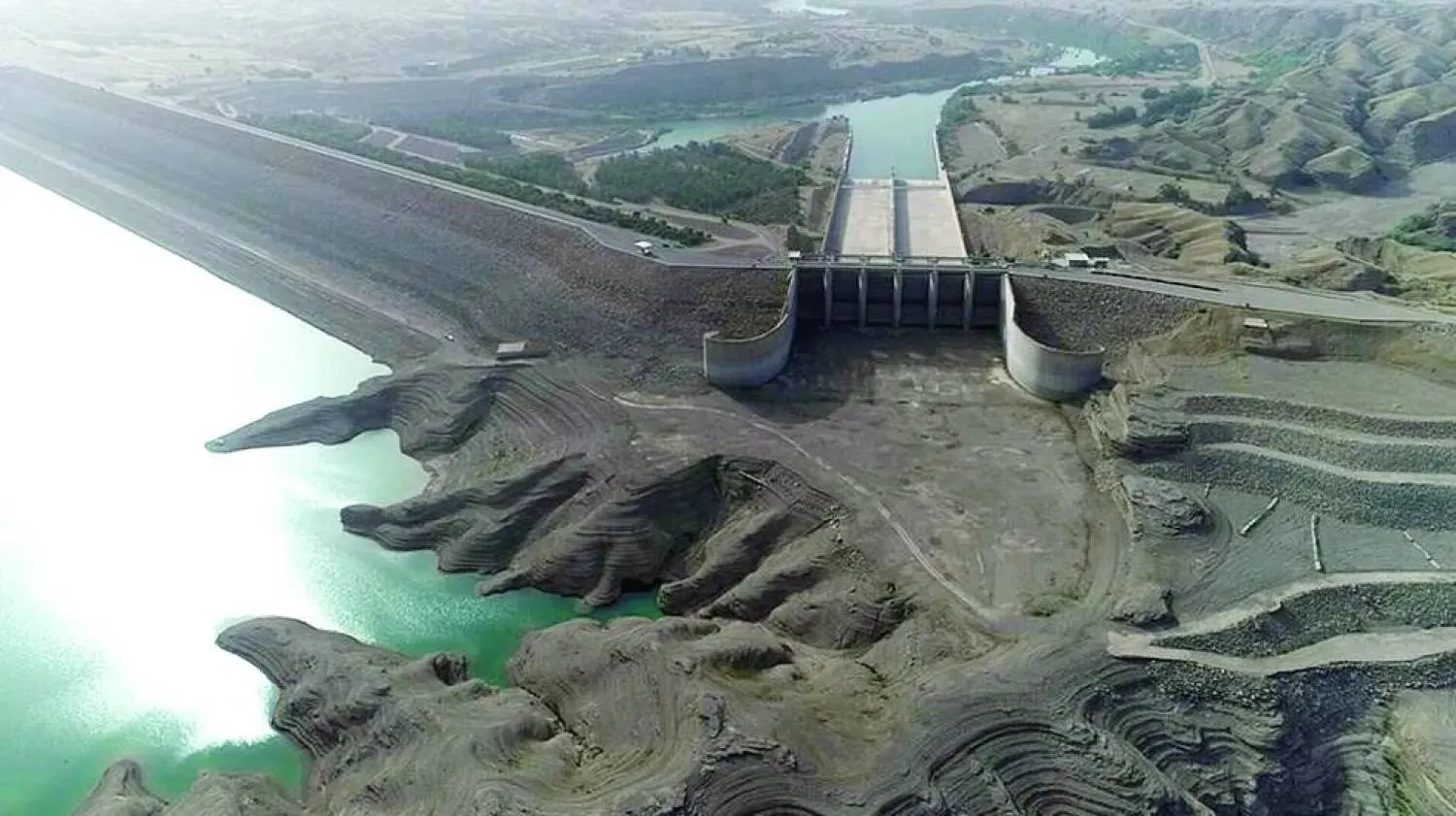


Iran Threatens to Turn to ‘Dam for Dam’ Scenario in Response to Attack on Its Civilian Infrastructure

A dam on the Karkheh River that stops the flow of water to the Iraqi border. (Tasnim)
TT

Iran Threatens to Turn to ‘Dam for Dam’ Scenario in Response to Attack on Its Civilian Infrastructure

A dam on the Karkheh River that stops the flow of water to the Iraqi border. (Tasnim)

Iran’s parliament Speaker Mohammad Bagher Ghalibaf warned on Tuesday that Tehran could target civilian facilities located near US and Israeli military bases in response to any attacks on the country’s civilian infrastructure.

Ghalibaf’s remarks came after the New York Times published a report this week raising questions about possible links between Iran’s water infrastructure and underground missile facilities.

In a post on X, the Speaker posted a link to the NYT article and wrote, “Prepping the next round on civilian infra, their ‘experts’ tell NYT: ‘dams near Iran’s missile sites are dual-use'.”

He added: “Cool. New rule: Any dam, port, or power plant near a US or Israeli base is dual-use. We’ll apply your logic consistently and even-handedly.”

Ghalibaf did not specify which dams could be targeted, but linked his threat to what he described as preparations for a new wave of attacks on Iran’s civilian infrastructure.

Targeting infrastructure

Iranian Foreign Ministry spokesperson Esmaeil Baghaei rejected the NYT report, calling the claims “baseless” and “a propaganda and security pretext to justify attacks on a country's vital infrastructure.”

On his X account, he said the claim that civilian infrastructure is geographically adjacent to missile bases, used to legitimize attacks against such infrastructure, is neither a valid justification nor supported by any evidence.

“Rather, it is merely a deliberate fallacy intended to justify targeting civilian infrastructure and normalize flagrant violations of international humanitarian law,” he wrote.

He said Iran knows very well how to deliver an “unforgettable” response to any malicious act or aggression.

However, he added: “the world must understand that silence and appeasement in the face of efforts to pave the way for flagrant violations of international legal norms and moral and humanitarian principles will have devastating consequences for all humanity and human civilization.”

Karun and Karkheh Dams

Iran has an extensive network of dams and water infrastructure, with major concentrations in the Karun and Karkheh River basins in the country’s southwest.

Environmental reports say the expansion of dam construction and the diversion of waterways have contributed to worsening drought, desertification and declining water resources in several regions.

On Monday, the NYT published a report, “Airstrikes on Iran missiles sites may shed light on justification for dams,” saying Iran has been building dams to help supply its various underground bunkers and “missile cities.”

According to the report, some analysts who have long been mystified by the significant proliferation of dams across Iran, especially in regions that had no apparent need for them, think they now know the answer after US and Israeli airstrikes on concealed Iranian missile sites this year targeted many of the same areas.

These analysts have concluded that the water projects may have been developed to support the country’s military buildup.


Eisenkot-Led Bloc Replaces Netanyahu Ally as Knesset Speaker

Newly elected Knesset Speaker Matan Kahana delivers a speech after being elected during a plenary session of the Knesset, Israel's parliament, in Jerusalem, 17 November 2026. (EPA)
TT

Eisenkot-Led Bloc Replaces Netanyahu Ally as Knesset Speaker

Newly elected Knesset Speaker Matan Kahana delivers a speech after being elected during a plenary session of the Knesset, Israel's parliament, in Jerusalem, 17 November 2026. (EPA)

Israel's parliament voted on Tuesday to select a new speaker opposed to the agenda of Benjamin Netanyahu, a potential first step in rolling back the prime minister's divisive political agenda even as his main rival struggles to form a government.

Parties led by Gadi Eisenkot, Netanyahu's main competitor in an inconclusive October election, voted to install Matan Kahana, a member of Eisenkot's center-right Yashar party, with 66 voting in favor of Kahana and 52 voting for another candidate, according to the office of the spokesperson for the parliament.

Kahana replaces Amir Ohana, a member of Netanyahu's Likud party.

"The Knesset of Israel is the home of all citizens of the State of Israel, and I intend to be the Speaker ‌for everyone," said Kahana ‌in his inaugural speech.

In Israel's unicameral 120-seat parliament, known as the Knesset, ‌the ⁠speakership is a ⁠powerful position that wields considerable influence, including over what legislation is brought to a vote.

Kahana will have the ability to advance bills prioritized by the Eisenkot-led bloc and other parties backing the former general in his bid to become prime minister.

These include establishing an independent inquiry into the October 7, 2023, Hamas attack, which Netanyahu has opposed; imposing term limits on the prime minister; and repealing laws passed by the previous Netanyahu-led government that critics said curtailed the powers of the judiciary.

Netanyahu's Likud party condemned the vote, saying lawmakers elected ⁠Kahana with "the votes of terror supporters." Throughout the election campaign, Netanyahu attacked ‌Israel's Arab-led parties saying that they represent an existential threat to ‌Israel, in attacks that the parties condemned as racist and discriminatory.

Members of the Eisenkot-led bloc have also been ‌appointed to chair several key parliamentary committees, which play an important role in advancing legislation.

The parliament was ‌sworn in on November 10 without a new government, after a deadlocked October 27 general election stripped Netanyahu of his majority but left his main rivals with no clear path to power.

DEADLOCKED ELECTION AFTERMATH

President Isaac Herzog has tasked Eisenkot, who heads the center-right Yashar political party, with forming a government. However, the former chief of the ‌military also lacks a majority and will likely have to compromise on some campaign promises if he is to secure the support needed to form ⁠a government.

Netanyahu remains ⁠caretaker prime minister until a government is formed. His right-wing Likud's alliance with far-right and ultra-Orthodox parties outperformed election expectations but still lost its majority. It now holds 53 of the Knesset's 120 seats.

Eisenkot's Yashar party and patchwork coalition partners hold just 48 seats. But they have potential allies in the parties representing Israel's Arab minority, which hold 19 seats and are aligned with Eisenkot in their vehement opposition to Netanyahu.

If no one is able to form a government, another election will be held next year.

Netanyahu has sought to cast doubt on the election results by baselessly alleging voter fraud by Arabs, who make up a fifth of the population. Election officials have said that they are probing potential misconduct but that they have seen no evidence of fraud that could have influenced the vote's outcome.

Israel's Channel 12 News reported on Sunday that law enforcement was investigating whether officials in Netanyahu's office had deliberately planted information that prompted an inquiry into alleged vote-buying in Arab communities.

Netanyahu's office has dismissed the Channel 12 report as "false".


Son of Ousted Shah Says ‘Finish Job’ Against Iranian Regime

A woman walks past an image of the Iran's late supreme leader Ali Khamenei, assassinated by the US and Israel in a military strike in February 2026, in Tehran on November 17, 2026. (AFP)
TT

Son of Ousted Shah Says ‘Finish Job’ Against Iranian Regime

A woman walks past an image of the Iran's late supreme leader Ali Khamenei, assassinated by the US and Israel in a military strike in February 2026, in Tehran on November 17, 2026. (AFP)

The son of the ousted shah of Iran told an Israeli virtual conference on Tuesday that countries should "finish the job" against Tehran and empower the Iranian people.

Reza Pahlavi, the US-based figurehead of Iran's exiled monarchist movement, regularly calls for the overthrow of the Iranian regime.

Speaking during a webinar with Israeli President Isaac Herzog, Pahlavi said that "civilized nations cannot gamble with a regime seeking nuclear blackmail and global reach".

Western nations accuse Iran of seeking nuclear weapons, something it has always denied.

"Half measures and temporary ceasefires only allow this regime to regroup and reload," he added during a virtual conference hosted by Ben-Gurion University of the Negev.

"The only way to deal with an existential threat is to finish the job of eliminating it."

"Western policy can and should help this," Pahlavi said, "but it ultimately must rest on empowering those fighting the regime on the ground every day -- the Iranian people."

Herzog in turn thanked Pahlavi for his "friendship", saying: "Our war is not with the Iranian people."

"Our war is with the regime that calls for our annihilation, that wants to eradicate us," he added.

Pahlavi's father, Mohammed Reza Pahlavi, was the last shah of Iran, an autocratic ruler groomed by the West who relied on his feared Savak security service to crush political opposition. He was overthrown and fled the country during the 1979 revolution.

Reza Pahlavi remains controversial among critics of the Iranian regime because of his support for Israel and for not distancing himself from his father's autocratic rule.