


Israeli Police Prevent Catholic Leaders from Celebrating Palm Sunday Mass at Jerusalem Church

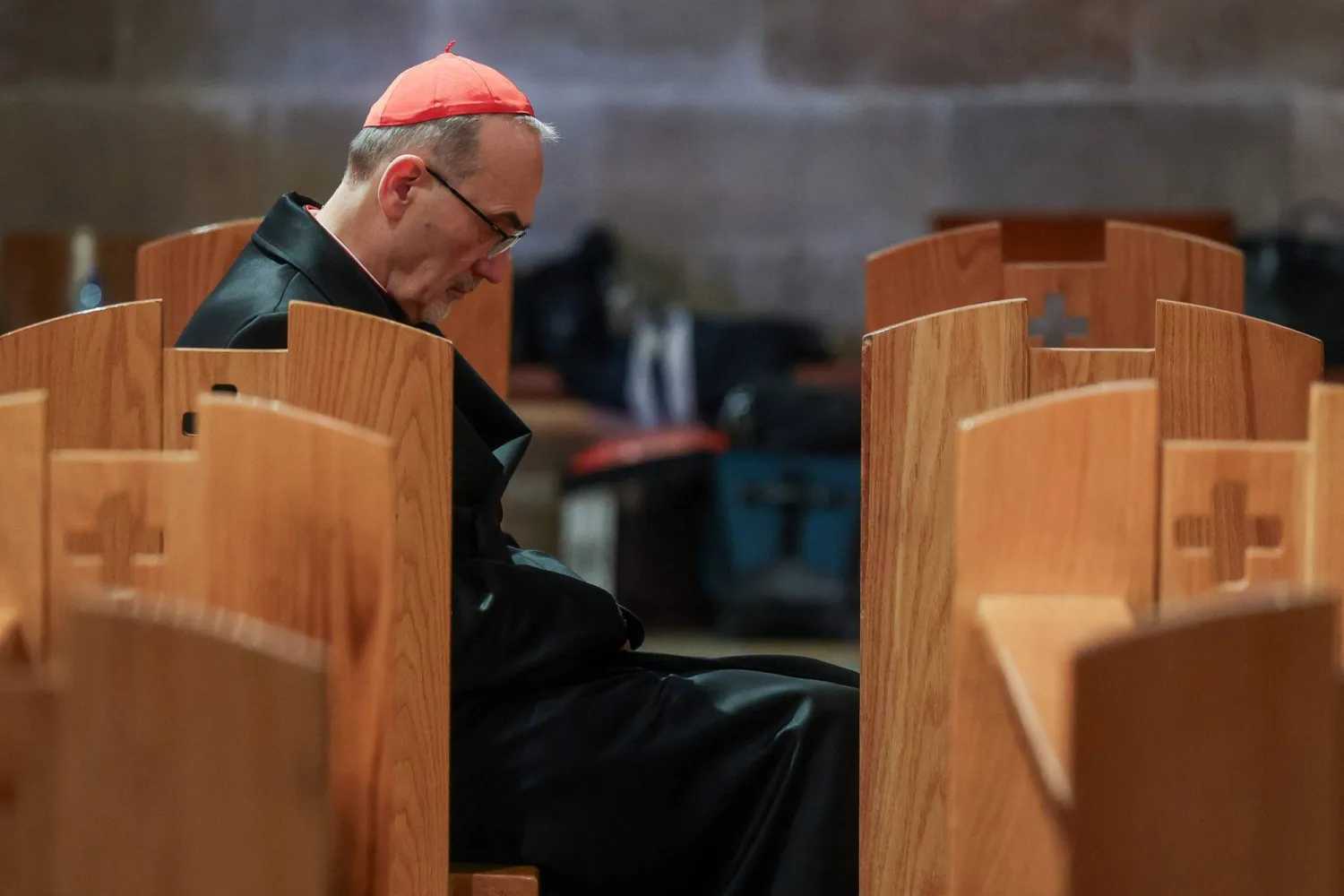
 Latin Patriarch of Jerusalem, Cardinal Pierbattista Pizzaballa, sits inside the Church of All Nations on the day of a prayer service to mark Palm Sunday in Jerusalem on March 29, 2026, following the cancellation of the traditional Palm Sunday procession from the Mount of Olives amid restrictions on gathering in large groups and the US-Israeli war on Iran. (AFP)
Latin Patriarch of Jerusalem, Cardinal Pierbattista Pizzaballa, sits inside the Church of All Nations on the day of a prayer service to mark Palm Sunday in Jerusalem on March 29, 2026, following the cancellation of the traditional Palm Sunday procession from the Mount of Olives amid restrictions on gathering in large groups and the US-Israeli war on Iran. (AFP)
TT

Israeli Police Prevent Catholic Leaders from Celebrating Palm Sunday Mass at Jerusalem Church

 Latin Patriarch of Jerusalem, Cardinal Pierbattista Pizzaballa, sits inside the Church of All Nations on the day of a prayer service to mark Palm Sunday in Jerusalem on March 29, 2026, following the cancellation of the traditional Palm Sunday procession from the Mount of Olives amid restrictions on gathering in large groups and the US-Israeli war on Iran. (AFP)
Latin Patriarch of Jerusalem, Cardinal Pierbattista Pizzaballa, sits inside the Church of All Nations on the day of a prayer service to mark Palm Sunday in Jerusalem on March 29, 2026, following the cancellation of the traditional Palm Sunday procession from the Mount of Olives amid restrictions on gathering in large groups and the US-Israeli war on Iran. (AFP)

The Israeli police prevented Catholic leaders from entering the Church of the Holy Sepulchre to celebrate Mass on the Christian holiday of Palm Sunday for the first time in centuries, the Latin Patriarchate said Sunday.

Jerusalem's major holy sites are closed because of the ongoing Iran war, including the church, as the city has come under frequent fire from Iranian missiles.

The Catholic Church called the police decision “a manifestly unreasonable and grossly disproportionate measure.” It prevented two of the church’s top religious leaders, including Cardinal Pierbattista Pizzaballa and the head of the Custos in the Holy Land, from celebrating Palm Sunday at the place where Christians believe Jesus was crucified.

Palm Sunday commemorates Jesus’ triumphant entry into Jerusalem and launches the Holy Week commemorations for Christians who follow the Latin calendar, which culminates in Easter next Sunday.

The Israeli police said it had notified the Catholic Church on Saturday that no Mass could take place on Palm Sunday because of safety considerations, the lack of access for emergency vehicles in narrow alleys of the Old City and lack of adequate shelter.

However, the Latin Patriarchate said the Church of the Holy Sepulchre has been hosting Masses that aren't open to the public since the Iran war began on Feb. 28, and it was unclear why Sunday’s Mass and access by the two priests was any different.

“It’s a very, very sacred day for Christians and in our opinion there was no justification for such a decision or such an action,” said Farid Jubran, the spokesperson for the Latin Patriarchate of Jerusalem.

Jubran said that the church had requested permission from the police for a few religious leaders to enter the church for a private Mass on Sunday — not one that was open to the public. The Patriarchate said that the decision impeded freedom of worship and the status quo in Jerusalem.

The traditional Palm Sunday procession normally sees tens of thousands of Christians from around the world walk from the Mount of Olives down the narrow, hilly streets toward the Old City, waving palm fronds and singing.

The Patriarchate canceled the traditional processional last week because of safety concerns, and has held Masses limited to fewer than 50 worshippers in compliance with the Israeli military’s guidelines for civilians.

Pizzaballa celebrated Mass in the nearby St. Savior’s Monastery, a soaring marble church which is located next to an underground music school that the Israeli military has deemed a safe shelter space. Later on Sunday, Pizzaballa held a prayer for peace at the Dominus Flevit Shrine on the Mount of Olives, but kept his homily concentrated on Jesus and didn't mention the morning’s incident.

Pope Leo XIV, at the end of Palm Sunday Mass in St. Peter’s Square, prayed for all Christians in the Middle East who he said were living through an “atrocious” conflict. He said that “in many cases, they cannot live fully the rites of these holy days,” though he didn’t elaborate.

The Vatican spokesman didn’t immediately respond when asked to comment on the Jerusalem incident.

Italy formally protested the incident to Israeli authorities. Premier Giorgia Meloni said that the police action “constitutes an offense not only against believers but against every community that recognizes religious freedom.”

“The Church of the Holy Sepulchre in Jerusalem is a sacred site of Christianity, and as such must be preserved and protected for the celebration of sacred rites,” Meloni said. “Preventing the Patriarch of Jerusalem and the Custos of the Holy Land from entering, especially on a solemnity central to the faith such as Palm Sunday, constitutes an offense not only against believers but against every community that recognizes religious freedom.”

Meloni’s conservative government tried to keep a balanced position with Israel during the war in Gaza, supporting Israel’s right to defense but condemning the toll on Palestinians.

The Italian leader has also said that Italy won't participate in the Iran war, while affirming that Tehran can't be allowed to possess nuclear weapons.

Foreign Minister Antonio Tajani instructed Italy’s ambassador to Israel to convey the protest “and to reaffirm Italy’s commitment to protecting religious freedom at all times and under all circumstances.”

In addition, Tajani summoned the Israeli ambassador to Italy for talks on Monday at the Italian Foreign Ministry to seek clarification about the decision.

Israeli Prime Minister Benjamin Netanyahu said on Sunday evening that there was no “malicious intent” and that the cardinal was prevented from accessing the church because of safety concerns, but that Israel would try to partially open the Church of the Holy Sepulchre in the coming days.

“Given the holiness of the week leading up to Easter for the world’s Christians, Israel’s security arms are putting together a plan to enable church leaders to worship at the holy site in the coming days,” Netanyahu wrote on X.

The Western Wall, the holiest site where Jews can pray, is also mostly closed because of safety issues, but authorities are letting up to 50 people at a time pray in an enclosed area adjacent to the plaza.

Smaller churches, synagogues, and mosques are open in Jerusalem’s Old City if they are located within a certain distance of a bomb shelter deemed acceptable by Israel’s military and, if gatherings are kept under 50 people.



Egypt Says Only Trump Can Stop War, Warns Oil Could Top $200

US President Donald Trump shakes hands with Egyptian President Abdel Fattah al-Sisi during a bilateral meeting at the World Economic Forum (WEF) in Davos, Switzerland, January 21, 2026. (Reuters)
TT

Egypt Says Only Trump Can Stop War, Warns Oil Could Top $200

US President Donald Trump shakes hands with Egyptian President Abdel Fattah al-Sisi during a bilateral meeting at the World Economic Forum (WEF) in Davos, Switzerland, January 21, 2026. (Reuters)

Egypt’s President Abdel Fattah al-Sisi urged US President Donald Trump on Monday to stop the Iran war and said fears of the oil price going above $200 were not exaggerated.

"I tell President Trump: nobody can stop the war in our region in the Gulf but you," Sisi said at the Egypt Energy Show 2026 energy conference in Cairo.

Noting ‌the impact ‌of supply shortages and price ‌rises, ⁠Sisi cited analysts' concerns ⁠that "the price of a barrel of oil could reach more than $200, and this is not an exaggeration."

Egypt has condemned Iranian attacks on Gulf Arab ⁠states and pushed diplomatic efforts ‌to avoid a wider regional ‌war.

The secretary-general of the Gulf Cooperation Council ‌bloc, Jasem Mohamed Albudaiwi, urged the international community ‌to protect vital maritime corridors, condemning Iran's closure of the Strait of Hormuz and its attacks on regional energy infrastructure.

Addressing the conference virtually, he said Iranian aggression ‌was a threat to the world.

"The brutal Iranian threats against energy ⁠facilities ⁠and the closure of the Strait of Hormuz constitute not only a blatant violation of international law but also a direct threat to global energy," he said.

The GCC, grouping Saudi Arabia, the United Arab Emirates, Qatar, Kuwait, Oman and Bahrain, has faced drone and missile attacks. The closure of the Strait of Hormuz has choked off a crucial route that previously handled about a fifth of global oil supplies.


Rocket Attack Targets Baghdad Army Base

Iraqi soldiers inspect the site of a destroyed healthcare center in the Habbaniyah military base, which was targeted by in an airstrike killing seven security personnel and wounding 13 others, in Habbaniyah, west of Baghdad on March 26, 2026. (AFP)
TT

Rocket Attack Targets Baghdad Army Base

Iraqi soldiers inspect the site of a destroyed healthcare center in the Habbaniyah military base, which was targeted by in an airstrike killing seven security personnel and wounding 13 others, in Habbaniyah, west of Baghdad on March 26, 2026. (AFP)

Rockets fired overnight targeted an Iraqi military base inside the Baghdad airport complex, which also houses a support center for the US embassy, Iraq's defense ministry said Monday.

The base is near a US diplomatic and logistics hub in the airport complex, which has been repeatedly targeted since the start of the war in the Middle East on February 28.

Iraq has been drawn into the conflict despite seeking to avoid it at all costs. Pro-Iran armed groups have claimed responsibility for attacks on US interests in Iraq and across the region, while strikes have also targeted these groups.

Early on Monday morning "an air base was targeted by 122mm Grad rockets launched from the outskirts of Baghdad", a statement from the ministry said.

"This attack resulted in the destruction of an Antonov-132 aircraft belonging to the Iraqi Air Force. No casualties were reported," it added.

A military official told AFP that "rockets fell inside the diplomatic support center early Monday morning, causing a fire".

Earlier this month, a security official told AFP that the US diplomatic hub had evacuated much of its personnel.

Since the outbreak of war, pro-Iran factions -- which have repeatedly claimed attacks against US interests -- have also been targeted by strikes they blame on the US or Israel.

Monday's incident comes after Washington and Baghdad said last week they would "intensify cooperation" to prevent attacks and ensure Iraqi territory is not used to launch assaults against US facilities.

For the first time in 10 days, two drones targeted the US embassy over the weekend but did not hit their targets.

The influential pro-Iran armed group Kataib Hezbollah said on March 19 it would pause such attacks for five days, twice extending.


Lebanese Soldier Killed in Israeli Strike on Checkpoint

This picture taken from the southern Lebanese area of Marjeyoun on March 29, 2026 shows smoke as it rises from the site of an Israeli airstrike that targeted the outskirts of the village of Yohmor. (Photo by AFP)
TT

Lebanese Soldier Killed in Israeli Strike on Checkpoint

This picture taken from the southern Lebanese area of Marjeyoun on March 29, 2026 shows smoke as it rises from the site of an Israeli airstrike that targeted the outskirts of the village of Yohmor. (Photo by AFP)

An Israeli strike has killed a Lebanese soldier at a checkpoint in the country's southern Tyre region, Lebanon's military said Monday.

"An Israeli attack targeted an army checkpoint" in al-Amriyeh near Tyre, "resulting in the death of one soldier and injuries to others", the military said.

A military source told AFP the attack was the first direct targeting of a Lebanese army position since the start of the war.

Also Monday, the Israeli military said a soldier was killed a day earlier in combat in southern Lebanon, bringing to six the number of troops killed since fighting with Hezbollah started earlier in March.

"Sergeant Liran Ben Zion, aged 19, from Holon... fell during combat in southern Lebanon," the military said.

Israeli Prime Minister Benjamin Netanyahu said on Sunday he had ordered the military to further expand its operations in southern Lebanon, citing continued rocket fire by Hezbollah.

Israel has said it will seize a chunk of southern Lebanon to create a "buffer zone" against Hezbollah, stoking Lebanese fears of Israeli military occupation that could deepen instability and cause further displacement.

Authorities in Lebanon say nearly 1,240 people have been killed there. Over 400 Hezbollah fighters have been killed since it fired on Israel on March 2, sources told Reuters, but it is unclear if the official death toll includes those fighters.