Iran Inflation Rate Rises to 50.6 Percent

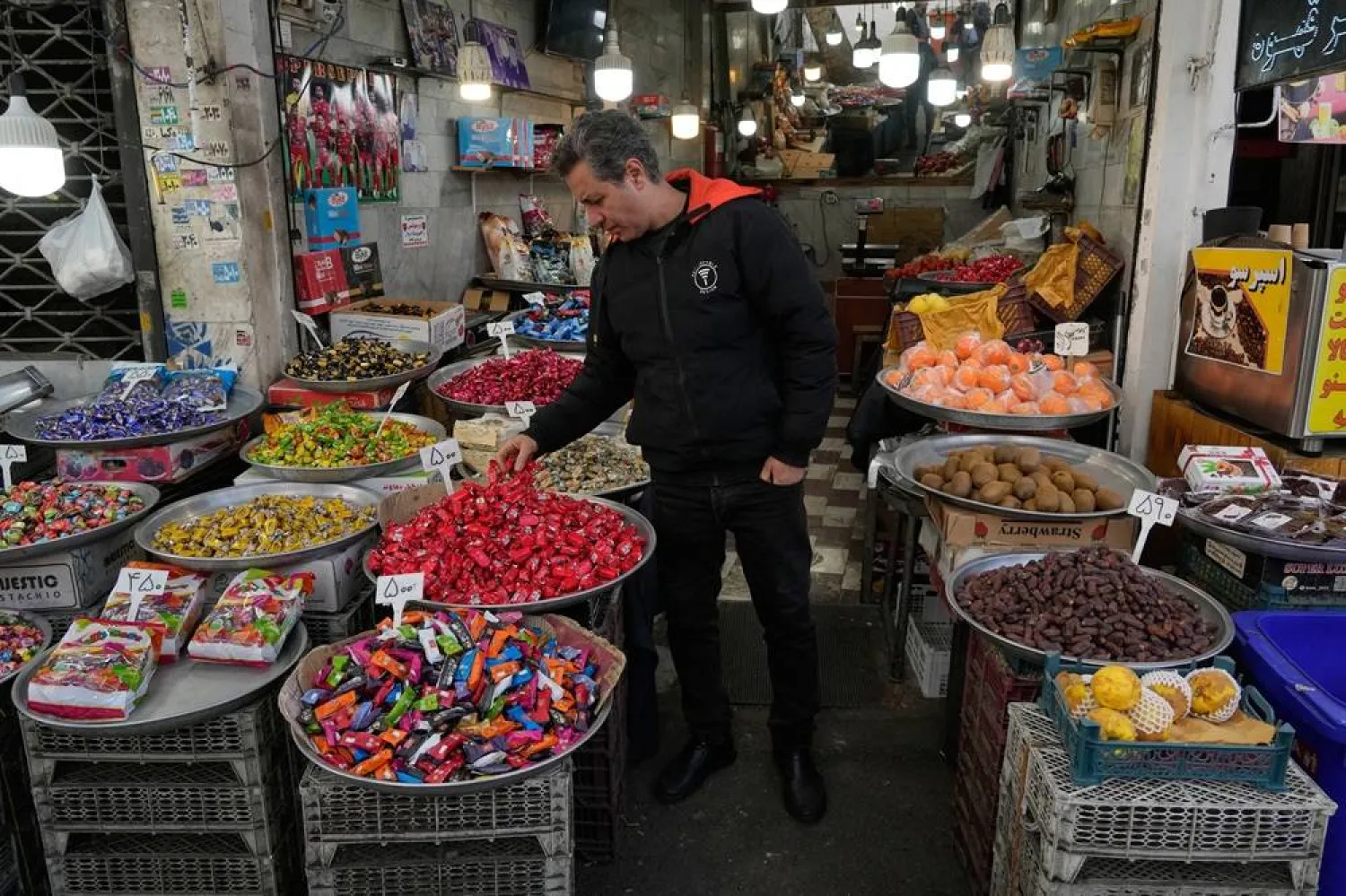
 A shopkeeper arranges items at his shop around the traditional grand bazaar of Tehran, Iran, Sunday, March 29, 2026. (AP)
A shopkeeper arranges items at his shop around the traditional grand bazaar of Tehran, Iran, Sunday, March 29, 2026. (AP)
TT

Iran Inflation Rate Rises to 50.6 Percent

 A shopkeeper arranges items at his shop around the traditional grand bazaar of Tehran, Iran, Sunday, March 29, 2026. (AP)
A shopkeeper arranges items at his shop around the traditional grand bazaar of Tehran, Iran, Sunday, March 29, 2026. (AP)

Iran's annual inflation rate rose to 50.6 percent by mid-March, up three percentage points from the previous month, the country's official statistics center said on Sunday.

"The inflation rate for the twelve months ending in Esfand (from February 20 to March 20) reached 50.6 percent," the center said in a statement carried by the official IRNA news agency.

The rate had stood at 47.5 percent in the previous month, covering the period from January 21 to February 19.

The rise in prices comes with Iran at war with the United States and Israel since February 28, when strikes that killed the country's supreme leader triggered a conflict that has since spread across the Middle East.

On March 20, Iran marked the start of the Nowruz holidays, the Persian New Year.


Saudi Aramco, S-OIL Inaugurate $7 Billion Petrochemicals Complex in South Korea

Amin Nasser, Aramco President & CEO, speaks at the event. (Aramco)
TT

Saudi Aramco, S-OIL Inaugurate $7 Billion Petrochemicals Complex in South Korea

Amin Nasser, Aramco President & CEO, speaks at the event. (Aramco)

Saudi Aramco, one of the world’s leading integrated energy and chemicals companies, and its subsidiary S-OIL inaugurated on Wednesday the Shaheen Project at a ceremony in Seoul.

The project is Aramco’s largest investment in the country, and the inauguration was attended by senior government and business leaders from Saudi Arabia and South Korea, in addition to representatives of the energy and chemicals industries, said Aramco in a statement.

It coincides with S-OIL’s 50th anniversary and represents an important milestone in the 35-year strategic partnership between Aramco and S-OIL, a relationship that began with Aramco’s initial S-OIL investment in 1991.

The $7 billion Shaheen project is a transformative step for both South Korea’s downstream sector and Aramco’s integrated downstream value chain. Combining world-class refining capabilities with the first major commercial deployment of Aramco’s proprietary thermal crude to chemicals (TC2CTM) technology, it features the world’s largest single steam cracker, a propylene fractionator, crude-to-chemicals conversion facilities, and polymer production units.

Amin Nasser, Aramco President & CEO, said: “Economic headwinds and rising geopolitical risks do not alter our long-term view on strategic investments. One clear example is Shaheen, our largest ever investment in Korea, reflecting our confidence in the country and in a region that will drive future energy demand. Investments like Shaheen build the resilience that markets need in uncertain times.”

“Through Aramco’s thermal crude to chemicals technology, deployed at scale, the project will strengthen S-OIL’s international competitiveness and create more value from every barrel,” he added.

“Together, we are positioned to meet the rising demand for materials essential to Asia’s key industries, from electric vehicles to semiconductors. As S-OIL celebrates its 50th anniversary, we are building the foundation for its next 50 years and beyond,” he declared.

Mohammed Al Qahtani, Aramco Downstream President, said: “Petrochemicals are critical to overall industrial competitiveness, and Shaheen brings cutting-edge technology to the region, helping position the Republic of Korea as one of the world’s most competitive producers by prioritizing efficiency, technological differentiation, and value addition.”

“Our investment in S-OIL and Shaheen underscores our long-term vision for this partnership, with a focus on advanced manufacturing that is expected to support product diversification and industrial growth and help meet rising demand for petrochemical feedstock in the years to come,” he remarked.

Anwar Al-Hejazi, Representative Director & CEO of S-OIL, said: “We are proud to celebrate this milestone with Aramco. We will continue to strengthen synergies across our refining, petrochemical, and lube base oil businesses and enhance our global competitiveness through continuous innovation and investment, leading S-OIL's growth into its next 50 years.”

Shaheen is expected to add approximately 3.2 million tons of annual petrochemical production capacity for S-OIL, positioning the company as a key player in the global supply of high-value polymers and advanced materials.

By deploying Aramco’s TC2CTM technology, developed in collaboration with Lummus Technology, the project integrates refining and petrochemical processes to increase the share of crude oil converted into high-value chemicals.

This expanded petrochemical production is projected to increase the share of petrochemicals in S-OIL’s overall business portfolio from 12% to 25%, while improving competitiveness through reduced operating costs. This innovation allows S-OIL to process a broader range of feedstocks, further integrating refining and chemical processes to enhance industrial competitiveness.

The project will be integrated with S-OIL’s existing refining and petrochemical facilities in Ulsan, with the aim of creating synergies with other companies across the Ulsan petrochemical complex. Through dedicated pipeline networks, the facility is expected to provide a stable domestic supply of basic petrochemical feedstocks to nearby downstream companies, reducing their reliance on imports and logistics.

This integration aims to strengthen the competitiveness of the broader petrochemical value chain and contribute to the development of Ulsan’s industrial ecosystem. Commercial operations are scheduled to commence in 2027 following the completion of commissioning.

Aramco is the majority shareholder of S-OIL, holding more than 63% of the company’s shares on a non-diluted basis through its subsidiary Aramco Downstream Asia Pte. Ltd.


Gold Holds Steady Ahead of US Inflation Data

A jeweller arranges gold jewellery at a shop in Peshawar, Pakistan, 24 November 2026. (EPA)
TT

Gold Holds Steady Ahead of US Inflation Data

A jeweller arranges gold jewellery at a shop in Peshawar, Pakistan, 24 November 2026. (EPA)

Gold prices steadied on Wednesday after falling more than 2% in the previous session, as investors awaited US inflation data due later in the day for clues on the Federal Reserve's policy path.

Spot gold was little changed at $3,558.85 per ounce by 0312 GMT. Prices had hit a 14-month ‌low on Friday. ‌US gold futures for December delivery dropped ‌0.1% ⁠to $3,557.80.

"The recent decline ⁠was mainly driven by a selloff in the equity market because investors needed cash to pay for margin calls. As of now, markets continue to remain in consolidation mode until further signals," said ANZ analyst Soni Kumari.

Asian stocks tumbled as fresh US tariff threats hit sentiment and a tech-led rally ⁠fizzled, with the region's chip-heavy markets bearing the ‌brunt of the selloff.

The ‌US Personal Consumption Expenditures (PCE) Index, a key gauge closely watched by the ‌central bank as it targets a 2% inflation rate, ‌is due at 1330 GMT.

Markets are pricing in a 96.4% chance of a 25-basis-point rate increase at the Fed’s December policy meeting and a 3.6% probability of a larger 50-bp hike, according ‌to CME’s FedWatch tool.

Higher rates increase the opportunity cost of holding non-yielding bullion.

US consumer confidence increased ⁠more than ⁠expected in November, touching its highest level in nearly two years, amid optimism over labor market conditions and the overall economy following this month's midterm elections.

"We expect gold's downward pressure to eventually reverse, although the recovery could remain muted into early 2027 before gaining momentum," analysts at OCBC said in a note.

Elsewhere, the World Gold Council said on Tuesday its Wholesale Digital Gold Initiative completed live pilot transactions under a new settlement model that enables electronic ownership and transfer of physical gold.

Among other metals, spot silver steadied at $40.89 per ounce, platinum slid 1% to $1,263.62 and palladium rose 0.3% to $856.11.


Crown Prince: 2027 State Budget Maximizes Saudi Vision 2030 Impact, Turns Achievements into Sustainable Economic Strength

Saudi Crown Prince Mohammed bin Salman bin Abdulaziz Al Saud - SPA
TT

Crown Prince: 2027 State Budget Maximizes Saudi Vision 2030 Impact, Turns Achievements into Sustainable Economic Strength

Saudi Crown Prince Mohammed bin Salman bin Abdulaziz Al Saud - SPA

On the approval of the State's General Budget for fiscal year 1448/1449 AH (2027), Prince Mohammed bin Salman bin Abdulaziz Al Saud, Crown Prince, Prime Minister, and Chairman of the Council of Economic and Development Affairs, affirmed that the 2027 budget embodies the government's commitment to placing the nation's advancement and the interests of its citizens at the forefront of its priorities, and preserving development gains for current and future generations.

He noted that the achievements realized thus far are the result of the directives of Custodian of the Two Holy Mosques King Salman bin Abdulaziz Al Saud and the efforts of Saudi Arabia's citizens.

The Crown Prince stated that work in the third phase of Saudi Vision 2030 builds upon the reforms and accomplishments achieved during the previous two phases, stating: "We are maximizing the impact of the Vision on people's lives, transforming its achievements into a sustainable strength for our economy and renewed opportunities for future generations."

He emphasized the continued expansion of development opportunities, investment in the capabilities of Saudi citizens, and the building of a more diverse and competitive economy whose impact extends beyond 2030, SPA reported.

The Crown Prince affirmed that the 2027 budget is part of a long-term financial plan that balances supporting sustainable growth, implementing development priorities, and strengthening public finance sustainability, while maintaining flexibility in resource allocation and continued funding for programs and projects with economic and social impact. He noted that enhancing the effectiveness of the social support and protection system—by directing spending to those most in need and raising living standards and quality of life—remains a core priority within Saudi Arabia's fiscal and economic policy, alongside continued investment in infrastructure and essential services for citizens, residents, and visitors, and the development of transport and logistics networks to strengthen regional connectivity, enhance investment appeal, improve the efficiency of goods movement, and bolster economic resilience against shifts in global supply chains.

According to SPA, the Crown Prince underscored the importance of increasing spending efficiency, measuring its outcomes, aligning resource allocation with national strategies, and maximizing returns from government assets and investments. He stressed that government entities are responsible for ensuring high-quality monitoring, execution, and transparency, as well as achieving targeted project outcomes that support medium- and long-term development. He further noted that economic reforms and policies supporting economic activity have broadened the economic base and enhanced competitiveness, pointing out that 2026 estimates indicate a 2.5% growth in real GDP from non-oil activities, reflecting progress in economic diversification plans.

The Crown Prince stated that financial sector growth, underpinned by strong regulatory frameworks, supports economic financing and private sector expansion, and that maintaining the strength of Saudi Arabia's financial position facilitates access to financial markets and diversifies funding sources while keeping public debt at sustainable levels and maintaining substantial government reserves to navigate changes and sustain development.

He commended the private sector's role in driving economic growth amid ongoing regulatory and structural reforms aimed at developing the business environment, enhancing investment stability and attractiveness for local and international investors, expanding investment opportunities, increasing the private sector's economic contribution, and supporting small- and medium-sized enterprises (SMEs), local content development, non-oil exports, and job creation.

The Crown Prince affirmed that the Public Investment Fund (PIF) continues to develop strategic and promising sectors aligned with development priorities and economic diversification by strengthening partnerships with the private sector and supporting SMEs through investments that localize knowledge, develop national talent, enhance local content in the fund's operations, and expand investment opportunities in domestic and global markets.

Complementing this role, the Crown Prince said that the National Development Fund, through its affiliated development funds and banks, continues to enhance financing efficiency, direct funding toward national priorities, expand financing opportunities for development sectors and projects, and incentivize private sector participation to support the budget and maximize the developmental impact of available resources.

Internationally, the Crown Prince stressed that Saudi Arabia has demonstrated its capability and standing as a sustainable and reliable global supplier in securing world energy supplies, backed by strategic investments in energy and logistics infrastructure to ensure the flow of oil and non-oil exports by utilizing the East-West Pipeline and ports along the western coast. He reaffirmed the Kingdom's commitment to continued cooperation with producing countries, expanding economic partnerships, and contributing to efforts supporting regional and global development and stability, in line with Saudi Arabia's international standing and responsibility.

The Crown Prince stated that current geopolitical developments have demonstrated the resilience of the Saudi economy and its high capacity to adapt to changing circumstances through flexible fiscal policies and effective coordination among entities. He noted that the Kingdom closely monitors all regional and global developments, including uncertainty in the global economy, stressing that national security and stability are the foundation for preserving development achievements and continuing to develop military and defense capabilities. He expressed his pride in the officers and personnel of the armed forces and security sectors, including those stationed along the nation's borders, for their efforts and sacrifices in defending the Kingdom and its assets.

Concluding his statement, the Crown Prince affirmed that the Kingdom of Saudi Arabia, under the leadership and directives of the Custodian of the Two Holy Mosques, continues to expand opportunities for its citizens, safeguard its stability, security, and inviolable sovereignty, and defend its assets with strength and determination, while pursuing comprehensive growth and development across all sectors and reinforcing its active role in the global economy and in establishing the foundations of peace and stability in the region and the world with wisdom and objectivity.