


Dollar Bides Time as Markets Brace for Drawn-Out Middle East War

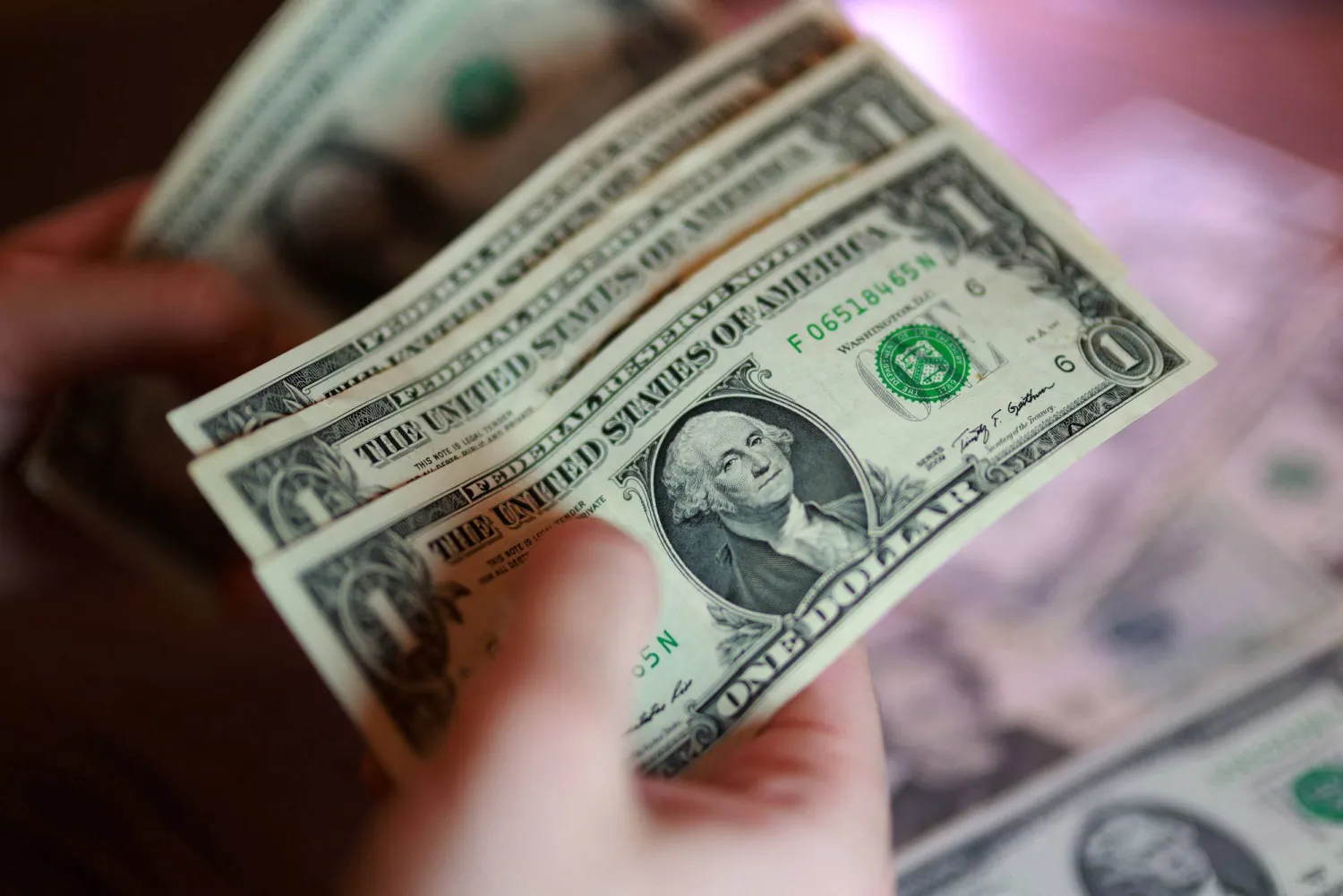
US dollar banknotes are seen in this illustration taken March 24, 2026. (Reuters)
TT

Dollar Bides Time as Markets Brace for Drawn-Out Middle East War

US dollar banknotes are seen in this illustration taken March 24, 2026. (Reuters)

The US dollar held broadly steady on Monday, poised for its strongest monthly gain since July as investors fret about the ramifications of a long war in the Middle East, denting the yen past the crucial 160 level and spurring intervention jitters.

Markets have been rattled this month after the conflict effectively shut the Strait of Hormuz, a chokepoint for about a fifth of global oil and gas flows, driving Brent crude toward its biggest monthly rise and unsettling rate expectations.

The war, sparked by US and Israeli strikes on Iran on February 28, has since spread across the Middle East, with fears of a ground offensive and the entry of Yemen's Iran-aligned Houthis on Saturday further souring sentiment.

Pakistan said it was preparing to host "meaningful talks" to end the conflict in coming days even though Tehran said it is ready to respond if the United ‌States launches a ‌ground operation.

Investors were largely unmoved by comments from US President Donald Trump that Washington has ‌held "direct ⁠and indirect" talks with ⁠Iran and that its new leaders have been "very reasonable."

The US dollar was a touch weaker in Asian hours but mostly held onto its recent gains. The euro was 0.1% higher $1.15145, yet was staring at a 2.5% drop in March, its weakest monthly performance since July.

Sterling was at $1.3271, little changed on the day but set for a drop of 1.7% this month. The dollar index, which measures the US currency against six other units, was 0.2% lower at 100.1.

"What stands out is how quickly probabilities have shifted. Only two weeks ago, US boots on the ground in Iran was seen as a low-probability ⁠outcome," said Chris Weston, head of research at Pepperstone.

"That has clearly changed, reinforcing the ‌need for markets to remain open-minded. The playbook is to sell rallies ‌in risk and maintain volatility hedges"

For now, the broader market focus is firmly on oil prices as Brent crude futures sit at $115.53 ‌per barrel, up about 59% in March, its strongest monthly surge on record.

"Where the USD goes from here ‌is simply a view on oil. Where oil goes, the USD goes," said Prashan Newnaha, senior rates strategist at TD Securities.

Elevated oil prices have reignited inflation concerns, prompting US rate futures to begin pricing in the risk of a Federal Reserve rate hike later this year, a sharp shift from earlier this year when traders were betting on as many as two rate cuts in 2026.

At ‌the same time, investors are increasingly weighing the longer-term economic toll of a prolonged war.

"Central banks find themselves in the most uncomfortable of positions: facing prices that argue ⁠for tightening while growth signals ⁠argue for caution," said Marc Chandler, chief market strategist at Bannockburn Capital Markets.

"It is stagflation's calling card, and it arrived before most were ready to receive it."

FRAIL YEN BACK IN SPOTLIGHT

The Japanese yen firmed to 159.70 per dollar after hitting 160.47 earlier in the session, its weakest level since July 2024 when Tokyo last intervened in the currency markets.

The reversal came as Japan geared up its threat of yen intervention and signaled that further falls in the currency could justify a near-term interest rate hike. The yen has dropped over 2% in March on higher oil price worries.

Japan's top currency diplomat Atsushi Mimura said authorities may need to take "decisive" steps if speculative moves persist in the currency market, while Bank of Japan Governor Kazuo Ueda said the central bank will closely watch yen moves as they affect the economy and prices.

The risk-sensitive Australian dollar has struggled in March, as fears over global growth driven by higher energy costs and supply-chain disruptions have outweighed support from expectations of rate hikes at home.

The Aussie hit a two-month low of $0.6843 and was headed for a monthly drop of about 3.5%, its steepest decline since December 2024. The New Zealand dollar weakened 0.3% to $0.57355, down 4.3% in March.



Oman Port Hit by Drone to Reopen from Tuesday

General view of Port of Salalah in Dhofar governorate, Oman, August 6, 2024. REUTERS/Rula Rouhana/File Photo
TT

Oman Port Hit by Drone to Reopen from Tuesday

General view of Port of Salalah in Dhofar governorate, Oman, August 6, 2024. REUTERS/Rula Rouhana/File Photo

Danish shipping firm Maersk announced Monday that Oman's port of Salalah, which was hit by a drone at the weekend, would start to reopen from Tuesday.

The Oman authorities said one worker was injured and minor damage caused by the strike on the port, which is run by Maersk subsidiary APM Terminals and is one of the key shipping facilities in the Gulf state.

Maersk said the area damaged was "limited" and that the port's management would take "necessary measures" to progressively build up to full capacity.

Some "constraints" would remain but additional safety and "preventive" measures had been taken because of the strike, it added.


US Stocks Open Higher after Trump Threatens Iran

Stock market statistics are displayed on a screen at the New York Stock Exchange (AFP)
TT

US Stocks Open Higher after Trump Threatens Iran

Stock market statistics are displayed on a screen at the New York Stock Exchange (AFP)

Wall Street stocks opened higher Monday after US President Donald Trump claimed progress in talks with Iran, even as he threatened to destroy key oil facilities on Kharg Island and to decimate the country's power infrastructure.

International benchmark Brent North Sea crude was up 2.2 percent to $115.02 per barrel on Monday morning, while the main US oil contract, West Texas Intermediate, rose 1.7 percent to $101.35, AFP reported.

All three major US indices started the week on the front foot.

About ten minutes into trading, the tech-rich Nasdaq Composite was up 0.8 percent at 21,124.23, the Dow Jones Industrial Average rose 0.9 percent at 45,566.69, and the broad-based S&P 500 also rose 0.9 percent to 6,426.20.

Art Hogan of B. Riley Wealth Management said investors "would desperately like to see an exit ramp in this war."

Still, even as Trump claims progress towards talks, he is often contradicted by Tehran and the Middle East region remains engulfed by war, with US-Israeli strikes continuing, Iran's retaliation targeting US allies in the Gulf and Israeli strikes against Lebanon expanding.

"The market's going to wake up every day and try to figure out where we are in the war with Iran and what that means for energy prices," said Hogan.

"If in fact, the president's announcement on Truth Social can be even taken a little bit seriously about negotiations going well, then the market would celebrate that."

Hogan added that markets were currently oversold and therefore "very susceptible to any good news, especially as it pertains to this war in Iran."

Monday's gains came after a series of losses last week, with the S&P 500 ending the week lower for the fifth straight week, its longest such run in four years.


Turkish Cenbank Total Reserves Fell $55 billion Since War Began

Turkish Central Bank (official website)
TT

Turkish Cenbank Total Reserves Fell $55 billion Since War Began

Turkish Central Bank (official website)

The Turkish Central Bank's total reserves fell by a hefty $22 billion last week to $155.5 billion, bringing their declines since the start of the Iran war to $55 billion, bankers said, Reuters reported.

They said the central bank sold $18 billion in foreign exchange last week, meaning its total forex sales amid the one-month war totaled $44 billion.

The central bank's net reserves fell $22.5 billion last week to $35 billion, the bankers also said.