

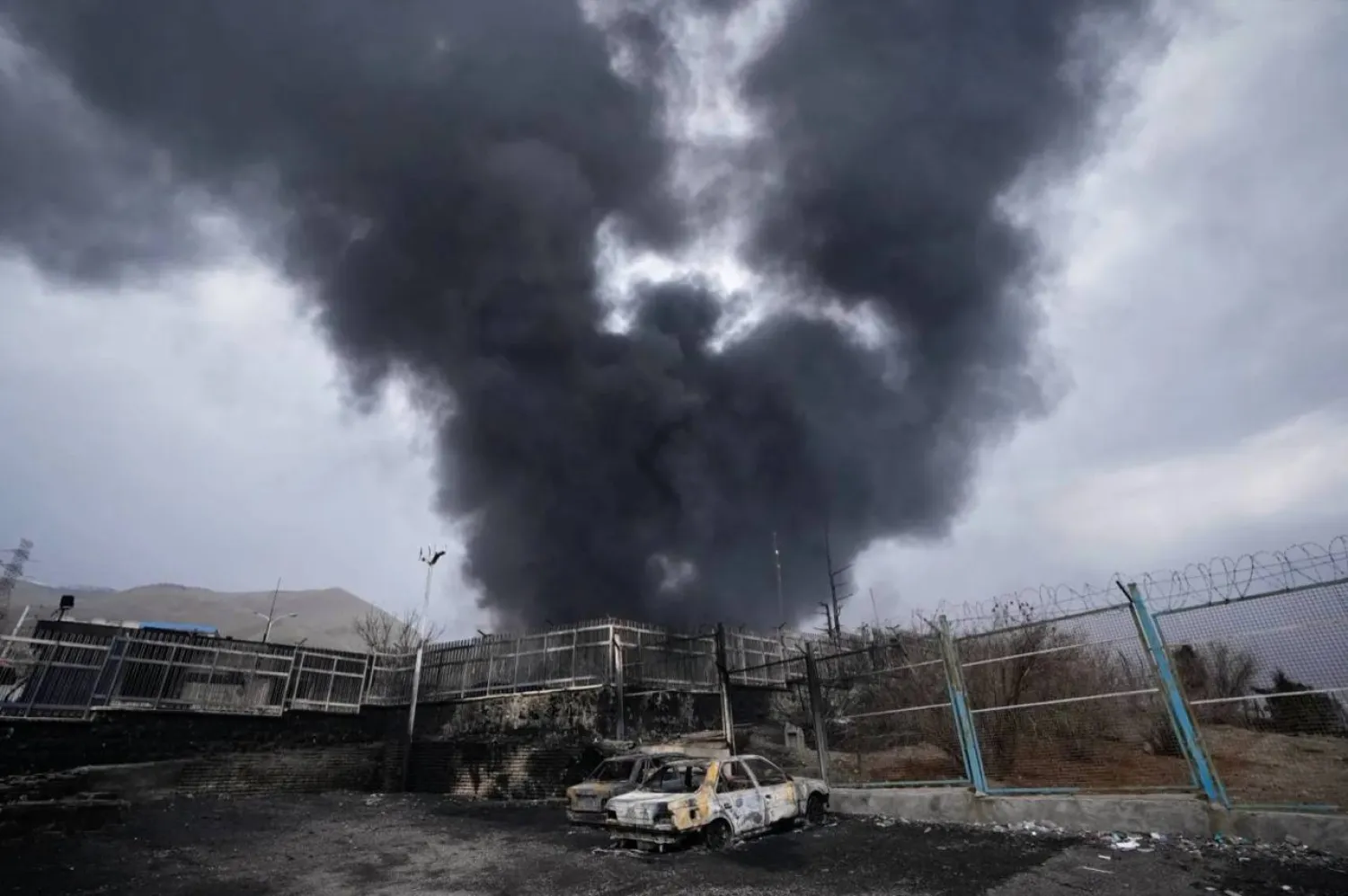

New US Missile Hit Iranian Sports Hall and School, Analysis Shows

FILE - A thick plume of smoke rises from an oil storage facility hit by a US-Israeli strike in Tehran, Iran, March 8, 2026. (AP Photo/Vahid Salemi, File)  
TT

New US Missile Hit Iranian Sports Hall and School, Analysis Shows

FILE - A thick plume of smoke rises from an oil storage facility hit by a US-Israeli strike in Tehran, Iran, March 8, 2026. (AP Photo/Vahid Salemi, File)  

John Ismay and Christiaan Triebert

Washington: On the first day of the war with Iran, a weapon bearing the hallmarks of a newly developed US-made ballistic missile was used in an attack that struck a sports hall and adjacent elementary school near a military facility in southern Iran, according to weapons experts and a visual analysis by The New York Times.

Local officials cited in Iranian media said this strike and others nearby in the city of Lamerd killed at least 21 people.

The Feb. 28 attack occurred the same day as a US Tomahawk cruise missile struck a school in the city of Minab, several hundred miles away, killing 175 people. In the case of Lamerd, though, it involved a weapon that had been untested in combat.

The Times verified videos of two strikes in Lamerd, as well as aftermath footage from the attacks. Times reporters and munitions experts found that the weapon features, explosions and damage are consistent with a short-range ballistic missile called the Precision Strike Missile, or PrSM (pronounced like “prism”), which is designed to detonate just above its target and blast small tungsten pellets outward.

Videos that capture one strike, in a residential area about 900 feet from the sports hall and school, show the weapon in flight, with a distinctive silhouette that matches the PrSM. The missile erupts in a large fireball midair.

Another video, filmed from a security camera directly across from the sports hall, shows the strike on the hall and adjacent school. While the video does not capture an incoming missile, it clearly shows an explosion just above the structure.

Photos of the aftermath show both sites were pockmarked with holes, apparently from the tungsten pellets.

There is an Iranian Revolutionary Guards Corps, or IRGC, compound directly next to the sports hall. It’s not known if it was struck in the attack.

The PrSM completed prototype testing only last year, according to an Army press release. On March 1, US Central Command posted a video of a PrSM launch from the first 24 hours of the war. Days later, Adm. Brad Cooper, who leads Central Command, said the PrSM had been used in combat for the first time.

The military has been touting its debut.

Since the weapon is so new, it’s more difficult to assess whether the PrSM strikes in Lamerd were intentional, stemmed from a design flaw or manufacturing defect, or were the result of improper target selection.

It’s unclear if or how the school or sports hall might be affiliated with the IRGC compound, but according to archival satellite imagery, they have been walled off from the compound for at least 15 years.

The sports hall, at the time of the strikes, was being used by a female volleyball team, according to Amir Saeid Iravani, Iran’s representative to the United Nations.

Photos and videos posted to a social media account linked to the school show the premises were regularly used by children.

The sports hall has also for years been publicly identified as a civilian-use facility on readily available digital mapping platforms, including Google Maps, Apple Maps and Wikimapia, according to a review by The Times.

Ground-level and satellite images of the aftermath show the sports hall with scorch marks and a partly collapsed roof. Footage from inside the school shows blown-out windows, fire damage and splotches of blood.

The PrSM’s intended use is to kill enemy troops and destroy unarmored vehicles, and it can fly more than twice as far as any other missile in the Army’s arsenal.

A US official who spoke to The Times confirmed that the missile used in the Lamerd strike was the PrSM. The official was not authorized to comment publicly about the attack and spoke on the condition of anonymity.

Other experts consulted by The Times also provided an assessment of the weapon.

“While we knew PrSM was fired, this is the first look we’ve gotten at the business end of the system,” Jeffrey Lewis, a nuclear nonproliferation expert at Middlebury College, said after reviewing videos and photos of the incident.

Lewis’s observation was supported by Frederic Gras, another munitions expert.

He said the video showing airburst detonation was very clear, and “the pattern of fragmentation damages are impressive and match with the few technical information available on the PrSM.”

Capt. Tim Hawkins, a spokesman for US Central Command, said in a statement to The Times on Saturday: “We’re aware of the reports and are looking into them. US forces do not indiscriminately target civilians, unlike the Iranian regime.”

Lewis said the missile seen in the video also resembled another ground-launched American weapon — a guided rocket called GMLRS-ER, but since that munition has a range of only 93 miles, versus the PrSM’s 400 miles, it would have had to have been fired from inside Iran, which is highly unlikely.

In addition to the sports hall and school, and nearby residential area, a third location may have been hit in the attack.

The Times verified a video that shows another plume of smoke rising close to the other strikes at the same time. Local Telegram and media reports stated a cultural center had been hit, but that couldn’t be independently verified.

The BBC and public radio program “The World” reported earlier that the missiles used in Lamerd may have been PrSMs, and that the Pentagon was looking into the incident.

The strikes on Iran are being conducted by a joint Israeli-US coalition, but senior American military officials made it clear that in the opening days of the conflict the United States was operating in the southern part of the country, where Lamerd is located.

At least 21 people were killed in the strikes, according to Iran’s state news agency, IRNA.

While that figure has not been independently verified, photos and videos posted online by local media outlets show scenes from a mass funeral the next day, March 1. An additional hundred people were injured, said Amir-Saeid Iravani, Iran’s representative to the UN.

Some of the casualties were volleyball players who were training inside the hall when the missile struck, according to Iravani, and eyewitnesses cited by US-based online media outlet Drop Site News.

Tasnim, a semiofficial Iranian news agency, published the names of the 21 people it said were killed. An Iran-based journalist, Negin Bagheri, wrote about two of the victims: Helma Ahmadizadeh, a 10-year-old fourth-grader, and Elham Zaeri, a fifth-grader, both of whom were at volleyball practice when the missile struck. Khabar-e Jonoub, an Iranian newspaper, reported on the death of a sports coach identified as Mahmoud Najafi.

The PrSM is a short-range ballistic missile designed to replace the Army Tactical Missile System, or ATACMS, in the Army and Marine Corps arsenal.

Developed by Lockheed Martin in Camden, Arkansas, it’s capable of hitting targets at a range of approximately 400 miles.

But additional details about the weapon, including its expected accuracy and the quantity of explosives it carries, remain unknown to the public.

In past wars, the Pentagon has at times deployed developmental weapons like the PrSM to active war zones for what the military calls “combat evaluation,” so long as commanders knowingly accept the attendant risk of using a munition before it has gone through more testing.

The New York Times


Merz Floats Sanctions Relief for Iran Peace Deal, Other EU Leaders Cautious

 Germany's Chancellor Friedrich Merz speaks during a press conference after taking part in an informal meeting of the European Council in Nicosia on April 24, 2026. (AFP)
Germany's Chancellor Friedrich Merz speaks during a press conference after taking part in an informal meeting of the European Council in Nicosia on April 24, 2026. (AFP)
TT

Merz Floats Sanctions Relief for Iran Peace Deal, Other EU Leaders Cautious

 Germany's Chancellor Friedrich Merz speaks during a press conference after taking part in an informal meeting of the European Council in Nicosia on April 24, 2026. (AFP)
Germany's Chancellor Friedrich Merz speaks during a press conference after taking part in an informal meeting of the European Council in Nicosia on April 24, 2026. (AFP)

German Chancellor Friedrich Merz suggested on Friday that the European Union could ease sanctions on Tehran as part of a comprehensive deal that would end the Iran war, but other EU leaders struck a more cautious note.

The 27-nation EU has imposed sanctions on Iran for years, including travel bans and asset freezes for senior officials and entities, in response to human rights violations, nuclear activities and military support for Russia.

US officials have suggested a ‌comprehensive deal covering Iran's ‌nuclear and missile programs and the ‌re-opening ⁠of the Strait of ⁠Hormuz could bring a lasting end to the US-Israeli war with Tehran, beyond the current ceasefire.

After an EU summit in Cyprus, Merz said the bloc could gradually ease sanctions on Iran in the event that a comprehensive agreement was reached.

European leaders have been largely sidelined in the current Middle ⁠East conflict but some European officials see ‌the bloc's sanctions as a possible ‌way for the EU to be involved in a diplomatic solution.

"The ‌easing of sanctions can be part of a process," ‌Merz told reporters after the Nicosia summit.

"No one has objected to that," he said of the summit deliberations. "It is, so to speak, part of the contribution we can make to advance this ‌process and, hopefully, lead to a permanent ceasefire."

But European Council President Antonio Costa, the chair ⁠of the summit, ⁠told a press conference after the end of the meeting: "It is too early to talk about relieving any kind of sanctions."

European Commission President Ursula von der Leyen said sanctions relief could only come after clear evidence of fundamental changes of course from Iran.

"We believe that sanctions relief should be conditional on verification of de-escalation, particularly on progress on the international effort to contain its nuclear threat, and on a change to the repression of its own people," she told the same press conference.


German Court Jails Hezbollah Supporter Over Videos Showing Weapons

Coffins sit on a trailer beneath portraits of Hezbollah fighters killed before a 10-day ceasefire was agreed between the Iran-backed militant group and Israel during a mass funeral procession in the southern village of Kfar Sir on April 21, 2026. (AFP)
TT

German Court Jails Hezbollah Supporter Over Videos Showing Weapons

Coffins sit on a trailer beneath portraits of Hezbollah fighters killed before a 10-day ceasefire was agreed between the Iran-backed militant group and Israel during a mass funeral procession in the southern village of Kfar Sir on April 21, 2026. (AFP)

A German court on Friday sentenced a supporter of Lebanon's Hezbollah party to more than three years in jail Friday over for "illegal access to weapons" and social media posts supporting the group.

Earlier in the same trial the 30-year-old was acquitted on charges of actually fighting for Hezbollah and being a member of the group.

The court in Berlin gave him a sentence of three years and nine months over social media posts he made with videos taken during a trip to Lebanon in 2023.

In the videos he was seen handling rifles and anti-tank missiles and taking part in shooting practice.

The court found he also spread propaganda videos and displayed Hezbollah symbols, such as flags and scarves.

However, the court said that the videos in question showed that the accused had had no training in dealing with the weapons and that he had acted in a "partly amateurish" fashion.

His earlier claims to have fought with the group were made up in order to impress his friends, the court found.

Hezbollah's military wing is classed as a terrorist organization by the United States, the European Union and Britain.

Germany considers Hezbollah a "Shiite terrorist organization" and in 2020 banned Hezbollah from carrying out activities on its soil.


Key Go-Between Switzerland to Reopen Embassy in Iran

 Milad telecommunication tower is seen at left in a general view of a part of Tehran, Iran, Thursday, April 23, 2026. (AP)
Milad telecommunication tower is seen at left in a general view of a part of Tehran, Iran, Thursday, April 23, 2026. (AP)
TT

Key Go-Between Switzerland to Reopen Embassy in Iran

 Milad telecommunication tower is seen at left in a general view of a part of Tehran, Iran, Thursday, April 23, 2026. (AP)
Milad telecommunication tower is seen at left in a general view of a part of Tehran, Iran, Thursday, April 23, 2026. (AP)

Switzerland said Friday it had begun sending staff back to Tehran and would gradually reopen its embassy, enabling it to continue as a facilitator for diplomatic contacts between Washington and Tehran.

For decades, neutral Switzerland has played a central role in maintaining basic diplomatic contacts between Iran and the United States.

But the country temporarily closed its embassy on March 11 days after the Middle East war erupted with the first US-Israeli attacks on Iran.

The Swiss foreign ministry said four staff had returned and insisted the channel of communication between the US and Iran had been kept open even while the mission was shut.

"The decision to gradually reopen the embassy was taken after a risk analysis and in consultation with Iran and the United States, whose interests Switzerland represents under its protecting power mandate," the foreign ministry said in a statement.

Switzerland "is prepared to provide its good offices if the parties so wish and supports all diplomatic initiatives that contribute to de-escalation and a lasting peace".

Switzerland has represented US interests in Iran since Washington broke off relations with Middle Eastern country after the 1980 hostage crisis, which came a year after the Iranian revolution.

The Swiss embassy in Tehran handles all consular affairs between the United States and Iran, including passport requests, altering civil status and consular protection for US citizens in Iran.

Under the protecting power mandate, "Switzerland can either offer to act as a go-between on its own initiative or can fulfil this function at the request of the parties concerned, provided that all those involved agree", the foreign ministry says on its website.

A ceasefire has been in place since April 8 but prospective peace talks between senior US and Iranian envoys Pakistan are hanging in the balance.

Iran has all but closed the Strait of Hormuz in retaliation for the war, while the US has imposed a blockade of its own on Iranian ports.
