

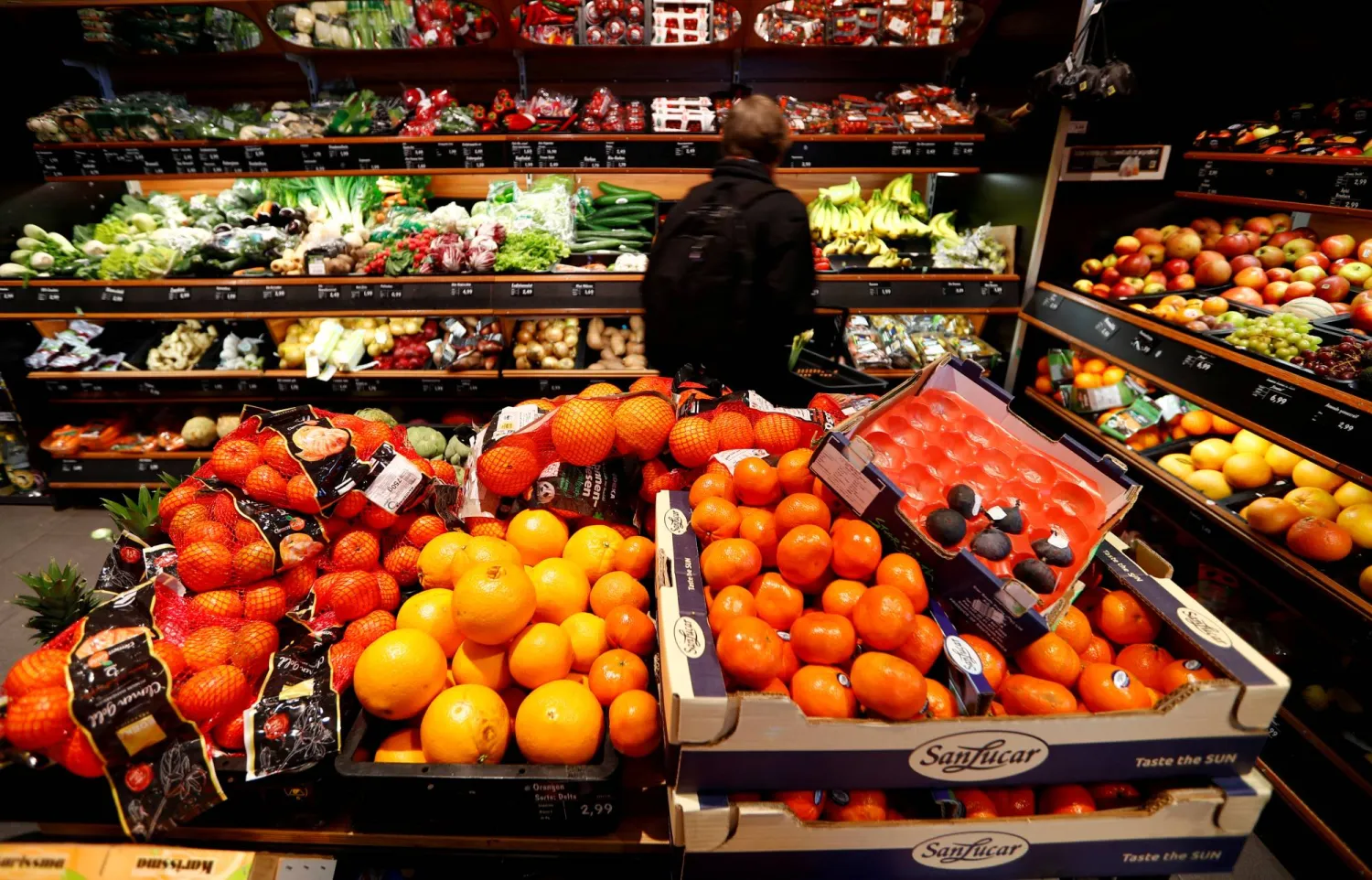

Euro Zone Inflation Surges Past ECB Target on Oil Shock

Shelves filled with fruit inside a supermarket in Berlin (Reuters)
TT

Euro Zone Inflation Surges Past ECB Target on Oil Shock

Shelves filled with fruit inside a supermarket in Berlin (Reuters)

Euro zone inflation soared past the European Central Bank's 2% target this month due to surging oil and gas prices, heightening a policy dilemma as expensive energy drags growth and risks generating a self-reinforcing inflation spiral.

Oil prices have nearly doubled as a result of the Iran war and the ECB is now debating whether to raise interest rates to prevent this surge from becoming entrenched in the price of other goods and services, Reuters reported.

Overall inflation in the 21 countries sharing the euro currency jumped to 2.5% in March from 1.9% a month earlier, below expectations for 2.6% in a Reuters poll of economists, as energy costs rose 4.9%.

"The previously price-stable environment is saying goodbye" said Alexander Krueger, chief economist at Hauck Aufhaeuser Lampe. "What matters is that this inflationary dirt does not feed through into the core rate." A closely-watched figure on underlying inflation, which excludes volatile ⁠food and energy, ⁠meanwhile, fell to 2.3% from 2.4%, data from Eurostat, the EU's statistics agency showed on Tuesday.

Basic economic theory argues that central banks should look past one-off price shocks generated by supply disruptions, especially because monetary policy works with long lags.

But a quick rise in energy inflation can easily broaden out if companies start building this into selling prices and workers begin demanding higher wages for the loss of disposable income.

High energy prices should increasingly make other goods more expensive and push up core inflation, said Commerzbank's chief economist ⁠Joerg Kraemer, forecasting headline inflation will rise above 3% by May unless the war ends quickly. The public may also start doubting the ECB's resolve if it remains idle, firming the case for rate hikes even in the event of large but not so persistent inflation episodes, ECB President Christine Lagarde said last week.

Financial markets now see three interest rate hikes from the ECB this year, with the first in either April or June.

"The mounting inflation pressure suggests that the ECB will raise its key interest rates in April or, at the latest, in June," Kraemer said. While some policymakers, such as the influential Bundesbank head Joachim Nagel, said that a rate hike as soon as April was an option, others, including ECB board member Isabel Schnabel, have warned against hasty action.

But policymakers agree that the ECB must act if energy starts ⁠generating second round ⁠price pressures, especially since domestic inflation had been above 2% for years.

Services inflation, the single largest item in the consumer price basket and the key gauge for domestic inflation, fell to 3.2% in March from 3.4% a month earlier.

Part of the issue is that the ECB was late in recognizing the inflation problem in 2021/22, arguing for months that the surge was transitory and would pass. It only raised rates when price growth hit 8%, forcing the central bank into its steepest tightening cycle in its history.

But the bloc is now in a very different position, so comparisons with 2022 are not entirely valid.

Rates are already higher, budget policy is tighter, the labor market has been weakening for months and there is no pent-up demand created by pandemic-era lockdowns.

The ECB will next meet on April 30.

"We find it hard to see the ECB moving at the next meeting at the end of April," said Carsten Brzeski, global head of macro at ING. "Unless the ghosts of 2022 are really keeping policymakers awake at night."



Supertanker with Iraqi Oil Heads for Vietnam After Hold-up in US Blockade

Tankers are seen off the coast of the Fujairah, as Iran vows to close the Strait of Hormuz, amid the US-Israel conflict with Iran, in Fujairah, United Arab Emirates, March 3, 2026. (Reuters)
TT

Supertanker with Iraqi Oil Heads for Vietnam After Hold-up in US Blockade

Tankers are seen off the coast of the Fujairah, as Iran vows to close the Strait of Hormuz, amid the US-Israel conflict with Iran, in Fujairah, United Arab Emirates, March 3, 2026. (Reuters)

Supertanker Agios Fanourios I is heading for Vietnam to discharge its Iraqi crude oil cargo after it was held by the US Navy for five days in the Gulf of Oman, the vessel's manager said on Monday.

The Maltese-flagged Very Large Crude Carrier sailed out of the Strait of Hormuz on May 10 and was sailing in the Gulf of Oman before making a ‌U-turn on ‌May 11.

It resumed its journey ‌toward ⁠Vietnam on May 16 ⁠and is expected to arrive at the Nghi Son refinery on May 30, LSEG shipping data showed.

A VLCC can carry a maximum of two million barrels of oil.

A source at the vessel's Athens-based manager Eastern Mediterranean Maritime, who spoke on condition of ⁠anonymity, confirmed that the tanker was sailing ‌on to Vietnam after ‌it had received US Navy approval.

The US military's Central Command ‌said last week that the vessel was redirected as ‌part of ongoing enforcement of the blockade against Iran.

At least two other crude tankers sailed from the strait last week, but overall crude traffic through the strait has ‌remained limited.

Before the war on Iran began, the Strait of Hormuz was the conduit ⁠for 20% ⁠of the world's energy supplies, equating to 125 to 140 daily passages.

"Shipping confidence around Hormuz is still very weak," ship broker Clarksons said in a note on Monday.

A further 12 ships crossed the strait in the past 24 hours, including two liquefied petroleum gas tankers bound for India, according to satellite analysis from data analytics specialists SynMax.

A separate LPG tanker was sailing through the strait on Monday also bound for India, data on the MarineTraffic platform showed.


Asian Markets Cautious, Oil Dips after Trump Holds Off on Iran Attack

Vessels are seen anchored in the Strait of Hormuz, off the port city of Khasab on Oman's northern Musandam Peninsula on May 17, 2026. AFP
TT

Asian Markets Cautious, Oil Dips after Trump Holds Off on Iran Attack

Vessels are seen anchored in the Strait of Hormuz, off the port city of Khasab on Oman's northern Musandam Peninsula on May 17, 2026. AFP

Asian markets were mixed Tuesday as oil prices eased on hopes of a US-Iran deal, though elevated crude levels capped investor appetite for risk.

Energy markets held center stage after US President Donald Trump signaled "serious negotiations" with Tehran and called off planned strikes, boosting optimism that tensions could.

The war the United States and Israel launched February 28 has led to an effective blockade of the Strait of Hormuz, through which around 20 percent of global oil exports passed in peacetime.

The leaders of Qatar, Saudi Arabia and the United Arab Emirates asked him "to hold off on our planned Military attack of the Islamic Republic of Iran, which was scheduled for tomorrow, in that serious negotiations are now taking place", Trump wrote on his Truth Social platform.

But Trump added that he instructed the US military to be "prepared to go forward with a full, large scale assault of Iran, on a moment's notice, in the event that an acceptable Deal is not reached".

Speaking later at a White House event, Trump said there had been a "very positive development" and that Arab allies said a deal was near that would leave Iran without nuclear weapons, which Tehran denies pursuing.

"There seems to be a very good chance that they can work something out. If we can do that without bombing the hell out of them, I'd be very happy," Trump said.

However, he also warned the United States was prepared to launch a "full, large-scale assault" if negotiations collapse, underscoring the fragility of the situation.

Oil dipped on the prospect of diplomacy, but the move offered only limited relief after weeks of volatility driven by the Middle East conflict.

International benchmark Brent was hovering around $109 while West Texas Intermediate at $107.

Equity performance wavered.

Tokyo's Nikkei 225 opened lower, with local jitters offset by local resilience. Japan's gross domestic product expanded 0.5 percent in the first quarter, exceeding market forecasts of 0.4 percent.

Seoul's Kospi slid by more than four percent, with tech stocks losing ground after taking their lead from Wall Street. Shanghai, Taipei and Jakarta also slid.

Hong Kong, Sydney and Wellington were ahead.

Safe-haven demand was higher, with both gold and silver edging up, suggesting investors remain wary.

All eyes are on Wednesday's quarterly results from US chip titan Nvidia, which will be scrutinized as investors question whether huge spending on AI data centers is justified by potential returns.


Australia Secures Jet Fuel from China to Keep Flying in Energy Squeeze

 13 May 2026, Australia, Canberra: Australian Prime Minister Anthony Albanese is interviewed on morning television after delivering the 2026-27 Federal Budget in the House of Representatives at Parliament House in Canberra. (dpa)
13 May 2026, Australia, Canberra: Australian Prime Minister Anthony Albanese is interviewed on morning television after delivering the 2026-27 Federal Budget in the House of Representatives at Parliament House in Canberra. (dpa)
TT

Australia Secures Jet Fuel from China to Keep Flying in Energy Squeeze

 13 May 2026, Australia, Canberra: Australian Prime Minister Anthony Albanese is interviewed on morning television after delivering the 2026-27 Federal Budget in the House of Representatives at Parliament House in Canberra. (dpa)
13 May 2026, Australia, Canberra: Australian Prime Minister Anthony Albanese is interviewed on morning television after delivering the 2026-27 Federal Budget in the House of Representatives at Parliament House in Canberra. (dpa)

Australia has secured three shipments of jet fuel from China totaling 600,000 barrels, Prime Minister Anthony Albanese said Tuesday, doubling the national supply.

The Middle East conflict and closure of the Strait of Hormuz have caused fuel prices to soar and left many Asia-Pacific nations facing an energy crisis.

Tourism and freight exports in the island continent are reliant on air travel, a sector heavily impacted by the climbing prices.

The jet fuel shipments are expected to arrive in June and follow talks between Albanese and Chinese Premier Li Qiang on energy security last month.

China supplied a third of Australia's aviation fuel last year and is a major importer of Australian iron ore, coal and liquefied natural gas (LNG).

Canberra has highlighted to Beijing that jet fuel supports the Australian resources sector, officials said.

Australia's Trade Minister Don Farrell is expected to meet his Chinese counterpart Wang Wentao in Suzhou this week on the sidelines of an APEC trade ministers meeting in the Chinese city.

Trade between Australia and China reached Au$326 billion ($233 billion) last year, dominated by Australian commodities exports.

Farrell is expected to arrive in Tokyo on Tuesday, to discuss energy security and trade.

Japan is another major buyer of Australian LNG and coal.

Australia said this month it will reserve the equivalent of 20 percent of gas exports for the domestic market to avoid supply shortfalls.