


Khamenei Message to Hezbollah Chief Reaffirms Ties, Sends Political Signals

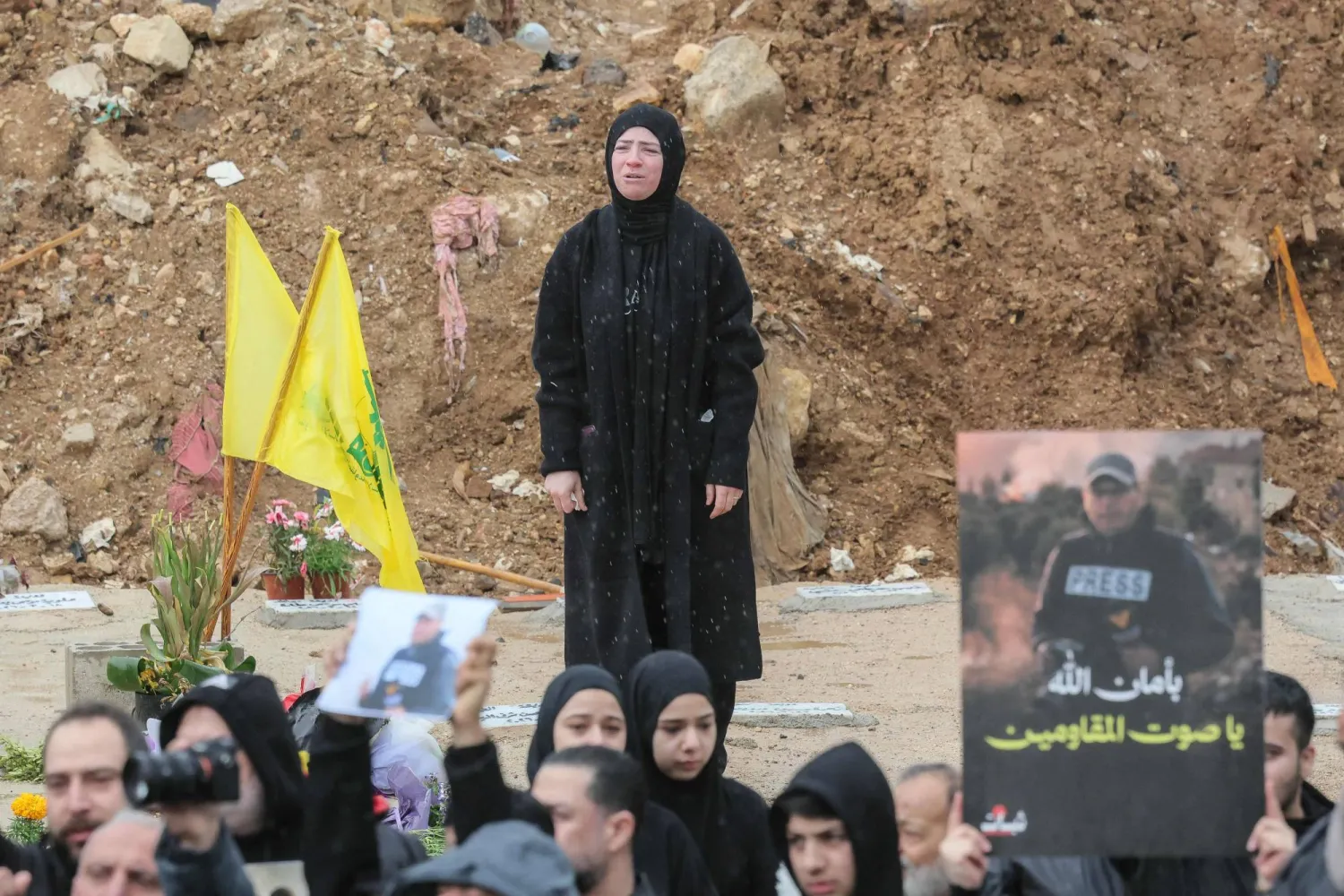
A woman reacts as mourners gather on March 29, 2026, in the Choueifat area on the outskirts of Beirut during the funeral of journalists killed the previous day in an Israeli strike in south Lebanon. (Photo by ibrahim AMRO / AFP)
TT

Khamenei Message to Hezbollah Chief Reaffirms Ties, Sends Political Signals

A woman reacts as mourners gather on March 29, 2026, in the Choueifat area on the outskirts of Beirut during the funeral of journalists killed the previous day in an Israeli strike in south Lebanon. (Photo by ibrahim AMRO / AFP)

A message from Iran’s Supreme Leader, Mojtaba Khamenei, to Hezbollah Secretary General Naim Qassem, thanking him for condolences over the death of his father, “leader of the Islamic Revolution,” came at a pivotal moment of regional escalation, giving it clear political weight and signaling messages to both domestic and foreign audiences.

The message reaffirms the depth of ties between Iran and Hezbollah, reinforces the group’s place within Tehran’s strategy, and signals a push to sustain open confrontation.

It made no reference to the Lebanese state, even as officials in Lebanon seek to “disassociate” from Iran after Hezbollah opened the southern front in support of Tehran. Authorities have taken steps in that direction, including expelling the Iranian ambassador and banning the group’s military wing.

“Reaffirming the obvious”

Lebanese ministerial sources described the message as “a reaffirmation of the obvious,” saying it “offers nothing new, but reinforces an established reality.”

“The relationship between Iran and Hezbollah has never been severed,” the sources told Asharq Al-Awsat, pointing to continued coordination and joint operations in the current war.

They said the message aligns fully with both sides’ declared positions, making it “a restatement of existing policy.” The core of the relationship, they added, is now explicit and entrenched, forming part of a fixed political landscape that goes beyond the traditional concept of the state.

One battle, with the US named as an enemy

Political analyst Ali al-Amine said the message underscores that Iran and Hezbollah see themselves as fighting a single battle against a common enemy, reflected in references to “steadfastness” against the United States and Israel.

He said the narrative, invoking Hezbollah and Iranian figures killed by Israel, reinforces a shared path and common fate in the war.

Al-Amine noted one sharper shift, the explicit placement of the United States alongside Israel as an equal enemy, highlighted in the closing reference to the “American-Zionist enemy.”

Khamenei told Qassem he is leading the movement at a defining moment in the resistance’s history, voicing confidence in his ability to defeat Israeli plans and restore pride to the Lebanese people.

He reaffirmed that Iran’s policy remains aligned with the path of the late imam and the “martyred leader,” pledging continued support for the resistance against Israel and the US.

Ignoring the Lebanese state, overlooking the cost

Al-Amine said the message pointedly omits any reference to the Lebanese state, addressing only the Lebanese people and speaking directly to Hezbollah.

“All the focus is on confrontation and the role of the party,” he said, with no acknowledgment of state authority or decision-making power.

He added that the message also overlooks the scale of destruction and displacement in Lebanon. More than one million people have been displaced, most from the Shiite community, including many Hezbollah supporters forced from their homes and scattered across the country.



Iraqi Oil Ministry Says It Began Exporting Fuel Oil Via Syria

A worker performs checks at Türkiye's Mediterranean port of Ceyhan, February 19, 2014. REUTERS/Umit Bektas
TT

Iraqi Oil Ministry Says It Began Exporting Fuel Oil Via Syria

A worker performs checks at Türkiye's Mediterranean port of Ceyhan, February 19, 2014. REUTERS/Umit Bektas

Iraq's oil ministry said on Thursday it began exporting fuel oil via Syria after ‌disruptions ‌to the Strait ‌of ⁠Hormuz caused by the ⁠Iran war.

The oil will be trucked overland ⁠and export ‌operations ‌would gradually increase ‌to ‌boost the Iraqi economy, the ministry added.

Reuters reported ‌in an exclusive on Tuesday ⁠that ⁠the land route, which Iraq has not used for decades, became its best option.


Israel Expands Warnings to Hezbollah-linked Money Changers

Lebanese security personnel at the site of an Israeli strike targeting senior military commander Youssef Hashem in the Jnah area on the outskirts of Beirut (Reuters). 
TT

Israel Expands Warnings to Hezbollah-linked Money Changers

Lebanese security personnel at the site of an Israeli strike targeting senior military commander Youssef Hashem in the Jnah area on the outskirts of Beirut (Reuters). 

The Israeli army said it has killed a senior Hezbollah commander, Youssef Ismail Hashem, in a naval strike, as it widened its warnings in Lebanon to include individuals it accuses of handling the group’s finances.

The military described Hashem as Hezbollah’s “southern front commander”, adding he had more than 40 years of experience and was one of Hezbollah’s “major pillars”.

A security source told AFP that Hashem, also known as Sayyed al-Sadeq, was responsible for Hezbollah’s military and security file in Iraq and was killed in a strike on the Jnah area of Beirut. Lebanon’s health ministry said the attack killed seven people.

The source noted that Hashem “was in a meeting with other party members inside a tent near several vehicles” at the time of the attack.

A source close to Hezbollah confirmed the killing, describing him as “the most senior official targeted since the start of the war”. Hezbollah also announced the death of one of its members, Mohammad Baqer al-Nabulsi, who was killed in the same strike.

US sanctions

Hashem has been under US sanctions since 2018 for working for or on behalf of Hezbollah, according to the US Treasury.

The Treasury noted that he oversaw Hezbollah’s operational activities in Iraq and was responsible for protecting the group’s interests there.

It added that he managed relations with armed groups in Iraq, including coordinating the deployment of fighters to Syria.

Senior figure

Hashem is the most senior military figure killed since the start of the war, succeeding Ali Karaki, who was assassinated in an Israeli strike that targeted former Hezbollah secretary-general Hassan Nasrallah in Beirut’s southern suburbs on Sept. 27, 2024.

Israel had previously targeted lower-ranking commanders, including Hassan Salameh, head of Hezbollah’s “Nasr Unit”, who was killed on March 10.

According to Israeli media, Hezbollah’s southern front is divided into three sectors — the Nasr, Aziz and Badr units — which operate independently, with Hashem overseeing all three.

Warnings broadened

Israel has expanded its warnings in Lebanon to include “money changers working in the service of Hezbollah”.

Israeli army spokesman Avichay Adraee said in a post on X that the military had targeted Hezbollah funding sources during the war, including the Al-Qard al-Hassan association and fuel networks.

“Another source that has been targeted is the network of money changers, which constitutes the main and most important financial source for this terrorist organization,” he added.

He named Mohammad Noureddine and Hussein Ibrahim as key money changers working for Hezbollah.

Addressing them directly, he said: “Due to your involvement in financing Hezbollah, the IDF warns you that continuing to fund Hezbollah puts you at risk.”

He also urged Lebanese citizens to avoid “any contact with Hezbollah money changers” and to “stay away from them” for their own safety.

Security zone plans

The intensified strikes come as Israeli Defense Minister Israel Katz said that “at the end of the operation, the Israeli army will establish a security zone inside Lebanon along a defensive line against anti-tank missiles”.

He added that Israel would maintain security control over the area up to the Litani River, about 30 kilometers from the border.

Lebanese Defense Minister Michel Menassa condemned the remarks, saying they “no longer constitute mere threats, but reflect a clear intention to impose a new occupation of Lebanese territory”.


US Embassy in Baghdad Warns of Attacks in City over Next 24-48 Hours

A view of the US Embassy in Baghdad (archival - Reuters)
TT

US Embassy in Baghdad Warns of Attacks in City over Next 24-48 Hours

A view of the US Embassy in Baghdad (archival - Reuters)

The US embassy in Baghdad warned Thursday that pro-Iran armed groups in Iraq may attack the city in the coming one or two days.

"Iraqi terrorist militia groups aligned with Iran may intend to conduct attacks in central Baghdad in the next 24-48 hours," the embassy said in a statement on X, again urging Americans in the country to leave immediately.