

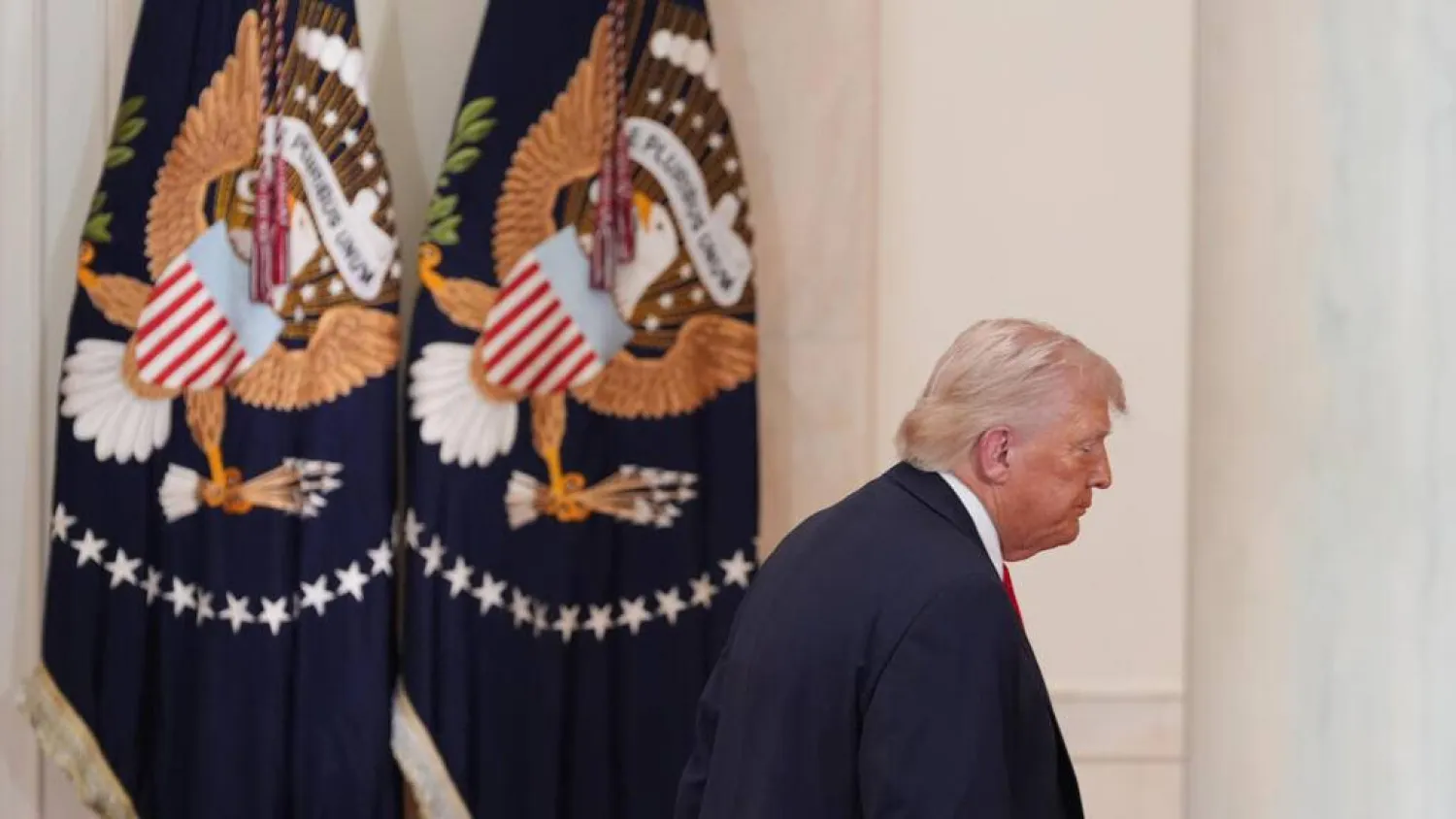

Oil Rallies, Stocks Tumble as Trump Says US to Hammer Iran Further

Oil prices surged and stocks sank after Donald Trump's address to the nation. Alex Brandon / POOL/AFP
TT

Oil Rallies, Stocks Tumble as Trump Says US to Hammer Iran Further

Oil prices surged and stocks sank after Donald Trump's address to the nation. Alex Brandon / POOL/AFP

Oil prices spiked and stocks sank on Thursday after Donald Trump reiterated that US forces would hammer Iran for another two to three weeks but offered no solution to the closure of the Strait of Hormuz that has crippled global markets.

Investors appeared to be unimpressed with the US president's much-anticipated address to the nation, in which he again called on countries that rely on the waterway for their energy supplies to reopen it themselves, AFP said.

The comments came amid growing fears about the economic impact of the crisis, which has seen governments introduce support measures, with the World Bank saying it was "extremely concerned".

In a speech lasting less than 20 minutes, Trump added little to what he has said in the past, warning that "over the next two to three weeks, we are going to bring them back to the Stone Ages, where they belong".

He also told the nation that US forces would meet all their battlefield goals "very, very shortly".

The address dented a nascent recovery in world markets that had come after Trump said earlier this week that the war would be ending "very soon", while his Iranian counterpart said his country had the "necessary will" to end it.

Brent crude, which had fallen back below $100 a barrel Wednesday, surged as much as five percent to hit $106.29, while West Texas Intermediate jumped more than four percent to as high as $104.29.

Trump "spoke of objectives met, but not of resolution. Of continued strikes, not withdrawal. Of optional escalation, not closure", wrote Stephen Innes at SPI Asset Management.

"The message was not one of panic, but it was unmistakably one of unfinished business. And in markets, unfinished business is oxygen for volatility.

"So oil did what oil always does when the illusion cracks. It surged, not because the war suddenly worsened, but because the market had prematurely priced in the expectation that it would end."

The reaction among equity traders was no better, with Seoul -- which soared more than eight percent Wednesday -- losing three percent. Tokyo, Hong Kong, Shanghai, Singapore, Taipei and Sydney were also well down.

The speech "did not contain what the market had hoped for -- namely, indications of an end to the fighting", Jumpei Tanaka, of Pictet Asset Management, said. "Instead, he suggested a potential escalation of the situation, which is a clear negative for stocks."

Markets have endured huge volatility since the US-Israeli war on Iran was launched on February 28, with the president frequently U-turning after making policy statements, particularly with regards to foreign relations and military operations.

His announcements that Washington and Tehran were in peace talks have often been denied by the Iranian republic, while its Revolutionary Guards insisted the strait will remain closed to the country's "enemies".

Trump's repeated demand that countries that rely on energy through the Strait of Hormuz "get your own oil" comes as Britain prepares to host a meeting of about 35 nations Thursday to discuss how to reopen the waterway.

The meeting will "assess all viable diplomatic and political measures that we can take to restore freedom of navigation, guarantee the safety of trapped ships and seafarers and resume the movement of vital commodities", UK Prime Minister Keir Starmer said.

Meanwhile, the World Bank Managing Director Paschal Donohoe said he was fearful about the global economic impact of the crisis.

"We are extremely concerned regarding the effect that this will have on inflation, on jobs and on food security," he told AFP as the Bank announced a new partnership with the International Monetary Fund and International Energy Agency to coordinate aid responses.



Iraq Could Restore Oil Exports to Pre-war Level within a Week if Hormuz Reopens, Basra Oil Chief Says

A cargo ship in the Gulf, near the Strait of Hormuz, as seen from northern Ras al-Khaimah, near the border with Oman’s Musandam governance, amid the US-Israeli conflict with Iran, in United Arab Emirates, March 11, 2026. REUTERS/Stringer/File Photo
TT

Iraq Could Restore Oil Exports to Pre-war Level within a Week if Hormuz Reopens, Basra Oil Chief Says

A cargo ship in the Gulf, near the Strait of Hormuz, as seen from northern Ras al-Khaimah, near the border with Oman’s Musandam governance, amid the US-Israeli conflict with Iran, in United Arab Emirates, March 11, 2026. REUTERS/Stringer/File Photo

Iraq could restore crude oil exports to around 3.4 million barrels per day within a week provided the Iran war ends and the Strait of Hormuz reopens, the head of the country’s state-run Basra Oil Company said.

Among Gulf oil producers, Iraq has suffered the biggest drop in oil revenue as a result of the effective closure of the Strait, a Reuters analysis has found, because it lacks alternative shipment routes.

But the country, the second biggest producer in the Organization of the Petroleum Exporting Countries, can quickly restore output to levels before US-Israeli attacks on Iran at the end of February led to the effective closure of the waterway. The Strait typically is the route for about a fifth of global oil and LNG flows.

SO FAR IRAN HAS MADE ONLY VERBAL PROMISES

Bassem Abdul Karim said Iran has so far provided only verbal guarantees that would allow Iraqi tankers permission to transit the Strait.

“We have not received any formal documents regarding permission for Iraqi tankers to pass,” he said in an interview with Reuters.

He said production from Iraq's southern oilfields was around 900,000 barrels per day, but if the war ends and safe passage through the Strait is guaranteed exports could reach 3.4 million bpd within a week.

US President Donald Trump has threatened to rain "hell" on Tehran unless it makes a deal by the end of Tuesday that would allow traffic to move through the Strait of Hormuz.

STEEP DROP IN IRAQI OIL OUTPUT

Last month, Iraq’s oil production dropped by about 80% to around 800,000 barrels per day, Iraqi energy officials told Reuters last month as the war meant Iraq could not export and storage tanks filled.

With limited outlets for Iraqi oil, production from the Rumaila field fell to around 400,000 bpd, down from about 1.35 million bpd before the conflict, and at the Zubair field the level was about 300,000 bpd, down 340,000 bpd before the war, Abdul Karim said.

Several smaller fields are being operated at limited levels to ensure continued production of associated gas, used in domestic power generation, while shutdowns at other sites have been used as an opportunity to carry out maintenance work, he added.

Production from Iraq's fields was around 4.3 million bpd before the war, which should leave enough leeway to export 3.4 million bpd even allowing for war-related damage.

Gas output from fields in Basra has dropped to around 700 million standard cubic feet per day, compared with about 1.1 billion standard cubic feet mscf per day before the war, largely because of the reduced oil production, Abdul Karim said.

MEETING REFINERY DEMAND

To supply domestic demand, BOC is sending around 400,000 bpd of crude to northern Iraq. That includes about 150,000 bpd by truck and roughly 250,000 bpd via a domestic pipeline, to supply refineries that have demand of around 500,000 bpd.

Production from the northern Kirkuk fields is roughly 380,000 barrels per day, Abdul Karim said.

Asked about the impact of drone attacks, Abdul Karim said strikes on oil facilities had caused “major losses to the continuity of production and oil operations,” adding that both foreign and Iraqi service companies had been targeted.

A two-drone attack that targeted the Rumaila oilfield on Saturday wounded three Iraqi workers, security and energy sources told Reuters.

Abdul Karim said the attack on the northern part of the Rumaila field hit sites used by US oilfield services companies Schlumberger and Baker Hughes, causing a fire that was later brought under control.

Neither Schlumberger nor Baker Hughes immediately responded to requests for comment.


Gold Holds Nearly Steady with Focus on US-Iran Tensions

Gold jewelry in a Korean gold exchange store in Seoul (AFP)
TT

Gold Holds Nearly Steady with Focus on US-Iran Tensions

Gold jewelry in a Korean gold exchange store in Seoul (AFP)

Gold prices were nearly steady on Monday, as market participants stayed cautious and awaited further signals on the evolving US-Iran situation and its impact on global interest rates.

Spot gold was little changed at $4,669.13 per ounce by 9:26 a.m. ET (1326 GMT) after falling 1% earlier in the session. US gold futures rose 0.3% to $4,694.20 per ounce, Reuters reported.

On the eve of a US deadline, the United States and Iran were weighing the framework of a plan to end their five-week-old conflict, even as Tehran pushed back against pressure to swiftly reopen the Strait of Hormuz. President Donald Trump has threatened to rain "hell" on Tehran if it did not make a deal by the end of Tuesday.

"Focus is likely to remain on the war and interest rates. If the conflict drags on, oil will grind higher amid tightening supply conditions, adding to inflationary pressures," said Bart Melek, global head of commodity strategy at TD Securities.

"That leaves central banks, particularly the Federal Reserve, with less room to ease policy and could even revive discussions about higher rates if energy prices rise further, which is negative for gold."

Oil prices fell in choppy trading on Monday, though they have risen sharply since the conflict began.

Gold is widely regarded as a hedge against geopolitical risks and inflation, but because it yields no interest, it tends to be less attractive when interest rates are high. Other items on investors’ radar include minutes of the Fed’s March policy meeting due on Wednesday, US Personal Consumption Expenditures (PCE) data due on Thursday, and the Consumer Price Index (CPI) on Friday.

The US central bank held rates steady last month and a majority of traders now see no chance of the Fed cutting interest rates this year, according to CME’s FedWatch tool. Among other metals, spot silver fell 0.4% to $72.67 per ounce, platinum lost 1% to $1,969.81, and palladium was down 1% at $1,488.58.


Morocco Launches Financial Futures Trading with Contract on MASI 20 Index  

File photo of a police officer standing near a Moroccan national flag near the main stadium during preparations for the FIFA Club World Cup in Agadir, December 10, 2013. REUTERS/Amr Abdallah Dalsh
TT

Morocco Launches Financial Futures Trading with Contract on MASI 20 Index  

File photo of a police officer standing near a Moroccan national flag near the main stadium during preparations for the FIFA Club World Cup in Agadir, December 10, 2013. REUTERS/Amr Abdallah Dalsh

Morocco on Monday began futures trading in financial instruments with its first listing of a standard futures contract on the MASI 20 equity index, the central bank and the AMMC - the capital markets regulator - said.

The contract, called the "MASI 20 Future," is based on an index that tracks the 20 largest and most liquid stocks listed on the Casablanca Stock Exchange, they said in a joint statement, AFP reported.

The contract's launch coincided with the unveiling of an institutional website by the Futures Market Coordination Body, a joint authority established to coordinate oversight of the futures market between the central bank and the AMMC.

The introduction of a futures contract represents the first step under Morocco's regulatory framework for derivatives trading, which will also allow for the development of other instruments such as options and swaps.