
Armenia's Underground Salt Clinic at Center of Alternative Medicine Debate

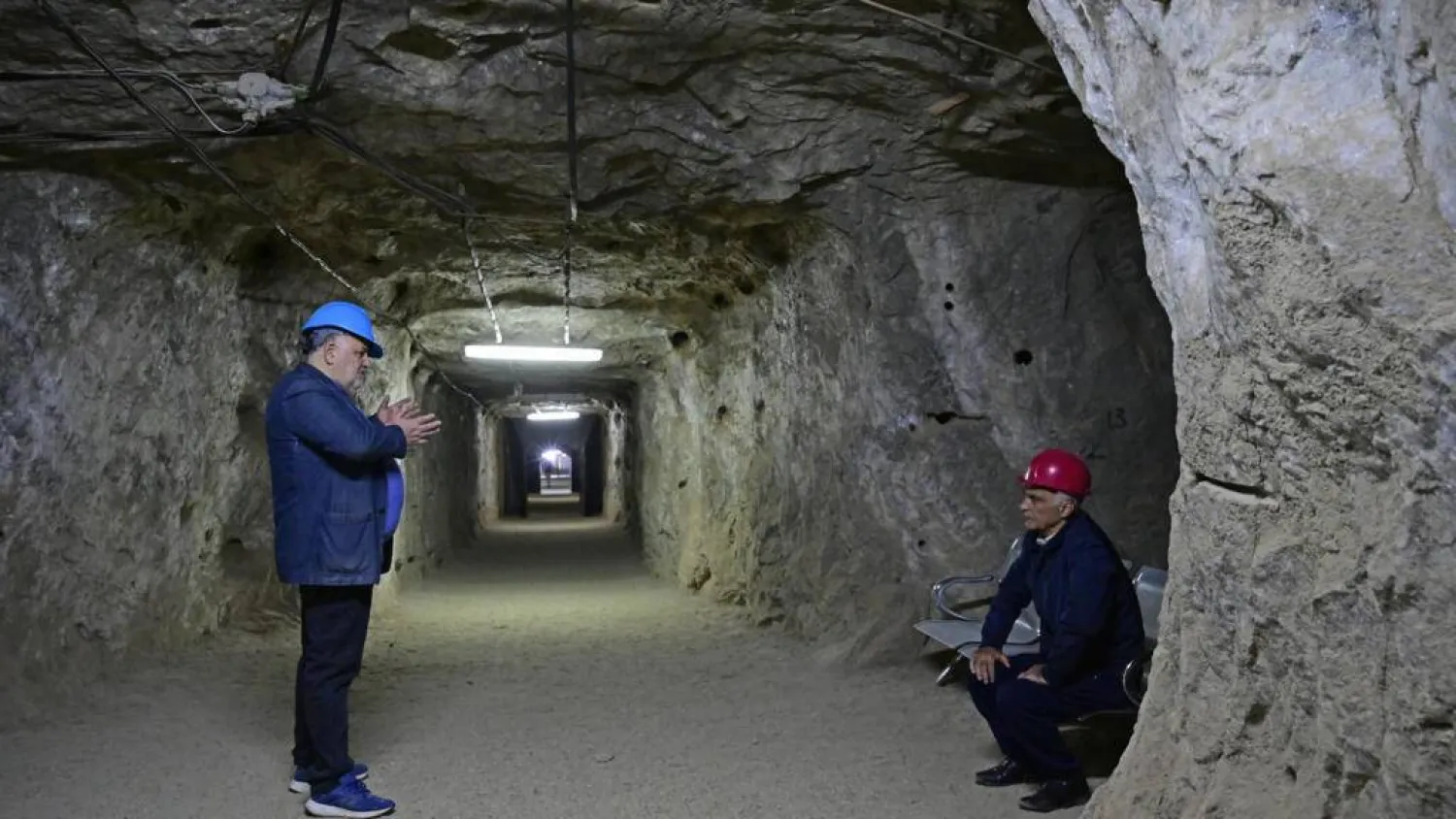
Speleotherapy has been practiced for decades in parts of Eastern Europe and the former Soviet Union © KAREN MINASYAN / AFP
TT

Armenia's Underground Salt Clinic at Center of Alternative Medicine Debate

Speleotherapy has been practiced for decades in parts of Eastern Europe and the former Soviet Union © KAREN MINASYAN / AFP

A mining cage drops deep beneath the Armenian capital, carrying asthma patients in helmets down into a salt cave clinic -- an alternative treatment center whose future is now at risk.

State funding for the speleotherapy center in the Avan salt mine was recently cut as the small Caucasus nation rolls out a new universal healthcare system that does not cover alternative medicine.

The fate of the facility is a snapshot of a global debate over the effectiveness and role of alternative treatments in modern healthcare, a particularly pressing issue in developing countries, AFP said.

Speleotherapy -- where patients spend several hours a day in caves breathing mineral-rich underground air believed to reduce respiratory irritation -- has been practiced for decades in parts of Eastern Europe and the former Soviet Union.

At the bottom of the Avan salt mine, a dim tunnel carved from grey rock salt leads to the Soviet-era center.

"We are 235 meters (770 feet) underground, and yet this is a hospital," doctor Anush Voskanyan said as she guided visitors into a vast chamber illuminated by rows of electric lamps.

Opened in 1987 inside a former mine, the center spans about 4,000 square meters of tunnels converted into treatment and recreation areas. For decades, patients received therapy for free under the state's healthcare program.

But in 2019, Armenia's health ministry stopped financing the clinic, arguing that speleotherapy does not meet evidence-based medical standards required for public funding.

Annual patient numbers dropped from more than 300 to around 50.

"We struggle to pay salaries and cannot renew equipment that has not been replaced since opening," clinic director Gurgen Hakobyan told AFP, saying its future was "uncertain."

- Global strategy -

Globally, supporters of traditional or complementary remedies say they have been overlooked by Western medicine.

The World Health Organization's members have called for a global effort to build a solid evidence base, regulate practitioners and integrate treatments that are proven safe and effective.

Supporters of speleotherapy say the cave environment, free from dust and allergens and with a constant temperature of around 19-20C, helps ease symptoms of asthma and allergies.

Voskanyan, the doctor, said she had seen children make full recoveries after treatment.

But the scientific evidence remains limited.

"Since 1985, only two dissertations have been written on the subject," said Lamara Manukyan, chair of the Armenian Association of Internal Medicine.

"We lack statistics and large-scale research."

She said speleotherapy "helps conventional medicine ease a patient's condition" and should be considered a "complementary therapy rather than a standalone treatment."

- 'Salvation' -

Armenia's health ministry said its decision to stop the clinic's funding reflects broader healthcare priorities as the country transitions toward universal medical insurance.

"At this stage, priority is given to diseases with high mortality rates such as cancer and cardiovascular illnesses," ministry spokeswoman Mariam Tsatryan told AFP.

"Alternative and wellness treatments cannot be included in insurance coverage."

Many of the centers's patients -- and its doctors -- lament the decision to strip funding.

Armen Stepanyan, a 63-year-old engineer from Russia's Siberian city of Kemerovo, has travelled to Yerevan annually for more than a decade after developing severe asthma.

"I tried everything -- sanatoriums, treatments -- nothing helped," he said. "Here I felt improvement after the first course."

Supporters argue the center's significance extends beyond medicine.

Manukyan, the chair of the internal medicine association, described it as part of Armenia's tradition of natural therapies, including mineral springs and spa resorts.

"There is no reason to dismantle an existing structure and lose a valuable tradition."

The government, which holds a stake in the center, is trying to privatize its shares, raising hopes that private investment could preserve or repurpose it as a research or medical tourism center.

"It would be really sad if the clinic had to shut down because it simply ran out of funding," said Stepanyan, the patient.

"I realized this was my salvation. This is the only place where I see real results."


Boat Carrying Stranded Whale 'Timmy' Reaches Denmark

Aerial photo taken on April 29, 2026 shows the rescued humpback whale in a special barge along the Danish coastline enroute back to the North Sea after it beached on a sandbank near the city of Luebeck, in late March. (Photo by Philip Dulian / dpa / AFP)
TT

Boat Carrying Stranded Whale 'Timmy' Reaches Denmark

Aerial photo taken on April 29, 2026 shows the rescued humpback whale in a special barge along the Danish coastline enroute back to the North Sea after it beached on a sandbank near the city of Luebeck, in late March. (Photo by Philip Dulian / dpa / AFP)

A special barge carrying a humpback whale that was stranded in Germany had entered Danish waters by Wednesday afternoon and is expected to reach the North Sea in two days, local officials said.

The whale, dubbed "Timmy" by German media, was coaxed into the vessel in a last-ditch rescue attempt on Tuesday after a weeks-long struggle for survival on the Baltic Sea coast.

The ship Fortuna B, which is towing the barge, was located between the islands of Langeland and Lolland in southeastern Denmark at around 1400 GMT, according to the VesselFinder website.

"If everything goes well, he'll be in the North Sea in two days. The very worst is already behind him now," Till Backhaus, environment minister for the state of Mecklenburg-Western Pomerania, told the Bild daily.

Speaking to reporters on the island of Poel, where the whale was most recently stranded, Backhaus said the animal was "doing well" and had made sounds during the night, AFP reported.

Backhaus thanked rescuers for their "wonderful" effort in "an exceptional situation that is hardly comparable anywhere in the world in this form".

The whale had been struggling for more than a month around the German coast, getting stuck on sandbanks and then managing to free itself again several times.

At the start of April, officials gave up on trying to rescue the animal, saying they believed it could not be saved.

But this triggered an outcry and authorities were persuaded to approve a privately financed rescue plan proposed by two wealthy entrepreneurs.

The barge idea was hatched after their initial attempt to save the whale with inflatable cushions and pontoons was unsuccessful.

The rescue effort was seen as a long shot and criticized by experts who said it would only cause the animal more distress.

The whale's ordeal has sparked a media frenzy -- with non-stop coverage from TV channels, online outlets and social media influencers -- but has also led to angry spats and conspiracy theories.


Dragon Diplomacy: Indonesia Lends Komodo Lizard Pair to Japan Zoo

A delegation from Japan's iZoo inspects the Komodo dragon enclosure at Surabaya Zoo in Surabaya on April 29, 2026. (Photo by JUNI KRISWANTO / AFP)
TT

Dragon Diplomacy: Indonesia Lends Komodo Lizard Pair to Japan Zoo

A delegation from Japan's iZoo inspects the Komodo dragon enclosure at Surabaya Zoo in Surabaya on April 29, 2026. (Photo by JUNI KRISWANTO / AFP)

Indonesia will lend a breeding pair of endangered Komodo dragons to Japan under an agreement signed Wednesday between zoos from the two countries that emphasized the project's conservation merits.

The five-year renewable deal, criticized by animal rights group PETA, will in turn see Indonesia's Surabaya Zoo receive a pair of red pandas, a pair of giraffes, four Aldabra giant tortoises and two female Japanese macaques from iZoo in Kawazu in Japan's Shizuoka prefecture, officials said.

"This is not just animal exchange. This is a bridge between our two countries, Japan and Indonesia," iZoo director Tsuyoshi Shirawa said at the signing ceremony.

Indonesia's environment ministry said in a statement this month the program's main objective was "long-term conservation".

PETA Asia has expressed concern that any dragon offspring born in Japan will be "condemned to a lifetime of confinement".

"True conservation protects Komodo dragons where they belong -- in their natural habitats -- not by exporting them for political optics or public relations gains," PETA Asia president Jason Baker said in a statement.

The ministry said conservation of the dragons in their natural habitat remained "the main priority".

"Through this cooperation, it is hoped there will be more Japanese people and tourists coming to Indonesia, particularly to the Komodo National Park... to witness Komodos in their natural habitat," Indonesian forestry official Ahmad Munawir said at Wednesday's event, according to AFP.

Under the rules of the CITES pact that governs international trade in endangered species, transfers like this one are allowed for non-commercial breeding programs.

The zoo in Surabaya, Indonesia's second-largest city over 700 kilometers (434 miles) from the dragon's natural habitat, has bred dozens of the dragons in recent years in conditions that mimic their natural home.

In the wild, the world's largest living lizards are found only in the World Heritage-listed Komodo National Park and on neighboring Flores island.

According to the International Union for Protection of Nature, the global population was about 3,458 adult and juvenile Komodo dragons at the last count in 2019.

The fearsome reptiles, which can grow to three meters (10 feet) in length and weigh up to 90 kilograms (200 pounds), are threatened by human activity and climate change destroying their habitat.

In some places, they are losing natural prey to human hunters, and they sometimes die in conflict with humans over livestock.

Some are captured and illicitly traded to zoos or as pets.

There have been legal transfers of Komodos to other zoos in the past, including London and Singapore.

The Indonesian and Japanese governments signed a Memorandum of Understanding last month to make the exchange with Japan possible.


French Teen in Straw Licking Case Allowed to Leave Singapore

French teenager Didier Gaspard Owen Maximilien arrives for an application to leave jurisdiction, for the court's permission to leave Singapore, at the State Courts in Singapore on April 29, 2026. (Photo by Roslan RAHMAN / AFP)
TT

French Teen in Straw Licking Case Allowed to Leave Singapore

French teenager Didier Gaspard Owen Maximilien arrives for an application to leave jurisdiction, for the court's permission to leave Singapore, at the State Courts in Singapore on April 29, 2026. (Photo by Roslan RAHMAN / AFP)

A French teen facing criminal charges in Singapore for a straw licking stunt was granted permission on Wednesday to leave the country for three weeks on pledges to return.

The 18-year-old is accused of posting to social media a video of himself putting the straw he licked back into the dispenser on an orange juice vending machine.

Didier Gaspard Owen Maximilien's clip went viral and triggered a backlash that led to his arrest in Singapore, which has a reputation for not tolerating bad behavior.

The teen's lawyer sought permission from a judge for him to travel to Manila from May 2-25 for an internship, a key requirement for him to graduate, AFP reported.

The judge granted the request after the prosecution posed no objection, but asked that he must remain contactable while overseas and required a SG$5,000 ($3,900) bond.

His next appearance in the Singapore court was also rescheduled from May 22 to May 29.

The teen, who is studying in Singapore and is out on bail, was charged last Friday over the straw stunt.

He uploaded the video on Instagram knowing that it "would or would probably cause annoyance to the public", according to court documents.

The public nuisance offence carries a jail term of up to three months and a fine.

A second charge of committing mischief said Maximilien knew that he was "likely to cause wrongful loss or damage" to iJooz, the company operating the vending machine which had to replace all 500 straws in the dispenser.

The mischief offence carries a punishment of up to two years in jail on conviction and a fine, according to the charge sheet.

Both offences were allegedly committed on March 12.

The Straits Times newspaper said the video "quickly went viral, sparking shock and concern among netizens".