


Israeli Army Sets Gaza-style ‘Yellow Line’ in Lebanon amid Differences with Govt

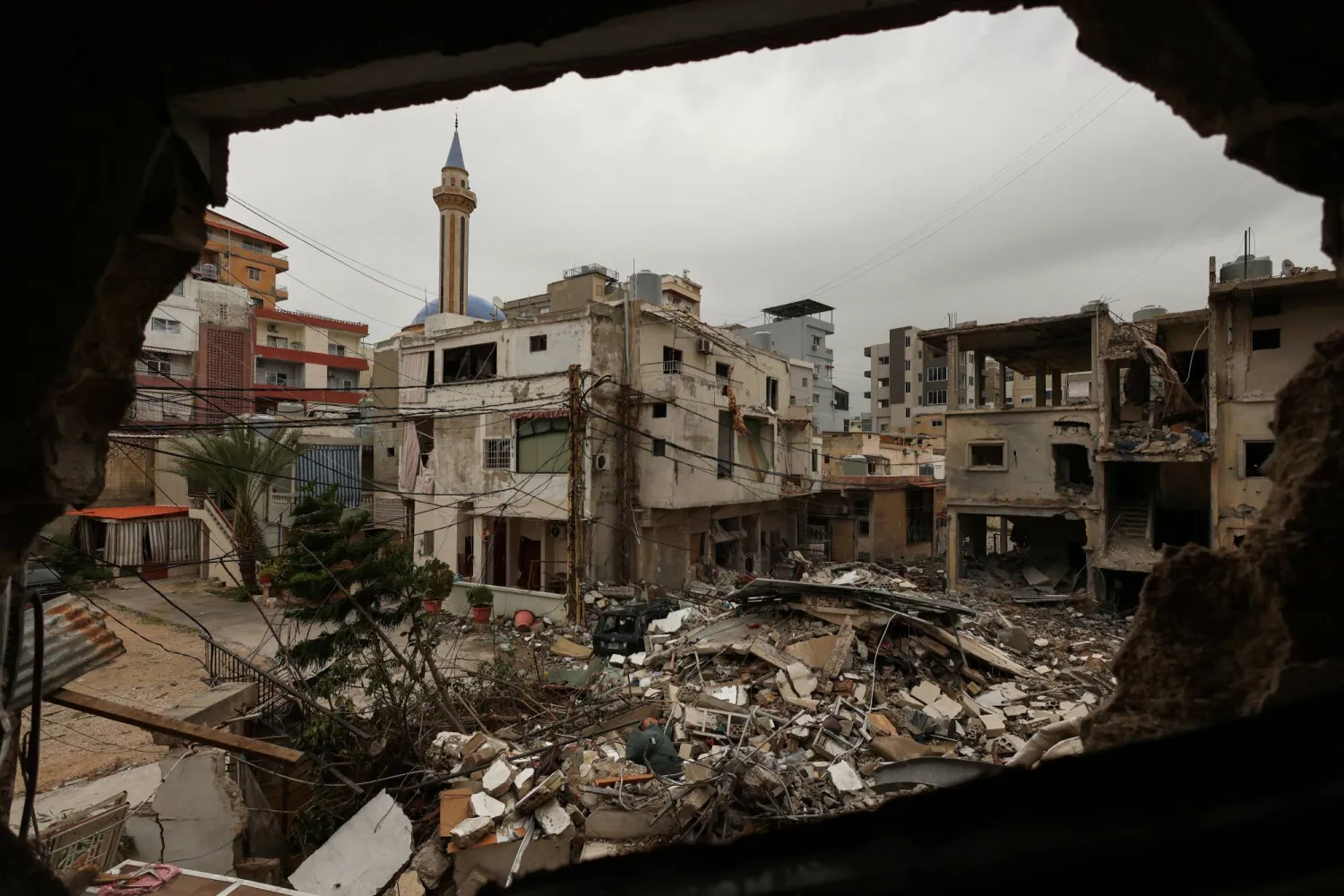
The rubble of a destroyed building, seen from inside a heavily damaged building, after an Israeli strike, amid escalating hostilities between Israel and Hezbollah, as the U.S.-Israeli conflict with Iran continues, in Tyre, Lebanon, April 2, 2026. (Reuters)
TT

Israeli Army Sets Gaza-style ‘Yellow Line’ in Lebanon amid Differences with Govt

The rubble of a destroyed building, seen from inside a heavily damaged building, after an Israeli strike, amid escalating hostilities between Israel and Hezbollah, as the U.S.-Israeli conflict with Iran continues, in Tyre, Lebanon, April 2, 2026. (Reuters)

Israeli forces have advanced into Lebanon’s Ras al-Bayada area, a hilly region about 14 kilometers from the Galilee border overlooking the Litani River, with the army saying it plans to remain there for an extended, though temporary, period.

The move comes as tensions emerge between the military and the government over the scope of operations in southern Lebanon.

Families of several soldiers from the Nahal Infantry Brigade have written to Prime Minister Benjamin Netanyahu, Defense Minister Israel Katz and senior commanders, urging a reassessment of their sons’ deployment.

They warned that the “risks are unjustified due to a lack of air support” and cited rising casualties. “Remaining in Lebanon, under current conditions, exposes soldiers to danger in an extremely unreasonable way,” they said, calling for an urgent review and alternative strategies.

The government has advocated full control of South Lebanon and making the Litani River Israel’s new border. The army has rejected that approach, saying it will instead treat the Litani as a “line of fire,” monitored from what it calls a “yellow line” — a concept previously applied to the Gaza Strip border and viewed as temporary pending a withdrawal decision.

Tens of thousands of troops have been deployed to Lebanon under this framework.

The soldiers’ families said 13 people have been killed so far — 10 soldiers and three civilians — and 20 soldiers wounded. They added that “since most air force resources are currently devoted to Iran, soldiers in Lebanon are not receiving sufficient air support,” which they said was likely a key factor behind the casualties.

Debate over protecting northern civilians

Citing military sources, the families said one objective of the ground incursion is to draw Hezbollah fire toward Israeli troops rather than civilians in northern Israel.

While stressing the importance of protecting border communities, they argued this should not come at the direct expense of soldiers’ lives. “It is not legitimate to define drawing fire toward fighters as a war objective... without using all available tools to ensure their safety,” they wrote.

They suggested temporary alternatives, including evacuations or expanding shelters and fortified rooms in threatened areas.

“Exploiting our sons — young men who have been fighting for three years in a multi-front war — is a grave injustice,” they added, calling for accountability and an immediate review of operational decisions.

An Israeli report on Wednesday said Hezbollah is not currently capable of launching mass daily barrages toward central Israel, and that many recent projectiles have missed their targets.

However, it retains the ability to wage guerrilla warfare and target Israeli forces in southern Lebanon, where four divisions are operating.

According to Haaretz military analyst Amos Harel, Hezbollah is firing around 200 rockets and drones daily toward northern Israel and Israeli forces — more than many Israelis had expected at the start of the war.

He said the situation is “more complex” than official narratives suggest, adding that Hezbollah has used months of fighting and a ceasefire period since November 2024 to regroup and rebuild its capabilities.

A report in Maariv cited a senior officer who fought in the 2006 Lebanon war as saying current troop levels are insufficient for the political objectives being set.

“Promises of a decisive victory over Hezbollah do not match the reality on the ground,” he stated, warning of a repeat of past scenarios in which Israeli forces come under sustained anti-tank fire in exposed positions.

“A decisive outcome would require greater effort and larger forces,” he added, noting that the war with Iran and ongoing operations in the West Bank continue to stretch military resources.



French Boats Set Sail to Join Gaza Aid Flotilla

Activists gather in l'Estaque, part of Marseille's harbor, southern France, on April 4, 2026, during a rally in support of a flotilla carrying activists from “Thousand Madleens to Gaza” movement as they prepare to set sail. (AFP)
TT

French Boats Set Sail to Join Gaza Aid Flotilla

Activists gather in l'Estaque, part of Marseille's harbor, southern France, on April 4, 2026, during a rally in support of a flotilla carrying activists from “Thousand Madleens to Gaza” movement as they prepare to set sail. (AFP)

Some 20 French boats set sail from Marseille on Saturday to join up with an international flotilla making a renewed effort to break an Israeli blockade and deliver aid to Gaza, AFP reporters saw.

"Gaza, Marseille is with you" shouted around a thousand people who had come to the docks to support the initiative.

The ships, mostly sailboats, set off to a round of applause and songs shortly after 5:00 pm (1500 GMT) to join the "Global Sumud Flotilla", named after a Gazan fisherman.

The international flotilla of some 100 boats, mostly setting sail from Barcelona on April 12, will head towards Gaza around April 20, according to the organizers. A week-long stopover is planned in southern Italy for "non-violence training."

"The goal is to give Palestine more visibility. We're not talking about it much right now, because of the international context," said Manon, a crew member who declined to give her full name.

In late 2025, an initial flotilla of about 50 boats, composed of political figures and activists such as Sweden's Greta Thunberg, was boarded by the Israeli navy -- illegally according to the organizers and Amnesty International.

The crew members were arrested and expelled by Israel.

The Gaza Strip, governed by Hamas, has been under an Israeli blockade since 2007. Israel and the Palestinian movement accuse each other of violating a ceasefire that came into effect on October 10, 2025, after two years of war.


Tens of Thousands of Sadr Supporters Rally in Baghdad Against War

Followers of Iraq's Moqtada al-Sadr wave Iraqi national flags during a protest against the joint US-Israeli strikes on Iran, as they gather in Tahrir Square, Baghdad, Iraq, 04 April 2026. (EPA)
TT

Tens of Thousands of Sadr Supporters Rally in Baghdad Against War

Followers of Iraq's Moqtada al-Sadr wave Iraqi national flags during a protest against the joint US-Israeli strikes on Iran, as they gather in Tahrir Square, Baghdad, Iraq, 04 April 2026. (EPA)

Tens of thousands of supporters of Iraqi Shiite cleric Moqtada al-Sadr rallied in Baghdad and across the country on Saturday, condemning Israel and the United States and demanding an end to the war.

The massive crowds came as the Middle East war was due to enter its sixth week after strikes launched by the US and Israel against Iran on February 28.

Iraq has been unwillingly drawn into the conflict, with strikes targeting US interests on its soil as well as attacks against pro-Iran groups in the country.

Tens of thousands of men and some women packed into the streets around Baghdad's central Tahrir Square on Saturday, waving the national flag and chanting: "No, no to Israel" and "No, no to America".

"What America and Israel are doing in their aggression against the countries of the region is not a war of a military nature, but a senseless war," Dhirgham Samir, attending the rally, told AFP.

"Today's demonstration is an expression of rejection of aggression, arrogance, and injustice throughout the world, not just in Iraq," he said.

Samir, who was in his forties, added that "this is a senseless war, targeting civilians".

Across the region since the onset of war thousands have been killed.

In a statement, Sadr called for peaceful demonstrations "to condemn the Zionist-American aggression and to establish peace in the region".

Under the giant Freedom Monument, commemorating Iraq's declaration of independence, demonstrators also railed against what they said was US and Israeli meddling in the region.

"They violate the rights of all the peoples of the region first, and then the world," cleric Ali Al-Fartousi told AFP.

"Humanity must speak out against these people and stop them," he said, adding: "The time has come for the entire world to stand united against global Zionist-American arrogance."

Sadr retains a devoted following of millions among Iraq's majority Shiite population, and has previously mobilized huge crowds.

As well as popular support, Sadr also has representatives among Iraqi ministries and official institutions, despite opposing several governments over the years.


Israeli Forces Destroy 17 UN Peacekeeper Cameras in South Lebanon

A dog lies an empty road outside a Lebanese army outpost in the area of Naqoura in southern Lebanon on March 27, 2026. (AFP)
TT

Israeli Forces Destroy 17 UN Peacekeeper Cameras in South Lebanon

A dog lies an empty road outside a Lebanese army outpost in the area of Naqoura in southern Lebanon on March 27, 2026. (AFP)

Israeli forces destroyed 17 surveillance cameras linked to the United Nations peacekeepers' main headquarters in southern Lebanon in 24 hours, a UN security official told AFP on Saturday.

Since the start of the Israel-Hezbollah war on March 2, the UN force in Lebanon (UNIFIL) has been caught in the crossfire in the country's south, with Hezbollah launching attacks on Israel and its troops, and Israeli forces pushing into border towns.

The official, who requested anonymity, said "17 of our headquarters' cameras have been destroyed by the Israeli army" in the coastal town of Naqoura.

On Thursday, UNIFIL spokeswoman Kandice Ardiel told AFP peacekeepers had seen "Israeli soldiers conducting demolitions of large parts" of Naqoura since the start of the week.

"Not only have these demolitions destroyed civilian homes and businesses, but the strength of the blasts have caused damage to UNIFIL's headquarters," she added.

Three Indonesian peacekeepers from the UN force have been killed in two separate incidents over the past week.

UNIFIL also reported Friday an "explosion" in one of its bases near Adaisseh in south Lebanon that wounded three personnel, adding that they "do not yet know the origin of the explosion".

The Israeli army accused Hezbollah of firing " a rocket that landed in a UNIFIL outpost".

The UN office in Jakarta said on Saturday the wounded were Indonesian.

Indonesia condemned the incident as "unacceptable", saying "these events underscore the urgent need to strengthen protection for UN peacekeeping forces amid an increasingly dangerous conflict situation".

According to the UN, 97 force members have been killed in violence since its establishment in 1978 to monitor the withdrawal of Israeli forces after they invaded Lebanon.

"This has been a difficult week for peacekeepers working near the central part of UNIFIL's area of operations," Ardiel said in her statement.

She added that UNIFIL "reminds all actors of their obligations to ensure the safety and security of peacekeepers, including by avoiding combat activities nearby that could put them in danger".