


Artemis Astronauts More than Halfway to Moon, Putting Earth in Rearview

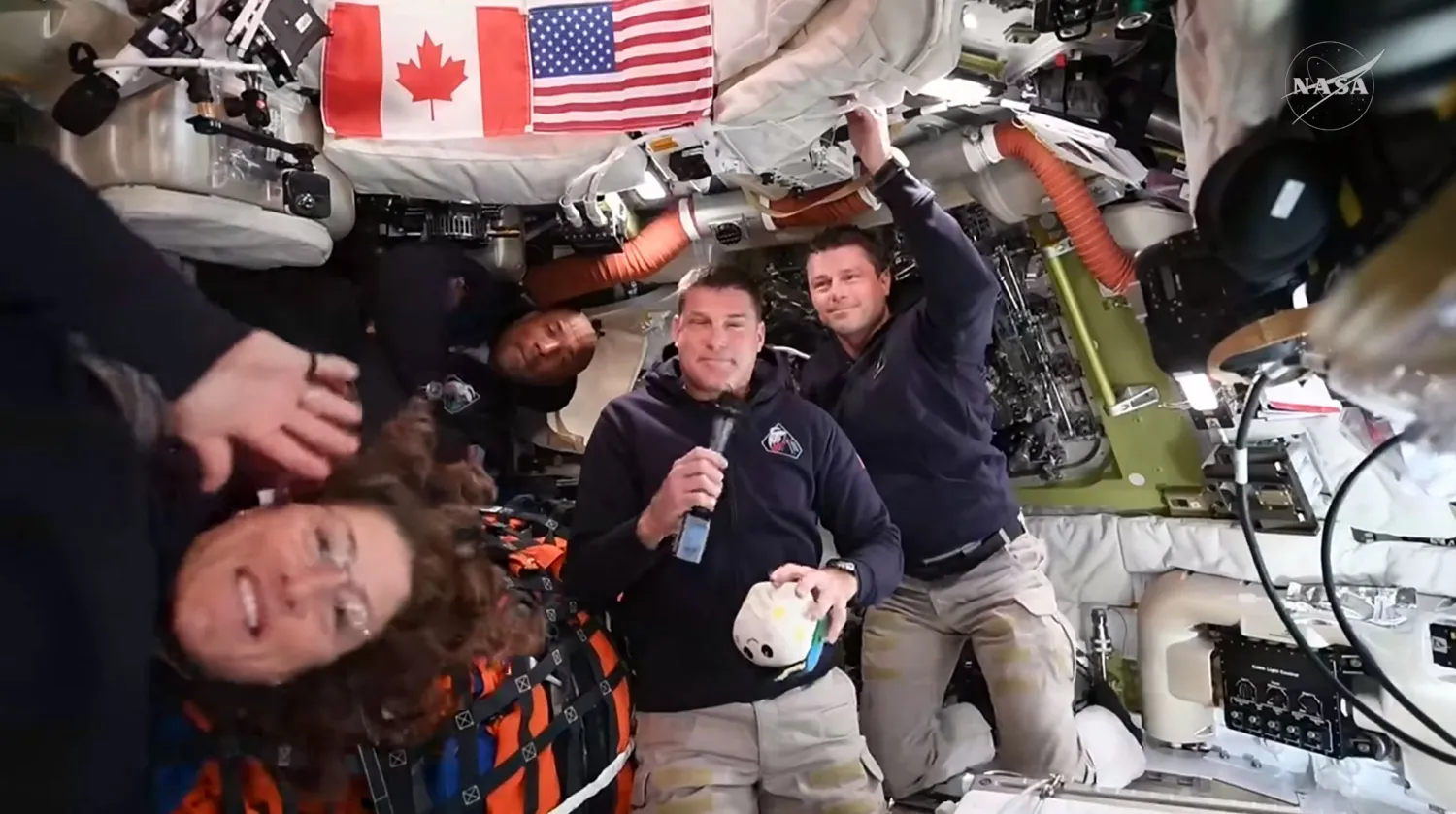
This screengrab from a NASA live broadcast video shows (L-R) NASA astronaut and Artemis II Mission Specialist Christina Koch, NASA astronaut and Artemis II pilot Victor Glover, Canadian Space Agency astronaut Artemis II Mission Specialist Jeremy Hansen and NASA astronaut and Artemis II Commander Reid Wiseman during a press call as they travel to the Moon in the Orion spacecraft, on April 3, 2026.  (Photo by NASA / AFP)
This screengrab from a NASA live broadcast video shows (L-R) NASA astronaut and Artemis II Mission Specialist Christina Koch, NASA astronaut and Artemis II pilot Victor Glover, Canadian Space Agency astronaut Artemis II Mission Specialist Jeremy Hansen and NASA astronaut and Artemis II Commander Reid Wiseman during a press call as they travel to the Moon in the Orion spacecraft, on April 3, 2026. (Photo by NASA / AFP)
TT

Artemis Astronauts More than Halfway to Moon, Putting Earth in Rearview

This screengrab from a NASA live broadcast video shows (L-R) NASA astronaut and Artemis II Mission Specialist Christina Koch, NASA astronaut and Artemis II pilot Victor Glover, Canadian Space Agency astronaut Artemis II Mission Specialist Jeremy Hansen and NASA astronaut and Artemis II Commander Reid Wiseman during a press call as they travel to the Moon in the Orion spacecraft, on April 3, 2026.  (Photo by NASA / AFP)
This screengrab from a NASA live broadcast video shows (L-R) NASA astronaut and Artemis II Mission Specialist Christina Koch, NASA astronaut and Artemis II pilot Victor Glover, Canadian Space Agency astronaut Artemis II Mission Specialist Jeremy Hansen and NASA astronaut and Artemis II Commander Reid Wiseman during a press call as they travel to the Moon in the Orion spacecraft, on April 3, 2026. (Photo by NASA / AFP)

The Artemis 2 astronauts have passed the halfway point between Earth and the Moon on Saturday as they sped toward a planned lunar flyby, with NASA releasing initial images of Earth taken from inside the Orion spacecraft.

Astronaut Christina Koch said the crew had a collective "expression of joy" upon being told of the milestone, which was hit around two days, five hours and 24 minutes after the spacecraft blasted off from the Kennedy Space Center in Florida, AFP said.

"We can see the Moon out of the docking hatch right now, it is a beautiful sight," Koch said around 11 pm (0400 GMT) Friday, according to the space agency's official live broadcast.

NASA's online dashboard showed early Saturday that the Orion spacecraft carrying the astronauts was more than 229,000 kilometers (142,000 miles) from Earth.

The space agency earlier released images from Orion that included a full portrait of Earth, featuring its deep blue oceans and billowing clouds.

After a flurry of high-stakes activity including a dramatic blast-off and an engine firing that catapulted them on their historic trajectory to circle the Moon, the four astronauts aboard were able to catch their breath, even as they continued to perform a variety of equipment checks and tests.

"There has been a tremendous amount of disbelief for me, it's just so extraordinary," said Canadian Jeremy Hansen during a Q&A session with press late Thursday.

"I really like it up here," said Hansen, on his first ever journey to space. "The views are extraordinary."

"It's really fun to be floating around" in zero gravity, he added. "It just makes me feel like a little kid."

Hansen is on the crew with Americans Koch, Victor Glover and Reid Wiseman.

They are due to loop around the Moon early next week -- a feat not accomplished in more than 50 years.

NASA official Lakiesha Hawkins praised the photographs taken by commander Wiseman, calling them "amazing" during a briefing Friday.

"We continue to learn all about our spacecraft as we operate it in deep space with crew for the first time," Hawkins said.

"It's important to remind ourselves of that as we learn a little bit more day by day."

- 'Great spirits' -

Friday's to-do list includes a CPR demonstration and medical kit checks, the US space agency said, as well as preparation for the scientific observations they'll need to document when they are closest to the Moon on day six of their journey.

NASA officials reported Friday that all systems were performing well, and that the astronauts were in "great spirits" and had spoken to their families.

The next major milestone of the approximately 10-day journey is expected overnight Sunday into Monday, at which point the astronauts will enter the "lunar sphere of influence" -- when the Moon's gravity will have stronger pull on the spacecraft than Earth's.

If all proceeds smoothly, as Orion whips around the Moon the astronauts could set a record by venturing farther from Earth than any human before.

"There is nothing normal about this," said mission commander Wiseman late Thursday.

"Sending four humans 250,000 miles away is a Herculean effort, and we are now just realizing the gravity of that."

The Artemis 2 mission is part of a longer-term plan to repeatedly return to the Moon, with the goal of establishing a permanent lunar base that will offer a platform for further exploration.



Bird Nests of Fiber-Optic Cables Show War’s Impact on Ukraine

Bird's nests made with fragments of optic fiber, which were found by a Ukrainian serviceman on the front line and then passed to the National Museum of the History of Ukraine in the Second World War, lie on a table in a museum, amid Russia's attack on Ukraine, in Kyiv, Ukraine June 23, 2026. (Reuters)
TT

Bird Nests of Fiber-Optic Cables Show War’s Impact on Ukraine

Bird's nests made with fragments of optic fiber, which were found by a Ukrainian serviceman on the front line and then passed to the National Museum of the History of Ukraine in the Second World War, lie on a table in a museum, amid Russia's attack on Ukraine, in Kyiv, Ukraine June 23, 2026. (Reuters)

Woven from fiber-optic cable and grass, a small bird's nest found near the front line of the war in Ukraine shows how the more than four-year-old conflict is reshaping the natural environment, researchers say.

Areas along the 1,200-km (746-mile) front line are covered with ultra-thin fiber-optic cables, which are used by Ukrainian and Russian troops to guide aerial attack drones to make them impervious to electronic jamming.

The cables, which can stretch for 20 km, lie tangled in trees and scattered across fields and on the rooftops ‌of towns in ‌Ukraine's frontline regions, glistening in the sunlight like giant spider ‌web.

Birds ⁠have begun repurposing ⁠the discarded cables to weave their nests, says Yana Hrynko, a senior researcher at Kyiv's War Museum, cautiously examining two delicate nests which the armed forces sent to the museum from the front line.

"Objects such as bird nests with fragments of optic fiber demonstrate the change in the nature of war," said Hrynko.

Russia invaded Ukraine in February 2022 with tanks, armored vehicles and artillery. Trying to counter ⁠Russia's advantage in such conventional equipment, Ukraine has poured resources ‌into developing aerial drones. Drones now dominate ‌the battlefield.

Hrynko said researchers did not know which birds made the nests nor how they ‌had gathered the long cables.

"The first nest mainly contains dry grass ‌and fiber-optic cable. And it's pretty tightly twisted," she said.

ONLINE VIDEOS AND PHOTOS

Reuters spoke to several Ukrainian servicemen in the frontline regions of Donetsk, Kharkiv and Zaporizhzhia who had found such nests and posted their pictures and videos online.

One of the two nests ‌will remain in Kyiv as a part of the War Museum's war collection, and the other will be sent ⁠for study in the ⁠Netherlands and later returned, researchers said.

Auke-Florian Hiemstra, a 33-year-old biologist based in the Dutch city of Leiden who specializes in artificial nest materials, said Ukraine had rich avian biodiversity and there were many species that could have built the nests.

"We're going to look for DNA traces still in a nest to determine who actually made the nest," she said. "I have never seen nests like this before - and I have seen many, many bird nests."

The impact of the fiber-optic on birds could be mixed, Hiemstra said. It could cause harm as the birds could become entangled but it could also benefit them by helping them make a strong nest. "And by documenting this nest, we're also documenting the impact of war on nature in Ukraine," Hiemstra said.


France to Illuminate Statue of Liberty for US 250th Birthday

The lower Manhattan skyline, including the new One World Trade Center building at right, is shown as viewed from near the Statue of Liberty, Jan. 31, 2014, in New York.  (AP)
The lower Manhattan skyline, including the new One World Trade Center building at right, is shown as viewed from near the Statue of Liberty, Jan. 31, 2014, in New York. (AP)
TT

France to Illuminate Statue of Liberty for US 250th Birthday

The lower Manhattan skyline, including the new One World Trade Center building at right, is shown as viewed from near the Statue of Liberty, Jan. 31, 2014, in New York.  (AP)
The lower Manhattan skyline, including the new One World Trade Center building at right, is shown as viewed from near the Statue of Liberty, Jan. 31, 2014, in New York. (AP)

France will stage an elaborate light show at the Statue of Liberty to mark the 250th anniversary of the United States, the French consulate said Monday.

Described as a "monumental artistic creation," the show will be recorded in advance and broadcast by the ABC network at the start of its 25 hours of programming for Independence Day, July 4.

"The Statue of Liberty will be revealed to the public as it has never been seen before, in a staging designed to magnify its symbolic and emotional power," the consulate said.

"Our friendship goes back 250 years, it is still very strong, it runs deep, and that is why we wanted to do something significant," France's consul to New York Cedrik Fouriscot told AFP.

The Statue of Liberty in New York Harbor was given to the United States by France in 1886, and is one of the country's most famous monuments.

France also dispatched its air force acrobatics team to the United States this month to mark the 250th anniversary.

On June 9, eight Alpha jets of the Patrouille de France filled the skies above Manhattan with the colors of the French tricolor -- soaring above the iconic statue.


Brooch Given to First Passenger to Board Doomed Steamship Found at Roadshow

The brooch contains a dedication with the date April 21 1894 (AP)
TT

Brooch Given to First Passenger to Board Doomed Steamship Found at Roadshow

The brooch contains a dedication with the date April 21 1894 (AP)

A brooch given to the first passenger to board a Dundee-built steamship 37 years before she sank has surfaced at an antiques roadshow.

The decorative item was presented to Elizabeth Anderson on April 21 1894, the date of the maiden voyage of the SS Citrine, according to the British website ‘itv News.’

Built by Dundee shipbuilders W B Thompson & Co, the Citrine was one of a number of vessels in the Glasgow-based “Gem line,” all of which were named after gemstones or minerals.

The shipping firm was owned by William Robertson, who started out with a single barge in 1852 before growing it into one of the largest coastal bulk shipping fleets in Britain.

The brooch was presented to Anderson by Robertson and is inscribed with the words “SS Citrine, April 21 1894, Elizabeth McIntyre Anderson, from William Robertson.”

The sides of the gold-colored item are shaped as a ship’s rope and its center has been designed as a life ring mounted with a citrine stone, echoing the name of the vessel.

The Citrine sank on March 17 1931 after striking rocks at Bradda Head, Port Erin, on the Isle of Man.

Accounts at the time described the ship’s final moments in darkness, heavy weather and confusion, and the disaster claimed the lives of nine of her 11 crew members.

William Robertson had been dead for 12 years by the time of the sinking but the business remained in family hands under his sons, William Francis Robertson and James Robertson.
The brooch was discovered at a WeBuyVintage roadshow in Fleetwood, Lancashire.