
Israel Aiming to Impose Security Control through Fire over Southern Lebanon

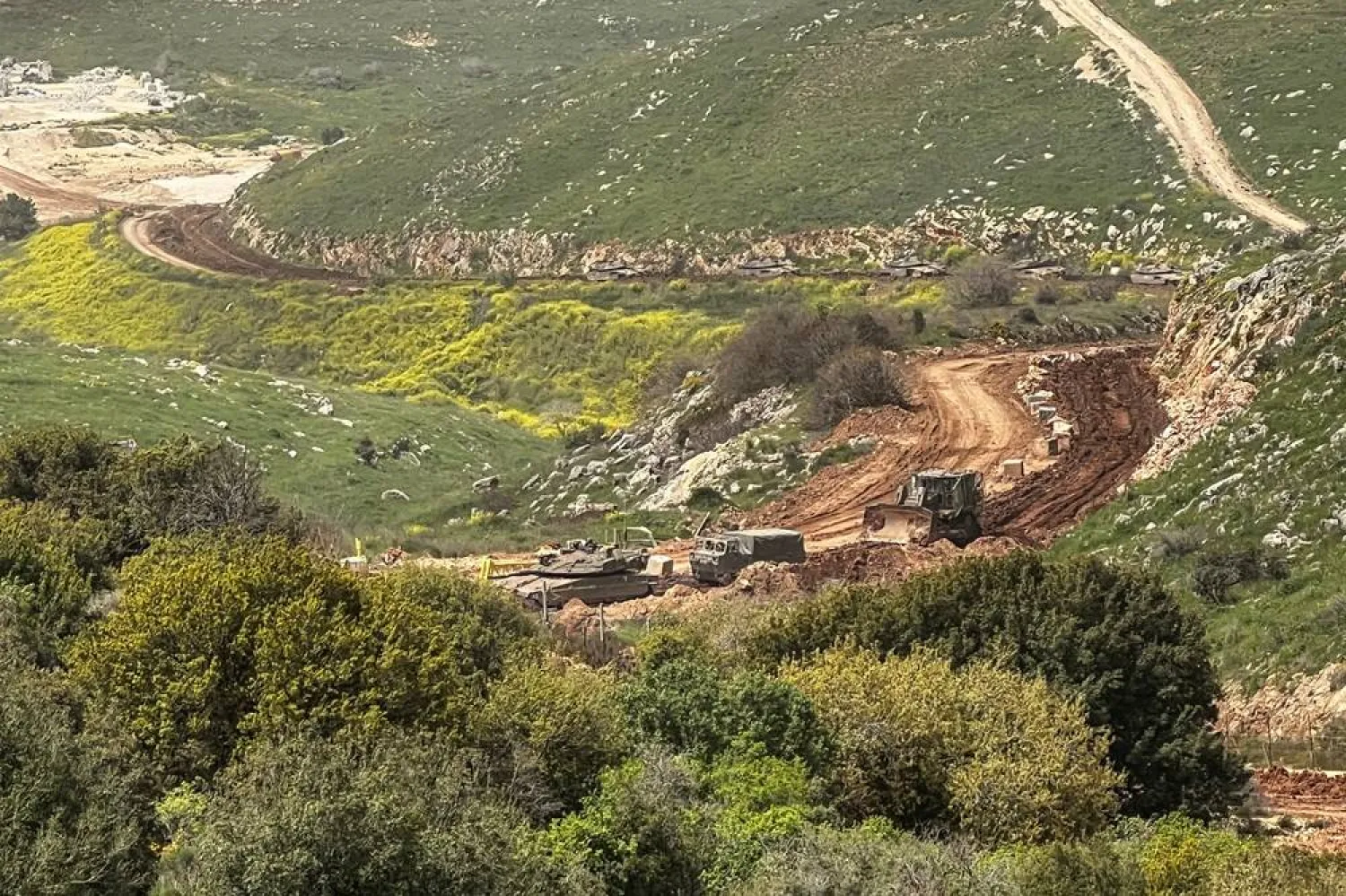
Israeli military vehicles drive through mud on the Lebanese side of the Israel-Lebanon border, after Israeli forces launched a campaign against Iran-backed Hezbollah in southern Lebanon, amid the US-Israeli conflict with Iran, as seen from northern Israel April 4, 2026. (Reuters)
TT

Israel Aiming to Impose Security Control through Fire over Southern Lebanon

Israeli military vehicles drive through mud on the Lebanese side of the Israel-Lebanon border, after Israeli forces launched a campaign against Iran-backed Hezbollah in southern Lebanon, amid the US-Israeli conflict with Iran, as seen from northern Israel April 4, 2026. (Reuters)

The conflict between Hezbollah and Israel in southern Lebanon is taking on a more complex shape, no longer limited to images of tanks and front line. Based on its operations on the ground and statements from its officials, Israel is not aiming for a traditional sense of occupation of the South, but rather imposing security control without actually holding territory.

This position reflects a shift in tactics and push towards managing the conflict, moving from military control that is based on advances and positioning, to security hegemony based on prevention, control, and reshaping geography and the population.

Modern security belt

Here rises the concept of the security belt, but in a more modern form than the one that prevailed pre-2000 when Israel occupied the South for nearly two decades. Israeli Prime Minister Benjamin Netanyahu has spoken of “expanding the security belt in southern Lebanon.”

Defense Minister Israel Katz has also said that Israel aims to disarm Iran-backed Hezbollah and that it will target its leaders and members “throughout Lebanon.” Houses that are used as Hezbollah positions “will be destroyed according to the model adopted in [Gaza’s] Rafah and Khan Younis.”

Israel will seek to control territories up to the Litani River and prevent tens of thousands of people from returning to their homes before it achieves its security.

Despite the escalation, Israel keeps saying that it is not aiming to fully occupy Lebanon. Israel’s Haaretz reported that the army has not set this as a war goal, despite acknowledging that in theory, the disarmament of Hezbollah would demand it.

This contradiction reflects the essence of the strategy: avoiding the cost of occupation, while achieving its end goals through other means based on control by fire and clearing the area.

18 positions

An informed source on the ground told Asharq Al-Awsat that Israel is seeking to re-occupy 18 strategic positions it had held before 2000. They include al-Bayyada, Shamaa, Beit Leef, Tallet al-Aweida, al-Tayba hills, the Beaufort Castle, and the Iqlim al-Tuffah heights that overlook the western Bekaa region.

Israel will not deploy its forces, but impose complete security control by fire over the Nabatieh district, all the way to al-Zahrani, Sidon, western Bekaa and Jezzine, allowing for control on the ground without actually having to position its troops there permanently.

Israel is aiming to acquire the ability to manage the South from heights and strategic points, the source explained.

Of the 600,000 people displaced from the area, the source said Israel will prevent them from returning. This includes areas beyond Iqlim al-Tuffah, al-Nabatieh and parts of the western Bekaa, reflecting an intent to change demographics on the ground.

Retired General Naji Malaeb told Asharq Al-Awsat that Israel does not want a permanent ground occupation, but the ability to control the field through fire, air or alternate forces.

This can happen through either direct military presence that runs the area or through establishing a buffer zone on scorched earth that prevents the people from returning to their homes and prevents any military positioning in the area.

This approach also prevents Israel’s adversaries from using the territory, he added.


Israel Court Extends Gaza Flotilla Activists’ Detention Until Sunday

 Brazil's activist Thiago Avila is escorted into court in the Israeli coastal city of Ashkelon on May 5, 2026. (AFP)
Brazil's activist Thiago Avila is escorted into court in the Israeli coastal city of Ashkelon on May 5, 2026. (AFP)
TT

Israel Court Extends Gaza Flotilla Activists’ Detention Until Sunday

 Brazil's activist Thiago Avila is escorted into court in the Israeli coastal city of Ashkelon on May 5, 2026. (AFP)
Brazil's activist Thiago Avila is escorted into court in the Israeli coastal city of Ashkelon on May 5, 2026. (AFP)

An Israeli court has extended the detention of two foreign activists from a Gaza-bound flotilla until Sunday, a rights group representing them said, as authorities continue to question the pair.

Spanish national Saif Abu Keshek and Brazilian national Thiago Avila appeared before a court in the city of Ashkelon for their second hearing on Tuesday, after they were brought to Israel for questioning last week.

The two, held in a prison in the southern Israeli city, were among dozens of activists aboard a Gaza-bound flotilla intercepted by Israeli forces off the coast of Greece early on Thursday.

At their first hearing on Sunday, the court extended their detention by two days. A second hearing was held on Tuesday, where both appeared with their legs shackled.

"The court approved their detention until Sunday morning" at Tuesday's hearing, Miriam Azem, international advocacy coordinator at the Israeli rights group Adalah told AFP.

An AFP journalist saw the two activists brought to the courtroom.

Adalah said the two activists were on hunger strike, with Tuesday their sixth day of protest.

On Monday, the rights group alleged the pair had been subjected to physical and psychological abuse in detention.

- Abuse claims -

Both Abu Keshek and Avila are being held in isolation, with "high-intensity lighting" on at all times in their cells, Adalah said, adding that Avila was being held in "extremely cold temperatures".

"They are kept blindfolded at all times whenever they are moved outside their cells, including during medical examinations," it said.

Israeli authorities have rejected the abuse claims.

At Sunday's hearing, Adalah said the state attorney had presented a list of offences the pair were accused of, including "assisting the enemy during wartime" and "membership in and providing services to a terrorist organization".

But Adalah's lawyers challenged the state's jurisdiction, arguing there had been an "unlawful abduction" of the two activists in international waters.

Israel's foreign ministry said both individuals were affiliated with the Popular Conference for Palestinians Abroad (PCPA), a group accused by Washington of "clandestinely acting on behalf of" Palestinian group Hamas.

The ministry said Abu Keshek was a leading PCPA member, and that Avila was also linked to the group and "suspected of illegal activity".

The flotilla's vessels had set sail from France, Spain and Italy with the aim of breaking Israel's blockade of Gaza and bringing humanitarian supplies to the devastated Palestinian territory.

But they were intercepted by Israeli forces off the coast of Greece.

The Global Sumud Flotilla's first voyage last year was also intercepted by Israeli forces off the coasts of Egypt and Gaza.

Israel controls all entry points into Gaza, which has been under an Israeli blockade since 2007.

Throughout the Gaza war that started in October 2023, there have been shortages of critical supplies in the territory, with Israel at times cutting off aid entirely.


With Wood Scarce, Gaza Carpenters Make Simple Beds from Pallets

 Palestinian carpenter Mohammed Wafi builds furniture from recycled wooden pallets in his workshop amid shortages of materials in Khan Younis, in the southern Gaza Strip, May 2, 2026. (Reuters)
Palestinian carpenter Mohammed Wafi builds furniture from recycled wooden pallets in his workshop amid shortages of materials in Khan Younis, in the southern Gaza Strip, May 2, 2026. (Reuters)
TT

With Wood Scarce, Gaza Carpenters Make Simple Beds from Pallets

 Palestinian carpenter Mohammed Wafi builds furniture from recycled wooden pallets in his workshop amid shortages of materials in Khan Younis, in the southern Gaza Strip, May 2, 2026. (Reuters)
Palestinian carpenter Mohammed Wafi builds furniture from recycled wooden pallets in his workshop amid shortages of materials in Khan Younis, in the southern Gaza Strip, May 2, 2026. (Reuters)

As Israeli restrictions continue to curb the entry of goods into Gaza, local carpenters are turning to scrap wood and shipping pallets to make much-needed basic beds and tables in a strip battered by two years of war between Hamas and Israel.

In a workshop in southern Gaza, carpenters dismantle used pallets to make beds, cupboards, and shelves for families displaced by fighting, after regular construction materials became scarce or prohibitively expensive.

Mohammed Wafi, 34, a carpenter in Khan Younis, said pallets became one of the few available sources of wood when limited ‌aid trucks began entering ‌Gaza.

Demand for his handiwork has grown as people living ‌in ⁠tents seek basic furniture ⁠to get by, Wafi said. Even recycled furniture has become more costly as prices for basic components soar.

"Today people say, 'I just need something to get by, something to get my clothes off the floor'... especially those (living) in tents," said Wafi, who has worked in carpentry for 16 years.

"Due to the rats and cockroaches, they need a tent or a bed to be lifted off the ground," he said.

Rats and parasites are spreading ⁠through Gaza's tent camps, biting people as they sleep, gnawing through ‌possessions, and spreading disease.

COGAT, the Israeli military agency ‌that coordinates aid into Gaza, didn't respond to a request for comment. Wood is a construction material ‌that Israel bans from entry to Gaza because it is considered a dual-use ‌item - items for civilian but also potential military use.

"We used to get a kilo of nails for 5 shekels ($1.70). Today, a kilo of nails costs around 100 or 130 shekels," Wafi said. Hinges and other fittings have also multiplied in price.

Still, furniture made from pallets remains far ‌cheaper than conventional bedroom sets, consisting of a bed, closet and dresser, he said. A pallet set sells for 4,000 to ⁠5,000 shekels compared ⁠to 18,000 for a traditional set.

Shortages of electricity and wood have slowed production, he added, leaving carpenters unable to guarantee delivery times.

The ceasefire in Gaza has been repeatedly violated, with over 830 Palestinians and four Israeli soldiers reported killed since it began in October, according to Palestinian and Israeli tallies.

Israel cites security concerns for curbs on Gaza, and COGAT has previously said it invests considerable efforts to ensure aid reaches Gaza and has denied restricting supplies.

In tent encampments near Khan Younis, Mohammed Tayseer, who has lived in a tent for two years, said he slept on the ground until recently.

"The ground is sandy and dirty, and as you can see, you find the clothes full of sand. There are rats and mice," he said.

"One's back hurts and is stiff from sleeping on the floor... now (we) have a bed," he said.


Sudan Recalls Ambassador to Ethiopia After Airport Attack

Smoke rises, following a drone attack in Khartoum airport, in Khartoum, Sudan, in this screengrab taken from social media video released on May 4, 2026. (Social media/Reuters TV via Reuters)
TT

Sudan Recalls Ambassador to Ethiopia After Airport Attack

Smoke rises, following a drone attack in Khartoum airport, in Khartoum, Sudan, in this screengrab taken from social media video released on May 4, 2026. (Social media/Reuters TV via Reuters)

Sudan has recalled its ambassador to Ethiopia, accusing the country of involvement in a drone attack targeting the airport in the capital, the official news agency SUNA reported Tuesday.

A military source told AFP that Sudanese air defenses downed drones that targeted Khartoum airport on Monday, while witnesses confirmed hearing blasts and seeing smoke rise from an area nearby.

Drone attacks by both Sudan's army and paramilitary group Rapid Support Forces (RSF), which have been at war since April 2023, have intensified across the country in recent months.

The Sudanese military accused RSF in March of launching drone attacks "from inside Ethiopian territory", the first public allegation of Ethiopian involvement in the conflict.

Mohieddin Salem, the Sudanese army-aligned government's foreign minister, "announced the recall of Sudan's ambassador to Ethiopia for consultations regarding the drone attack on Khartoum International Airport on Monday," SUNA quoted Salem as saying in a statement.

Salem "stated that it has been conclusively proven that the attack originated from Ethiopia, a country that is supposed to be a sister nation," the statement added.