


Saudi Arabia Launches ‘Shams,’ 1st Arab Satellite to Monitor Space Weather from Distant Orbit

The satellite represents a milestone in Saudi innovation (Saudi Space Agency)
TT

Saudi Arabia Launches ‘Shams,’ 1st Arab Satellite to Monitor Space Weather from Distant Orbit

The satellite represents a milestone in Saudi innovation (Saudi Space Agency)

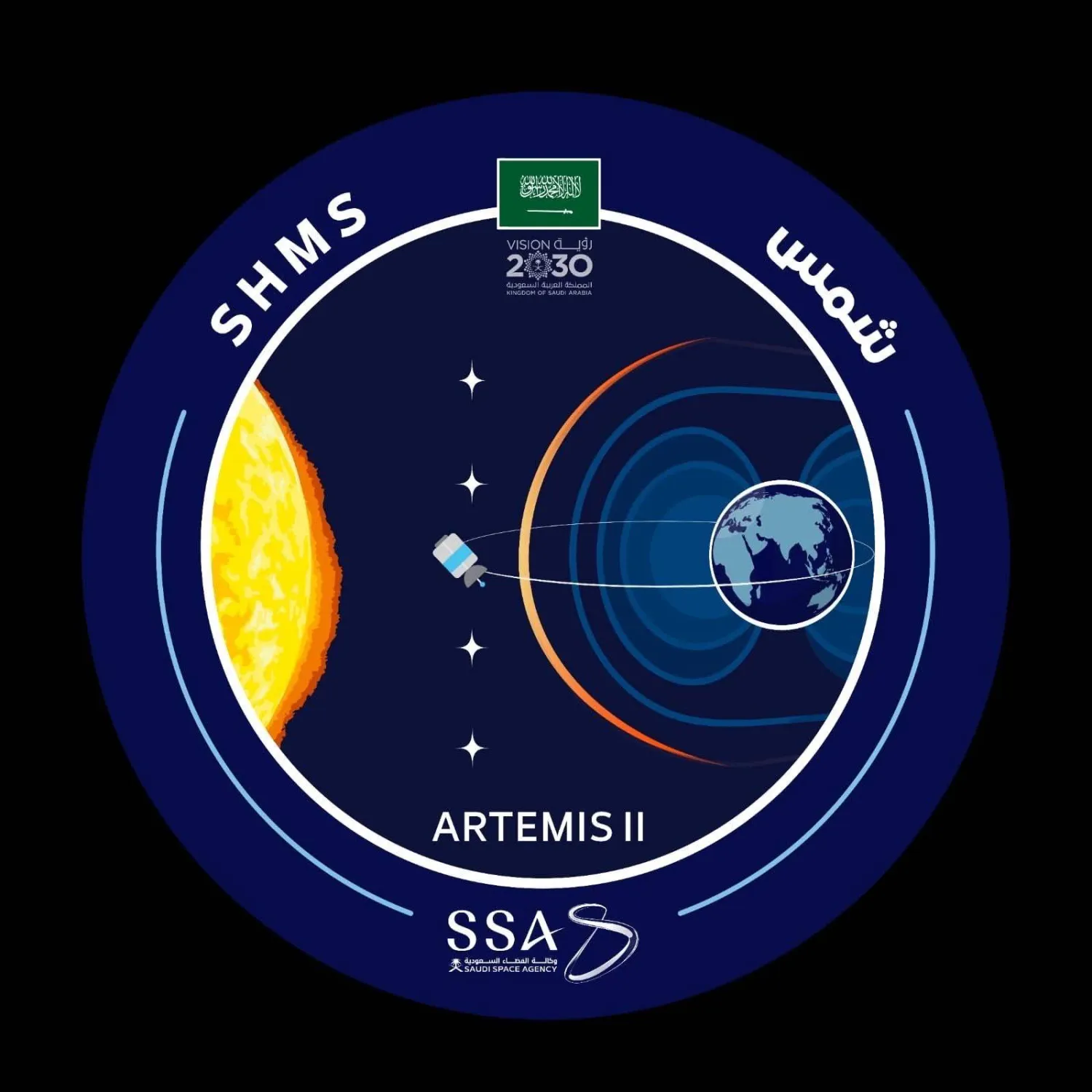
The Saudi Space Agency announced the successful launch of its new satellite, Shams, and established contact with it as part of the Artemis II mission, marking the Kingdom’s emergence as both the leading Arab partner in the program and the first to deploy a dedicated national mission to study space weather.

The satellite represents a milestone in Saudi innovation. Developed domestically by Saudi engineers, Shams has evolved from a national ambition into a scientific platform designed to monitor solar activity and radiation and their effects on Earth, with implications for safeguarding global communications and navigation systems.

The Artemis program, led by NASA in partnership with dozens of countries, aims to return humans to lunar orbit for the first time in more than 50 years, paving the way for future missions to Mars. Saudi Arabia joined the Artemis Accords in 2022 alongside more than 60 nations to help establish a framework for space exploration and strengthen its role in the sector.

The Artemis II mission will carry four astronauts on the first crewed flight to orbit the Moon aboard the Orion spacecraft, launched by the Space Launch System (SLS), the most powerful rocket ever operated. Shams is included as one of the mission’s scientific payloads.

The satellite will operate in a highly elliptical orbit (HEO), ranging from approximately 500 km to 70,000 km above Earth. This trajectory enables broad monitoring of solar and radiation activity, advancing space weather research and supporting critical applications.

Space laboratory to tackle radiation and solar activity challenges

Shams is designed to study space weather through four scientific areas: space radiation, solar X-rays, Earth’s magnetic field and high-energy solar particles. It will also collect data to support the development of protection technologies for future human spaceflight and improve understanding of solar particle behavior and magnetic fields.

The mission is expected to enhance the reliability and sustainability of key sectors such as communications, aviation and navigation by providing data that improves operational readiness and strengthens the security of critical infrastructure.

The Saudi Space Agency said the project aims to boost scientific research, develop future solutions and support a knowledge-based economy through the localization of advanced technologies, in line with Saudi Vision 2030. It also seeks to reinforce Saudi Arabia’s global standing in the space sector and empower national talent in space science and technology.

Data from Shams is expected to improve early warning systems for solar storms that can disrupt internet services, telecommunications and navigation signals. The findings could also help protect power grids and energy infrastructure from severe solar activity that can cause outages or damage.

By improving monitoring of radiation and solar winds, the mission may contribute to safer air travel and future crewed missions to the Moon and Mars, while opening new avenues in medicine, energy and science.



Lions and Tigers Begin Long-awaited Rescue from Notorious Argentine Zoo

Members of the Four Paws animal welfare organization carry a tiger to a crate for its transfer from a shuttered zoo to a sanctuary in South Africa, in Lujan, Argentina, Friday, Aug. 14, 2026. (AP Photo/Natacha Pisarenko)
TT

Lions and Tigers Begin Long-awaited Rescue from Notorious Argentine Zoo

Members of the Four Paws animal welfare organization carry a tiger to a crate for its transfer from a shuttered zoo to a sanctuary in South Africa, in Lujan, Argentina, Friday, Aug. 14, 2026. (AP Photo/Natacha Pisarenko)

Thirty lions and tigers that were kept alive — barely — for years in cramped concrete cages at a shuttered Argentine zoo began entering jumbo-size transport crates Friday as they embarked on ambitious journeys to wildlife sanctuaries halfway across the world in South Africa and the United States.

The cats are being rescued from the former Luján Zoo, about 70 kilometers (43 miles) northwest of Argentina's capital of Buenos Aires, after years of uncertainty over their fate.

Four Paws, the international animal-welfare organization overseeing the transfer, described it as one of the largest relocations of captive big cats in the world.

“We are putting everything into making this go as smoothly as possible so we can celebrate that 30 lives have improved because of this effort,” said Luciana D’Abramo, program director for Four Paws.

Once loaded into their crates and placed aboard cargo and passenger jets, nine tigers and six lions will be flown to Lionsrock, a Four Paws sanctuary in South Africa that houses more than 80 big cats across natural enclosures sprawling 60 hectares (148 acres).

The Wild Animal Sanctuary in Colorado, a vast refuge on the grasslands northeast of Denver where rescued lions, tigers and other animals roam expansive habitats.

But getting there is no easy feat: The big cats bound for Colorado will fly through Chile, while the others will travel to Johannesburg via Frankfurt or Amsterdam before a four-hour drive to Lionsrock.

The Four Paws handlers trained many of the lions and tigers to enter the crates voluntarily. But some of the big cats required sedation, including two tigers that veterinarians hoisted in canvas slings Friday and carried by hand to their transport crates, The Associated Press reported.

Argentine authorities shut down the Lujan Zoo — famous for letting visitors handle and pose for pictures with tigers and lions — over safety and animal welfare concerns in 2020.

D’Abramo said about 200 big cats were living there when it closed. Only 112 remained when Four Paws first arrived in 2023 seeking a solution.

By the time the organization was allowed to take over the site two years later, that number had fallen to 62. Some of the captive animals can barely walk because of obesity, muscle loss or poor nutrition. Others suffer from dental and kidney disease, complications from declawing and injuries that never healed properly.

“That alone shows the level of overcrowding and the conditions in which these animals have endured,” D’Abramo said.

The organization retrained longtime zoo employees in modern animal-welfare practices and began improving the cats’ diets and medical care. This transfer leaves more than 20 lions and tigers at Luján while Four Paws searches for their long-term homes.


Spain Investigates Likely Shooting of Endangered 'Grandmother' Orca

A handout photo shows marks on the dorsal fin of an elderly Iberian orca known as "Toñi," in the Strait of Gibraltar, Spain, August 11, 2026. WeWhale & Iberian Orca Guardians/Handout via REUTERS
TT

Spain Investigates Likely Shooting of Endangered 'Grandmother' Orca

A handout photo shows marks on the dorsal fin of an elderly Iberian orca known as "Toñi," in the Strait of Gibraltar, Spain, August 11, 2026. WeWhale & Iberian Orca Guardians/Handout via REUTERS

Spain's Environment Ministry has ordered an investigation into the likely shooting of a rare Iberian orca that was filmed swimming with wounds to its dorsal fin, Deputy Prime Minister Sara Aagesen said on Friday.

"The oldest orca in the Strait of Gibraltar has appeared with marks compatible with pellets" fired from a shotgun this week, she wrote in a post on Bluesky, announcing the investigation. "It is a vulnerable species and any harm to them is a serious ⁠crime."

The WeWhale Association ⁠and Iberian Orca Guardians said earlier they had documented multiple new wounds across the dorsal fin of Toñi, the oldest known Iberian orca, during their field operations.

"Seeing Toñi, “La Abuela” (the grandmother) like this is devastating," said Janek Andre, head of ⁠the two conservation groups. "If someone has deliberately fired a shotgun at her, this is not only an act of extreme cruelty against an individual animal. It is an attack on one of the last remaining members of a critically endangered population."

The Iberian orca subpopulation counts fewer than 40 animals, Reuters quoted the groups as saying.

Referring to a series of boat rammings by orca pods off the coasts of ⁠Spain ⁠and Portugal in recent years, Andre said: "Whatever someone’s opinion about those interactions may be, shooting at these animals can never be an acceptable response. These orcas need protection, not retaliation."

Scientists have yet to reach a consensus on the reasons for this relatively recent boat-ramming behavior. Although known as killer whales, orcas are part of the dolphin family. They can measure up to 8 meters (26 feet) and weigh up to 6 metric tons (13,200 pounds) as adults.


Too Smart to Eat... Why an Octopus is Difficult to Farm

An octopus is a highly intelligent animal (Getty)
TT

Too Smart to Eat... Why an Octopus is Difficult to Farm

An octopus is a highly intelligent animal (Getty)

In 2022 Nueva Pescanova, Spain’s largest fisheries business, announced it was investing €65 million (£56 million) in the world’s first industrial octopus farm and processing plant near the Canary Islands’ port of Las Palmas.

Despite the creatures being notoriously difficult to farm, the company predicted that by 2025 it would be producing 3,000 tons of octopus a year on Gran Canaria, according to The Guardian.

There followed years of controversy, with activists and scientists condemning the plans to farm an animal lauded for its apparent “intelligence,” which reached near-celebrity status five years ago thanks to the Oscar-winning documentary My Octopus Teacher.

Then, at the end of July 2026, Nueva Pescanova shelved plans for the farm. But why – and with what implications for the future of octopus farming?

A Guardian request for comment from Nueva Pescanova was met with silence but it told the Canary Islands’ port authority in a letter that it was pulling out for “business and regulatory” reasons.

Activists who have long opposed the farm were quick to claim a victory. “Social, scientific and political pressure has borne fruit, faced with this ethical and environmental atrocity,” Spain’s animal rights party, Pacma, said in a statement.

When the Guardian visited the company’s research center in 2023, Roberto Romero Perez, the marine biologist overseeing aquaculture at Nueva Pescanova, had said: “The truth is that we’re finding the mood to be a bit more hostile than expected.”

However, Silvia Fernandez Diaz, a journalist at Canarias7 who has covered the story from the start, said that far from being a mass movement, demonstrations on the island against the project rarely attracted more than a few dozen protesters.

“I believe the reality is that the farm didn’t go ahead because it wasn’t viable, not because of popular protest,” she said.

Sources at Las Palmas port authority confirmed that they had not been approached by anyone from Nueva Pescanova and no work had been done on building the farm.

Ian Gleadall, a marine biologist at Tohoku University in Japan who has spent 50 years researching octopuses, said he has been trying for two years to get a response from Nueva Pescanova about the Canary Islands project without success.

“The same thing happened here in Japan with the fisheries company Nissui,” he said. “The company said they’d cracked it and were going to be producing massive amounts of octopus but it never happened.”

Gleadall said octopuses have so far been virtually impossible to farm because the larvae of the common octopus spend at least 20 days floating in the water before they settle on the sea bed, making it difficult to move on to the next phase. Even then, he said, the hatchlings are so delicate that if anything goes wrong they die.

He added that another significant problem is what to feed the octopus: “One feed is a form of fish paste. But even if they eat it, they won’t go on eating it because octopus are very finicky – they don’t like to eat the same thing day in, day out.”

Gleadall said: “Even if you could solve the feed problem. You’d probably spend more on feed than the octopus was worth on the market.”

The ethical objections to octopus farming are that the creatures are solitary and antisocial, as well as the studies showing “compelling evidence” of sentience.

Richard Schweid, author of Life on the Octopus Farm, said many marine biologists hold that an octopus not only has nine brains but a mind. “[This is] something that we generally associate with higher orders of mammals, like dogs, cats, primates and humans,” he said.

The idea that the octopus is somehow like us – or at least like some of our pets – was fueled by Craig Foster’s film My Octopus Teacher, in which Foster appears to form a reciprocal relationship with a female octopus.

“The octopus is a prime candidate for humans to anthropomorphise because it is so smart, so responsive, and yet so different as to be essentially unreadable,” said Schweid.

Whatever the reasons for the end of the Spanish enterprise, no one has yet successfully farmed octopuses, aside from a small project in Mexico that cultivated a different species from the common octopus (Octopus vulgaris), found in the Mediterranean and Atlantic.

While octopuses may be safe from farming for now, the UN’s food agency, the Food and Agriculture Organization, estimates that about 370,000 tons of octopus are caught every year, much of them off Morocco and Mauritania. The principal markets are China and Japan, while Spain consumes about 40,000 tons a year, or almost 1kg per person.

And warming waters globally means octopuses are finding their way on to plates in new territories. Over the past two years, for example, the UK witnessed the biggest octopus bloom since 1950.

Octopus grow fast, have a short lifespan, are high in nutrients and are much in demand, so there are plenty of incentives to find a way to farm them.

“The conversion rate of what an octopus eats into a high-protein, low-fat meat is much better than any land-based livestock,” said Schweid.

He added: “Octopus is potentially a more environmentally sustainable farmed meat than beef, pork or poultry, and in a world shaped by rising temperatures it could become a meat of choice.”

In the meantime, the potency of the ethical argument against farming octopuses is likely to remain a strong weapon in the armory of those who oppose it.

“An octopus is a highly intelligent, naturally solitary wild animal,” said Charlotte Reid, a campaigner at Compassion in World Farming. “These are wild animals and they belong in the wild, not these underwater prisons,” she added.