


Death Toll From Extreme Weather in Afghanistan Increases to 110

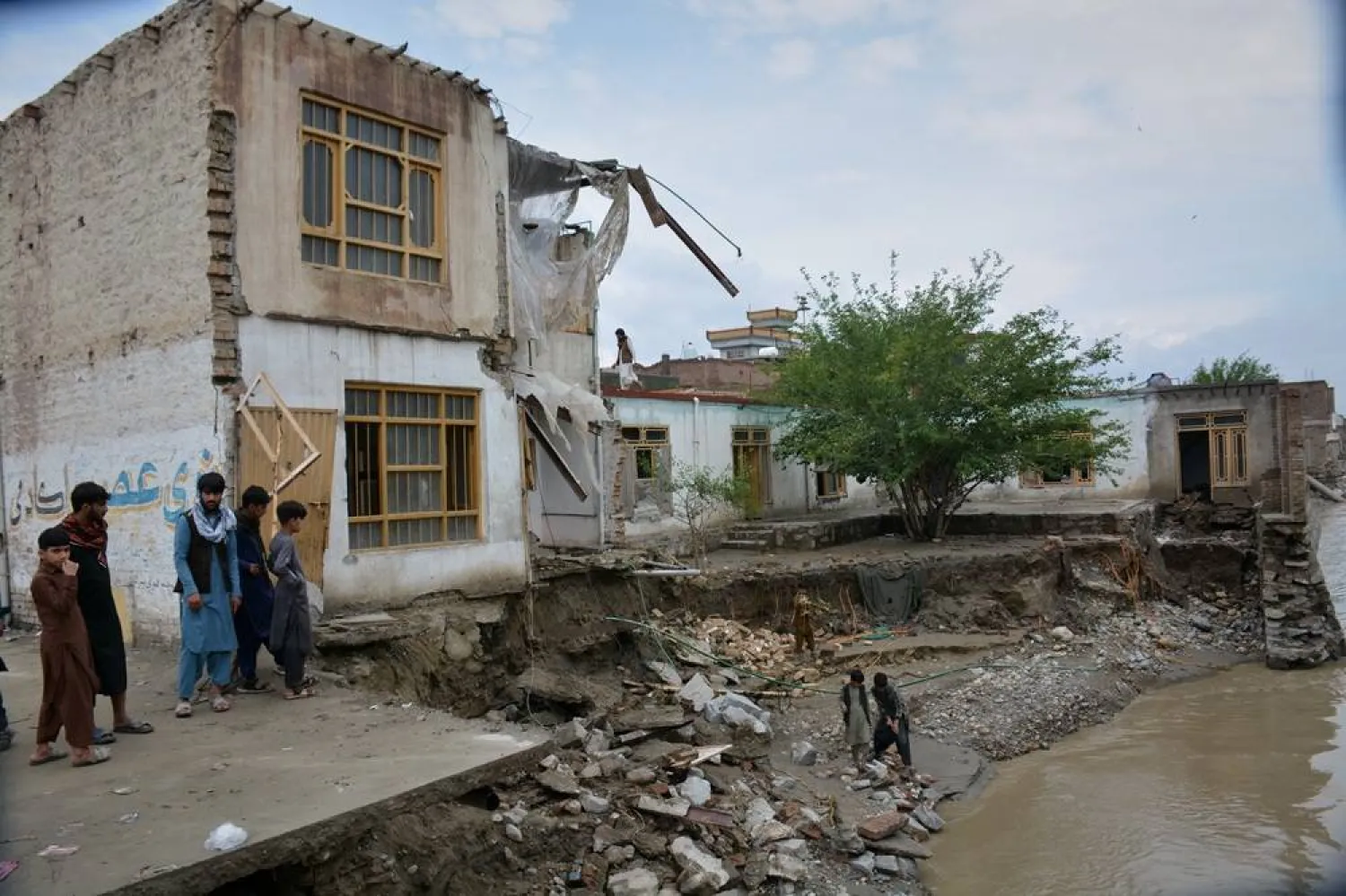
Residents inspect a building that partially collapsed due to heavy flooding in Jalalabad, Afghanistan, Saturday, April 4, 2026. (AP)
TT

Death Toll From Extreme Weather in Afghanistan Increases to 110

Residents inspect a building that partially collapsed due to heavy flooding in Jalalabad, Afghanistan, Saturday, April 4, 2026. (AP)

The death toll from extreme weather that has triggered widespread flooding and landslides in many parts of Afghanistan has increased to at least 110, authorities said Monday, with another seven people missing and more heavy rain forecast.

Storms and heavy rainfall began across Afghanistan about 12 days ago, affecting most of the country’s 34 provinces. Over the past 24 hours alone, 11 people have died and six have been injured, the Disaster Management Authority said. Seven people were reported missing in separate incidents, all believed to have been carried away by floodwater.

Overall, the flooding, landslides and lighting strikes have killed 110 people and injured 160 in the past 12 days, the authority said, while 958 homes have been completely destroyed and another 4,155 have suffered partial damage.

The Defense Ministry said Monday that it had used a helicopter to airlift two people to safety after they became stranded by floodwater in the western province of Herat.

More than 325 kilometers (200 miles) of roads have been destroyed, while businesses, agricultural land, irrigation canals and fresh-water wells have also been damaged, affecting 6,122 families, the authority said. It said the figures are preliminary.

Authorities issued weather warnings for Tuesday for nearly the entire country, warning people to stay away from rivers and areas prone to flooding.

Earlier this year, heavy snowfall and flash floods left dozens of people dead across the country.

Two major highways have been closed for days due to landslides and floods, forcing travelers to take long, circuitous routes to reach their destinations. The Kabul to Jalalabad highway — the main route linking the capital to the Pakistani border and eastern Afghan provinces — has been shut since last Thursday, while the road from Jalalabad, the main city in eastern Afghanistan, heading northeast to Kunar and Nuristan provinces has been closed since Sunday by falling rocks.

Snow and heavy rain often trigger flash floods that kill scores, or even hundreds, of people at a time in Afghanistan. In 2024, more than 300 people died in springtime flash floods.



Pezeshkian Says Middle East Has No Need for US 'Policeman'

Indian Prime Minister Narendra Modi, right, greets Iranian President Masoud Pezeshkian upon his arrival for the BRICS summit in New Delhi, India, Saturday, Sept. 12, 2026. (Indian Foreign Ministry via AP)
TT

Pezeshkian Says Middle East Has No Need for US 'Policeman'

Indian Prime Minister Narendra Modi, right, greets Iranian President Masoud Pezeshkian upon his arrival for the BRICS summit in New Delhi, India, Saturday, Sept. 12, 2026. (Indian Foreign Ministry via AP)

Iran's President Masoud Pezeshkian said on Saturday that the Middle East does not need the United States to be a "regional policeman,” with the two countries at war and vying for control of the Strait of Hormuz.

"We do not need a regional policeman," he said on the sidelines of a BRICS summit in India during a meeting with Malaysian Prime Minister Anwar Ibrahim.

"The territorial integrity and security of the region can only be guaranteed by its main players and the countries that comprise it," he added, according to the Iranian presidency.

Iran has been at war since February 28, when US-Israeli strikes killed its supreme leader.

Tehran retaliated with attacks across the region and blockaded the Strait of Hormuz, through which one-fifth of the world's oil previously flowed.

Iran and the US have since been vying for control of the strategic waterway.

The strait was free to transit before the war, but Iran now requires vessels to obtain permission and is considering a mechanism to impose service fees.

Ships that do not comply are regularly targeted by Iranian strikes, while the US periodically bombs the Iranian coastline to challenge the country's control of the strait.

More than six months into the Middle East war, the blockade continues to drive up oil prices, which soared past $100 a barrel this week.

"Despite all the injustices suffered by our people, we neither desire war nor its continuation. Peace remains our priority," Pezeshkian added.


Trump Says Iran War Will End after US Midterm Elections

US President Donald Trump meets with Ireland's Prime Minister (Taoiseach) Micheal Martin (not pictured) at Farmleigh House in Dublin, Ireland, September 12, 2026. REUTERS/Kylie Cooper
TT

Trump Says Iran War Will End after US Midterm Elections

US President Donald Trump meets with Ireland's Prime Minister (Taoiseach) Micheal Martin (not pictured) at Farmleigh House in Dublin, Ireland, September 12, 2026. REUTERS/Kylie Cooper

President Donald Trump repeated on Saturday that he believed the war with Iran will end after US midterm elections in November and that oil ⁠prices will tumble once ⁠it does.

"I think very soon. I think it'll be probably ⁠right after the mid-terms. They're trying to hold out as long as they can to complicate the election. But I think people are wise to ⁠it," Trump ⁠told reporters in Dublin.

"When that happens, oil prices will come tumbling down."

Earlier, Iran's President Masoud Pezeshkian said that the Middle East does not need the United States to be a "regional policeman.”

Iran has been at war since February 28, when US-Israeli strikes killed its supreme leader.

Tehran retaliated with attacks across the region and blockaded the Strait of Hormuz, through which one-fifth of the world's oil previously flowed.

Iran and the US have since been vying for control of the strategic waterway.


French Police Suspect Train Derailment Was Sabotage

SNCF workers stand next to a derailed train carriage in Cléon, northwestern France, on September 12, 2026, the morning after the train derailed. (Photo by Guillaume SALIGOT / AFP)
TT

French Police Suspect Train Derailment Was Sabotage

SNCF workers stand next to a derailed train carriage in Cléon, northwestern France, on September 12, 2026, the morning after the train derailed. (Photo by Guillaume SALIGOT / AFP)

Investigators suspect that a train derailment in northwest France which injured 44, one gravely, was the result of sabotage, a police source told AFP on Saturday.

A fragment of rail was found on the track, with the possibility of a malicious act being treated as the main line of inquiry as a result, the source said.

Carrying 186 passengers, the train was running between the Normandy cities of Rouen and Caen when it derailed around 7:45 pm (1745 GMT) Friday.

Authorities activated a mass-casualty response plan, with 130 firefighters, five medical teams and 80 vehicles drafted in.

Rouen prosecutor Sebastien Gallois said 44 people were injured including an 18-year-old woman evacuated "in a critical condition", while tests for drugs and alcohol on the train driver had come back negative.

SNCF Reseau, which controls the French rail network, told AFP that traffic on the line has been suspended and power to the tracks cut to allow emergency services to operate.