


Asian Airlines Trim Schedules and Carry Extra Fuel as Supplies Tighten

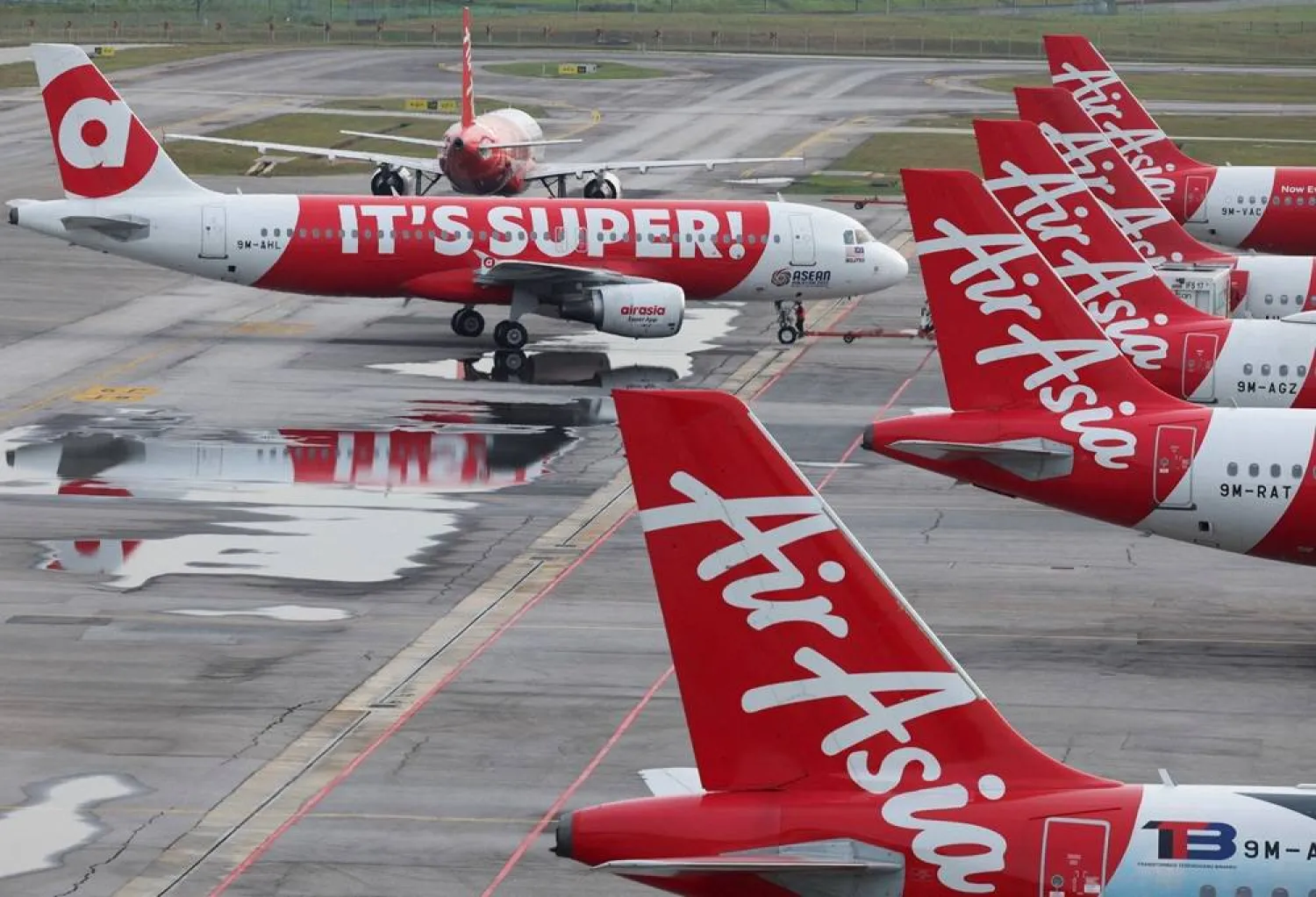
AirAsia planes stand on the tarmac at Kuala Lumpur International Airport Terminal 2 (KLIA2) in Sepang, Malaysia, January 21, 2026. (Reuters)
TT

Asian Airlines Trim Schedules and Carry Extra Fuel as Supplies Tighten

AirAsia planes stand on the tarmac at Kuala Lumpur International Airport Terminal 2 (KLIA2) in Sepang, Malaysia, January 21, 2026. (Reuters)

Airlines across Asia are cutting flights, carrying extra fuel from home airports and adding refueling stops as the Middle East conflict squeezes jet fuel supply in some countries, adding to pressure on an industry already hit by a sharp jump in fuel costs.

European carriers are bracing for similar disruption after Iran's closure of the Strait of Hormuz cut off nearly 21% of global seaborne jet fuel supply, according to Kpler.

Previous oil shocks mainly drove up prices, but this one is also constraining physical supply, forcing governments, airlines and airports to consider rationing.

"In my conversation with airlines, they are very concerned about what the future looks like, because we do not know when the war will end and we don't know when the supply chain, the feedstock, will come from the Gulf area," said Shukor Yusof, founder of aviation consultancy Endau Analytics.

Asia, Europe and Africa are most exposed, analysts say, because the US has ample domestic supplies.

Within Asia, the pain has so far been sharpest in lower-income, import-dependent markets such as Vietnam, Myanmar and Pakistan after China and Thailand halted jet fuel exports and South ‌Korea capped them at ‌last year’s levels.

Budget airline AirAsia X is now loading extra fuel in Malaysia before flying to Vietnamese ‌airports, ⁠CEO Bo Lingam told ⁠reporters on Monday.

"Not to say that they are not giving us fuel, but they limit the amount of fuel," he said of Vietnam.

JET FUEL RATIONING

Past temporary jet fuel shortages at airports due to shipment disruptions or contamination have usually led to rationing rather than complete outages.

Airlines have typically responded by loading extra fuel at home airports, adding refueling stops on longer routes or carrying less cargo.

For a more prolonged crisis, another solution is cutting flights, Ryanair CEO Michael O'Leary said last week when he expressed concerns the Middle Eastern conflict may not end this month.

"If there's a risk to 10% or 20% of the fuel supply in June or July or August, then we and other airlines will have to start looking at cancelling some flights or taking some capacity out," he told reporters.

Asia, which has a ⁠thinner supply cushion than Europe and is more dependent on Hormuz flows, has been hit more quickly.

Vietnam Airlines ‌has cut 23 domestic flights per week to conserve fuel, according to the country's aviation authority.

Airlines based ‌in Myanmar suspended domestic flights for part of March due to jet fuel shortages, its transport ministry said, and some of its carriers have also cut capacity in ‌April, according to aviation data provider Cirium.

Air India is making refueling stops in Kolkata on its return from Yangon to Delhi due to fuel ‌shortages at Yangon airport, according to a source familiar with the matter.

In the South Pacific, Tahiti International Airport has restricted refueling for international flights to quantities essential for flight operations due to the Middle Eastern crisis, a notice to pilots shows.

In Pakistan, pilots are being advised to carry maximum fuel from abroad.

That practice, known as "tankering", is costly because carrying extra fuel increases fuel burn.

"Some countries are in better shape than others," said Brendan Sobie, a Singapore-based independent aviation analyst. "Some may be limiting (fuel for) foreign airlines, which ‌then leads to the tankering. This could be proactive as some countries fear they could run out."

DEMAND DESTRUCTION

A more than doubling of jet fuel prices since the start of the Iran war has pushed some airlines ⁠to cut capacity, while others have hiked ⁠fares and imposed fuel surcharges.

In one of the starkest examples, Batik Air Malaysia has slashed domestic capacity by 36%, with CEO Chandran Rama Muthy describing the cuts as a necessary and proactive response to a "crisis-mode" environment.

"If we were to continue operating without making adjustments, it could further expose the company to operational and financial risk," he said.

Gulf carriers such as Emirates and Qatar Airways have been operating well below normal capacity due to the conflict, while other global airlines have also cut flights as fare increases needed to cover fuel costs deter price-sensitive travellers.

Even with flight cuts, airline demand is not falling fast enough to match the drop in jet fuel supply, analysts said.

At least 400,000 barrels per day of jet fuel that normally is produced in the Asia-Pacific region via crude that transits the Strait of Hormuz have been affected since the crisis started, according to Reuters' calculations.

"There is no easy way to replace the lost volumes, especially as Asian supply will start to tighten as refiners cut runs," said Alex Yap, senior oil products analyst at Energy Aspects.

Industry sources estimate flight cancellations have lowered April demand in Asia specifically by only about 50,000 to 100,000 barrels per day, suggesting deeper cuts may be needed.

"We're only just at the start of that cycle (of flight cuts) as demand from passengers seems to be resilient, but I think any oil-spike induced economic slowdown could hit demand in the second half of the year," said Cirium's Asia editor, Ellis Taylor.



Türkiye, Syria Step Up Banking Ties as Lenders Eye Expansion

Türkiye’s Ziraat Bank tower is seen in Sarajevo, Bosnia and Herzegovina, May 16, 2018. (Reuters)
TT

Türkiye, Syria Step Up Banking Ties as Lenders Eye Expansion

Türkiye’s Ziraat Bank tower is seen in Sarajevo, Bosnia and Herzegovina, May 16, 2018. (Reuters)

Türkiye and Syria are accelerating cooperation between their central banks, Trade Minister Omer Bolat said on Tuesday, adding that Syria’s central bank governor will meet Turkish banking ‌regulators.

Speaking at ‌a business ‌forum, ⁠Bolat said closer ⁠banking ties and the entry of Turkish lenders into Syria could help boost trade and industrial ⁠investment.

State lender Ziraat ‌Bank ‌and private lender Aktifbank ‌are both working to ‌establish a presence in Syria, company officials said separately, with applications submitted ‌and operations expected to begin in the near ⁠term.

Business ⁠leaders at the forum said restoring banking services and resolving customs and logistics issues would be key to increasing bilateral trade.


Türkiye Not Facing Energy Security Problem Amid War but Situation ‘Volatile’

Travelers cross from Iran into Türkiye at the Kapikoy border crossing in eastern Van province, Türkiye, Saturday, April 4, 2026. (AP)
TT

Türkiye Not Facing Energy Security Problem Amid War but Situation ‘Volatile’

Travelers cross from Iran into Türkiye at the Kapikoy border crossing in eastern Van province, Türkiye, Saturday, April 4, 2026. (AP)

Türkiye is not ‌facing any problems regarding energy supply security due to the Iran war, but the situation is "volatile", Energy Minister Alparslan Bayraktar was quoted as saying by Turkish media on Tuesday.

"We hope the war will not last any longer. But the process is currently under our control," Bayraktar told reporters on Monday evening after a cabinet meeting, broadcaster Haberturk reported.

"There is no problem or difficulty in energy ‌supply security."

Türkiye ‌is a big energy importer which ‌neighbors ⁠Iran and is among ⁠the most exposed emerging market economies to the global energy price jump.

Bayraktar said in late March that Türkiye’s dependence on Middle East oil was at a "manageable" 10% of total supplies and that the country had taken protective diversification steps.

At the ⁠time he said every $1 increase in ‌oil prices adds about $400 million ‌to Türkiye’s energy bill, while there had not been ‌any natural gas supply cuts so far from ‌Iran, Türkiye’s fourth largest supplier last year.

On Monday, Bayraktar told reporters that he had spoken with the Hungarian foreign minister and discussed the issue of protecting the security ‌of the TurkStream pipeline, which carries Russian natural gas to southern Europe through ⁠the ⁠Black Sea and Türkiye.

Explosives were found near the TurkStream pipeline in Serbia at the weekend, prompting Hungarian Prime Minister Viktor Orban to convene an emergency defense council.

Russia and Türkiye formally launched the TurkStream pipeline, which has a capacity of 31.5 billion cubic meters per year, in January 2020. The pipeline allows Moscow to bypass Ukraine as a transit route to Europe.

"The security of the pipeline in the Black Sea and on our side is important," Bayraktar said.


SME Financing Moves to the Core of Saudi Arabia’s Non-Oil Economy

A night view of Riyadh, Saudi Arabia (SPA file)
TT

SME Financing Moves to the Core of Saudi Arabia’s Non-Oil Economy

A night view of Riyadh, Saudi Arabia (SPA file)

In a sign of a deep shift in the structure of financing within Saudi Arabia’s economy, and reflecting the goals of Vision 2030 to diversify the production base, credit facilities extended to micro, small and medium-sized enterprises reached a record high at the end of 2025.

Banks and finance companies injected around SAR 467.7 billion ($124.5 billion) into the sector last year, marking a 33 percent annual increase. The surge highlights the transition of these enterprises from the margins of economic activity to the center, positioning them as a key driver of non-oil growth and job creation.

On a yearly basis, total facilities rose 33 percent from about SAR 351.7 billion ($93.6 billion) in 2024, according to monthly bulletin data from the Saudi Central Bank (SAMA).

The banking sector accounted for the largest share, with facilities provided by banks reaching approximately SAR 446.6 billion, up 34 percent year on year. Finance companies contributed around SAR 21.1 billion, an annual increase of 15.4 percent.

By enterprise size, growth rates varied. Lending to medium-sized firms rose 18 percent year on year to SAR 220.9 billion. Small enterprises recorded stronger growth of 34 percent, reaching SAR 163.5 billion. Micro-enterprises saw the sharpest increase, with facilities surging 97 percent to SAR 83.3 billion, underscoring a notable expansion in financing to this segment.

Structural shift

The strong growth has been driven by several factors, most notably the clear strategic direction under Vision 2030, which places SMEs at the heart of economic diversification, along with the expanding role of institutions supporting the sector.

Among these is Monsha’at, which has helped improve the business environment and connect enterprises with funding sources, according to economist Hussein Al-Attas.

“This level of facilities is not just a record figure. It reflects a structural shift in the philosophy of financing within the Saudi economy,” Al-Attas told Asharq Al-Awsat.

He identified four main drivers behind the growth: a clear economic vision, a stronger regulatory environment, the expansion of credit guarantee programs, and a shift in how banks view the SME sector.

The Kafalah program has been particularly important, helping reduce lending risks and enabling banks to increase exposure to SMEs. This has coincided with improvements in financial data quality and governance practices, which have strengthened lenders’ confidence in the sector.

Sustainable growth

Al-Attas said the current trend reflects not a temporary expansion in credit but a redefinition of the role of SMEs in the economy, with growth expected to continue over the medium term.

However, he pointed to several challenges that could affect the pace of expansion. These include limited managerial expertise in some firms, the risk of defaults if financing is poorly managed, concentration of lending in specific sectors, and the potential impact of future interest rate increases.

Authorities are aware of these risks. This is reflected in a growing focus on improving governance, strengthening management efficiency, and linking financing more closely to actual operating performance to ensure funds are directed toward sustainable and productive activities.

The importance of this expansion extends beyond the headline figures. It supports a higher contribution of SMEs to non-oil GDP and plays a central role in job creation, given the sector’s labor-intensive nature.

According to Al-Attas, the growth also strengthens economic diversification by supporting the entry of new firms into promising sectors such as technology, industry, and services. It also increases local value added and reduces reliance on imports and large corporations.

Looking ahead, he expects financing growth to continue at a healthy pace over the next three to five years. This outlook is supported by the expansion of digital financing solutions, continued integration between government and banking sectors, and improving market maturity and enterprise quality. Large-scale projects and non-oil expansion are also expected to create new financing opportunities, gradually shifting the focus from the volume of funding to the quality of its economic impact.

Digital transformation

Mohammed Al-Farraj, senior head of asset management at Arbah Capital, said the development reflects alignment between ambitious government policies aimed at raising SMEs’ contribution to GDP to 35 percent and a responsive banking sector that has led the growth and captured the largest share of financing.

He noted that guarantee and incentive programs, as well as the SME Bank, have played a key role in reducing credit risks and boosting banks’ willingness to lend.

Digital transformation and the rise of fintech companies have also marked a turning point by improving access to financing and lowering operating costs. This has created a more flexible and attractive environment for business growth beyond traditional constraints.

Despite these positive indicators, Al-Farraj cautioned that rapid expansion requires strategic vigilance, particularly regarding credit risks and potential defaults amid interest rate volatility and increased competition in sectors such as retail.

He continued that the next phase will require a shift from quantitative growth, focused on expanding financing volumes, to qualitative growth that emphasizes credit quality, project sustainability, and resilience to economic changes.

Alternative financing tools such as venture capital are expected to play a growing role. These tools can ease pressure on bank balance sheets while directing funding toward strategic sectors including technology, tourism, and industry to ensure meaningful value creation in the national economy.

Developments seen in 2026 suggest early returns from this expansion. These include the emergence of a new generation of high-growth firms, increased SME contribution to non-oil exports, and greater use of instruments such as sukuk tailored for SMEs as a cost-effective long-term financing option.

Al-Faraj said SMEs are no longer a peripheral segment but a central driver of innovation and growth in Saudi Arabia’s economy. Sustaining this momentum will require continued regulatory development and more flexible repayment mechanisms to ensure durable growth aligned with long-term economic development goals.
