

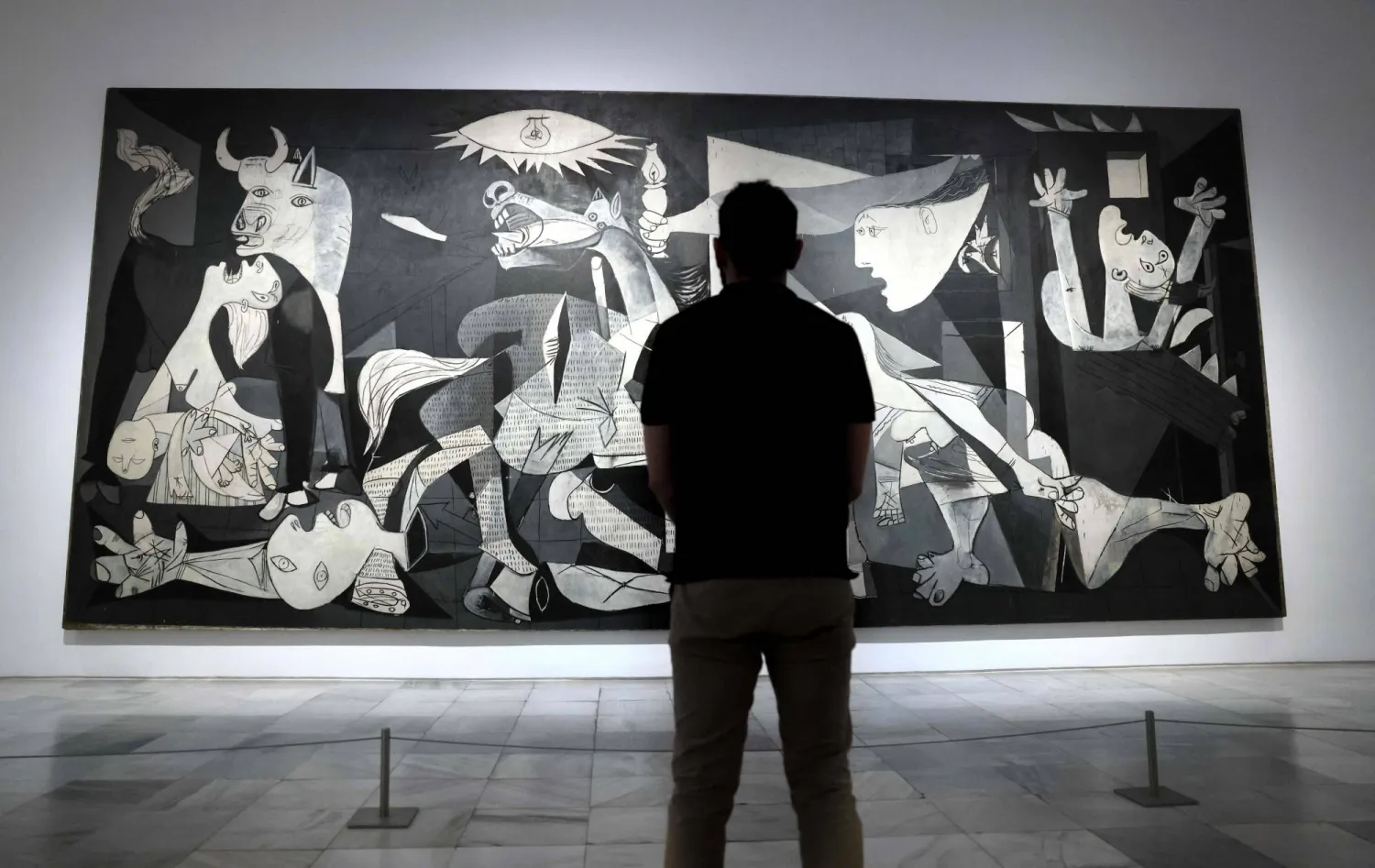

Picasso’s ‘Guernica’ at Heart of Battle in Spain Over Location

A visitor looks at Spanish painter Pablo Picasso's master piece "Guernica" during a press conference presenting the "Year of Picasso" events, marking the 50th anniversary of the painter's death, at the Reina Sofia museum in Madrid, on September 12, 2022. (Thomas Coex/ AFP)
TT

Picasso’s ‘Guernica’ at Heart of Battle in Spain Over Location

A visitor looks at Spanish painter Pablo Picasso's master piece "Guernica" during a press conference presenting the "Year of Picasso" events, marking the 50th anniversary of the painter's death, at the Reina Sofia museum in Madrid, on September 12, 2022. (Thomas Coex/ AFP)

Pablo Picasso's anti-war masterpiece "Guernica" is swept up in a conflict in Spain, where Basque leaders want the government in Madrid to move the painting to their region, whose 1937 bombing inspired it.

The mural-sized painting has been on display since 1992 at the Reina Sofia museum in the Spanish capital, and repeated requests for it to be moved to Spain's Basque Country have been refused.

The latest demand was made by the head of the regional Basque government, Imanol Pradales, during talks with Socialist Prime Minister Pedro Sanchez.

The Basque government wants the painting to be hung in the Guggenheim Museum in Bilbao to commemorate the 90th anniversary of the April 26, 1937, bombing, in which forces from Nazi Germany and Fascist Italy razed the town of Guernica to help General Francisco Franco in the Spanish Civil War.

Bringing the painting to Bilbao from October until June would be a form of "reparation and historical memory", the Basque government said.

Sanchez -- whose minority government depends on the support of two Basque parties in parliament to pass laws -- did not reject the proposal outright, instead referring it to the culture ministry.

The ministry asked the Reina Sofia museum for a technical report on the viability of the request, which once again "strongly advised" against moving the painting.

The report said the painting is too fragile to travel, citing risks of damage from vibration or movement.

Picasso's black-and-white masterpiece is the highlight of the Reina Sofia museum, which welcomed around 1.6 million visitors last year.

The outspoken head of the regional government of Madrid, Isabel Diaz Ayuso of the conservative Popular Party (PP), weighed in on Monday, calling the request to move the painting "provincial".

"It makes no sense for everything to be returned to its origin. In that case we should send all of Picasso's works to Malaga," she said, a reference to the southern Spanish city where Picasso was born.

- Return from New York -

Asked about the controversy on Tuesday, Spain's central government spokeswoman Elma Saiz said the government relies on the advice of "professionals", referring to the museum report, and "never resorts to insults".

Painted in 1937 in the aftermath of the bombing, "Guernica" debuted in Paris at the World's Fair, then was placed in the care of the Museum of Modern Art in New York.

When Franco's forces overthrew the Spanish republic, Picasso stipulated that the painting should not return to Spain until democracy had been restored.

The work was moved to Spain in 1981, six years after Franco's death.

It was first displayed at the Prado museum, then moved to the Reina Sofia in 1992.

Picasso, who died in 1973, never lived to see the painting on exhibit in Spain.

In 1995, Spanish authorities refused to lend it to the Pompidou Center in Paris, citing the damage the work could suffer during its transport.



Hegra Highlights Status as Saudi Arabia’s First UNESCO World Heritage Site

Hegra Highlights Status as Saudi Arabia’s First UNESCO World Heritage Site
TT

Hegra Highlights Status as Saudi Arabia’s First UNESCO World Heritage Site

Hegra Highlights Status as Saudi Arabia’s First UNESCO World Heritage Site

The Kingdom of Saudi Arabia, a land that has witnessed successive civilizations whose traces remain across its regions, is home to AlUla Governorate, where the Hegra Archaeological Site stands as part of this rich human heritage.

It was the first Saudi site inscribed on the UNESCO World Heritage List, a testament to Saudi Arabia’s deep civilizational heritage and its commitment to preserving and safeguarding it for future generations.

As Saudi Arabia celebrates Saudi National Day, Hegra evokes part of the history of the Arabian Peninsula and the civilizational and cultural exchanges that took place across the region through the ages, according to SPA.

The Hegra Archaeological Site was inscribed on the UNESCO World Heritage List in 2008, becoming the first Saudi site to be added to the list, in an achievement that reflects its exceptional historical and civilizational significance. The site contains archaeological remains and carved rock facades that showcase the Nabataeans’ engineering and sculptural expertise.

Saudi Arabia, represented by the Royal Commission for AlUla (RCU), pays particular attention to the Hegra Archaeological Site through comprehensive efforts to preserve the site and safeguard its archaeological and historical components.

These conservation efforts are complemented by archaeological studies, surveys, and research conducted by the RCU in cooperation with experts and academic institutions.

Hegra remains one of the Kingdom’s most prominent heritage sites and a destination for visitors and researchers from around the world.


Tyre’s Ruins Survived the Strikes. Now Divers are Finding their Way Back Underwater

A diver passes above Roman-era columns at an archaeological site near the coast in the southern port city of Tyre, Lebanon, Thursday, Sept. 17, 2026. (AP Photo/Bilal Hussein)
TT

Tyre’s Ruins Survived the Strikes. Now Divers are Finding their Way Back Underwater

A diver passes above Roman-era columns at an archaeological site near the coast in the southern port city of Tyre, Lebanon, Thursday, Sept. 17, 2026. (AP Photo/Bilal Hussein)

Beneath the Mediterranean waters off the southern Lebanese city of Tyre, divers swim past stone walls, ancient structures and a submerged road — remnants of parts of a city that once stood above the water.

With a shaky ceasefire in place after the latest Israel-Hezbollah war, visitors are returning to Tyre, a city known for its Roman ruins and its much older Phoenician history. Diving operators say interest in the underwater archaeological sites is increasing, though the number of visitors remains below prewar levels, The Associated Press said.

“The diving season is not like it used to be before, but the number of people coming to dive to see the ruins is increasing day by day,” said Yousef al-Jundi, manager of the Lebanon Diving Center.

The remains underwater are part of Tyre’s wider archaeological landscape. UNESCO says substantial archaeological remains of the ancient city are submerged, while underwater archaeological research has documented walls, harbor structures and other remains along the former island and coastline.

“This is the identity of this city, which tells us how old this city is and what its history is,” al-Jundi said. He said the underwater sites attract divers from around the world who want to see what is commonly described as Tyre’s “sunken city.”

Tyre was one of the major Phoenician maritime cities of antiquity, with trading networks that extended across the Mediterranean. The city was also famous for its purple dye and later became an important Greek and Roman center. Its archaeological remains were added to UNESCO’s World Heritage List in 1984.

The war raised concerns over the preservation of those remains, both on land and underwater.

“We were worried about the archaeological sites on land, which were affected by the war and the strikes, but at the same time we were also worried about the archaeological sites underwater, but thank God they were not affected,” al-Jundi said.

Before the ceasefire in late June, Tyre came under intense Israeli airstrikes, with neighborhoods in the coastal city heavily damaged during the fighting. UNESCO’s World Heritage Committee placed Tyre on its List of World Heritage in Danger in July 2026, citing the threat and damage caused by the ongoing hostilities.

Ali Badawi of Lebanon’s Directorate General of Antiquities said protecting the underwater sites remains a challenge.

“They’re not very well protected," Badawi said, adding that “encroachments” sometimes happen. “But we are trying very hard through surveys and research that we’re conducting, and we’re trying to develop laws to ensure their safety in the future.”

Badawi said the authorities also want to expand research and investment in underwater tourism, including the creation of underwater archaeological parks that would allow more visitors to see the sites.

The effort comes as Tyre seeks to rebuild its tourism sector after the war, while preserving archaeological remains that reflect thousands of years of the city’s history.


Historic Linah Marks Saudi National Day with Heritage Events, International Performances

Linah is one of the most prominent historical sites in northern Saudi Arabia - SPA
TT

Historic Linah Marks Saudi National Day with Heritage Events, International Performances

Linah is one of the most prominent historical sites in northern Saudi Arabia - SPA

Historic Linah, located south of Rafha in Northern Borders Region, will celebrate Saudi National Day with a series of national and heritage events at the Historic Linah Market.

The program features performances by local and international artistic groups, along with a variety of artistic segments, solo musical performances, and equestrian and camel-riding displays, SPA reported.

The festivities will also include puppet shows, children’s competitions, and a musical evening showcasing traditional songs.

The Historic Linah Municipality has completed preparations across sites, parks, and roads, decorating streets with national flags and festive lighting to welcome visitors and create a celebratory atmosphere that reflects national pride.

Linah is one of the most prominent historical sites in northern Saudi Arabia.

Once a key stop along ancient caravan routes, the town’s historic palaces and market continue to stand as enduring witnesses to the region’s collective memory.