

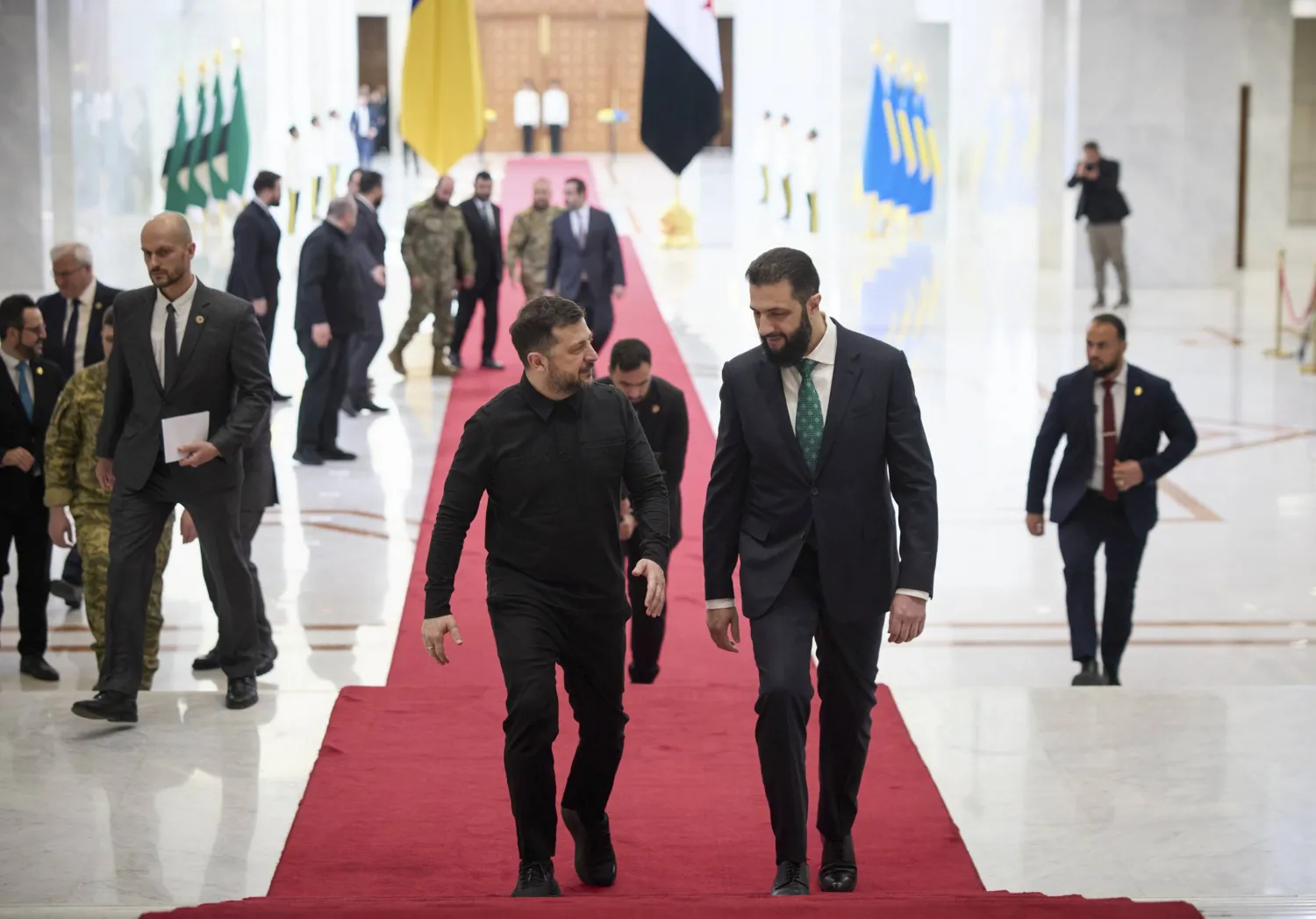

Expert to Asharq Al-Awsat: Zelenskyy Offered Syria Phosphate-for-Wheat, Drones Deal

A handout photo made available by Presidential Press Service shows Ukrainian President Volodymyr Zelenskyy (L) and Syrian President Ahmed al-Sharaa (R) during their meeting in Damascus, Syria, 05 April 2026. (EPA/Presidential Press Service)
TT

Expert to Asharq Al-Awsat: Zelenskyy Offered Syria Phosphate-for-Wheat, Drones Deal

A handout photo made available by Presidential Press Service shows Ukrainian President Volodymyr Zelenskyy (L) and Syrian President Ahmed al-Sharaa (R) during their meeting in Damascus, Syria, 05 April 2026. (EPA/Presidential Press Service)

Ukrainian President Volodymyr Zelenskyy’s first visit to Damascus might have passed as routine, aimed at strengthening ties, but its timing amid regional tensions and Türkiye’s presence gave it added weight.

Analysts saw multiple messages in the trip, including signals to Russia as regional power balances shift. A military expert instead framed it as part of Zelenskyy’s regional push to promote Ukrainian drones, curb sales of stolen Ukrainian grain, and secure Syrian phosphate.

Retired colonel Imad Shahoud told Asharq Al-Awsat that Türkiye is keen to keep relations between Damascus and Kyiv balanced, in line with Ankara’s cautious approach to Syria. Turkish participation, he said, was meant to keep talks on track and avoid politically sensitive positions during the ongoing war.

He placed the visit within Zelenskyy’s broader outreach, which included defense agreements with Qatar, Saudi Arabia, and the United Arab Emirates, as well as security talks in Istanbul.

Shahoud said Ukraine is seeking to market its drones in exchange for French Mirage jets from Gulf states, while also pressing Gulf states for help to prevent Egypt from buying Ukrainian grain that Russia is selling at lower prices.

On Syria, he said Ukraine is offering wheat in exchange for phosphate at a low cost. A Russian company controls about 70 percent of Syria’s phosphate output and sells it to Europe.

He added that Western countries want to pull Syria away from Russia, but Damascus is maintaining a balanced relationship based on accepting “current realities”.

Many agreements remain in place and are under review, especially oil and gas deals granted to Russian firms as wartime compensation. Any misstep could affect those talks.

Abdulwahhab Assi, head of studies at Jusoor Center, said Syria is seeking to use current regional conditions to build a deterrence system. Israel has repeatedly opposed Turkish plans to deploy air defenses in southern and central Syria and has also objected to potential US provision of Patriot systems.

Assi told Asharq Al-Awsat that Syria’s options are limited between Ukraine and Russia. Kyiv offers lighter technologies that may avoid political and military complications with Syria or Israel, while Moscow appears weaker but remains in play.

He said Damascus needs leverage in talks with Russia over rebuilding military assets damaged during the war, particularly after Israel’s Operation Arrow of Bashan in December 2024.

Talks with Moscow have yet to deliver what Syria hopes for, he said, making engagement with Ukraine a potential pressure tool.

Still, he stressed Ukraine is not a strategic alternative to Russia, but a technical partner that could help reduce threats from Iranian missiles and drones, and assist in repairing military equipment through its officers and advisers.

Assi said Russia is likely to factor this into ongoing negotiations, as Syria, with Turkish backing, has secured a technical alternative that could strengthen its political position.

Abdulhamid Tawfiq, head of the Renaissance Center for Research and Studies, said the growing Ukrainian presence in Syria following Russia’s declining role was central to Zelenskyy’s visit.

The trip reflects wider regional and international shifts, with Ukraine now at the forefront of confrontation with Russia alongside NATO, the United States, and the West, which views Syria as strategically important, Tawfiq told Asharq Al-Awsat.

He said Ukraine’s emergence in Syria sends a direct message to Russia that new balances can be shaped in the country and the region.

Syria, he added, could turn to Ukraine for support across sectors, including the economy, agriculture, and civilian and military industry, helping drive development.



Is Hamas Counting on Iran Talks to Resolve the Disarmament Crisis?

Palestinians inspect damage after an Israeli strike in Gaza City on Monday (Reuters)
TT

Is Hamas Counting on Iran Talks to Resolve the Disarmament Crisis?

Palestinians inspect damage after an Israeli strike in Gaza City on Monday (Reuters)

As Iranian officials link any halt in fighting with the US and Israel to all fronts of the so-called “axis of resistance,” with a focus on Hezbollah in Lebanon, Hamas and other Palestinian factions in Gaza are negotiating a disarmament plan while pushing to retain part of their arsenal.

Israel and the United States insist on full disarmament. The al-Qassam Brigades, Hamas’s armed wing, reject that demand.

A two-week ceasefire announced by Washington and Tehran, meant to pave the way for a final deal, has raised questions over whether Hamas will use it to delay or reshape disarmament.

Field sources in Hamas and other factions say they fear Israel could escalate again in Gaza, increasing targeted killings and possibly striking new targets, whether the war with Iran ends temporarily or permanently.

Two field sources from Hamas and Palestinian Islamic Jihad said there are signs of Israeli escalation, but without large-scale ground operations, adding that factions are on heightened alert.

Limited reliance

A senior Hamas official said the group’s stance is rooted in “national constants,” including keeping its weapons to deter any aggression, a duty it cannot abandon.

He described Iran’s call to link all fronts as “important,” but said Hamas does not fully rely on it and sees no such option for now. Israel and the United States, he said, have worked for more than two years to separate the fronts.

Three Hamas sources said the group had previously counted on linking fronts, during talks on Lebanon and Yemen and during the 12-day war on Iran in June 2025, but “circumstances imposed a different reality.”

A Hamas source in Gaza said tying Gaza talks to other fronts had failed before, leaving no clear reliance on that approach now.

He added Iran’s position may relate more to Lebanon than Gaza, stressing that relying on it is misplaced, as Israel and the US would reject it, as they have before.

“What Hamas is relying on now is its own position, alongside the Palestinian factions, as it enters the most difficult phase of negotiations,” he said.

Two Hamas sources said the group’s strategy is to remove any pretext for Israel to resume the war, while rejecting proposals from the “Board of Peace” or mediators as fixed terms without amendments.

Core demands

Hamas and other factions said they had told mediators in a unified position that they want “full Israeli commitment” to the first phase before moving to the second, including the issue of weapons.

They also demand that reconstruction and aid not be tied to other files, a full Israeli withdrawal, a complete halt to violations, guarantees against interference in Palestinian political affairs, particularly governance in Gaza, and an end to restrictions on movement through the Rafah crossing and on the entry of goods.

New meetings between Hamas and mediators are expected early next week as disarmament talks continue.

A senior Hamas delegation met in Cairo about a week ago with Nickolay Mladenov, the high representative for Gaza at the “Board of Peace,” for the second time in two weeks.

The group’s leadership also met Turkish President Recep Tayyip Erdogan earlier this week on the same issue.


Lebanon Rejects Iran Negotiating on Its Behalf

People gather at the scene of an Israeli airstrike in the Corniche al-Mazraa neighborhood of Beirut, Lebanon 08 April 2026. (EPA)
TT

Lebanon Rejects Iran Negotiating on Its Behalf

People gather at the scene of an Israeli airstrike in the Corniche al-Mazraa neighborhood of Beirut, Lebanon 08 April 2026. (EPA)

Lebanon was left outside contacts that produced a US-Iran ceasefire deal, despite reports it would be included and moves by Iran and Hezbollah suggesting otherwise.

Hezbollah halted its military operations before the deal was announced early on Wednesday, while Lebanese officials scrambled to contact countries involved in the issue to clarify the situation.

Prime Minister Nawaf Salam told Asharq Al-Awsat that Lebanon would not accept anyone negotiating on its behalf.

President Joseph Aoun welcomed the US-Iran announcement of a 15-day ceasefire and praised efforts by all parties that helped secure the agreement, particularly Pakistan, Egypt, and Türkiye.

He said he hoped it would mark a first step toward a final, comprehensive deal that addresses the drivers of conflict in the region, safeguarding the sovereignty of all states.

Aoun said violence was not an effective means to resolve disputes and that governments should work to ensure a free and dignified life for their people, not push them toward futile and needless death.

He added that the Lebanese state would continue efforts to ensure any regional calm extends to Lebanon on a firm and lasting basis.

Aoun affirmed that the efforts are in line with principles agreed upon by the Lebanese: full sovereignty over all territory, liberation from any occupation, and the exclusive right to wage war, maintain peace, and use legitimate force, resting with constitutional institutions alone.

Responsibility for any negotiations to secure Lebanon’s national interest lies solely with the Lebanese state, he said.

Berri: Lebanon included

Parliament Speaker Nabih Berri told Asharq Al-Awsat that Lebanon was covered by the ceasefire agreement with Iran, but said Israel had not complied with it across Lebanon so far, in breach of the deal.

Berri said the agreement clearly included Lebanon and that this was what should be implemented. He said he had contacted the Pakistani side to inform it of Tel Aviv’s failure to abide by the ceasefire and asked it to engage the United States to pressure Israel.

He said he remained in contact with several parties involved and had received assurances that Lebanon was part of the agreement, though he did not rule out that Israel could seek to “undermine this agreement as the party most harmed by it.”

Salam: The state alone negotiates

In his first comment on the ceasefire and the debate over whether Lebanon was included, Salam said: “No one negotiates over Lebanon except the Lebanese state.”

He declined to elaborate on ongoing contacts to secure a ceasefire in Lebanon, saying only that the state was carrying out its duties and mobilizing all its capabilities to pull the country out of a crisis imposed on it.

“With the announcement of an agreement between the US and Iran, through appreciated Pakistani efforts, we are intensifying our contacts and our political and diplomatic efforts to secure a ceasefire in Lebanon,” said Salam.

“I also stress that no one negotiates in the name of Lebanon except the Lebanese state, through its constitutional institutions, in a way that safeguards its sovereignty and the interests of its people,” he added.

Foreign Ministry: One voice

For its part, Lebanon’s Foreign Ministry welcomed the announcement of the two-week ceasefire between Iran and the US as a step toward de-escalation and regional stability, but stressed that no party has the right to negotiate on the country’s behalf.

“Lebanon unequivocally affirms that it speaks with one voice — its own — and that no party has the right to negotiate on its behalf except the Lebanese state,” the ministry said in a statement.

“Any such action constitutes a direct violation of its sovereignty and national decision-making,” it added, noting that Lebanon has previously announced its readiness for direct negotiations with Israel, with civilian participation and under international auspices.

The ministry reiterated that Lebanon’s sovereignty is indivisible and not negotiable, and that its national choices, security, and political future are determined exclusively by its constitutional institutions, free from any external interference.


Iran Guards Threaten Response if Israel Does Not Cease Lebanon ‘Aggression’

 First responders work at the site of an Israeli airstrike that struck an apartment building in Beirut, Lebanon, Wednesday, April 8, 2026. (AP)
First responders work at the site of an Israeli airstrike that struck an apartment building in Beirut, Lebanon, Wednesday, April 8, 2026. (AP)
TT

Iran Guards Threaten Response if Israel Does Not Cease Lebanon ‘Aggression’

 First responders work at the site of an Israeli airstrike that struck an apartment building in Beirut, Lebanon, Wednesday, April 8, 2026. (AP)
First responders work at the site of an Israeli airstrike that struck an apartment building in Beirut, Lebanon, Wednesday, April 8, 2026. (AP)

Iran's Revolutionary Guards warned on Wednesday they would respond if Israel did not cease attacks on Lebanon as deadly strikes killed hundreds of people a day after a ceasefire was agreed between the United States and Iran.

"We issue a firm warning to the United States, which violates treaties, and to its Zionist ally, its executioner: if the aggression against beloved Lebanon does not cease immediately, we will fulfil our duty and deliver a response," the Guards said in a statement carried on state TV, using a reference to Israel.

Israel says the US-Iran truce does not include Lebanon, which was drawn into the war after Iran-backed group Hezbollah launched attacks on Israel.

Israeli strikes hit several dense commercial and residential areas in central Beirut without warning on Wednesday afternoon, hours after the ceasefire was announced. Lebanon’s health ministry said at least 250 people were killed and 700 were wounded.

US President Donald Trump told PBS News Hour that Lebanon was not included in the deal because of Hezbollah. When asked about Israel’s latest strikes, he said, "That’s a separate skirmish."