


Artemis Crew's Families Enthralled by Messages from Space

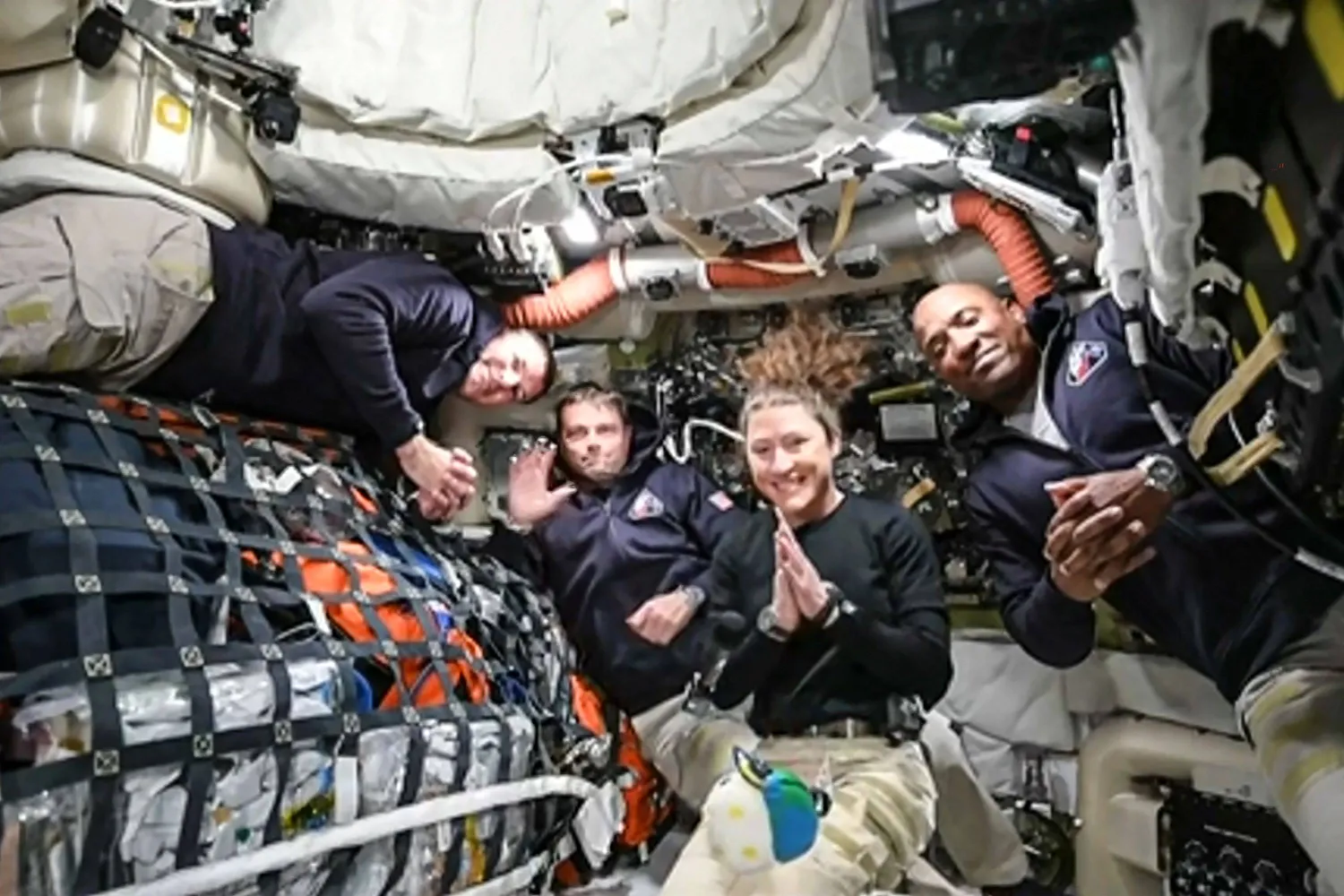
TOPSHOT - This screen grab from NASA's feed released on April 3, 2026, shows the four Artemis II crew members (L-R) Canadian Space Agency (CSA) astronaut Jeremy Hansen, Artemis II mission specialist, NASA astronauts Reid Wiseman, Artemis II commander, Christina Koch, Artemis II mission specialist and Victor Glover, Artemis II pilot as they head to orbit the Moon for the first time in more than half a century. The spacecraft lifted off from Kennedy Space Center in Florida at 18:35 EDT the previous day. (Photo by Handout / NASA TV / AFP)
TT

Artemis Crew's Families Enthralled by Messages from Space

TOPSHOT - This screen grab from NASA's feed released on April 3, 2026, shows the four Artemis II crew members (L-R) Canadian Space Agency (CSA) astronaut Jeremy Hansen, Artemis II mission specialist, NASA astronauts Reid Wiseman, Artemis II commander, Christina Koch, Artemis II mission specialist and Victor Glover, Artemis II pilot as they head to orbit the Moon for the first time in more than half a century. The spacecraft lifted off from Kennedy Space Center in Florida at 18:35 EDT the previous day. (Photo by Handout / NASA TV / AFP)

A week after astronaut Jeremy Hansen blasted off on the historic Artemis II mission to the Moon, his wife Catherine recalled the anxiety and thrill of witnessing the journey from afar.

The Canadian obstetrician-gynecologist told AFP that she has closely followed the mission carrying her husband among a crew of four, hanging onto every update during family phone calls and from NASA mission control.

"It's incredible to me to know that they were up close," said Catherine, wearing rocket-shaped earrings during a video call.

Lifting off from Florida, Hansen became the first non-American to journey toward the Moon as the crew reached a record-breaking distance of 250,000 miles (400,000 kilometers) from Earth.

Catherine and her children followed the lunar flyby from NASA mission control in Houston on Monday, and later heard Hansen share his observations in a family call.

"Jeremy was describing... the fact that it looks so three-dimensional, like this globe outside the window," recalled his wife.

"He certainly will continue to describe to us and everyone else what it felt like to be that close to that celestial body."

- 'Emotional' -

Catherine said, before liftoff, her husband gave her a pair of powerful binoculars to follow the space voyage.

"Our family would lie down and look at various places on the Moon that he would identify based on his mapping and his study guides," she said.

Some of those sites were later observed up close by the Artemis II crew.

As the astronauts flew on the far side of the Moon, they lost connection with Earth for some 40 minutes during an expected communications blackout.

That was the moment Catherine got especially anxious. "I wanted to be there for that, because as someone who has never flown in space, I wanted to make sure they actually reacquired signal."

As onlookers held their breath, she was surprised by the "energy in mission control."

"There was no stress or anxiety. Everyone just trusted that this is what's going to happen: they're going to lose signal and come back again," she said.

"It has been a very emotional week."

Catherine and their three children also recorded videos that Jeremy was able to watch near the Moon.

"When you're out in deep space by the Moon, and you are listening to a video they recorded for you before you launch. That's something," the Canadian astronaut told a press conference.

- 'Get him home safely' -

"There's been a lot of happiness and excitement, a lot of joy" but also "some anxiety and some wanting to get him home safely," Catherine said.

She is now preparing for the moment when the crew splashes down in the Pacific Ocean, expected for Friday.

The Artemis II, the first mission to carry humans around the Moon in more than 50 years, was considered a risky first spaceflight for Jeremy.

Described by NASA as a "test mission," the flight aimed to verify the reliability of the rocket and Orion capsule, which had not carried humans before.

At the moment of liftoff, Catherine was with her children and the other astronauts' families near the launch pad in Florida.

"It was absolutely incredible. And I think everyone is sort of at a loss for words," she recalled.

"I don't think anyone was quite prepared."


Holy Kaaba to Align with Sun on Thursday in Rare Astronomical Event

During the moment of alignment, shadows cast by vertical objects in Makkah’s surroundings nearly disappear as sunlight falls almost perpendicularly on the surface. (SPA)
TT

Holy Kaaba to Align with Sun on Thursday in Rare Astronomical Event

During the moment of alignment, shadows cast by vertical objects in Makkah’s surroundings nearly disappear as sunlight falls almost perpendicularly on the surface. (SPA)

The skies above Makkah will witness the phenomenon of the sun aligning directly over the holy Kaaba on Thursday, at approximately 12:18 PM local time.

Jeddah Astronomy Society Director Eng. Majed Abu Zahra described the phenomenon as a precise astronomical event that attracts wide interest among those seeking to determine the Qibla direction.

He noted that it provides a direct opportunity to verify geographical and astronomical calculations without complex instruments.

During the moment of alignment, shadows cast by vertical objects in Makkah’s surroundings nearly disappear as sunlight falls almost perpendicularly on the surface, he added.

This phenomenon occurs twice annually as the sun moves between the Tropics of Cancer and Capricorn due to Earth’s axial tilt of approximately 23.44 degrees, allowing it to pass over Makkah’s latitude twice a year, once northward and once southward.


Heat Dome Over Europe Scorches UK, France, Spain

A drone view shows people using kayaks and paddle boards in the River Thames at Teddington Lock, London’s first official river bathing water site, as temperatures climb over the bank holiday weekend due to a heat dome spreading across the region, in London, Britain, May 24, 2026. (Reuters)
TT

Heat Dome Over Europe Scorches UK, France, Spain

A drone view shows people using kayaks and paddle boards in the River Thames at Teddington Lock, London’s first official river bathing water site, as temperatures climb over the bank holiday weekend due to a heat dome spreading across the region, in London, Britain, May 24, 2026. (Reuters)

Temperatures hit record highs for May in the United Kingdom and France on Monday, as forecasters warned of a prolonged period of extreme heat across Europe throughout the week. 

A so-called "heat dome" of warm air from northern Africa trapped under a high-pressure system over western Europe is behind the high temperatures not usually seen until high summer. 

Temperatures in Spain were expected to peak later this week at 38C, while parts of Italy imposed restrictions on working outdoors. 

"The weather here, it's like a mini version of hell. It's boiling. It's like really hot," said 10-year-old Liza Nizari on a visit to London, where temperatures normally average about 17C or 18C at this time of year. 

Lindy Brand-Daloze, a 66-year-old Australian administrator who has been living in in London for 12 years, said: "It's warm, but it's climate change, isn't it? So, you know, (we have) probably got to get used to this." 

The Met Office weather agency said Monday was the hottest May day on record, with the mercury rising to 33.5C at Heathrow, west of the capital, at 1:00 pm (1200 GMT) -- 1.3C more than the previous benchmark recorded in 1922 and 1944. 

"Records are usually only broken by tenths of a degree -- making this heatwave unprecedented for the time of year," the agency said in a social media post. 

Scientists say human-induced climate change is making extreme weather events like heatwaves, droughts and floods more intense, resulting in temperature records being broken more frequently. 

Met Office meteorologist Greg Dewhurst told AFP the increase in extreme temperatures was "a good indication of climate change in action" and more likely to become "the new norm". 

Climate advisers last week warned the UK government that the country was "built for a climate that no longer exists" and urged it to adapt infrastructure like schools and hospitals for a warming planet. 

In 2022, temperatures in the UK soared above 40C for the first time since records began. 

- Heatwave alert - 

Across the Channel, weather agency Meteo-France put eight areas in the west of France on heatwave alert -- signifying three days and nights of intense heat that are likely to pose a health risk to the population. 

In the northwestern city of Rennes, 74-year-old Daniele Dupont tried to stick to the shade as she walked her dog in 27C on Monday morning. 

"I'm going to close the shutters. I won't be going out this afternoon," she said in the capital of the Brittany region. 

On Sunday, "record high maximum temperatures for the month of May" were felt in at least 10 locations, including the northwestern seaside towns of Lorient and Noirmoutier. 

The capital, Paris, on Saturday notched up its first temperature above 30C of the year, hitting 31.9C. 

Temperatures of up to 35C are expected in Brittany and between 36C and 37C in the south. 

On Sunday, a man died during a 10-kilometer running race in Paris, civil defense services said, while 10 more runners had to be taken to hospital in critical condition after a race in the capital's suburb of Maisons-Alfort, the authorities said. 

In Spain, the State Meteorological Agency (Aemet) warned the "extraordinarily high temperatures for this time of year" will continue across the country all week, except in the Canary Islands, in the Atlantic Ocean, off the northwest coast of Africa. 

"Widespread tropical nights" are also forecast in southwestern Spain from Wednesday, with temperatures peaking from Wednesday to Friday at between 36C and 38C, it wrote on X. 

Farther east, Italy's Lazio region, which includes Rome, on Monday approved rules limiting work in conditions "with prolonged exposure in the sun" between 12:30 pm and 4:00 pm. 

The measures apply, for example, to farms, construction sites and in the logistics sector and apply until September 15. 

Similar rules had been put in place last year but only from May 30. 


How Collecting DNA Samples in the Wild Could Transform Conservation

A golden monkey is seen in Volcanoes National Park in Kinigi, Rwanda, Thursday, March 19, 2026. (AP)
TT

How Collecting DNA Samples in the Wild Could Transform Conservation

A golden monkey is seen in Volcanoes National Park in Kinigi, Rwanda, Thursday, March 19, 2026. (AP)

A guide called out to endangered golden monkeys with grunts and clicks to signal he posed no threat, a familiar sound in the mist-covered forests of Rwanda ’s Volcanoes National Park.

Here in one of Africa's most well-known parks, steep ridges and dense vegetation often obscure even the largest mountain gorillas — also endangered — and scientists are turning to new technology to detect and protect them.

Known as environmental DNA, or eDNA, the technology allows researchers to identify species using genetic material like fur or feces left in soil and water. This reduces the impact of human interaction during wildlife surveys that can leave researchers groping through the mist.

The technology, more often used in marine conservation work, was introduced by the African Wildlife Foundation in partnership with the Rwandan government. It aims to develop a list of all species in the country. That will help protect biodiversity that is threatened by climate change and population growth.

“We selected eDNA as a new technology to bring solutions and to complement existing methods used in ecological monitoring,” said the foundation’s country manager for Rwanda, Patrick Nsabimana.

Biodiversity monitoring for decades has relied on camera traps, which operate when animals trigger their sensors, and ranger observations.

But that is a challenge in rugged terrain such as the Virunga mountains that are central to Volcanoes National Park, which covers part of Rwanda, Uganda and Congo. Insecurity in the border area also can limit ranger movement.

Nsabimana said eDNA is a cost-effective monitoring approach in large ecosystems such as Virunga. Samples are taken from locations like downstream ponds that are likely to have traces of animals on higher ground. Then they are tested.

“With one sample, you can detect multiple species, mammals, birds, amphibians and many others,” said Deogratias Tuyisingize, a Rwanda-based biodiversity researcher with the Dian Fossey Gorilla Fund that is also involved in the project.

He said a combination of traditional methods and new technology is needed to ensure all species are monitored. Because of steep ravines and mountainsides, “we are sure we were missing some species."

Meanwhile, having a better sense of where endangered species are could help in patrolling against poachers, people with the project said.

The ability to generate a broad snapshot of biodiversity is critical for conservation, especially as Rwanda expands some of its national parks by rehabilitating previously agricultural land.

“We can see how species are colonizing these sites over time,” Tuyisingize said.

That allows conservationists to measure success by the return of rare or threatened species, and offers early warnings of invasive species.

But the eDNA technology is not without limitations. It cannot reliably estimate how many animals are present in an ecosystem. DNA can linger long after a species has left.

Being able to process samples in Rwanda is also a challenge, as the project's initial ones had to be sent to Europe for analysis.

Joshua Newton, who conducted research on eDNA for Curtin University’s Trace and Environmental DNA Laboratory, said challenges also include having cold storage to preserve DNA samples and ensuring samples are not contaminated.

Data gaps are another issue. Africa has relatively limited genetic reference libraries, despite decades of conservation work on the continent, making it harder to match DNA samples to known species.

Most genetic reference libraries come from Europe and America, said James Munyawera, a lab specialist with the Dian Fossey Gorilla Fund.

Researchers are now building region-specific databases.

The project in Volcanoes National Park has also begun training residents of local communities, along with rangers, to participate in monitoring efforts by collecting samples.
