


IUCN: Emperor Penguins Listed as Endangered Species

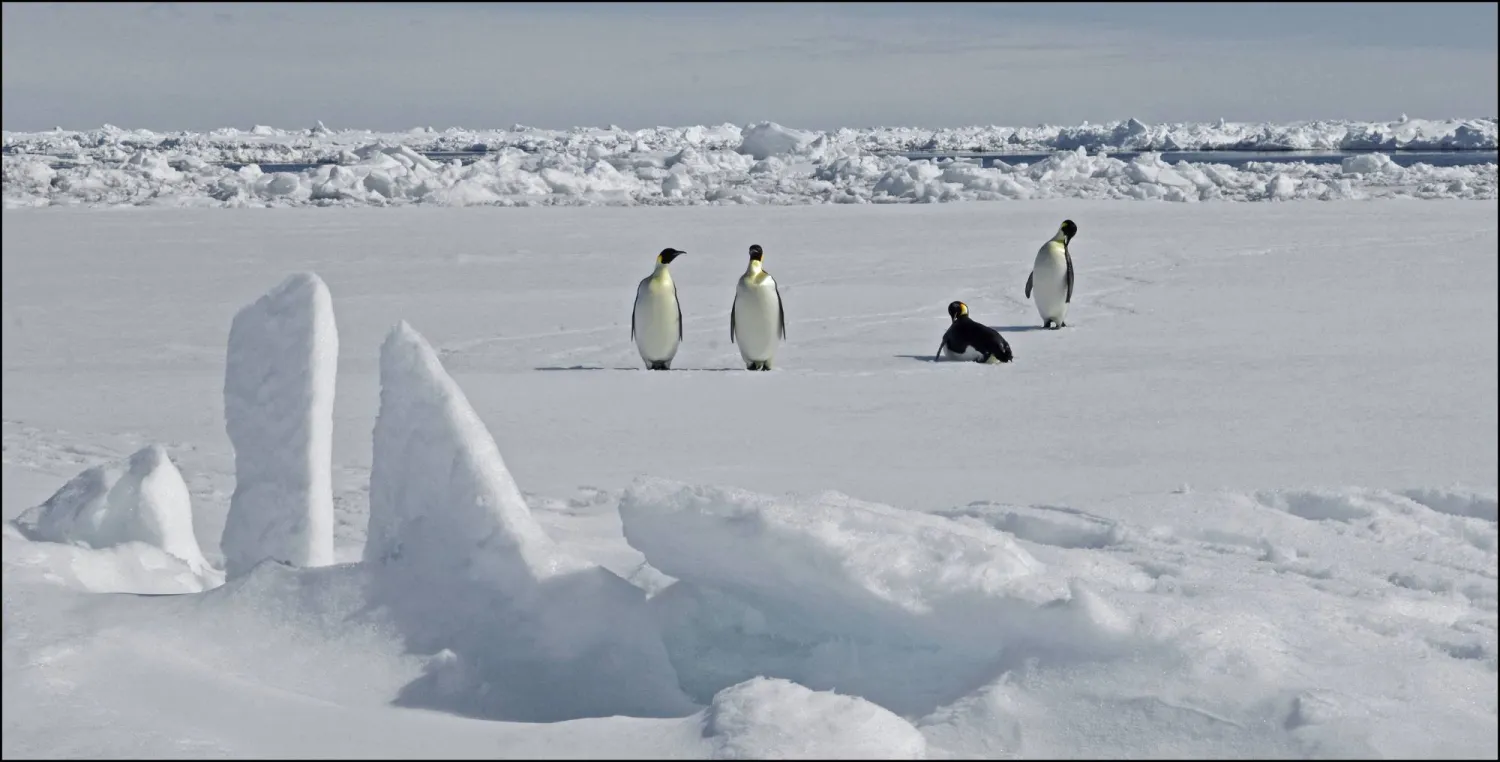
This handout photograph released by The British Antarctic Survey on April 8, 2026, shows Emperor Penguins on Antarctica on November 13, 2010. (Photo by PETER BUCKTROUT / BRITISH ANTARCTIC SURVEY / AFP)
TT

IUCN: Emperor Penguins Listed as Endangered Species

This handout photograph released by The British Antarctic Survey on April 8, 2026, shows Emperor Penguins on Antarctica on November 13, 2010. (Photo by PETER BUCKTROUT / BRITISH ANTARCTIC SURVEY / AFP)

The emperor penguin has been declared an endangered species as climate change pushes the icon of Antarctica a step closer to extinction, the global authority on threatened wildlife announced on Thursday.

Its change of status from "near threatened" to "endangered", made by the International Union for Conservation of Nature (IUCN), underscores the existential threat for ice-dependent species as global warming profoundly reshapes the frozen continent.

Emperor penguins rely on stable sea ice -- essentially platforms of frozen ocean water -- to live, hunt and breed.

Their numbers have plummeted as warming driven by greenhouse gas emissions has caused sea ice to break up earlier in the year.

The IUCN -- a global network of scientists, governments and conservation groups -- said changes in sea ice were expected to halve the emperor penguin population by the 2080s.

They "concluded that human-induced climate change poses the most significant threat to emperor penguins", Philip Trathan, part of the IUCN expert group who worked on the Red List assessment, said in a statement.

The Red List of Threatened Species is maintained by the IUCN and is the global reference on the extinction status of plants, animals and fungi.

There are six classifications from "least concern" to "extinct".

Emperor penguins now rank two steps below "extinction in the wild" -- a species surviving in captivity only, and not in nature.

The Antarctic fur seal -- once hunted to near extinction for their pelts -- was also moved to "endangered", their numbers having dropped more than 50 percent since 1999.

"The ongoing decline is due to climate change, as rising ocean temperatures and shrinking sea ice are pushing krill to greater ocean depths in search of colder water, reducing the availability of food for seals," the IUCN said.

The largest and heaviest of the penguin species, boasting a brilliant golden-orange streak on the neck, emperor penguins have become symbolic of the fight to survive in Antarctica's harsh climes.

They breed on the sea ice in the dead of winter, the males keeping their eggs warm beneath their feet.

The frozen surface also provides a habitat for their chicks during moulting season before they are waterproof.

Antarctic sea ice undergoes huge seasonal changes, expanding during winter and shrinking in summer.

But as global temperatures have reached new highs, sea ice has retreated earlier in the spring and become less stable.

Sea ice has been at record low levels since 2016 and the impact on emperor penguins has been well documented.

Satellite imagery indicates around 20,000 adults -- some 10 percent of the population -- disappeared between 2009 and 2018 alone, the IUCN said.

"This species is closely associated with sea ice and ice packs," Christophe Barbraud, a scientist at French research institute CNRS, told AFP.

"However, since 2016-2017, there has been a significant decrease in the extent of sea ice around Antarctica, and therefore without sea ice, it will have great difficulty surviving."

"The fate of these magnificent birds is in our hands," Rod Downie from conservation group WWF said in a statement.

"With the shocking decline in Antarctic sea ice that we are currently witnessing, these icons on ice may well be heading down the slippery slope towards extinction by the end of this century -- unless we act now."

The IUCN also moved the southern elephant seal from "least concern" to "vulnerable" following sharp population declines caused by a deadly contagious pathogen.


Meet Earth’s Newest Wild Cat Species, the First Named in Over a Century

A Leopardus tilcayo cat, a newly identified species through research led by National Geographic Explorer Paola Nogales Ascarrunz, walks at the Senda Verde animal refuge in the Yungas region, Bolivia, September 1, 2026. (Fernando Faciole/National Geographic/Handout via Reuters)
TT

Meet Earth’s Newest Wild Cat Species, the First Named in Over a Century

A Leopardus tilcayo cat, a newly identified species through research led by National Geographic Explorer Paola Nogales Ascarrunz, walks at the Senda Verde animal refuge in the Yungas region, Bolivia, September 1, 2026. (Fernando Faciole/National Geographic/Handout via Reuters)

A previously unknown cat species has been identified in plain sight: at a wildlife sanctuary in Bolivia, where the small, spotted feline had been living for years.

The discovery, reported Thursday in the journal Current Biology, marks the first time scientists have named and described a new living wild cat species in more than a century.

Bolivian biologist Paola Nogales-Ascarrunz, a National Geographic explorer and one of the study’s lead authors, said a colleague who thought the cat looked unusual invited her to examine it at the sanctuary in the country’s Yungas region, where she volunteered, a couple hours' drive from the administrative capital of La Paz.

A local family had left it there after finding it in the forest and struggling to keep it as a pet. What struck her was its size, she said — smaller than an average house cat, the male, now about 10 years old, measures 18 inches (46 centimeters) from its head to the base of its tail and weighs just 3 pounds (1.4 kilograms). Its light brown coat is patterned with dark, leopardlike spots.

“Knowing other wild cats, it was peculiar,” she said. “He really is tiny.”

To locate the cat in South America’s feline family tree, researchers compared genomes — complete sets of genetic instructions — from over 30 cats across locations including Colombia, Peru and Brazil. Bones and skins preserved in US and European museums supplied DNA to fill the gaps where fresh samples were unavailable.

The analysis revealed that the sanctuary cat belonged to a previously unrecognized species whose lineage split from its relatives about 1.4 million years ago. The last feline species formally identified was the Uruguayan pampas cat in 1923.

“During naturalist expeditions in the 17th, 18th and 19th centuries, this cat was never collected and the species was never properly described,” Nogales-Ascarrunz said.

While some species are named after scientists or explorers, the researchers named this one Leopardus tilcayo, preserving the moniker used by communities in the tropical cloud forests of the Andes Mountains in Bolivia where the animal lives.

“This isn’t an animal that nobody had ever seen before. Local communities knew it existed, but until now science had not recognized it as a separate species,” said Wai-Ming Wong, an expert with the global wild cat conservation group Panthera, in an email. Wong had no role in the new research.

The findings helped unravel a longstanding mystery about South America’s tiger cats, which scientists once classified as a single species because they look so much alike. The researchers' DNA analysis pointed to at least five distinct species — four previously named, plus the newly described tilcayo.

“Even in groups that are very well studied, like the cat family, apparently there’s still a diversity that is hidden,” said evolutionary biologist and study co-author Jonas Lescroart with the University of Antwerp.

The next challenge is finding out more about these tiny cats in the wild.

“We still don’t know how many there are,” Nogales-Ascarrunz said, adding that researchers still need to establish details about the new tiger cat's diet, behavior and habitat. Its presence has been confirmed only in Bolivia’s Yungas forests, but its full range remains unknown.

Scientists hope the designation of the new species will help protect its forest habitat, which faces threats from accelerating deforestation and gold mining.

“We should make haste in doing these kinds of discoveries, because all of this biodiversity is under pressure, and it’s disappearing as we speak,” Lescroart said.


Horse Race Returns to Palestinian Village After Wartime Halt

A Palestinian jockey rides during a local horse race in al-Majd, west of the Israeli-occupied West Bank city of Hebron on September 18, 2026. (AFP)
TT

Horse Race Returns to Palestinian Village After Wartime Halt

A Palestinian jockey rides during a local horse race in al-Majd, west of the Israeli-occupied West Bank city of Hebron on September 18, 2026. (AFP)

The thunder of hooves and clouds of dust returned to the hills west of Hebron as Palestinians raced Arabian horses through the village of Al-Majd to the cheers of residents.

The annual race in the Israeli-occupied West Bank had been suspended for the past two years in the wake of the Gaza war, but the tradition returned this week, despite ongoing tension.

"Our ambitions are constrained by a lack of financial and logistical resources needed to support the riders, so we simply try to provide whatever we can," said event coordinator Ismael Abu Awad.

After the starting gun was fired, the riders set off along the winding dirt track cutting through the rocky landscape, while spectators cheered the course and on rooftops.

The competition culminated in jubilant celebrations, with supporters surrounding the winning jockey and lifting trophies above the crowd.

Arabian horses occupy a special place in Palestinian culture, and horse races and equestrian beauty championships are held across the West Bank, drawing competitors from different towns and villages.

Open land has become becomes increasingly scarce amid expanding Israeli settlement construction in the West Bank, occupied since 1967.

But horse culture still draws Palestinians together, from urban neighborhoods to rural villages.

For the local community, Friday's race was more than just about sports. It was aimed at "preserving a form of Arab heritage that our ancestors cherished and that we continue to uphold today," Abu Awad told AFP.

The event also provided an opportunity for local jockeys who cannot easily participate in international races to showcase their skills, the organizer said.

"Some horses and riders face difficulties travelling to Jordan or abroad," he said.

Despite the challenges, participants spoke of dreams that stretch beyond the local track.

"My ambition is to travel to Italy to ride horses," said racer Mohammed Al-Ajlouni. "We ride here now, but for the future, that is what I hope for."


Princess Diana's Famous 'Revenge Dress' Goes on Show Ahead of Sotheby's Auction

A Sotheby’s employee adjusts Princess Diana's "Revenge Dress" by Greek designer Christina Stambolian in London, Britain, September 18, 2026. REUTERS/Toby Melville
TT

Princess Diana's Famous 'Revenge Dress' Goes on Show Ahead of Sotheby's Auction

A Sotheby’s employee adjusts Princess Diana's "Revenge Dress" by Greek designer Christina Stambolian in London, Britain, September 18, 2026. REUTERS/Toby Melville

Revenge has rarely been so stylish.

A striking black dress worn by the late Princess Diana on the day her estranged husband publicly admitted adultery is going up for auction at Sotheby’s, with a presale estimate of up to $300,000.

First, the “revenge dress,” as it has become known, is going on an international tour, testament to the enduring global fascination with Diana almost 30 years after her death.

The garment, which went on public display Friday at Sotheby’s in London, was worn by Diana on June 29, 1994, the broadcast date of an interview in which the then-Prince Charles acknowledged infidelity.

Diana, who knew the revelation was coming, chose to wear the figure-hugging, off-the-shoulder silk dress by Greek designer Christina Stambolian for a gala at London’s Serpentine Gallery.

A Sotheby’s employee adjusts Princess Diana's "Revenge Dress" by Greek designer Christina Stambolian during a media preview, as it is displayed publicly for the first time in nearly 30 years ahead of its sale during Sotheby's Luxury Week, in London, Britain, September 18, 2026. REUTERS/Toby Melville

Morgane Halimi, Sotheby’s global head of handbags and fashion, said Diana chose the “beautiful and powerful outfit” as a way to seize control of her own story.

“She always used fashion as a way of expression, but this time (it) was a way to communicate her personal expression of herself,” Halimi said. “The way she felt on that day is that, ‘I’m taking back the story and I’m here and I stand for myself.’”

Images of Diana in the dress, accessorized with a sapphire necklace, black pumps and bright red nail polish, shot around the world. The Sun tabloid proclaimed on its front page the next day: “Revenge is chic.”

The following year Diana gave an interview in which she acknowledged her own extramarital affair, and famously said “there were three of us in this marriage,” in reference to Charles’ paramour Camilla Parker-Bowles, now Queen Camilla. Charles and Diana divorced in 1996, a year before Diana was killed in a car crash in Paris at the age of 36.

The dress remained so famous that a life-size waxwork replica of Diana wearing it was unveiled at a Paris museum last year.

The dress is being auctioned for the first time since 1997, when Diana sold it and other garments to raise money for AIDS charities. It has a presale estimate of $150,000 to $300,000, but Sotheby’s experts would not be surprised if it far exceeds that price.

A red sweater adorned with sheep that Diana wore to a polo match in 1981 sold in 2023 for $1.1 million, many times its presale estimate and a record for an item owned by the late royal.
“I personally believe that this dress is the most powerful item linked to Diana,” Halimi said.

“The Diana provenance always attracts collectors,” she added. “But the story of this dress and the universal message that it brings will definitely attract also institutions as well as private collectors who are looking for unique pieces and one-of-a kind items.”

In her lifetime, Diana was a style icon and one of the world’s most photographed women. Her star power has not dimmed, and neither has the fascination with the dramatic disintegration of her marriage to the now King Charles III. A new book by Diana’s brother Charles Spencer has seized headlines again and reignited a public feud between the Spencers and the royal family over the treatment of the princess.

The revenge dress is on show in London until Sept. 24 and travels to Hong Kong and Geneva ahead of its sale in New York on Dec. 9.
