

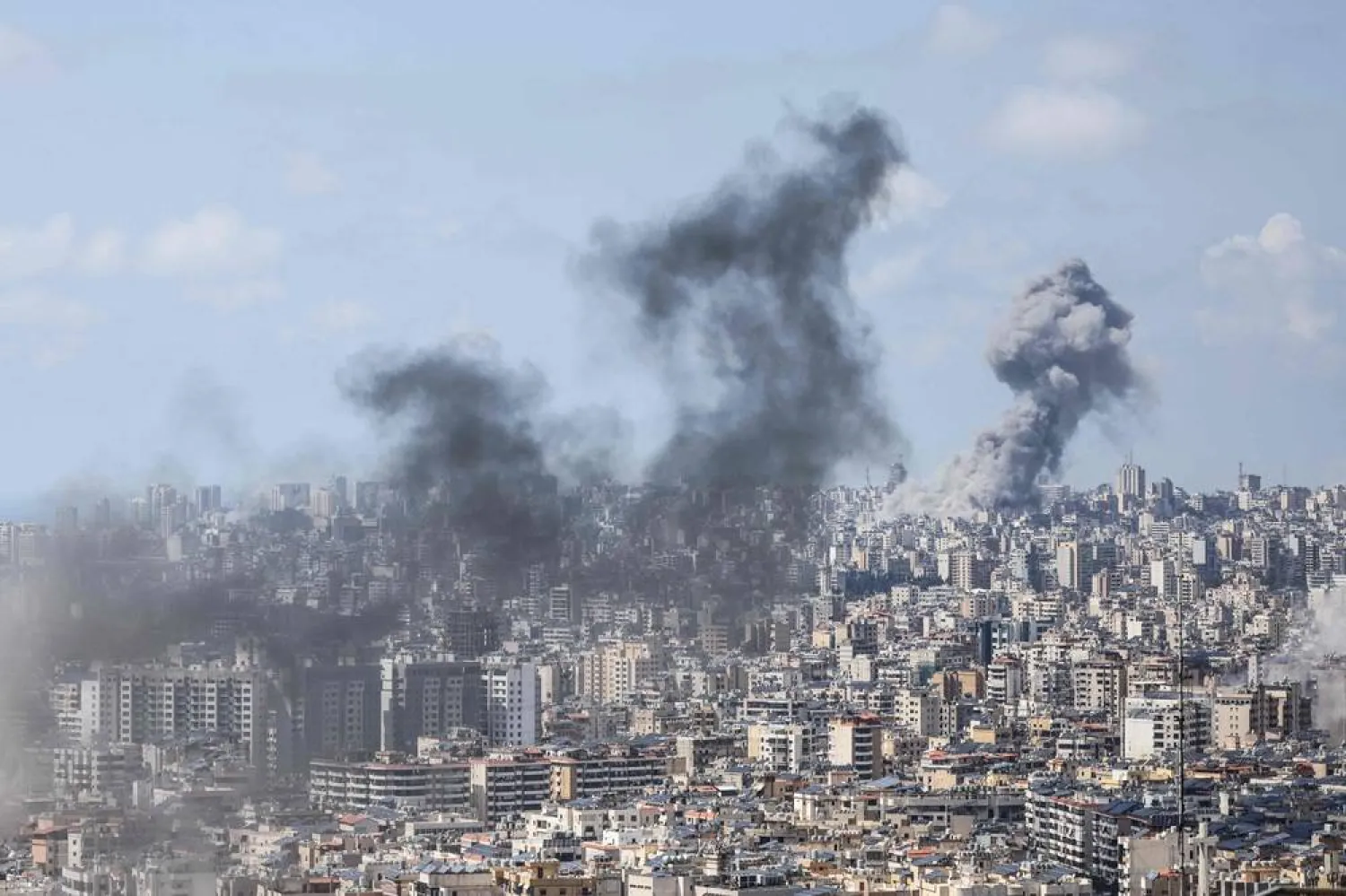

UN Demands Accountability for Violations of Rules of War in Middle East

Smoke rises from the sites of Israeli airstrikes in Beirut and its southern suburbs on April 8, 2026. (AFP)
TT

UN Demands Accountability for Violations of Rules of War in Middle East

Smoke rises from the sites of Israeli airstrikes in Beirut and its southern suburbs on April 8, 2026. (AFP)

UN agency chiefs on Saturday demanded an end to impunity for widespread international law violations in the Middle East, as casualties pile up six weeks into the war unleashed by US-Israeli strikes on Iran.

In a joint statement, the heads of multiple United Nations agencies said they were "alarmed by the sustained violations of the rules of war and international humanitarian law" in the region.

"Even wars have rules, and these rules must be respected," the statement from the UN Inter-Agency Standing Committee said.

The joint statement -- penned by UN humanitarian chief Tom Fletcher along with the heads of the UN agencies for human rights, health, food, refugees and children among others -- decried the soaring toll since the Middle East war erupted on February 28.

"In just the last month across the Middle East, thousands of civilians have been killed and injured. Hundreds of thousands have been displaced, many multiple times," it said.

"The numbers continue to rise and essential services are increasingly difficult to access.

"Health workers, hospitals and ambulances have been targeted. Schools have been struck. Civilian infrastructure - including bridges, residential buildings, houses, water facilities and power plants - has been destroyed," it said.

The agency chiefs voiced particular concern about the impact on "women and children and others with specific needs", as well as on global supply chains, "with food and fuel prices on the rise."

At the same time, they highlighted that "our humanitarian colleagues have been caught up in hostilities."

Just since the beginning of this year, they said, "14 aid workers have been killed or injured in the Occupied Palestinian Territory, eight in Iran and five in Lebanon."

"This is an alarming toll."

The agency chiefs said they "strongly condemn all attacks on civilians, including humanitarian and health workers, as well as civilian objects."

"We demand that all parties - whether Member States of the United Nations or armed groups - respect their legal obligation to protect civilians, including humanitarian personnel, and civilian infrastructure," they said.

"All violations must be met with accountability."


Separatists in Canada Oil Province Seek Independence Referendum

Oil pumpjacks operating in a farmer’s field near Calgary, Alberta, Canada, November 26, 2025. (Reuters)
TT

Separatists in Canada Oil Province Seek Independence Referendum

Oil pumpjacks operating in a farmer’s field near Calgary, Alberta, Canada, November 26, 2025. (Reuters)

Separatists in Alberta are preparing to submit a petition on Monday that they say has enough signatures to force a referendum on independence for the oil-rich Canadian province.

Polls indicate the pro-independence camp remains a minority among Alberta's five million people, but has hit a historic high of roughly 30 percent.

Alberta separatists are also closer than ever to forcing a referendum, riding momentum fueled by intensifying grievances over Ottawa's control of the provincial oil industry.

They have also undeniably gotten a boost from the return to power of US President Donald Trump.

After launching a petition in January, Stay Free Alberta, the group coordinating the independence push, had until the beginning of May to collect 178,000 signatures to force a referendum.

The group's leader, Mitch Sylvestre, expressed confidence the group will succeed.

"We will have the required signatures to trigger the referendum with a comfortable buffer," Sylvestre told AFP Thursday.

The separatists plan to present their list to provincial officials in the capital Edmonton on Monday.

- 'Permanent change' -

Alberta's First Nations have filed a court challenge, arguing independence would violate their treaty rights, a case that could render a referendum illegal.

But even if the vote never happens, or the separatists ultimately lose, many believe the process has left Canada permanently changed.

Michael Wagner is an independent historian and long-standing supporter of Albertan independence.

"Even if we lose the referendum, (this) is not going to just disappear," he told AFP. "I think this is going to be a permanent change in our political culture."

Jason Kenney, a conservative federalist former Alberta premier, agreed.

If the independence camp gets 20-35 percent support in a referendum, "it will turn the separatist movement from a marginal fringe into a real factor in our politics that will be disruptive for a long time to come," he told an event last month.

- 'Tipping point' -

Alberta joined the Canadian confederation in 1905 and resentments towards eastern political leaders in Ontario and Quebec fueled marginal separatist movements at various points over the last century.

But Wagner said separatism gathered real pace in protest against former prime minister Pierre Trudeau's 1980 National Energy Program, which broadened Ottawa's control over the oil industry.

The program included price controls for domestic oil sales and new taxes giving Ottawa more revenue from Alberta's oil.

Trudeau's government argued the measures protected Canadians following the global oil price shocks of the 1970s.

Wagner said the program was considered an attack in Alberta and called it a "game-changer" which entrenched the idea of independence.

Fast-forward 35 years, Trudeau's son Justin is elected prime minister with a climate-conscious agenda reviled by many in Alberta.

Through Trudeau's decade in power, Albertans accused his Liberal government of demonizing oil production and stifling investments in the sector, especially for pipeline capacity.

Mark Carney's 2025 election was "a tipping point", Wagner said.

Conservative leader Pierre Poilievre had a huge polling lead in early 2025.

"It was fully expected he would be our hero. He would rescue us from the Liberal government. When the polls started turning for Carney, and then Carney actually won, the disappointment here was so dramatic," Wagner said.

- 51st state? -

Trump has discussed annexing Canada and weakening it economically, but the US role in Alberta's current separatist effort is disputed.

Treasury Secretary Scott Bessent drew attention in January when he said the US and Alberta were "natural partners."

Some secessionists insist Alberta's future lies in union with Washington.

But Sylvestre's legal advisor Jeffrey Rath, who says he has met several times with top State Department officials on future Alberta-US ties, rejects statehood.

"The people in our movement are not interested in freeing themselves from the clutches of the federal government... just to put ourselves under yet another government 3,500 miles away," he told the right-wing True North media outlet.

But, he argued, Trump's support will be crucial to stabilizing Alberta as it breaks away from Canada.

For Wagner, "51st state people have always been a very small minority."

"Most Alberta independence supporters are actually patriotic Canadians who have just been frustrated."


Trump Expands US Sanctions on Cuban Government and Affiliates

People march while holding a giant Cuban national flag during a May Day rally in Havana, Cuba, May 1, 2026. (Reuters)
TT

Trump Expands US Sanctions on Cuban Government and Affiliates

People march while holding a giant Cuban national flag during a May Day rally in Havana, Cuba, May 1, 2026. (Reuters)

US President Donald Trump signed an executive order on Friday broadening US sanctions against the Cuban government, two White House officials told Reuters, as he seeks to put more pressure on Havana after ousting Venezuela's leader.

The fresh sanctions target people, entities and affiliates that support the Cuban government's security apparatus or are complicit in corruption or serious human rights violations, as well as agents, officials or supporters of the government, the officials said.

It was not immediately clear who exactly had been hit with sanctions under the order, which was first reported by Reuters.

But a copy of the order released by the White House said the sanctions could apply to "any ‌foreign person" operating ‌in the "energy, defense and related materiel, metals and mining, financial services, ‌or ⁠security sector of ⁠the Cuban economy, or any other sector of the Cuban economy."

The order authorizes secondary sanctions for conducting or facilitating transactions with those targeted under the order, the officials said.

Cuban President Miguel Diaz-Canel said the new "coercive" measures reinforce the US's "brutal, genocidal" blockade against the island.

"The blockade and its reinforcement cause so much harm because of the intimidating and arrogant behavior of the world's greatest military power," Diaz-Canel wrote on social media.

Cuba's foreign minister, Bruno Rodriguez, said the sanctions measures, which were announced as the island held its traditional May Day celebrations, ⁠aim to impose "collective punishment on the Cuban people" and that Cubans would not ‌be intimidated.

RATCHETING UP PRESSURE ON CUBAN GOVERNMENT

Jeremy Paner, a former ‌sanctions investigator at the US Treasury's Office of Foreign Assets Control, said the move was the most significant one ‌for non-American companies since the US embargo against Cuba began decades ago.

"Oil and gas, mining companies, ‌and banks that have carefully segregated their Cuba operations from the United States are no longer protected," said Paner, who is now a partner at Hughes Hubbard & Reed, a law firm.

The new sanctions are the latest broadside by the Trump administration against Cuba, which the president has repeatedly declared is near a state of collapse.

Under Trump, ‌US forces have launched strikes on boats allegedly carrying drugs off Venezuela and gone into Caracas to seize President Nicolas Maduro. Trump has said, without providing ⁠specifics, that "Cuba is ⁠next."

The officials said Trump's order contained an implicit warning to Cuba, accusing the Havana government of aligning itself with Iran and armed groups like Hezbollah.

"Cuba provides a permissive environment for hostile foreign intelligence, military, and terrorist operations less than 100 miles from the American homeland," one official said.

The US has long demanded Cuba open its state-run economy, pay reparations for properties expropriated by the government of former leader Fidel Castro and hold "free and fair" elections. Cuba has said its form of socialist government is not up for negotiation.

The US heaped additional sanctions and pressure on the island early this year, when it halted Venezuelan oil exports to Cuba after ousting Maduro on January 3. Trump later threatened to slap punishing tariffs on any other country that sent crude to Cuba, prompting Mexico, another top supplier, to stop shipments to the island.

The fuel shortage in Cuba has contributed to major national-level blackouts and prompted many foreign airlines to suspend flights to the island.


Mali Accuses Military Officers of Working with Extremists to Carry Out Attacks Against Govt

Commuters drive through the streets of Bamako, Mali, 27 April 2026. (EPA)
TT

Mali Accuses Military Officers of Working with Extremists to Carry Out Attacks Against Govt

Commuters drive through the streets of Bamako, Mali, 27 April 2026. (EPA)

Some military officers in Mali worked with extremists and separatists who recently launched their biggest round of attacks in over a decade in the conflict-battered country, authorities said late Friday.

The separatist fighters, meanwhile, said earlier in the day that they captured a strategic military camp in the northern town of Tessalit after the withdrawal of Mali's army and its Russian allies from there.

The claim by the Azawad Liberation Front separatist group was the latest setback for Mali’s ruling junta, which lost control of the major city of Kidal earlier in the week as part of the attacks that killed Malian Defense Minister Sadio Camara.

Mali has been run by the military since a 2020 coup and has long suffered violence as extremists groups expand in surrounding territories in the wider Sahel region south of the Sahara Desert, which is known as global hotspot for violent extremism.

The latest assault in the West African nation began Saturday after al-Qaeda-backed JNIM and the Azawad Liberation Front, or FLA, partnered to target the main international airport in the capital, Bamako, as well as other Malian towns and cities in near-simultaneous attacks, with the fighters riding on motorcycles and trucks.

A statement from the public prosecutor at the Military Court of Bamako, which was read on state television on Friday, noted that investigations found “solid evidence regarding the complicity of certain military personnel” in the attacks, including serving and recently dismissed officers.

The officers participated in “the planning, coordination, and execution” of the attacks, the prosecutor's statement said, while also alleging the involvement of politicians, including Oumar Mariko, a prominent Malian politician in exile.

Malian army withdraws from key town

Before the arrival of the FLA fighters Friday, the Malian army and members of Russia’s Africa Corp reportedly pulled out of the Tessalit military camp, which is strategically located near an airport and the border with Algeria.

Achafghi Ag Bouhanda, a top FLA commander, announced the capture of Tessalit in an online video verified by The Associated Press.

The AP could not independently confirm the situation at the camp. Malian authorities did not immediately respond to requests for comment.

At least 10 locations have been attacked by the militants since the latest assault began, forcing Malian and Russian forces to withdraw from the key northern city of Kidal, which was once a stronghold of the separatists.

The junta has vowed to continue its aerial and ground offensive against the militants.

“Military operations will continue until the armed groups involved have been completely neutralized and security has been sustainably restored throughout the country,” Assimi Goita, Malian military leader, said on Tuesday.

The extremists have at various times in recent days blocked roads leading to Mali’s capital Bamako, further squeezing the city that already was facing a fuel blockade imposed by the militants late last year.

JNIM earlier this week announced it would enforce a total blockade of Bamako's four major routes, which had previously been partially blocked by the militants.

Traffic leading to the city was disrupted Friday and there were reports of roadblocks. The partial blockade has forced some travel agencies to stop operating, travelers said.

“These days, traveling by road is a dangerous undertaking,” said Aminata Traoré, who travels between Bamako and the Sikasso region in the south of the country.
