

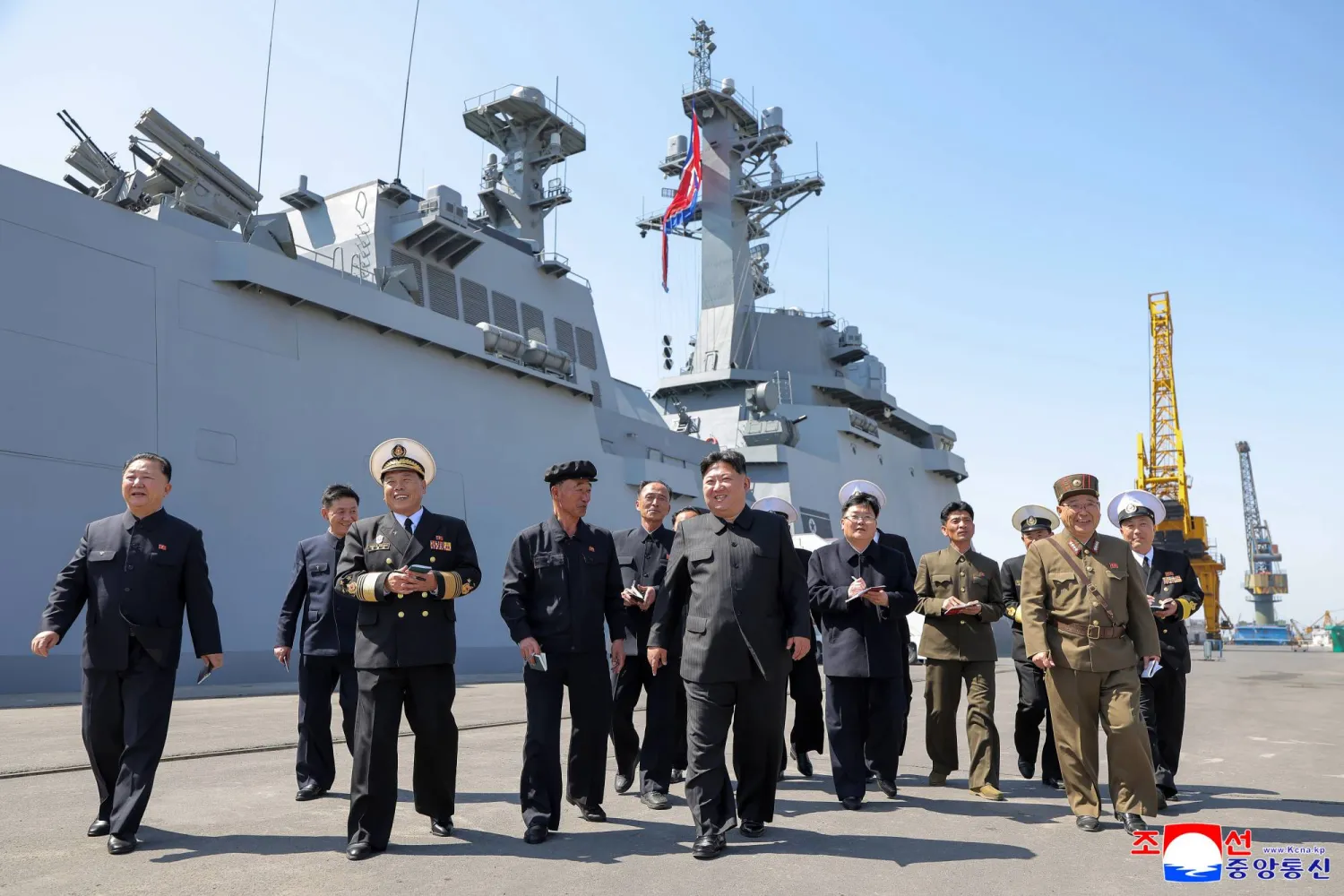

North Korea's Kim Oversees Navy Cruise Missile Test

In this photo provided by the North Korean government, its leader Kim Jong Un, center, visits to observe the test launches of missiles at an undisclosed place in North Korea Sunday, April 12, 2026. (Korean Central News Agency/Korea News Service via AP)
TT

North Korea's Kim Oversees Navy Cruise Missile Test

In this photo provided by the North Korean government, its leader Kim Jong Un, center, visits to observe the test launches of missiles at an undisclosed place in North Korea Sunday, April 12, 2026. (Korean Central News Agency/Korea News Service via AP)

North Korean leader Kim Jong Un oversaw new tests of strategic cruise missiles and anti-warship missiles launched from a naval destroyer, state media reported on Tuesday.

The weapons tests occurred on Sunday, the state-run Korean Central News Agency (KCNA) said, and are the latest in a string of recent missile launches by the nuclear-armed nation.

Two strategic cruise missiles each flew for just over two hours, according to KCNA, while the anti-warship missiles flew for 33 minutes.

The missiles flew "along the flight orbits set in the sky above the West Sea of Korea and struck the targets with ultra-precision hit accuracy", KCNA said, using its preferred name for the Yellow Sea.

The tests were carried out from the Choe Hyon, one of two 5,000-ton destroyers in the North's arsenal, both launched last year as Kim seeks to ramp up the country's naval capabilities.

A photo released by KCNA showed a missile in its initial flight stage after being launched from the warship, with an orange flame trailing from its tail.

KCNA said Kim was also briefed on planning for the weapons systems of two more destroyers under construction, referred to simply as "Nos. 3 and 4".

Kim reportedly "expressed great satisfaction over the fact that the preparedness of our army's strategic action has been strengthened".

According to AFP, he reiterated that bolstering the North's nuclear deterrent was the "most important priority task".

North Korea has previously said the Choe Hyon is equipped with the "most powerful weapons", and Kim has made multiple inspections of the vessels in its class since last month.

Analysts told AFP that the missile launch aimed to show North Korea's longtime adversary, the United States, that any war would be very different from Washington's conflict with Iran.

"The continuation of similar launches fired from a warship is a direct message to Washington that it will effectively cripple a fleet of US warships and air carriers in times of war," Lim Eul-Chul, from the Institute for Far Eastern Studies at Kyungnam University, said.

"One striking difference from the Iranians is that its anti-ship cruise missiles are designed to carry tactical nuclear warheads," he added.

"North Koreans are taking the Iran war as cautionary example."

A South Korean lawmaker said this month that North Korea appeared to be speeding up construction of its third such destroyer at the western port city of Nampo.

Citing satellite imagery from a US-based intelligence firm, Yoo Yong-won of the opposition People Power Party said North Korea was "accelerating the naval forces' modernization on the back of military assistance from Russia".

North Korea has sent ground troops and artillery shells to support Russia's invasion of Ukraine, and observers say Pyongyang is receiving military technology assistance from Moscow in return.



Far-Right Polish MP Draws Outrage with Swastika on Israeli Flag

Polish Far-right Confederation party MP Konrad Berkowicz dsiplays an Israeli flag marked with a swastika in the Sejm in Warsaw, Poland, 14 April 2026. (EPA)
TT

Far-Right Polish MP Draws Outrage with Swastika on Israeli Flag

Polish Far-right Confederation party MP Konrad Berkowicz dsiplays an Israeli flag marked with a swastika in the Sejm in Warsaw, Poland, 14 April 2026. (EPA)

A far-right Polish lawmaker displayed a paper Israeli flag emblazoned with a swastika in parliament, accusing the country of "genocide" in the Middle East, with Israel slamming his actions as "antisemitic horror".

"Israel is in the process of committing a genocide of exceptional cruelty before our very eyes," Konrad Berkowicz told lawmakers, comparing the country to a "new Third Reich".

Berkowicz, a member of the far-right nationalist Konfederacja (Confederation) opposition party, then brandished the paper flag, with the Nazi symbol replacing the Star of David at its center.

Parliamentarians reacted with outrage in a country that was the site of many of the concentration camps built by Nazi Germany during the Holocaust, in which six million European Jews were killed.

Berkowicz's actions prompted shouts of anger in the chamber, while the parliament speaker called the display of the swastika "unjustified".

The speaker later announced he was preparing a motion to impose penalties on Berkowicz for "presenting Nazi symbols in the chamber".

The Israeli embassy in Poland condemned Berkowicz's actions, calling them an "antisemitic horror" and demanding Polish authorities "act upon this disgrace".

The incident came on the same day the annual "March of the Living," held on the grounds of the former Nazi death camp Auschwitz commemorating Holocaust victims, took place.

Auschwitz was the largest of the extermination camps built by Nazi Germany in occupied Poland and has become a symbol of the Holocaust.

"As Holocaust Survivors march in Auschwitz today, this vile anti-Jewish act is especially appalling," the Israeli embassy wrote in a statement on X.

Berkowicz also accused the Israeli army of using white phosphorous bombs in the Middle East, describing in detail the severe injuries, suffering, and deaths of "tens of thousands of women and children" by such weapons.

Human Rights Watch has accused Israel of "illegally" using white phosphorous in Southern Lebanon after launching an offensive against Hezbollah.

Israel has said it "could not confirm" the allegations.

Berkowicz's actions prompted an immediate reaction from the United States ambassador to Poland, himself a follower of Orthodox Judaism.

"SHAME SHAME SHAME on YOU!! Maybe even you have noticed that we Jews aren't so easy to push around anymore, are we?" Ambassador Tom Rose wrote on his personal X account.

"We stand with our friends and we know how to fight and defeat our enemies!!!" he added.

Earlier Tuesday, Rose had also participated in the "March of the Living".

One million Jews and more than 100,000 non-Jews died at Auschwitz between 1940 and 1945.


Lavrov Blasts Efforts to ‘Contain’ Russia, China on Beijing Visit

In this handout picture provided by the Russian Foreign Ministry on April 14, 2026, Russian Foreign Minister Sergei Lavrov and Chinese Foreign Minister Wang Yi shake hands during a meeting in Beijing. (Handout / Russian Foreign Ministry / AFP)
TT

Lavrov Blasts Efforts to ‘Contain’ Russia, China on Beijing Visit

In this handout picture provided by the Russian Foreign Ministry on April 14, 2026, Russian Foreign Minister Sergei Lavrov and Chinese Foreign Minister Wang Yi shake hands during a meeting in Beijing. (Handout / Russian Foreign Ministry / AFP)

Russian Foreign Minister Sergei Lavrov criticized efforts he said were aimed at "containing" Russia and China on Tuesday during a visit to Beijing, where he also discussed with his Chinese counterpart plans for a meeting "within the year" between Vladimir Putin and Xi Jinping.

Lavrov was given a red-carpet welcome after he arrived in the Chinese capital, photographs released by the Russian foreign ministry showed.

He later met his Chinese counterpart Wang Yi, who he was seen shaking hands with in a picture posted on social media by Russian foreign ministry spokeswoman Maria Zakharova.

Beijing and Moscow are close economic and political partners, and the relationship has deepened further since Russia's invasion of Ukraine in 2022.

Lavrov warned of "some very, very dangerous games going on" in East Asian geopolitical hotspots that included Taiwan, the disputed South China Sea and the nuclear-armed Korean peninsula, according to quotes from the meeting with Wang published by state-run RIA Novosti.

Beijing claims Taiwan as part of its territory and is sharply critical of US military assistance the self-ruled island receives.

In comments apparently referring to the United States and its allies, Lavrov said "they are trying to dismantle (regional cooperation) by creating small-format, bloc-based structures aimed at containing both the People's Republic of China and the Russian Federation".

"Our vast continent as a whole demands constant attention," he said.

Wang and Lavrov "conducted in-depth exchanges on the US-Iran conflict, the Asia-Pacific situation, the Ukraine crisis" and other issues during their meeting, the Chinese foreign ministry said in a statement without providing details.

"The two sides coordinate and support one another on the international stage, demonstrating to the whole world that amid adversity, a righteous path remains, and that under changes, there lies greater responsibility," Wang said.

Lavrov and Wang also "communicated and synced up preparations for a meeting between the two heads of state within the year", according to the Chinese readout.

China is hosting this week a string of leaders of countries that have been affected by the US-Israeli war on Iran and its economic fallout, including Vietnam's To Lam and Abu Dhabi's Crown Prince Mohamed bin Zayed Al Nahyan.

Wang and Lavrov agreed during a call on April 5 that Beijing and Moscow would work together to de-escalate tensions in the Middle East.


US Says Six Vessels Turned Back by Iran Port Blockade

A ship is seen off the coast of Ras al-Khaimah, the day after the failure of US-Iran peace talks on April 13, 2026. (AFP)
TT

US Says Six Vessels Turned Back by Iran Port Blockade

A ship is seen off the coast of Ras al-Khaimah, the day after the failure of US-Iran peace talks on April 13, 2026. (AFP)

The US military said Tuesday that it successfully stopped six ships from sailing out of Iranian ports during the first 24 hours of a naval blockade against the country. 

Central Command (CENTCOM) -- which is responsible for American forces in the Middle East -- said more than 10,000 US troops, over a dozen warships, and dozens of aircraft are taking part in the mission. 

"During the first 24 hours, no ships made it past the US blockade and six merchant vessels complied with direction from US forces to turn around to re-enter an Iranian port on the Gulf of Oman," CENTCOM said in a post on X. 

"The blockade is being enforced impartially against vessels of all nations entering or departing Iranian ports and coastal areas, including all Iranian ports on the Arabian Gulf and Gulf of Oman," it added. 

But despite CENTCOM's assertion that no vessels made it through the blockade, tracking information from maritime data provider Kpler showed at least two ships sailing from Iranian ports crossed the Strait of Hormuz on Monday. 

Tehran's forces effectively closed the strait after the start of the US-Israeli air campaign against Iran on February 28, and the US on Sunday announced its own blockade after peace talks with Iran failed.