


Gulf Talks Focus on Containing Escalation, Boosting Regional, Global Security

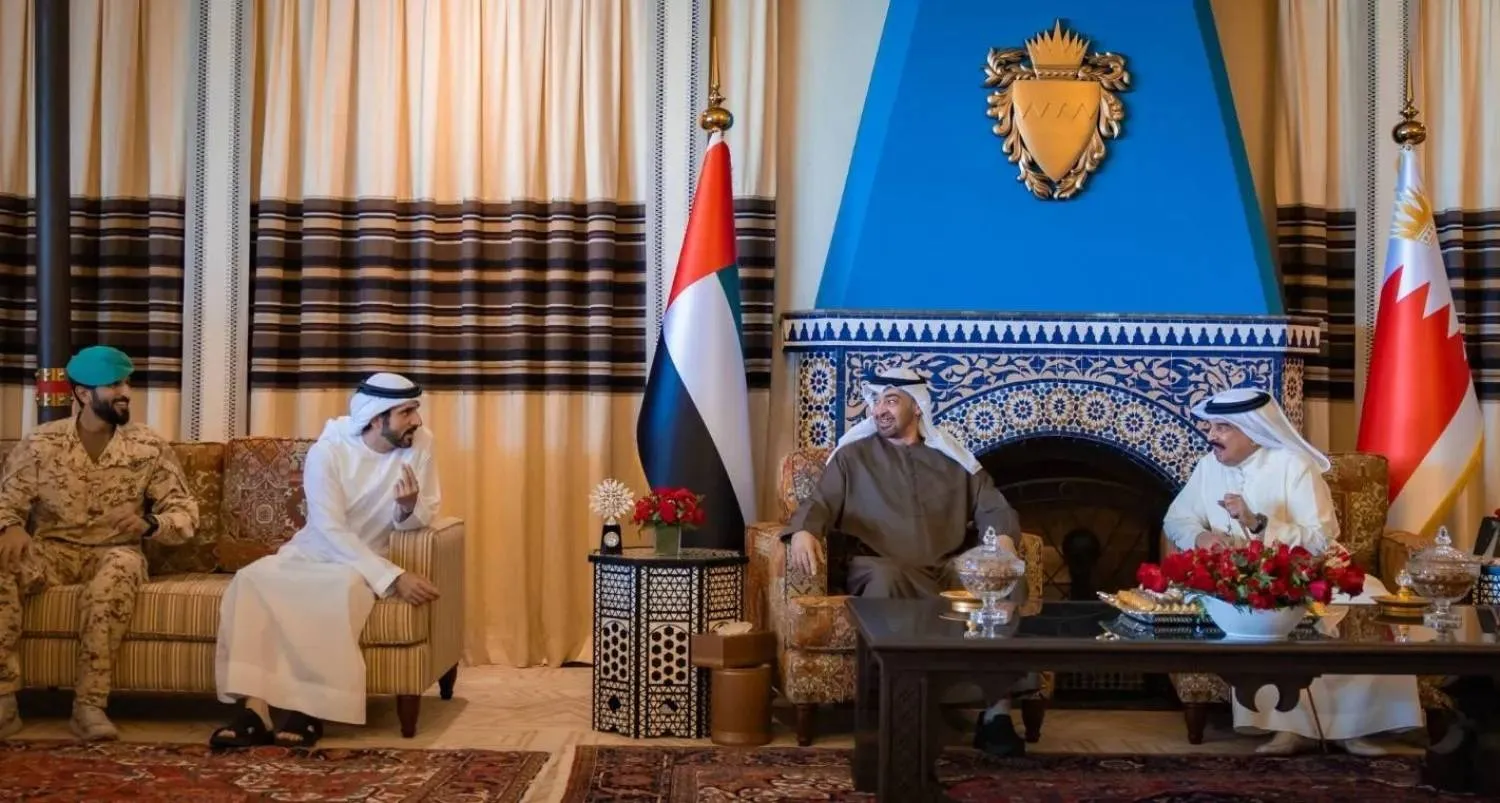
Bahrain’s King Hamad bin Isa Al Khalifa and UAE President Sheikh Mohamed bin Zayed Al Nahyan meet in Manama on Monday. (BNA)
TT

Gulf Talks Focus on Containing Escalation, Boosting Regional, Global Security

Bahrain’s King Hamad bin Isa Al Khalifa and UAE President Sheikh Mohamed bin Zayed Al Nahyan meet in Manama on Monday. (BNA)

Recent hours have seen a flurry of bilateral contacts across the Gulf addressing Iran-US peace negotiations and wider Middle East developments, with officials emphasizing efforts to strengthen regional and international security and stability.

In Manama, Bahrain said its forces intercepted and destroyed seven hostile drones, stressing readiness to confront any threats.

Peace negotiations

Saudi Foreign Minister Prince Faisal bin Farhan bin Abdullah held a phone call on Monday with his Iranian counterpart Abbas Araghchi, reviewing developments following Iran-US peace talks and exchanging views.

Prince Faisal later spoke with Egyptian Foreign Minister Badr Abdelatty, discussing the regional situation and ways to boost stability.

He also received a call from Kyrgyz Foreign Minister Jeenbek Kulubaev, covering bilateral ties and regional developments.

In separate calls, Prince Faisal discussed the situation with Kuwaiti Foreign Minister Sheikh Jarrah Al-Sabah, Qatari Prime Minister and Foreign Minister Sheikh Mohammed bin Abdulrahman Al-Thani, and Emirati Foreign Minister Sheikh Abdullah bin Zayed Al Nahyan.

Qatar, for its part, warned against using freedom of maritime navigation as “a tool of pressure or bargaining,” during a call between Sheikh Mohammed and Araghchi.

Sheikh Mohammed stressed the need to keep sea lanes open and ensure freedom of navigation, warning of negative consequences for regional countries, global energy and food supplies, and international peace.

He urged Washington and Tehran to respond to ongoing mediation efforts, paving the way for a sustainable agreement that addresses the roots of the crisis and prevents renewed escalation.

The two ministers also discussed ceasefire developments and the need to consolidate it to support regional stability.

Bahrain’s King Hamad bin Isa Al Khalifa and UAE President Sheikh Mohamed bin Zayed Al Nahyan met in Manama on Monday to review regional developments and their impact on international navigation, energy supplies and the global economy.

King Hamad later received Admiral Brad Cooper, Commander of the US Central Command (CENTCOM), praising longstanding strategic ties and growing defense cooperation between their countries.

Talks covered regional and international developments, with the Bahraini monarch highlighting the United States’ role, alongside allies, in supporting global stability.

Crown Prince Salman bin Hamad Al Khalifa, Bahrain’s prime minister and deputy supreme commander, also met Cooper, reviewing regional developments and issues of mutual concern.

Separately, Bahrain’s foreign ministry summoned Iraq’s chargé d’affaires in Manama Ahmed Ismail Al-Karawi to protest continued drone attacks launched from Iraqi territory toward Bahrain and other Gulf Cooperation Council states.

The ministry urged Iraq to address the threats urgently in line with international law, reaffirming Bahrain’s right to take necessary measures to protect its security.

Bahrain’s defense forces later said air defenses had intercepted seven drones, bringing the total destroyed since the start of Iranian attacks to 523 drones and 194 missiles. It said all units remain at high readiness.

Security reassurances

In Kuwait, Foreign Minister Sheikh Jarrah Jaber Al-Ahmad Al-Sabah spoke by phone with Indian External Affairs Minister Subrahmanyam Jaishankar about regional developments.

Kuwait’s interior ministry said security and military agencies are closely monitoring the regional situation in coordination with relevant authorities to ensure safety.

South Korean support for Qatar

Qatar’s Emir Sheikh Tamim bin Hamad Al-Thani received a written message from South Korean President Lee Jae-myung expressing support and solidarity following Iranian attacks on Qatar and other regional states, and voicing hope for an agreement to end the crisis.

The message was delivered to Sheikh Tamim by presidential envoy Kang Hoon-sik during a meeting in Doha, where the sides reviewed bilateral cooperation, particularly in energy and economic sectors, as well as regional developments.

Meanwhile, Oman’s Sultan Haitham bin Tariq discussed regional developments in a phone call with British Prime Minister Keir Starmer following the conclusion of US-Iran talks in Pakistan without agreement.

The two sides stressed intensifying international efforts to prevent further escalation and exchanged views on containing tensions and addressing root causes to safeguard regional interests.

They also underlined the importance of continued coordination and support for de-escalation and diplomatic solutions based on international law.



Saudi Arabia Chairs 118th Session of the Arab League’s Economic and Social Council

Arab League foreign ministers meet during an annual meeting in Cairo, Egypt. File/AP
TT

Saudi Arabia Chairs 118th Session of the Arab League’s Economic and Social Council

Arab League foreign ministers meet during an annual meeting in Cairo, Egypt. File/AP

The Economic and Social Council of the League of Arab States held its 118th ministerial session on Thursday under the chairmanship of the Kingdom of Saudi Arabia, the Saudi Press Agency reported.

Saudi Assistant Minister of Finance for Macro-Fiscal Policies and International Relations Eng. Abdullah bin Zaraah presided over the session at the League’s General Secretariat headquarters in Cairo, with representatives of member states participating.

The meeting addressed several economic and social issues of common Arab interest as part of efforts to enhance cooperation among member states, support development, promote intra-Arab trade, and expand opportunities for regional integration and growth.

In the Kingdom's statement, bin Zaraah affirmed that joint Arab economic and social action is a key pillar for strengthening collective capacity to address challenges and capitalize on opportunities.

He stressed the importance of moving beyond coordination and the exchange of views toward implementation and tangible results by strengthening implementation and follow-up mechanisms, and linking decisions and initiatives to clear objectives and measurable indicators.

He also called for enhanced coordination among institutions of joint Arab action and specialized Arab organizations, while directing resources and capabilities toward the highest-impact priorities.

He also highlighted the Kingdom's national achievements, noting that the World Bank Group's World Development Report 2026 ranked the Kingdom among the world's top 10 countries in private investment in artificial intelligence and recognized its advanced position in the global AI landscape.


Saudi Arabia Offers Yemen’s Central Bank New Support to Bolster Economic Stability

The Central Bank of Yemen in the interim capital Aden. (Government media)
TT

Saudi Arabia Offers Yemen’s Central Bank New Support to Bolster Economic Stability

The Central Bank of Yemen in the interim capital Aden. (Government media)

Saudi Arabia has provided new support to the Central Bank of Yemen as part of its ongoing efforts to stabilize the country's economy and financial sector, following directives from the Kingdom's leadership.

The Saudi Development and Reconstruction Program for Yemen (SDRPY) said the assistance aims to strengthen economic, financial, and monetary stability. It is also designed to build the capacity of government institutions while improving governance and transparency.

The support further aims to enable the private sector to contribute to sustainable economic growth, create job opportunities, and drive socio-economic development.

The SDRPY noted that this assistance will contribute to boosting purchasing power, improving living standards, and stimulating commercial activity. Additionally, it aims to create an environment conducive to sustainable economic recovery and development in Yemen.

The new support builds on Saudi Arabia's continuous economic and developmental assistance to Yemen. In February, the Kingdom provided 1.3 billion riyals to support the Yemeni budget for operational expenses and salaries, followed by another installment of over 224 million riyals in June for the same purpose.

The SDRPY, established in 2018, implements projects and initiatives across various development sectors, in addition to providing institutional and technical support to build the capacity of Yemeni government institutions.


Saudi Arabia Advances Gulf Food Security Cooperation at 38th GCC Committee Meeting in Bahrain

The committee commended Saudi Arabia for its role in developing the GCC Food Security Strategy  - SPA
The committee commended Saudi Arabia for its role in developing the GCC Food Security Strategy - SPA
TT

Saudi Arabia Advances Gulf Food Security Cooperation at 38th GCC Committee Meeting in Bahrain

The committee commended Saudi Arabia for its role in developing the GCC Food Security Strategy  - SPA
The committee commended Saudi Arabia for its role in developing the GCC Food Security Strategy - SPA

Saudi Arabia participated in the 38th Meeting of the GCC Committee for Agricultural Cooperation and Food Security in Bahrain, with a delegation led by General Food Security Authority President Eng. Ahmad Alfares, where it reviewed progress in implementing the GCC Food Security Strategy, as part of efforts to deepen coordination and integration among member states and build a more resilient regional food security system capable of maintaining stable agricultural and food supply chains.

The committee commended Saudi Arabia for its role in developing the GCC Food Security Strategy and preparing a comprehensive framework for a regional plant genetic resources bank. It also recognized Saudi Arabia's efforts to establish early-warning mechanisms to monitor and analyze indicators linked to food supply chains, SPA reported.

The meeting addressed a range of issues affecting agriculture, livestock, fisheries, and food security across the GCC. Officials also reviewed a report on a consultancy project examining modern technologies and artificial intelligence applications in farm management and agricultural productivity across the Gulf states.

The project is being carried out in cooperation with the International Center for Agricultural Research in the Dry Areas (ICARDA) and the Consultative Group on International Agricultural Research (CGIAR).

The committee also followed up on decisions from its 34th meeting and reviewed the implementation of resolutions adopted at its 37th meeting. Several unified regulations, laws, and implementing rules were approved during the session.

Saudi Arabia's participation underscores its efforts to strengthen an integrated Gulf food security framework and enhance coordination among GCC members as regional and global developments affect agricultural production and food supply chains.

At the conclusion of the meeting, Saudi Arabia announced that it will host and chair the committee's 39th meeting and continue working with GCC partners to expand cooperation. Saudi Arabia also thanked Bahrain for hosting the meeting and commended efforts to ensure its success.