Female Iranian Student Arrives in Iran After Release in France

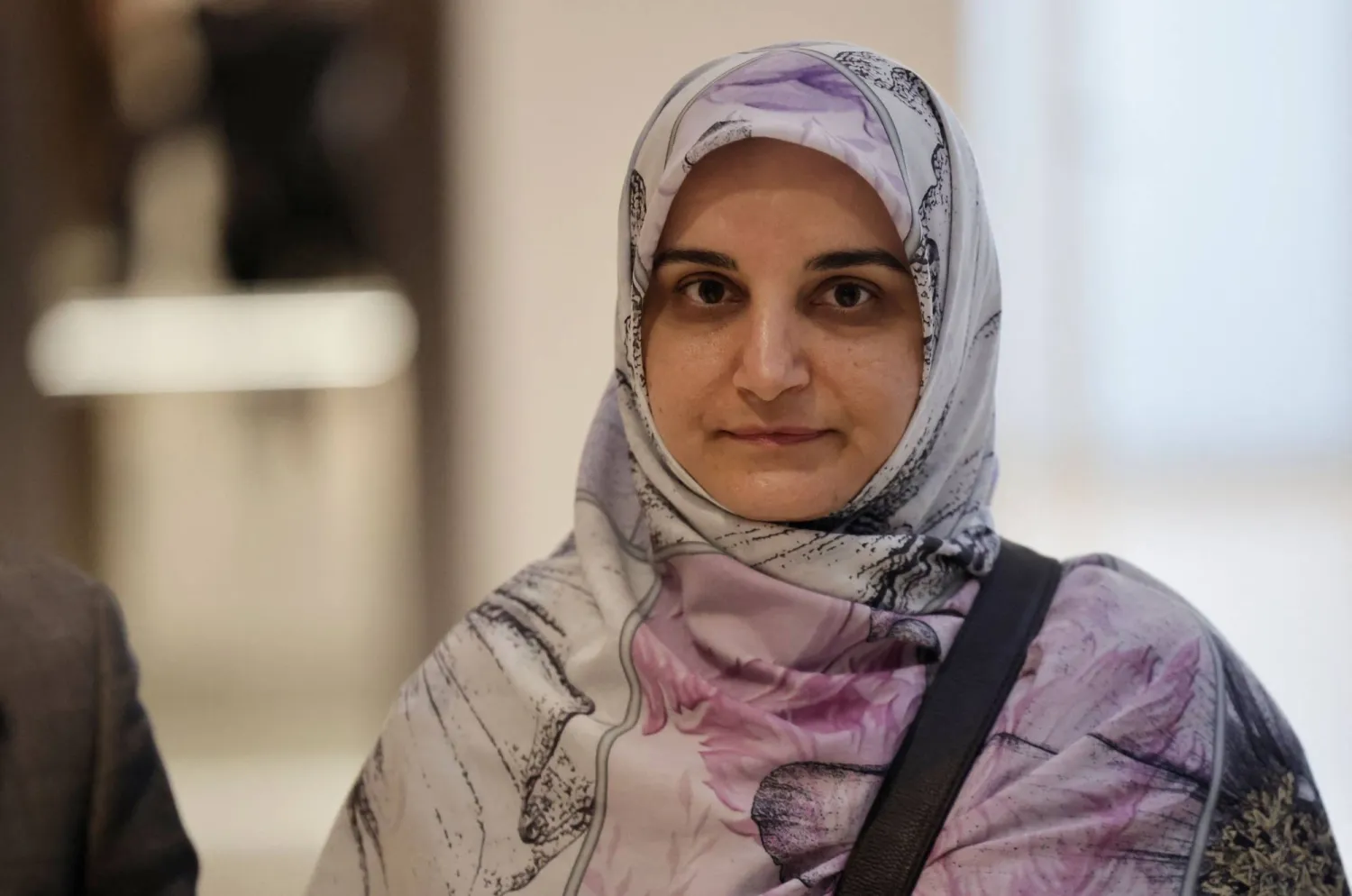
Iranian national Mahdieh Esfandiari arrives for her trial on charges of promoting terrorism on social media at a Paris courthouse on January 13, 2026. (AFP)
TT

Female Iranian Student Arrives in Iran After Release in France

Iranian national Mahdieh Esfandiari arrives for her trial on charges of promoting terrorism on social media at a Paris courthouse on January 13, 2026. (AFP)

Iranian national Mahdieh Esfandiari, who was held in France for over a year, has returned home, Iranian state television reported Wednesday, a week after Iran released two French citizens. 

"Mahdieh Esfandiari, a Palestinian rights activist, has returned to Iran after her release from prison in France," state television said. 

Esfandiari's release came a week after French citizens Cecile Kohler and Jacques Paris, who spent more than three years in Iranian prisons on espionage charges, arrived in France. 

Iran had previously suggested the couple could be freed as part of an exchange for Esfandiari. 

Esfandiari, around 40 years old, was arrested in France in February last year on charges of promoting terrorism and released on bail in October. 

In February this year, a French court sentenced her to one year in prison for justifying terrorism over comments she made on social media, including regarding the Palestinian group Hamas's attack on Israel on October 7, 2023. 

She had lived in France since 2018, graduating from the University of Lyon and working as a translator. 

Kohler and Paris were arrested in Iran in May 2022 but were freed in November after more than three years in prison on espionage charges that their families vehemently deny. 

They were taken by French diplomats to France's mission in Tehran, where they lived under house arrest until their full release on April 7. 


Toll from Türkiye School Shooting Rises to Nine

Turkish security forces and emergency staff stand at the courtyard of a high school where an assailant opened fire, in Siverek, south east Türkiye, Tuesday, April 14, 2026, (Mevlut Bayraktar/IHA via AP)
TT

Toll from Türkiye School Shooting Rises to Nine

Turkish security forces and emergency staff stand at the courtyard of a high school where an assailant opened fire, in Siverek, south east Türkiye, Tuesday, April 14, 2026, (Mevlut Bayraktar/IHA via AP)

The toll from Türkiye's second school shooting in as many days now stands at nine people dead, the interior minister said on Wednesday.

"We regret to report nine deaths (...) and 13 wounded. Six of them are currently in intensive care, three of whom are in critical condition," Mustafa Ciftci said in a statement from the city of Kahramanmaras in the center of the country, where a 13-year-old student opened fire earlier in the day.

It marked the second school shooting in Türkiye in two days. On Tuesday, an ex-student opened fire with a shotgun at his former high school in Siverek district of Sanliurfa province, wounding 16 people before killing himself in a showdown with police.

Until this week, such school shootings were rare in Türkiye.

State-run broadcaster, TRT, identified the shooter as Isa Aras Mersinli, and said his father was detained for questioning.

Turkish authorities imposed a ban on the broadcast of “traumatic” images from the shooting, warning media organizations to limit coverage to statements from officials.

Earlier, media reports said that authorities sent police and ambulances to the school in the Kahramanmaras' Onikisubat district, after gunfire was heard there. Images from the scene showed at least two people being put into ambulances.

Parents rushed to the school after hearing reports of an armed attack, NTV television reported, adding that police took security measures around the school.


Top Israel Court Hears Petitions to Oust Far-Right Minister

Israeli Supreme Court judges assemble on the day of the hearing for a petition to force Israeli Prime Minister Benjamin Netanyahu to oust Israeli National Security Minister Itamar Ben-Gvir from his position, following allegations Ben-Gvir used his role to intervene in investigations and operational matters, at the Supreme Court in Jerusalem April 15, 2026. (Reuters)
TT

Top Israel Court Hears Petitions to Oust Far-Right Minister

Israeli Supreme Court judges assemble on the day of the hearing for a petition to force Israeli Prime Minister Benjamin Netanyahu to oust Israeli National Security Minister Itamar Ben-Gvir from his position, following allegations Ben-Gvir used his role to intervene in investigations and operational matters, at the Supreme Court in Jerusalem April 15, 2026. (Reuters)

Israel's High Court was on Wednesday hearing four petitions backed by the country's attorney general that seek to oust hardline National Security Minister Itamar Ben-Gvir.

The case is the latest example of the tension between the judiciary and one of the most right-wing governments in Israel's history, and has been sharply criticized by several other ministers.

The petitions seek Ben-Gvir's removal on the grounds that he has undermined the independence of the police.

The petitions won the support of Attorney General Gali Baharav-Miara, who in January asked the court to order Prime Minister Benjamin Netanyahu to explain why he was not dismissing the cabinet member.

In her request, Baharav-Miara accused Ben-Gvir of "abusing his position to improperly influence the activities of the Israel Police in the most sensitive areas of law enforcement and investigations, and of violating basic democratic principles".

Ahead of the hearing, Ben-Gvir was defiant, calling for the "arrest and investigation" of the attorney general.

"(She) says I set policy and change the police -- she's right. She says I interfere in appointments, and appointed more than 1,000 people in order to implement my policy -- she's right about that too," he said, flanked by supporters.

"Attempts to interfere with a minister's appointment and his powers is dangerous for democracy. Democracy will not fall; the judicial dictatorship will fall," he vowed.

Justice Minister Yariv Levin also weighed in, denouncing the hearing as "illegal" and saying "the judges' decision will have no validity".

And Foreign Minister Gideon Saar, a former justice minister, urged the court "to refrain from harming democracy", saying the case -- which seeks to compel Netanyahu to dismiss Ben-Gvir -- "goes too far," he wrote on Telegram.

On Monday, Netanyahu submitted his 129-page response to the bid to oust Ben-Gvir, arguing it was an "unconstitutional demand" and that the court lacked authority to interfere in government decisions or in the appointment of ministers.

Last month, he described the attorney general's request as "inconceivable... in the midst of an existential war", saying her call to dismiss a senior minister, against whom no criminal investigation had been opened, "harms the foundations of democracy".


UN Nuclear Chief Urges Strict Iran Checks in Any Deal to End War

01 November 2004, Austria, Vienna: The flag of the International Atomic Energy Agency (IAEA) flies in front of the UN seat in Vienna. (dpa)
TT

UN Nuclear Chief Urges Strict Iran Checks in Any Deal to End War

01 November 2004, Austria, Vienna: The flag of the International Atomic Energy Agency (IAEA) flies in front of the UN seat in Vienna. (dpa)

The head of the UN’s nuclear watchdog said Wednesday that “very detailed” measures to verify Iran’s nuclear activities must be included in a potential US-Iran agreement to end their war in the Middle East.

International Atomic Energy Agency Director General Rafael Grossi stressed the need for the thorough verification regime for Iran’s nuclear program, as US President Donald Trump said Tuesday that a second round of talks with Iran could happen over the next two days.

The Trump administration has said that preventing Iran from gaining a nuclear weapon is a key war aim. Iran has previously said it isn't developing such weapons but rejected limits on its nuclear program.

Last weekend in Pakistan, an initial round of talks between the two countries failed to produce an agreement. The White House said Iran’s nuclear ambitions were a central sticking point. But an Iranian diplomatic official, speaking on the condition of anonymity because of the sensitivity of the closed-door talks, denied that negotiations had failed over Iran’s nuclear ambitions.

“Iran has a very ambitious, wide nuclear program so all of that will require the presence of IAEA inspectors,” Grossi told reporters in Seoul. “Otherwise, you will not have an agreement. You will have an illusion of an agreement.”

He said that any agreement on nuclear technology “requires very detailed verification mechanisms.”

Iran has not allowed the IAEA access to its nuclear facilities bombed by Israel and the United States during a 12-day war in June, according to a confidential IAEA report circulated to member states and seen by The Associated Press in February.

The report stressed that it “cannot verify whether Iran has suspended all enrichment-related activities,” or the “size of Iran’s uranium stockpile at the affected nuclear facilities.”

Iran has long insisted its program is peaceful, but the IAEA and Western nations say Tehran had an organized nuclear weapons program up until 2003.

The IAEA has maintained Iran has a stockpile of 440.9 kilograms (972 pounds) of uranium enriched up to 60% purity, a short, technical step away from weapons-grade levels of 90%.

That stockpile could allow Iran to build as many as 10 nuclear bombs, should it decide to weaponize its program, Grossi said earlier.

Such highly enriched nuclear material should normally be verified every month, according to the IAEA’s guidelines.