


Israeli Settlers Block Palestinian Kids’ Path to School with Tear Gas and Barbed Wire

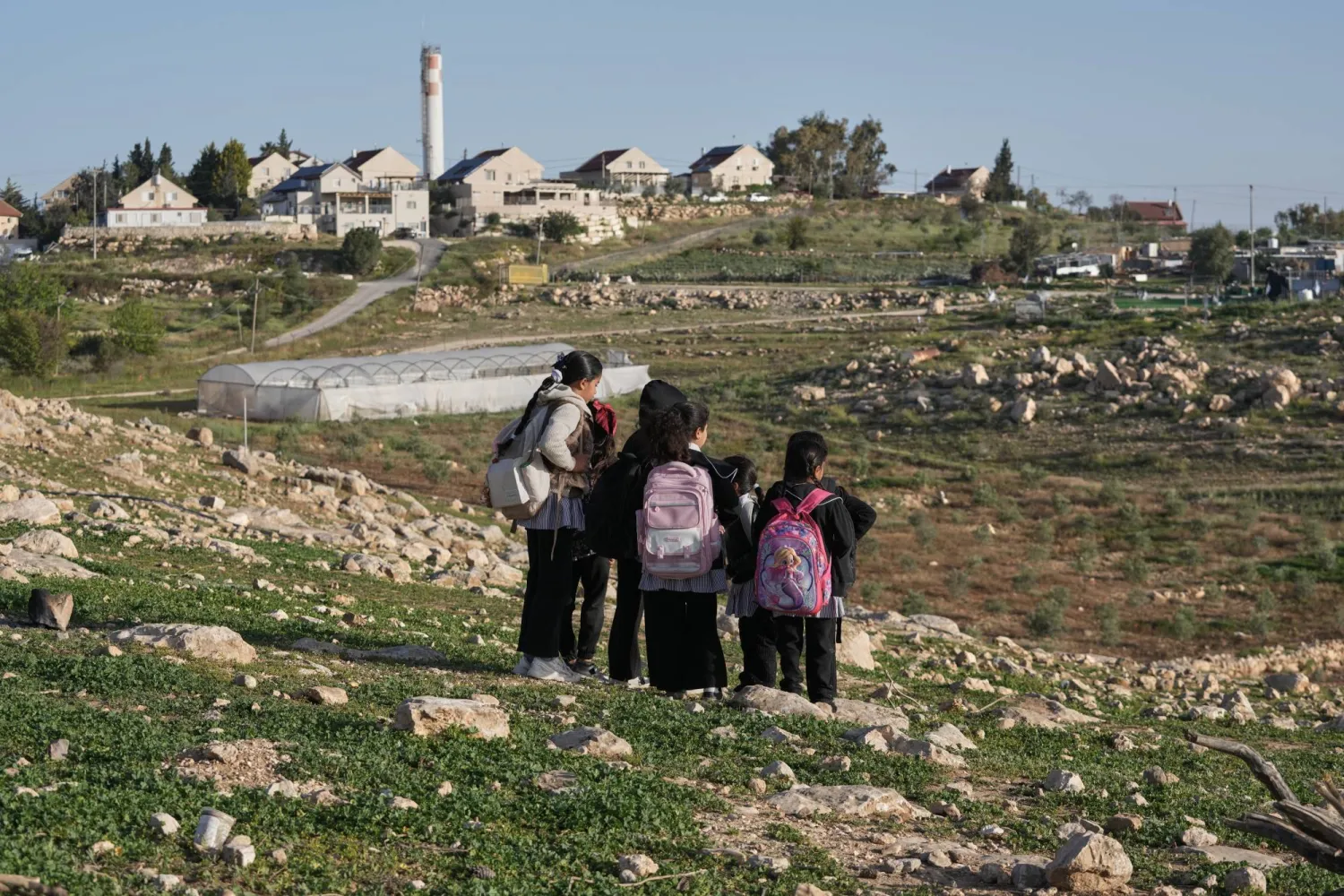
 Palestinian students walk to school using an alternative route that is nearly twice as long because a fence separates their village from the nearby Israeli settlement of Carmel, near the West Bank village of Umm al-Khair, Tuesday, April 14, 2026. (AP)
Palestinian students walk to school using an alternative route that is nearly twice as long because a fence separates their village from the nearby Israeli settlement of Carmel, near the West Bank village of Umm al-Khair, Tuesday, April 14, 2026. (AP)
TT

Israeli Settlers Block Palestinian Kids’ Path to School with Tear Gas and Barbed Wire

 Palestinian students walk to school using an alternative route that is nearly twice as long because a fence separates their village from the nearby Israeli settlement of Carmel, near the West Bank village of Umm al-Khair, Tuesday, April 14, 2026. (AP)
Palestinian students walk to school using an alternative route that is nearly twice as long because a fence separates their village from the nearby Israeli settlement of Carmel, near the West Bank village of Umm al-Khair, Tuesday, April 14, 2026. (AP)

Hajar and Rashid Hathaleen have always walked to school from their neighborhood on the outskirts of Umm al-Khair. But when classes resumed this week for the first time since the Iran war began, coiled barbed wire blocked the Palestinian siblings' path to the village center.

Israeli settlers had installed it overnight, according to video that Palestinian residents provided to The Associated Press. Palestinians say the improvised fence is just the latest attempt by settlers to expand control in part of the occupied West Bank where state-backed demolitions, arson and vandalism regularly occur and settler violence, at times lethal, is rarely prosecuted.

The villagers' plight was covered in the 2024 Oscar-winning documentary “No Other Land," but the publicity has done little to stem the bloodshed or curb land grabs. They say Israel has used the cover of the Iran war to tighten its grip over the territory, as settler attacks surge and the military imposes additional wartime restrictions on movement, citing security.

Khalil Hathaleen, head of the village council and a member of the extended family that makes up much of Umm al-Khair’s population, said settlers were exploiting the war to seize land, cut down olive groves and raid nearby villages at night. “It was a good chance for settlers to do what they want, with no rules,” he said.

Like in Israel, Palestinian kids stayed home before last week's ceasefire, with the threat of falling missile debris leading schools to close.

Hajar, her brother Rashid and their classmates sat waiting Monday and Tuesday near Israeli flags, the barbed wire and newly felled trees as their parents and village leaders demanded they be allowed to pass. On Monday, the children were met by plumes of tear gas and sound grenades hurled by armed men in an unmarked white truck, including some uniformed soldiers, according to the video.

Israel’s military said troops used “riot dispersal means” outside Carmel, the settlement next to Umm al-Khair. It acknowledged that children were present but said the measures — which it didn't detail — were directed at adults in the area, not the children. The Har Hevron Regional Council, the settlements' local government in the area, did not respond to questions about the fence.

Bedouins and other villagers have been using the 3-kilometer (1.8-mile) path from the neighborhood of Khirbet Umm al-Khair to the village center for decades. “We are determined to keep it,” Khalil Hathaleen said.

The fence is just another way that Palestinian movement is being restricted as Israeli settlements multiply in the occupied West Bank. Palestinians say it follows a well-worn pattern in which settlers erect fences or claim farmland that Palestinians say is theirs, and then move to enforce this new reality with the backing of Israel’s military.

Hathaleen said Israeli forces sometimes restrain the settlers, but more often than not they defer to them.

“We are refused a solution,” he said.

The international community overwhelmingly considers the settlements illegal. Israel, meanwhile, views the territory as disputed and says its final status is subject to negotiations. The outposts are built without the permission of Israeli authorities, who sometimes dismantle them, but other times turn a blind eye or even legalize them retroactively.

Hathaleen said the military's civil administration unit told Umm Al-Khair to divert students to another path. But parents said the alternate route is roughly twice as long and more dangerous, requiring them to pass near Carmel.

“We have deep concerns as parents and as residents that the (Israeli) occupation and soldiers will attack students,” said Al-Mutasim Hathaleen, another parent.

On Tuesday, some students got to school on buses that took the alternate route. But classrooms sat half-empty and the playground was deserted. There was no school on Wednesday due to Palestinian Authority cuts to teacher salaries in the area. But on Thursday, kids will try again to get to school on their regular route, Khalil Hathaleen said.

Testing the settlers' resolve could be risky.

Israeli officials and military leaders have recently sounded the alarm over intensifying violence and lawlessness by extremist settlers in the occupied West Bank, where arsons and deadly attacks have continued unabated. At least 35 Palestinians have been killed by Israeli soldiers and settlers across the territory in 2026. Settlers have killed eight Palestinians — an equal number to all of 2025.

The Israeli rights group B’Tselem, following the killing of a 23-year-old Palestinian man by a settler, said that what it called “daily unbridled violence” amounted to Israeli government policy, noting that many of those involved are army reservists.

“These militias are fully backed by the state of Israel and enjoy complete impunity for killing, assaulting and looting Palestinian residents,” it said.



Lebanese PM Says Premature to Talk of Any High-Level Meeting with Israel

Smoke rises as a result of an Israeli strike in the south of Lebanon, as seen from the Upper Galilee in northern Israel, 06 May 2026, amid a ceasefire between Israel and Lebanon. (EPA)
TT

Lebanese PM Says Premature to Talk of Any High-Level Meeting with Israel

Smoke rises as a result of an Israeli strike in the south of Lebanon, as seen from the Upper Galilee in northern Israel, 06 May 2026, amid a ceasefire between Israel and Lebanon. (EPA)

Lebanese Prime Minister Nawaf Salam said it is premature to talk of any high-level meeting between Lebanon and Israel, comments underlining the dim chances of one being held soon as hoped for by US President Donald Trump.

Salam, in comments reported by Lebanon's National News Agency (NNA) on Wednesday, said shoring up a ceasefire would be the basis for any new round of negotiations that might be held by Lebanese and Israeli government envoys in Washington.

Hostilities between Israel and Iran-backed Hezbollah have continued to rage in southern Lebanon despite a US-mediated ceasefire between Lebanon and Israel announced on April 16.

Since ‌Hezbollah triggered the ‌war by opening fire in support of Iran on March ‌2, ⁠the Lebanese administration ⁠led by Salam and President Joseph Aoun has initiated Beirut's highest-level contacts with Israel in decades, reflecting deep divisions between the Shiite group and its Lebanese opponents.

Washington last month hosted two meetings between the Israeli and Lebanese ambassadors to the United States. Hezbollah strongly objects to the contacts.

Announcing a three-week extension of the ceasefire on April 23, Trump said he looked forward to hosting Israeli Prime Minister Benjamin Netanyahu and Aoun in the near future, and that he ⁠saw "a great chance" the countries would reach a peace deal ‌this year.

Salam said Lebanon was not seeking "normalization with Israel, but ‌rather achieving peace".

The current circumstances "are not ripe to talk about high-level meetings," he added, according to NNA.

"Our ‌minimum demand is a timetable for Israel’s withdrawal," he said, adding that the government ‌would develop its plan to restrict weapons to state control - an effort aimed at securing Hezbollah's disarmament.

Aoun said this week the timing was not right for a meeting with Netanyahu. Lebanon "must first reach a security agreement and a halt to the Israeli attacks, before we raise the issue of a meeting ‌between us," he said.

TRADING BLOWS

Israel has occupied a so-called security zone extending as deep as 10 km (6 miles) into southern ⁠Lebanon, saying it aims ⁠to protect northern Israel from Hezbollah militants embedded in civilian areas.

Hezbollah and Israel have continued to trade blows.

Lebanon's Health Ministry said on Wednesday an Israeli airstrike killed four people including two women and an elderly man in the town of Zelaya in southern Lebanon.

The Israeli military said Hezbollah had launched explosive drones and rockets towards Israeli soldiers in southern Lebanon, injuring two Israeli soldiers.

It also said the Israeli air force intercepted a hostile aircraft before it crossed into Israel, and announced strikes on Hezbollah infrastructure in several areas in Lebanon.

More than 2,700 people have been killed in the war in Lebanon since March 2, the Health Ministry says.

The Israeli military says Hezbollah has fired hundreds of rockets and drones at Israel since March 2. Israel has announced 17 soldiers have been killed in southern Lebanon, along with two civilians in northern Israel.


EU Urged to 'Act Now' on West Bank Settlement Project

The Palestinian village of Turmus Ayya (foreground) and the Israeli settlement of Shilo (background), north of Ramallah in the Israeli-occupied West Bank, are pictured on May 6, 2026. (Photo by Zain JAAFAR / AFP)
TT

EU Urged to 'Act Now' on West Bank Settlement Project

The Palestinian village of Turmus Ayya (foreground) and the Israeli settlement of Shilo (background), north of Ramallah in the Israeli-occupied West Bank, are pictured on May 6, 2026. (Photo by Zain JAAFAR / AFP)

More than 400 former diplomats, ministers, and senior officials on Wednesday urged the European Union to "act now" against Israel's "illegal" settlements in the occupied West Bank.

The open letter comes as Israel intends to move forward with E1, a new construction project covering around 12 square kilometers (4.6 square miles) with some 3,400 housing units in the occupied West Bank.

The move would further separate east Jerusalem, occupied and annexed by Israel and predominantly inhabited by Palestinians, from the West Bank.

"The EU and its member states, together with partners, must take immediate action to deter Israel from further advancing its illegal annexation of Palestinian land in the West Bank," said the letter signed by more than 440 figures, including former EU foreign policy chief Josep Borrell and former Belgian prime minister Guy Verhofstadt.

The signatories called for targeted sanctions, such as visa bans and business restrictions, on "all those engaged in illegal settlement activity", calling for measures against those promoting or implementing the E1 scheme.

The Israeli government plans to publish an initial tender on June 1 for the construction of housing for up to 15,000 "illegal settlers", AFP quoted the letter as saying, urging the EU and its member states to "act now".

The plan has been condemned by international leaders, with UN Secretary General Antonio Guterres's spokesman saying it would pose an "existential threat" to a contiguous Palestinian state.

Excluding east Jerusalem, more than 500,000 Israelis live in the occupied West Bank in settlements that are illegal under international law, among some three million Palestinians.

In 2025, the expansion of Israeli settlements reached its highest level since at least 2017, when the United Nations began tracking data, according to a UN report.

There has been a spike in deadly attacks by Israeli settlers in the occupied West Bank since the start of the Iran war on February 28, Palestinian officials and the United Nations have said.

Israel has occupied the West Bank since 1967.


Israel Army Says Striking Hezbollah Targets across Lebanon

An Israeli soldier gestures next to a tank, on the Israeli side of the border with Lebanon, May 3, 2026. REUTERS/Shir Torem
TT

Israel Army Says Striking Hezbollah Targets across Lebanon

An Israeli soldier gestures next to a tank, on the Israeli side of the border with Lebanon, May 3, 2026. REUTERS/Shir Torem

Israel's army said Wednesday it had begun striking Hezbollah infrastructure in several areas of Lebanon, despite a truce with the neighboring country intended to halt fighting with the Iran-backed militant group. 

"The IDF has begun striking Hezbollah terror infrastructure sites in several areas in Lebanon," a military statement said. 

It came shortly after the army reported "several incidents" during which drones exploded near Israeli soldiers operating in Lebanon's south.  

Lebanon's health ministry said an Israeli strike in Lebanon's eastern Bekaa valley killed four people, with local media reporting the attack took place before the Israeli army issued a warning to evacuate the area along with 11 other towns. 

"An Israeli enemy raid on the town of Zellaya in West Bekaa resulted in four martyrs, including two women and an elderly man," the ministry said. 

Lebanese state media said the attack struck the house of the town's mayor, killing him and three members of his family.