


Ambassadors Set to Meet Again Ahead of Launch of Lebanon-Israel Negotiations

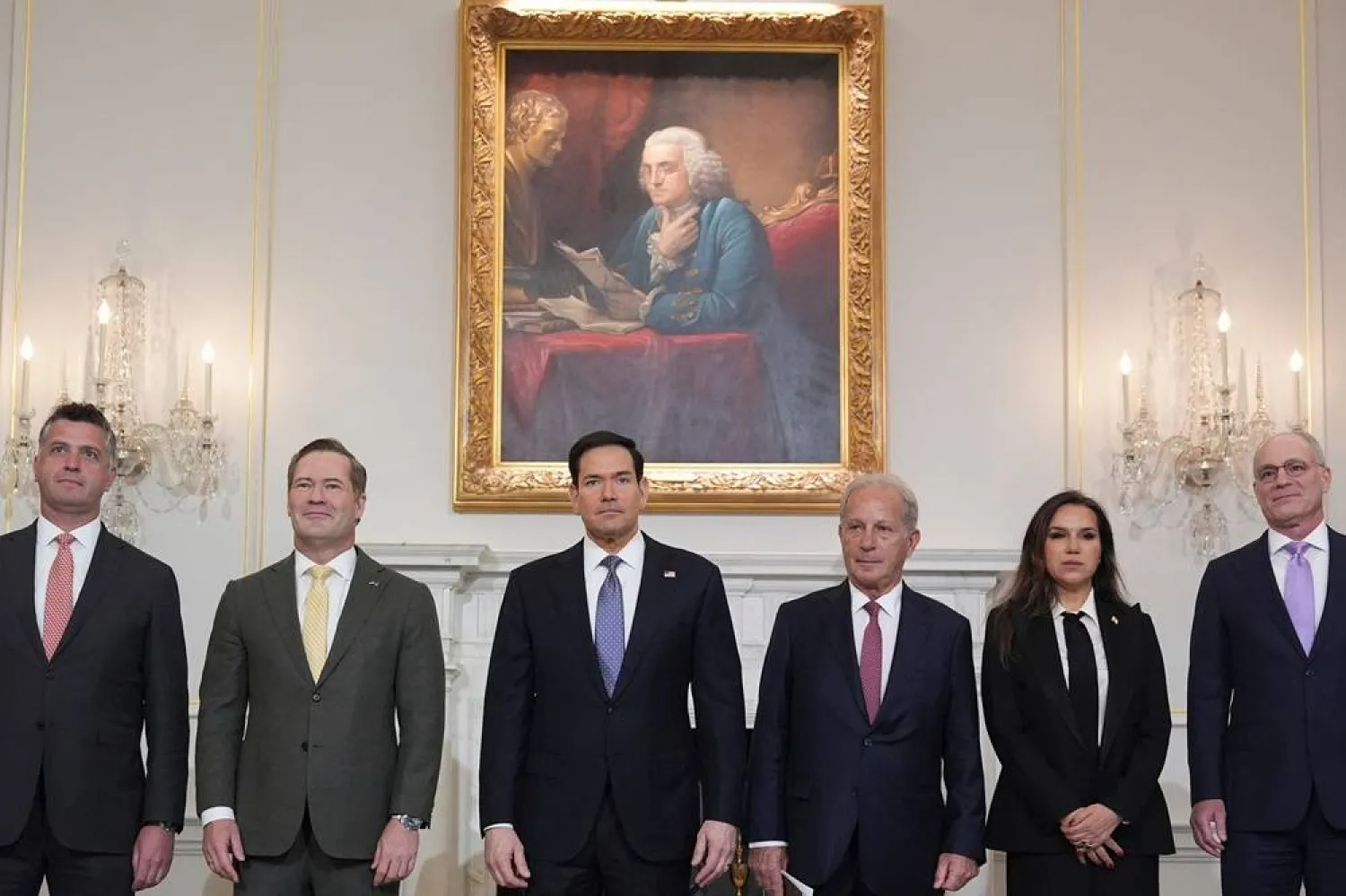
 From left, Michael Needham, counselor for the US Dept. of State, US Ambassador to the United Nations Mike Waltz, Secretary of State Marco Rubio, US Ambassador to Lebanon Michel Issa, Lebanese Ambassador to the US Nada Hamadeh Moawad, and Israeli Ambassador to the US Yechiel Leiter pose for a photo before a meeting at the State Department in Washington, Tuesday, April 14, 2026. (AP)
From left, Michael Needham, counselor for the US Dept. of State, US Ambassador to the United Nations Mike Waltz, Secretary of State Marco Rubio, US Ambassador to Lebanon Michel Issa, Lebanese Ambassador to the US Nada Hamadeh Moawad, and Israeli Ambassador to the US Yechiel Leiter pose for a photo before a meeting at the State Department in Washington, Tuesday, April 14, 2026. (AP)
TT

Ambassadors Set to Meet Again Ahead of Launch of Lebanon-Israel Negotiations

 From left, Michael Needham, counselor for the US Dept. of State, US Ambassador to the United Nations Mike Waltz, Secretary of State Marco Rubio, US Ambassador to Lebanon Michel Issa, Lebanese Ambassador to the US Nada Hamadeh Moawad, and Israeli Ambassador to the US Yechiel Leiter pose for a photo before a meeting at the State Department in Washington, Tuesday, April 14, 2026. (AP)
From left, Michael Needham, counselor for the US Dept. of State, US Ambassador to the United Nations Mike Waltz, Secretary of State Marco Rubio, US Ambassador to Lebanon Michel Issa, Lebanese Ambassador to the US Nada Hamadeh Moawad, and Israeli Ambassador to the US Yechiel Leiter pose for a photo before a meeting at the State Department in Washington, Tuesday, April 14, 2026. (AP)

Lebanon’s and Israel’s ambassadors to Washington are preparing for a second meeting after an initial round on Tuesday at the US State Department, hosted by Secretary of State Marco Rubio.

The meeting is aimed at shaping talks and securing a ceasefire pushed by Washington before launching a negotiation track between the two countries.

Lebanon is pressing ahead with direct negotiations with Israel under US sponsorship, describing it as the only viable option to end the war, as the military track has stalled and failed to secure a ceasefire for 45 days, according to ministerial sources following the talks.

The sources said Washington is acting as “mediator, facilitator, and driver of the talks,” while also “pressuring Tel Aviv to implement a ceasefire.”

Rubio launched the talks on Tuesday, attended by Lebanon’s ambassador to Washington, Nada Hamadeh Moawad, and Israel’s ambassador Yechiel Leiter.

He described the meeting as the beginning of a long process aimed at reaching a final solution to Hezbollah’s influence in the region, rather than merely securing a ceasefire.

Second meeting

Lebanese ministerial sources said the first session marked “the start of a process aimed at reaching a ceasefire agreement that would pave the way for negotiations under a mechanism to be agreed upon.”

They stressed the meeting was not a negotiating round, but a launch of the process, to be followed by setting a date for formal talks.

The sources revealed a second meeting would be held between the two ambassadors under US mediation to cement a ceasefire and continue the process afterward.

Rubio cautioned that the complexities of the conflict would not be resolved in a single day, framing the meeting as a “process” to lay the groundwork for future peace.

However, the sources said the atmosphere was “not tense and did not produce negative signals,” adding that Rubio “played a key role in backing the Lebanese position on implementing a ceasefire and strongly pushed for meeting Lebanon’s condition to move the file forward toward negotiations.”

Freedom of action

Lebanon is insisting on implementing the ceasefire agreement reached in November 2024, which it says Israel violated.

According to Asharq Al-Awsat sources, Beirut is demanding an end to Israeli assassinations, warnings, and attacks carried out over the past 15 months, demands Israel rejects as it insists on maintaining “freedom of action.”

The sources said the Israeli side presented its own vision, while Lebanon presented its demands through Moawad, with the US side speaking before the exchange of ideas began.

Rubio then intervened to support the Lebanese push for a ceasefire, they added, describing the US role as “more than a facilitator,” with the secretary of state acting as a driver of the talks.

The ambassadors’ role is expected to conclude once a ceasefire is secured, after which a formal negotiation will begin at a location yet to be determined. Participants have already been agreed upon by both sides, with technical committees to be formed later for follow-up and discussions.

Framework agreement

A framework agreement for negotiations is expected once a ceasefire is reached. Lebanon’s priorities begin with an Israeli withdrawal from occupied territories, followed by the return of residents, reconstruction, and the release of detainees. Israel, however, insists on disarming Hezbollah during these stages.

Lebanese estimates suggest progress would be step-by-step, with each issue addressed before moving to the next.

For Lebanon, the track represents the only available path to end the war, death, and destruction.

Despite opposition from Hezbollah, Beirut points to precedents of direct negotiations, including the 1949 armistice agreement; the May 17, 1983 talks; the Madrid and Washington negotiations in 1993; and UN-sponsored maritime border talks in 2022, where representatives of both sides sat in the same room without addressing each other directly, instead speaking through US or UN mediators.

Political backing

The negotiation track has garnered domestic political support, except from Hezbollah.

Interior Minister Ahmad al-Hajjar said Lebanon’s priority is reaching a ceasefire, stressing the importance of support from friendly and allied countries, as well as the key role of UN agencies, particularly as more than one million Lebanese have been displaced during the conflict.

The Kataeb party welcomed the launch of direct negotiations under US sponsorship, calling it “the only way to secure a ceasefire, end hostilities, ensure Israel’s withdrawal from occupied areas in southern Lebanon, enable displaced residents to return, achieve stability in Lebanon, and establish peace.”

It stressed the need for the Lebanese state to continue implementing its decisions on seizing all illegal weapons and banning Hezbollah’s military and security activities across Lebanese territory.


Aqaba Port Operations Normal, Says Director General

The Jordanian capital, Amman. Petra file photo
TT

Aqaba Port Operations Normal, Says Director General

The Jordanian capital, Amman. Petra file photo

Director-General of Aqaba Company for Ports Operation and Management Mahmoud Khleifat refuted reports on Sunday that Jordan’s Aqaba seaport has been evacuated due to unspecified threats.

“Aqaba seaport is working normally; it has not been evacuated”, he said.

Earlier, the US embassy in Amman said that Jordanian authorities evacuated the airport and the seaport in the coastal city of Aqaba, citing a threat that was not immediately specified.

"Due to a specific and credible threat, Jordanian authorities evacuated the international airport and seaport in Aqaba. We strongly advise all Americans to refrain traveling to either the airport or seaport," the embassy said in a statement.


Palestinians Say Israeli Settlers Torch Mosque, Factory

A Palestinian man checks the torched entrance at the damaged Al-Taqwa mosque, whose walls were also daubed with Hebrew graffiti in an attack allegedly carried out by Israeli settlers in the Palestinian village of Al-Tuwani, south of Yatta, near Hebron in the occupied West Bank on July 19, 2026. (AFP)
TT

Palestinians Say Israeli Settlers Torch Mosque, Factory

A Palestinian man checks the torched entrance at the damaged Al-Taqwa mosque, whose walls were also daubed with Hebrew graffiti in an attack allegedly carried out by Israeli settlers in the Palestinian village of Al-Tuwani, south of Yatta, near Hebron in the occupied West Bank on July 19, 2026. (AFP)

Israeli settlers set fire overnight to a mosque in a village in the occupied West Bank, a Palestinian official said Sunday, as an AFP journalist saw the structure's entrance scorched and Hebrew graffiti sprayed on its walls.

The incident came during a period of increased attacks against Palestinian communities by settlers in the Israeli-occupied West Bank since the start of the Gaza war in 2023.

More than two dozen settlers, some masked, attacked the Al-Taqwa mosque in the village of Al-Tuwani during the night and set it on fire, Mohammed Rabie, head of the village council, told AFP.

The settlers also set fire to two houses and a dairy factory, he said, adding the attackers spray-painted Hebrew graffiti on the walls of the mosque.

Rabie said the settlers fled after villagers emerged from their homes, adding that local volunteers managed to extinguish the flames before they spread further.

AFP photographs showed a child and an elderly man inspecting the charred entrance and windows of the mosque, where part of a prayer carpet had also been burned.

Rabie said the dairy factory, run by women from the Masafer Yatta community, suffered extensive damage.

"We thank God that this attack did not turn into a tragedy with loss of life," he said.

The Israeli police said it deployed officers to the village last night "after a report of suspects who caused damage at the site, including a vehicle that was set on fire, damage to the door of a prayer structure, and graffiti sprayed on walls."

"The investigation into the circumstances of the incident... is still ongoing."

"The settlers' attack took place in full view of the Israeli army," Palestinian activist Osama Makhamra told AFP, noting that an Israeli military watchtower stands close to the mosque that was set ablaze.

Rabie, however, said Israeli army, police and fire service personnel arrived in the village about half an hour after the attack and inspected the damage to the mosque and other property.

The Palestinian religious affairs ministry condemned the attack.

In a statement, the ministry described the arson as "a full-fledged terrorist act", accusing Israel's "extremist occupation government" of encouraging settler violence in an effort to displace Palestinians from Masafer Yatta and turn the conflict into "a religious war".

In a recent report, the United Nations Office for the Coordination of Humanitarian Affairs (OCHA) said Israeli settler violence in the occupied West Bank had reached "unprecedented" levels, averaging six attacks per day that resulted in casualties or property damage.

Excluding East Jerusalem, around three million Palestinians live in the occupied West Bank alongside more than 500,000 Israelis residing in settlements that are considered illegal under international law.

Israel has occupied the West Bank since 1967.


Eight Peshmerga Forces Wounded in Iranian Strike Targeting Northern Iraqi Kurdistan

A drone is intercepted in the sky over Erbil, Iraq, July 15, 2026, in this screengrab obtained from a social media video. Dlawer/X/via REUTERS
TT

Eight Peshmerga Forces Wounded in Iranian Strike Targeting Northern Iraqi Kurdistan

A drone is intercepted in the sky over Erbil, Iraq, July 15, 2026, in this screengrab obtained from a social media video. Dlawer/X/via REUTERS

Eight members of the Kurdish Peshmerga forces were wounded on Sunday in a drone attack targeting the headquarters of the Kurdistan Freedom Party, a Kurdish opposition group, in Erbil in Iraq's Kurdistan region.

Security sources also told Reuters that an attack drone was shot down near the US consulate in Erbil.

Kurdish media outlet Rudaw quoted Adib Khaledian, a member of the leadership of the Kurdistan Freedom Party, as saying that a drone strike early on Sunday targeted the party's Jamshar headquarters near the Darashakran camp in Erbil province, wounding eight Peshmerga fighters.

He added that "four of the Peshmerga fighters were seriously wounded," and said that "surveillance drones are constantly flying over our positions and gathering information," according to the German news agency.

According to the network, the force has been targeted several times by Iran, with previous attacks killing two Peshmerga fighters and wounding 26 others.
