


Riyadh Backs Seoul with 250 Million Barrels of Crude Oil

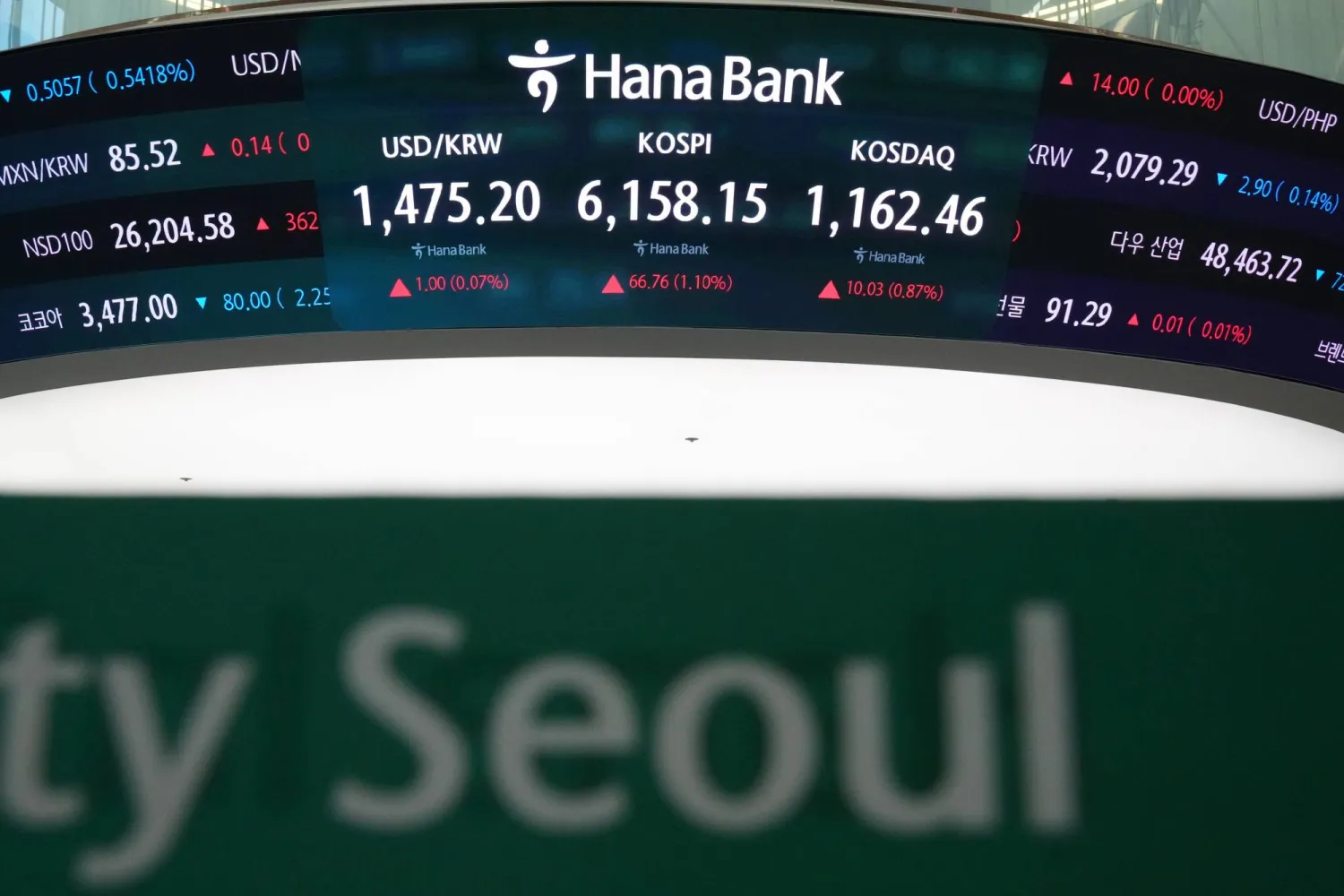
The screens showing the Korea Composite Stock Price Index (KOSPI), the foreign exchange rate between US dollar and South Korean won and the Korean Securities Dealers Automated Quotations (KOSDAQ) at a dealing room of Hana Bank, in Seoul, South Korea, Thursday, April 16, 2026. (AP Photo/Lee Jin-man)
TT

Riyadh Backs Seoul with 250 Million Barrels of Crude Oil

The screens showing the Korea Composite Stock Price Index (KOSPI), the foreign exchange rate between US dollar and South Korean won and the Korean Securities Dealers Automated Quotations (KOSDAQ) at a dealing room of Hana Bank, in Seoul, South Korea, Thursday, April 16, 2026. (AP Photo/Lee Jin-man)

South Korea has secured 273 million barrels of crude oil from the Middle East and Kazakhstan through the end of the year, with supplies routed outside the Strait of Hormuz, presidential chief of staff Kang Hoon-sik said on Wednesday.

Asia's fourth-largest economy has also secured 2.1 million metric tons of naphtha over the same period, Kang said at a press briefing following his visit as a special presidential envoy to Kazakhstan, Oman, Saudi Arabia and Qatar over the past week.

"In particular, the crude oil and naphtha secured this time will be sourced through ⁠alternative supply routes ⁠unrelated to closure of the Strait of Hormuz, and will therefore make a direct and tangible contribution to stabilizing domestic supply," Reuters quoted Kang as saying.

Saudi Arabia had agreed to ship about 50 million barrels of crude oil already allocated to South Korean companies, using alternative ports near the Red Sea in April and May, Kang said.

Riyadh had also pledged to prioritize South Korean companies in allocating and shipping 200 million barrels of crude oil between June and the end ⁠of the year, and promised to supply as much naphtha as possible through year-end, including 500,000 tons requested by South Korea's government, he said.

Kang said Kazakhstan would supply 18 million barrels of crude oil, while Oman has promised 5 million barrels of crude oil and 1.6 million tons of naphtha.

He said the secured crude oil would be sufficient to power the economy for more than three months under normal conditions based on last year’s usage, while the naphtha volumes were equivalent to about one month of imports.

Kang said the oil and naphtha would be sourced from alternative supply routes not affected by a potential closure of the Strait of Hormuz.

He described his trip as driven by the urgent need ⁠to secure key energy ⁠supplies amid what he called an economic emergency triggered by the conflict in the Middle East.

South Korea relied on the Strait of Hormuz for 61% of its crude oil imports and 54% of its naphtha imports last year, Kang said, adding the government could not afford to wait passively for the regional situation to improve.

President Lee Jae Myung conveyed deep concern over the prolonged Middle East conflict in letters sent to the leaders of the countries visited, expressing solidarity and calling for joint efforts to address the energy security crisis, Kang said.

South Korea also held discussions with oil producers including Saudi Arabia and Oman on cooperation in areas such as constructing bypass pipelines and building oil storage facilities outside the Strait of Hormuz to mitigate risks from a potential blockade.

With additional funding allocated to expand domestic storage facilities, Kang said joint stockpiling with major oil producers could be expanded, helping secure stable supplies.



UK Economy Surged Ahead of Iran War, but Energy Shock to Test Resilience

Buses pass in front of the Bank of England building in London (Reuters)
TT

UK Economy Surged Ahead of Iran War, but Energy Shock to Test Resilience

Buses pass in front of the Bank of England building in London (Reuters)

Britain's economy put on a burst of growth in February, suggesting it was in slightly better shape before the start of the Iran war than many economists had feared, official figures showed on Thursday.

Gross domestic product expanded 0.5% month-on-month in February, the biggest increase since January 2024, the Office for National Statistics said. Economists polled by Reuters had forecast a much more modest reading of 0.2%.

While the figures are likely to cheer finance minister Rachel Reeves, economists said Britain remained ⁠vulnerable to the fallout from ⁠the Middle East conflict, being highly dependent on imported energy and prone to higher inflation than peers.

"Unfortunately, the latest energy price shock has likely pulled the rug on this momentum, with another year of above-target inflation and a softening labour market likely to come," said Fergus Jiminez-England, associate economist from the National Institute for Economic and Social Research.

Britain suffered the sharpest cut to economic growth forecasts for large rich economies by the International ⁠Monetary Fund due largely to the Iran war, in forecasts published on Tuesday.

"Growth increased further in the three months to February led by broad-based increases across services," ONS chief economist Grant Fitzner said.

"Meanwhile car production recovered from the effects of the autumn cyber incident."

Economic growth for the three months to February was 0.5%, the ONS said, putting Britain's economy on track for a conspicuously strong first quarter, for a third year running.

That pattern has led to suspicions among some economists that the ONS' process of seasonal adjustment has gone awry following unusually large swings in output during the COVID-19 pandemic - something the ONS rejects.

"We're confident in our figures and seasonal adjustment processes," ⁠an ONS spokesperson ⁠said on Thursday, adding that statisticians had looked thoroughly at the issue.

James Smith, economist at ING, said he still doubted whether the ONS had fully accounted for the influence of the last period of high inflation in its seasonal adjustment process, and the timing of price increases.

"We wrote in our reaction to the January data that February or March could see a strong bounce back for exactly this reason," Smith said.

"Suffice to say, all of this is old news anyway, given the crisis we find ourselves in today."

Separate ONS data showed Britain's total trade deficit, excluding the volatile movements of precious metals, rose in inflation-adjusted terms in February to 5.627 billion pounds ($7.62 billion), its highest since November 2024.

The widening was driven by imports rising to their second-highest reading on record, after December 2022.


Oil Little Changed on Skepticism US-Iran Peace Talks Will Ease Hormuz Disruption

FILE PHOTO: A map showing the Strait of Hormuz, also known as Madiq Hurmuz, and 3D printed oil barrels are seen in this illustration taken March 26, 2026. REUTERS/Dado Ruvic/Illustration//File Photo
TT

Oil Little Changed on Skepticism US-Iran Peace Talks Will Ease Hormuz Disruption

FILE PHOTO: A map showing the Strait of Hormuz, also known as Madiq Hurmuz, and 3D printed oil barrels are seen in this illustration taken March 26, 2026. REUTERS/Dado Ruvic/Illustration//File Photo

Oil prices were little changed on Thursday, reversing earlier declines, on skepticism that peace talks between the US and Iran will reach a deal to end the war that has bottled up oil output from the key Middle East producing region.

Brent crude futures were down 26 cents to $94.67 a barrel at 0611 GMT. US West Texas Intermediate crude futures climbed 14 cents to $91.43 a barrel. Both benchmarks settled little changed on Wednesday but traded in a wide range. The US-Israeli war on Iran has ‌resulted in the ‌largest-ever disruption of global oil and gas supplies due ‌to ⁠Iran's interruption of traffic ⁠through the Strait of Hormuz, which typically carries about 20% of the world's oil and liquefied natural gas flows.

"While there are hopes for de-escalation, many investors remain skeptical, given that US-Iran talks have repeatedly broken down even after appearing to make progress," said Toshitaka Tazawa, an analyst at Fujitomi Securities.

"Until a peace deal is reached and free navigation through the strait is restored, WTI prices are expected to continue fluctuating between $80 and $100," ⁠he added.

Analysts from ING estimate that roughly 13 million barrels ‌per day of oil flow has been disrupted ‌by the closure of the strait, after taking into consideration pipeline diversions and the trickle of ‌tankers that have passed through the gateway, they said in a note on ‌Thursday.

With the US blockade on Iranian ports announced after the collapse of peace talks over the weekend, the disruption could increase.

"The physical market is becoming tighter every day that passes without a restart of oil flows through the Strait of Hormuz," the ING analysts said.

A source ‌briefed by Tehran told Reuters that Iran could consider allowing ships to sail freely through the Omani side of the ⁠Strait of Hormuz ⁠if a deal was reached to prevent renewed conflict after a two-week ceasefire started on April 8.

US and Iranian officials were weighing a return to Pakistan for further talks as early as the coming weekend. Pakistan's army chief arrived in Tehran on Wednesday as a mediator to try to prevent a renewal of the conflict.

US Treasury Secretary Scott Bessent said on Wednesday that Washington will not be renewing the waivers that allowed the purchase of some Iranian and Russian oil without facing US sanctions.

Underscoring the tightness of global crude and oil product supply, US inventories of oil, gasoline and distillate fuels fell last week, the Energy Information Administration said on Wednesday, as imports declined and exports jumped to meet the needs of countries searching for barrels to replace the disrupted flows.


TotalEnergies: Strong Trading, High Oil Prices Will Boost Q1 Earnings

(FILES) This illustrative photograph shows screens displaying the logo of the French company TotalEnergies, listed on the CAC 40, the main stock market index of the Paris Stock Exchange, in Toulouse on March 31, 2026. (Photo by Lionel BONAVENTURE / AFP)
TT

TotalEnergies: Strong Trading, High Oil Prices Will Boost Q1 Earnings

(FILES) This illustrative photograph shows screens displaying the logo of the French company TotalEnergies, listed on the CAC 40, the main stock market index of the Paris Stock Exchange, in Toulouse on March 31, 2026. (Photo by Lionel BONAVENTURE / AFP)

TotalEnergies expects a significant increase in first-quarter earnings from a strong trading performance, as well as in its upstream production and oil sales due to higher prices caused by the war in Iran, even as the conflict shut down 15% of the French group's overall production, it said on Thursday.

The group's margin on refining fuel in Europe during the quarter stood at $11.40 per barrel, up 192% from $3.90 a ⁠year earlier, and flat ⁠compared to the fourth-quarter 2025 margin of $11.40, it said in an earnings outlook.

It is due to report first-quarter earnings on April 29.

Benchmark Brent crude futures climbed to multi-year highs near $120 a barrel after US-Israeli strikes on Iran began in late February, followed by Tehran’s closure of the Strait of Hormuz and its attacks on Gulf neighbors.

Despite losing output of about 100,000 barrels of oil-equivalent per day in the Middle East, additional production in other geographies helped keep overall production flat compared to the fourth quarter of 2025.

That led to a significant rise in first-quarter upstream income due to oil price gains, Total said, while downstream results also increased due to refineries running above 90% and "strong performance from crude oil and petroleum product trading activities in March."

According to Reuters, Total said strong trading around market volatility also significantly boosted its liquefied natural gas earnings.

British rivals BP and Shell have said the oil price volatility caused by the ⁠war significantly boosted ⁠their trading profits.

US peers Chevron and Exxon said higher prices boosted their upstream earnings, but hit their downstream business due to financial hedging transactions undertaken around cargoes that could not be delivered due to the Strait of Hormuz's closure.

Total's Integrated Power results are expected to be around $500 million, roughly flat compared to a year ago.

Marketing and Services will also be in line with results a year ago.

The company expects a working capital build of $5 billion for the quarter — about $2.5-3 billion of which Total attributed to the seasonality of the business, with the remainder related to the impact of oil and product price rises on Total's inventories.

Shares of TotalEnergies SE were down 0.8% at 76.04 euros at 0702 GMT, paring losses after falling as much as 3.2%.