


Australia to Boost Defense Spending Citing Growing Threats

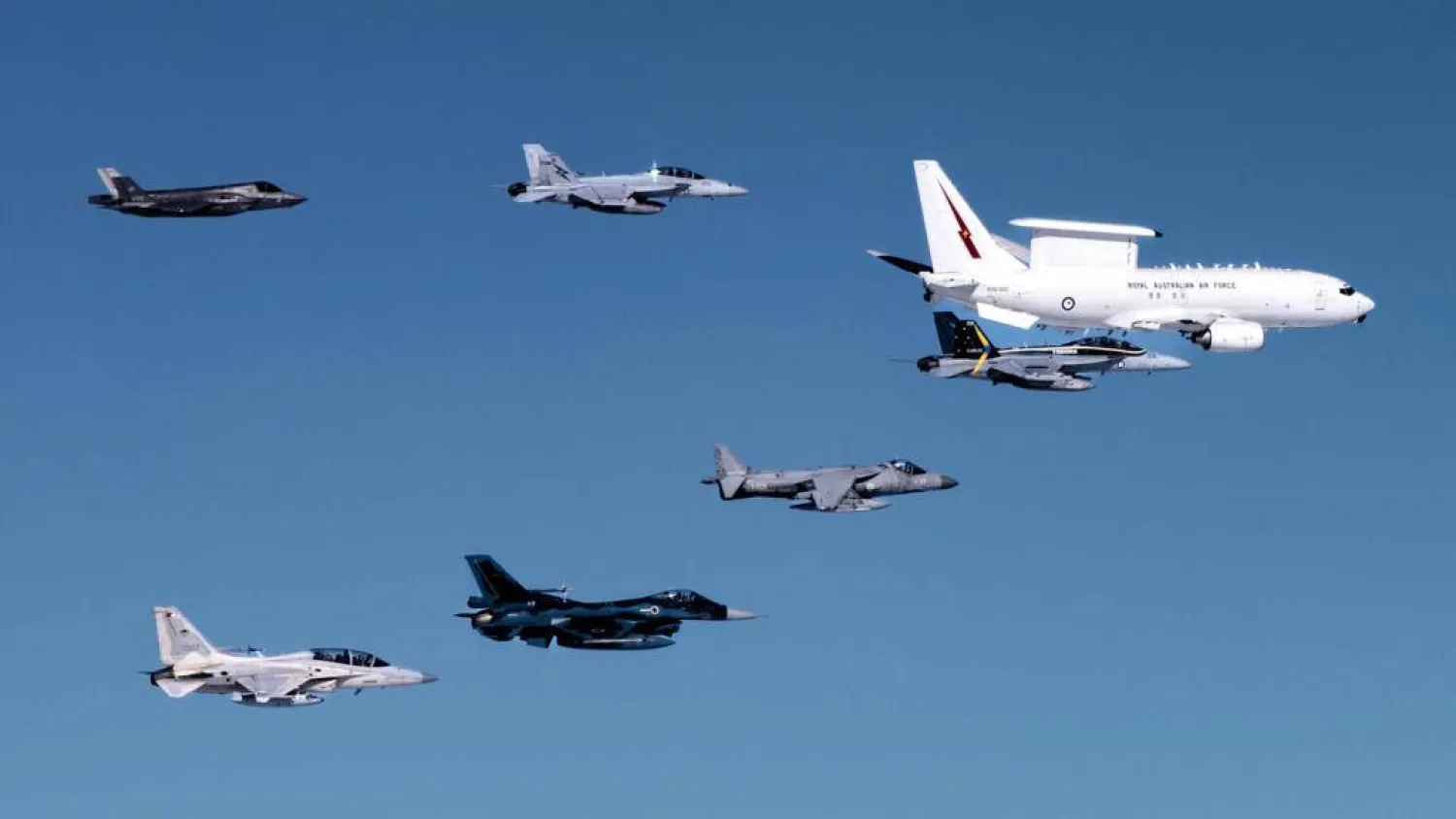
 This handout image taken on July 23, 2024 and released by the Australian Defense Force shows a Royal Australian Air Force (RAAF) E-7A Wedgetail airborne early warning and control aircraft (top R) in formation flight with an RAAF EA-18G Growler electronic warfare aircraft (bottom R), RAAF F/A-18F Super Hornet (top C), a Spanish Navy AV-8B Harrier II (bottom C), an F-35 Lightning II (top L), a Japan Air Self-Defense Force Mitsubishi F-2 (bottom 2nd L), and a Philippine Air Force FA-50 Golden Eagle (bottom L) over northern Australia during Exercise Pitch Black 2024.  Handout / AUSTRALIA DEFENCE FORCE/AFP
This handout image taken on July 23, 2024 and released by the Australian Defense Force shows a Royal Australian Air Force (RAAF) E-7A Wedgetail airborne early warning and control aircraft (top R) in formation flight with an RAAF EA-18G Growler electronic warfare aircraft (bottom R), RAAF F/A-18F Super Hornet (top C), a Spanish Navy AV-8B Harrier II (bottom C), an F-35 Lightning II (top L), a Japan Air Self-Defense Force Mitsubishi F-2 (bottom 2nd L), and a Philippine Air Force FA-50 Golden Eagle (bottom L) over northern Australia during Exercise Pitch Black 2024. Handout / AUSTRALIA DEFENCE FORCE/AFP
TT

Australia to Boost Defense Spending Citing Growing Threats

 This handout image taken on July 23, 2024 and released by the Australian Defense Force shows a Royal Australian Air Force (RAAF) E-7A Wedgetail airborne early warning and control aircraft (top R) in formation flight with an RAAF EA-18G Growler electronic warfare aircraft (bottom R), RAAF F/A-18F Super Hornet (top C), a Spanish Navy AV-8B Harrier II (bottom C), an F-35 Lightning II (top L), a Japan Air Self-Defense Force Mitsubishi F-2 (bottom 2nd L), and a Philippine Air Force FA-50 Golden Eagle (bottom L) over northern Australia during Exercise Pitch Black 2024.  Handout / AUSTRALIA DEFENCE FORCE/AFP
This handout image taken on July 23, 2024 and released by the Australian Defense Force shows a Royal Australian Air Force (RAAF) E-7A Wedgetail airborne early warning and control aircraft (top R) in formation flight with an RAAF EA-18G Growler electronic warfare aircraft (bottom R), RAAF F/A-18F Super Hornet (top C), a Spanish Navy AV-8B Harrier II (bottom C), an F-35 Lightning II (top L), a Japan Air Self-Defense Force Mitsubishi F-2 (bottom 2nd L), and a Philippine Air Force FA-50 Golden Eagle (bottom L) over northern Australia during Exercise Pitch Black 2024. Handout / AUSTRALIA DEFENCE FORCE/AFP

Australia will raise defense spending to 3.0 percent of GDP by 2033 as armed conflicts flare worldwide, Defense Minister Richard Marles said Thursday.

The new commitment follows pressure from US President Donald Trump's administration for Canberra to boost military expenditure as a share of total annual economic output.

"International norms that once constrained the use of force and military coercion continue to erode," Marles said in a speech in Canberra, outlining a boost to spending on missile defense, drones and guided weapon stockpiles.

"More countries are engaged in conflict today than at any time since the end of World War II, and this is occurring across every region of the world."

Australia's defense spending had previously been forecast to rise to 2.3 percent of GDP by 2033, AFP said.

But the country will spend an additional AU$53 billion ($38 billion) over the next decade when compared to its 2024 defense strategy, Marles said.

In the shorter term, spending would climb by an extra AU$14 billion over four years.

To reach the 3.0 percent figure, Australia changed how it calculates the defense budget to match a NATO definition that includes factors such as military pensions and defense intelligence.

Marles said Thursday this allowed better comparisons with other countries and put Australia ahead of comparable European and Asian nations with a defense spend this year of 2.8 percent.

- China build-up -

But the new spending still falls short of the 3.5 percent of GDP that US Defense Secretary Pete Hegseth demanded Australia shell out last year.

Wary of China's navy build-up, US ally Australia has reshaped its defense force in recent years to focus on its missile strike capability and deterring an adversary from its northern approaches.

It has also embarked on its largest-ever military spending project to build nuclear-powered submarines next decade under the AUKUS agreement with the United States and the UK.

Marles emphasized Australia would focus in 2026 on building greater military self-reliance but was not jettisoning its US security alliance, which he said remained "fundamental".

"There is no effective balance of power in the Indo-Pacific absent the continued presence of the United States," he said.

Spending to build a missile defense system will accelerate -- up to AU$30 billion over the next decade.

Another AU$36 billion will be spent to build guided missiles locally.

Australia's vast coastline and small population have also spurred a focus on developing large autonomous submarines and fighter jets, dubbed the Ghost Shark and Ghost Bat.

This week, Canberra said it would boost spending on drones by up to AU$5 billion in response to shifts in warfare tactics in the Middle East and Ukraine.

Under the AUKUS agreement, the United States will sell Australia two nuclear-powered submarines from 2032.

Australia and Britain will then build a new class of submarine in the 2040s.

Critics have alleged the deal does not guarantee that Australia will ever receive the submarines.



Israel PM Says Trump Agreed Any Final Iran Deal Must End ‘Nuclear Threat Entirely’

US President Donald Trump points his finger towards Israeli Prime Minister Benjamin Netanyahu during a press conference after meeting at Trump’s Mar-a-Lago club in Palm Beach, Florida, US, December 29, 2025. (Reuters)
TT

Israel PM Says Trump Agreed Any Final Iran Deal Must End ‘Nuclear Threat Entirely’

US President Donald Trump points his finger towards Israeli Prime Minister Benjamin Netanyahu during a press conference after meeting at Trump’s Mar-a-Lago club in Palm Beach, Florida, US, December 29, 2025. (Reuters)

Israeli Prime Minister Benjamin Netanyahu said on Sunday he and US President Donald Trump had agreed that any final deal with Iran must fully end the Islamic republic's "nuclear threat".

Netanyahu was referring to a conversation between the two leaders on Saturday night, which Trump had earlier said "went very well".

"President Trump and I agreed that any final agreement with Iran must eliminate the nuclear threat entirely. This means dismantling Iran's uranium enrichment facilities and removing enriched nuclear material from its territory," Netanyahu said in a statement.

"My policy, like that of President Trump, remains unchanged: Iran will not obtain nuclear weapons," he added.

Netanyahu said the two also discussed the memorandum of understanding on the reopening of the Strait of Hormuz.

"The partnership between our two nations has been proven on the battlefield, and it has never been stronger," the Israeli leader said, adding that Trump had reaffirmed his support for Israel's right to defend itself against threats on all fronts, "including in Lebanon".


Protesters in Spain Condemn Police Handling of Gaza Flotilla Activists

People hold Palestinian flags during a press conference organized by Basque Delegation within the Global Sumud Flotilla, in Bilbao, northern Spain, 24 May 2026. (EPA)
TT

Protesters in Spain Condemn Police Handling of Gaza Flotilla Activists

People hold Palestinian flags during a press conference organized by Basque Delegation within the Global Sumud Flotilla, in Bilbao, northern Spain, 24 May 2026. (EPA)

Around two thousand protesters ‌took to the streets of the Spanish city of Bilbao on Sunday to condemn the Basque police's treatment of activists from a Gaza aid flotilla on their return from detention in Israel.

When a relative of one of the six returning activists tried to approach them at Bilbao airport on Saturday, a police officer forcefully prevented him from doing so, leading to scuffles between both sides, images from state broadcaster TVE showed.

Images showed police striking people ‌with batons and ‌pinning others to the ground while being ‌jeered ⁠by onlookers. Before this, ⁠activists appeared to have blocked the exit for other passengers and police tried to move them.

The Basque regional police force said in a statement on Sunday it had launched an investigation to determine if officers complied with procedures. Reuters has reached out to the Spanish government for ⁠comment.

On Sunday's march, pro-Palestinian demonstrators carried banners ‌criticizing the Basque police force ‌and accusing the local government of being complicit with Zionism.

The ‌activists were released from Israeli custody after being detained ‌on a flotilla trying to bring aid to Gaza. Organizers alleged on Friday that the activists were subjected to abuse while in Israeli detention, with several hospitalized with injuries and at least ‌15 reporting sexual assaults, including rape.

Israel's prison service denied the allegations, and Reuters was not ⁠able to ⁠verify the activists' claims independently.

Spain was among a series of Western governments on Thursday which expressed their anger after Israeli minister Itamar Ben-Gvir posted a video of himself mocking the activists as they were pinned to the ground in a prison.

Francesca Albanese, a UN expert on the Palestinian territories, has called for those responsible for events at Bilbao airport to be held responsible, while Amnesty International has demanded a thorough investigation.

The Israeli Embassy in Spain has demanded an "explanation" from the Spanish government over the events at Bilbao airport.


Report: Macron Warns Belarus Against Involvement in Ukraine War

France's President Emmanuel Macron (C) speaks with Lens' French head coach Pierre Sage (L) ahead of the French Cup final football match between RC Lens and OGC Nice at the Stade de France stadium, in Saint-Denis, on the outskirts of Paris, on May 22, 2026. (AFP)
TT

Report: Macron Warns Belarus Against Involvement in Ukraine War

France's President Emmanuel Macron (C) speaks with Lens' French head coach Pierre Sage (L) ahead of the French Cup final football match between RC Lens and OGC Nice at the Stade de France stadium, in Saint-Denis, on the outskirts of Paris, on May 22, 2026. (AFP)

French President Emmanuel Macron on Sunday warned Belarusian leader Alexander Lukashenko, a key Russian ally, against an involvement in Moscow's war against Ukraine, a source close to Macron said.

The warning was made during the first reported phone call between the two leaders since the early days of Russia's invasion in February 2022, partly launched from Belarusian territory.

Macron "stressed the risks for Belarus of allowing itself to be drawn into Russia's war of aggression against Ukraine," the source, who spoke on condition of anonymity, said.

"He also urged Alexander Lukashenko to take the necessary steps to improve relations between Belarus and Europe," the source added.

A brief readout on the Belarusian presidency's website said that "the heads of state discussed regional issues and Belarus' relations with the EU and with France in particular."

The conversation took place "at the initiative of the French side", the readout added.

Earlier in May, Ukrainian President Volodymyr Zelensky ordered troops to reinforce the border with Belarus in the north, claiming Moscow was preparing a new offensive from there. The Kremlin denied that.

Russia and its smaller ally Belarus held nuclear drills days ago, on May 18, as Kyiv escalated its drone attacks on Russia.

Belarus, which borders NATO's eastern flank, hosts Russia's latest nuclear-capable missile, the Oreshnik.

On Sunday, Russia used the ballistic hypersonic missile for the third time in the war against Ukraine, as part of a massive drone and missile barrage that caused widespread destruction across Kyiv.