Over a Dozen Countries Offer to Play Role in Hormuz Mission, Starmer Says

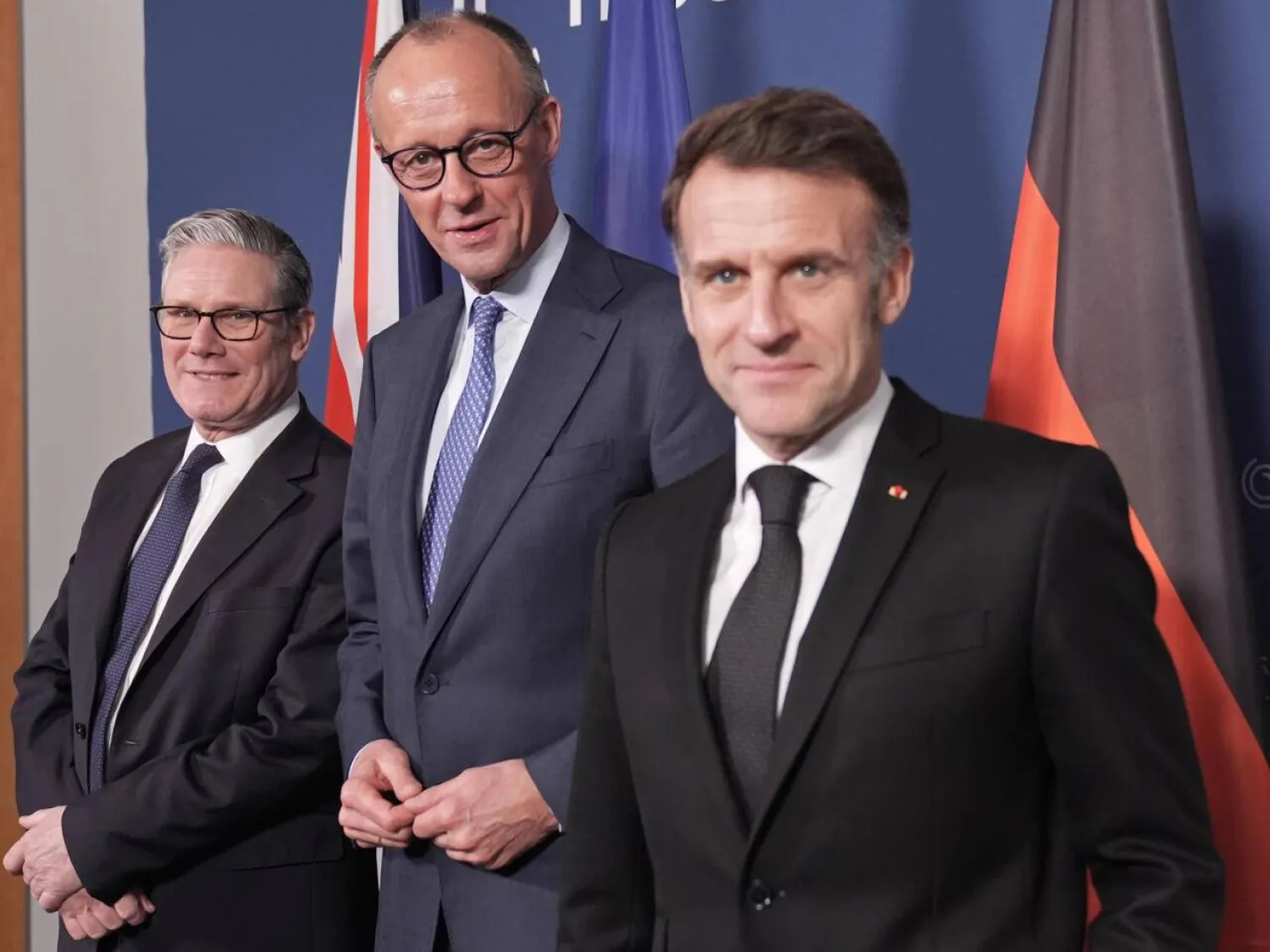
The leaders of Germany, Britain and France are expected to be present. Stefan Rousseau / POOL/AFP
TT

Over a Dozen Countries Offer to Play Role in Hormuz Mission, Starmer Says

The leaders of Germany, Britain and France are expected to be present. Stefan Rousseau / POOL/AFP

More than a dozen countries said on Friday they were willing to join an international mission to protect shipping in the Strait of Hormuz when conditions permit, Britain said, just as US President Donald Trump said he did not need allies' help. 

Some 50 countries from Europe, Asia and the Middle East joined a video conference chaired by France and Britain that followed on initial military planning and aimed to send a signal to Washington. 

Iran, which said on Friday it was ready to open the strait, has largely closed it to ships other than its own since the start ‌of US-Israeli airstrikes ‌against it on February 28. On Monday, Washington imposed a blockade ‌on ⁠ships entering or leaving ⁠Iranian ports. 

Trump has called on other countries to help enforce the blockade and has criticized NATO allies for not doing so, but just as the Paris talks concluded, Trump said he had told NATO to stay away. 

Britain, France and others say joining the blockade would amount to entering the war, but that they would be willing to help keep the strait open once there was a lasting ceasefire or the conflict ended. 

MORE TALKS NEXT WEEK 

French President Emmanuel Macron said the ⁠meeting had allowed them to send a united message to demand ‌the immediate and unconditional reopening of the strait, through which ‌around a fifth of the world's oil and liquefied natural gas usually passes, and restoration of free ‌passage. 

"We all oppose any restriction, anything that would amount, in effect, to an attempt to ‌privatize the strait, and obviously any toll system," Macron told reporters. 

He said part of French naval assets currently deployed in the eastern Mediterranean and Red Sea could be used for the mission. 

"We will take this forward with a military plan conference in London next week where we will announce more detail ‌on the composition of the mission, and over a dozen countries have already offered to contribute assets," British Prime Minister Keir Starmer said. 

The initiative ⁠being discussed did ⁠not, for now, include the United States or Iran, though European diplomats said any realistic mission would ultimately need to be coordinated with both. 

RESOURCES WILL DEPEND ON SITUATION, OFFICIAL SAYS 

German Chancellor Friedrich Merz said his country was prepared to contribute to the mission, adding that input from the US would also be "desirable" and that he did not want the issue to become a "stress test" for transatlantic relations. 

Several diplomats said the mission might never materialize if the situation in the Strait of Hormuz returned to normal. 

Others said shipping companies and insurers could seek such a deployment during a transitional phase to provide reassurance. 

"It can involve intelligence sharing, mine-clearance capabilities, military escorts, information procedures with neighboring countries and more,” a senior French official said. 

"The objective is clear, and the resources deployed will naturally depend on the situation." 


Trump Reportedly Holds Call with Netanyahu Over State of Iran War

FILE - President Donald Trump speaks at the Oval Office of the White House, in Washington. (AP Photo/Jacquelyn Martin, File)
TT

Trump Reportedly Holds Call with Netanyahu Over State of Iran War

FILE - President Donald Trump speaks at the Oval Office of the White House, in Washington. (AP Photo/Jacquelyn Martin, File)

US President Donald Trump held a call with Israel's Benjamin Netanyahu over when and whether to ramp up combat operations against Iran, US media reported Sunday.

Axios quoted one US and one Israeli official saying the two leaders on Saturday discussed the state of negotiations with Tehran, with Netanyahu pressing the president to launch strikes on Iran immediately after the US midterm elections and Trump eager to let negotiations play out.

The Israeli source described the call as "tough," while the American source said it was "direct," according to Axios.

Throughout the eight-month war Trump has pursued dual tracks with Tehran: a campaign of airstrikes and other attacks, while seeking to reach a deal that would jumpstart peace talks and fully open the Strait of Hormuz to vital oil and gas traffic.

On Saturday the president maintained to reporters that negotiations with Iran to end the war were "going fine," and that there were still one or two targets to "take care" of.

He stressed too that Washington was not in a hurry to take offensive action because it had already decimated Iran's military and its nuclear program.

The Trump-Netanyahu talks followed the disclosure Saturday by Iran's security chief Mohsen Rezaei that he had received a letter from US Vice President JD Vance seeking to revive stalled talks.

In another sign that mediators are keen to resume negotiations, a Qatari delegation arrived in Tehran on Friday for talks with Iranian officials, state media reported.


UKMTO: Vessel Struck in Strait of Hormuz

FILE PHOTO: Vessels at the Strait of Hormuz, as seen from Musandam, Oman, October 2, 2026. REUTERS/Stringer/File Photo
TT

UKMTO: Vessel Struck in Strait of Hormuz

FILE PHOTO: Vessels at the Strait of Hormuz, as seen from Musandam, Oman, October 2, 2026. REUTERS/Stringer/File Photo

A vessel was struck on Sunday by "an unknown projectile" in the Strait of Hormuz, a British maritime security agency said, after Qatari media reported an earlier attack on a gas tanker.

Britain's UKMTO maritime agency said "the master of a merchant vessel has relayed a mayday call... stating that another vessel has been struck by an unknown projectile" in the strait.

Earlier, Qatar's state news agency said a Qatari gas tanker had been attacked on Friday with "unidentified objects" while transiting Gulf waters.

The attack struck a liquefied natural gas carrier, Al Mayeda, which belongs to the Qatar Gas Transport Company, Qatar News Agency said.


Iran Army: Any New War with US Could be 'Longer Than Previous Conflict'

Iranians motorists drive past a poster of Iran's supreme leader Mojtaba Khamenei in central Tehran on November 1, 2026. (Photo by ATTA KENARE / AFP) /
TT

Iran Army: Any New War with US Could be 'Longer Than Previous Conflict'

Iranians motorists drive past a poster of Iran's supreme leader Mojtaba Khamenei in central Tehran on November 1, 2026. (Photo by ATTA KENARE / AFP) /

Iran warned on Sunday that any new war with the United States could last longer than the previous conflict and that US President Donald Trump would not be the one to determine its duration.

"A potential future war could last longer than previous conflict, and the American president would not be in a position to dictate the timing or the conditions of its conclusion," said army spokesman Mohammad Akraminia, according to Iranian state television.

He was referring to the most intense phase of the fighting in the war that began on February 28 with US-Israeli strikes on Iran, killing supreme leader Ali Khamenei.

Iran responded by launching missiles and drones across the region, while the militant groups it backs also entered the fray in Lebanon and Yemen.

Iran's Defense Minister Mehrdad Akhlaghi on Sunday warned of a "proportionate, decisive, and impactful response" to any attack on the country, according to state TV.

"Those who pose threats will not dictate the scope, timing, or consequences of Iran's defensive response," he added, according to AFP.

Also on Sunday, Hossein Mohebbi, the spokesperson of the Revolutionary Guard Corps echoed the remarks made by the country's new supreme leader Mojtaba Khamenei in a written message the day before.

"In a conflict with America, there are no geographical limitations; a vast theatre has been defined for inflicting damage upon the enemy," Mohebbi said, according to state TV.

US President Donald Trump said on Saturday that the United States has knocked out much of Iran's military but still has to "take care of" one or two targets.

"We've knocked out their nuclear. We still have to take care of, I would say one or two sites, but we can do that in 10 minutes," Trump said.