



Ericsson Lags Profit Expectations as AI Demand Drives Up Chip Costs

FILE PHOTO: A woman walks across the logo of Ericsson at the ongoing India Mobile Congress 2025 at Yashobhoomi, a convention and expo center in New Delhi, India, October 8, 2025. REUTERS/Anushree Fadnavis/File Photo
TT

Ericsson Lags Profit Expectations as AI Demand Drives Up Chip Costs

FILE PHOTO: A woman walks across the logo of Ericsson at the ongoing India Mobile Congress 2025 at Yashobhoomi, a convention and expo center in New Delhi, India, October 8, 2025. REUTERS/Anushree Fadnavis/File Photo

Sweden's Ericsson reported a first-quarter core profit that slightly missed market expectations on Friday, citing increasing chip costs caused by artificial intelligence demand and a sales slowdown in North America.

The network equipment maker is facing rising input costs partially due to high demand for AI technology that is driving up prices of semiconductors, CEO Börje Ekholm said in a statement.

"We are working ⁠together with our ⁠suppliers to mitigate this. But also, we will need to work with our customers to share the burden on this," finance chief Lars Sandström added in an interview with Reuters.

The company reported an adjusted operating profit of 5.2 billion Swedish ⁠crowns ($566 million), excluding restructuring charges, for the first quarter of 2026. Analysts polled by Infront were expecting 5.4 billion crowns on average.

Ericsson, one of the main Western suppliers of network equipment alongside Finland's Nokia, is betting heavily on the US market even as transatlantic ties have become strained under President Donald Trump's rule.

The Swedish group has significant exposure to the United States, especially after winning a $14 ⁠billion ⁠deal with operator AT&T in 2023, which could help outweigh slower telecoms investments in other markets.

Sandström said sales in North America fell by a mid-single-digit percentage in the quarter, compared to a strong year-ago period that was boosted by tariff-related demand. Underlying market conditions in the region remain solid, he added.

The group reported quarterly net sales of 49.3 billion crowns, compared with an Infront poll estimate of 50.7 billion crowns.



Saudi Human Resources Ministry Launches AI Arabia Center of Excellence Initiative at LEAP 2026

The Saudi Ministry of Human Resources and Social Development launched the AI Arabia Center of Excellence initiative during LEAP 2026 held in Riyadh. (SPA)
TT

Saudi Human Resources Ministry Launches AI Arabia Center of Excellence Initiative at LEAP 2026

The Saudi Ministry of Human Resources and Social Development launched the AI Arabia Center of Excellence initiative during LEAP 2026 held in Riyadh. (SPA)

The Saudi Ministry of Human Resources and Social Development, represented by the Digital Sector Skills Council, the Ministry of Communications and Information Technology, Microsoft, and Gulf Intelligence, launched the AI Arabia Center of Excellence initiative during LEAP 2026 held in Riyadh.

The initiative aims to accelerate the adoption of artificial intelligence technologies by workers in the labor market, develop their skills to meet future needs, and achieve the goals of Saudi Vision 2030, the Saudi Press Agency reported on Wednesday.

The joint initiative focuses on the opportunities offered by AI in developing economic sectors and increasing their productivity, in addition to strengthening national capabilities to utilize these technologies and transform them into applications and solutions with a tangible economic impact.

The initiative includes a range of knowledge and dialogue outputs, including three working papers on AI's future and its economic applications. It also features dialogue sessions bringing together leading experts, decision-makers, and sector leaders to discuss the transition from using AI technologies to achieving measurable economic value. In addition, the initiative includes several other outputs and knowledge content.


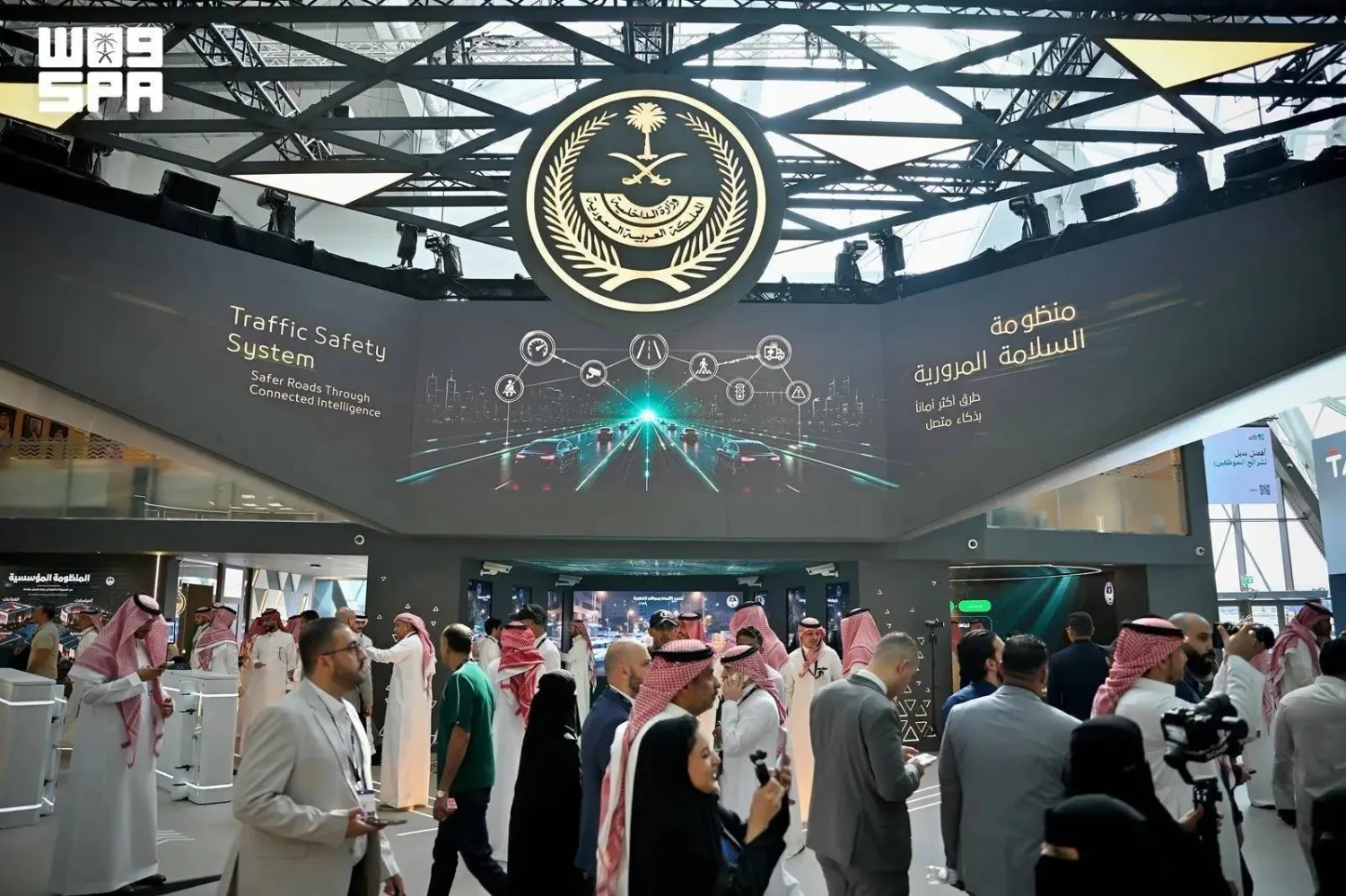
From Technology to Impact: Saudi Interior Ministry Showcases Future of Security at LEAP 2026

The Saudi Interior Ministry's pavilion at LEAP 2026 in Riyadh. (SPA)
TT

From Technology to Impact: Saudi Interior Ministry Showcases Future of Security at LEAP 2026

The Saudi Interior Ministry's pavilion at LEAP 2026 in Riyadh. (SPA)

Technology does not begin with a device, nor does it end at a screen. At LEAP 2026, the Saudi Ministry of Interior is presenting an integrated approach to harnessing modern technologies, data, artificial intelligence (AI), and digital solutions, reported the Saudi Press Agency on Tuesday.

The approach transforms standalone tools into interconnected capabilities that enhance security and safety, empower security personnel, improve institutional efficiency and services, and strengthen decision-making.

The ministry’s participation highlights six interconnected systems that reflect the broader digital transformation of the security and services ecosystem. These include field security and safety, where technology enhances readiness and accelerates response; rapid response, which strengthens early intervention capabilities; and road safety, which uses technology and data to make roads safer.

The systems also include security cameras, which provide broader visibility and more advanced monitoring capabilities, and digital services, which make users’ interactions easier, faster, and more integrated. Institutional services serve as the overarching intelligence connecting the various components of the system.

Together, the six systems encompass 36 services and projects: seven in field security and safety, eight in rapid response, three in road safety, seven in security cameras, nine in digital services, and two in institutional services.

The figures reflect the breadth of the Ministry of Interior’s digital transformation and the diversity of its applications across the ministry’s ecosystem.

At LEAP 2026, the Ministry of Interior is demonstrating more than a collection of technologies. It is presenting an integrated ecosystem in which technology translates into capability — from the field to command centers, from roads to communities, from monitoring to response, and from digital services to institutional operations.

Assistant Minister of Interior for Technology Affairs Thamer Alharbi stressed that the Ministry of Interior has harnessed modern technologies and artificial intelligence to deliver reliable security, humanitarian services, and public safety. 

Inaugurating the ministry's pavilion at the LEAP 2026 conference, Alharbi stressed that the ministry's core mission remains protecting people, fostering trust, and empowering service providers through robust digital capabilities. 

He highlighted key achievements, noting that the national digital identity platform "Nafath," developed with the National Information Center, serves over 32 million beneficiaries across 1,245 linked platforms, facilitating more than 6.5 billion transactions. 

Alharbi outlined field-support innovations, including the "Maidan Companion," which builds situational context and coordinates specialized emergency capabilities, alongside "Absher Open Services," enabling governed multi-entity integration. 

He added that "Absher Companion," developed with the Ministry of Communications and Information Technology and the Digital Government Authority, has processed over 3.3 million interactions and executed more than 348,000 transactions with a 96% completion rate. 


Palestine Signs Digital Cooperation Organization Charter at LEAP 2026

Palestinian Minister of Communications and Digital Economy Abdul Razzaq Al-Natsheh and DCO Secretary-General Deemah AlYahya at LEAP 2026 in Riyadh. (SPA)
TT

Palestine Signs Digital Cooperation Organization Charter at LEAP 2026

Palestinian Minister of Communications and Digital Economy Abdul Razzaq Al-Natsheh and DCO Secretary-General Deemah AlYahya at LEAP 2026 in Riyadh. (SPA)

The Digital Cooperation Organization (DCO) announced on Tuesday that the State of Palestine has signed the DCO Charter, becoming a signatory member.

The announcement was made on the sidelines of LEAP 2026 in Riyadh.

Palestine’s accession is expected to strengthen cooperation in building an inclusive, resilient, and sustainable digital economy and expand opportunities for individuals, businesses, and communities to benefit from digital transformation.

Palestinian Minister of Communications and Digital Economy Abdul Razzaq Al-Natsheh officially handed the DCO Charter to DCO Secretary-General Deemah AlYahya.

The move follows the DCO’s announcement that its council had approved the nominations of eight new countries for full membership. Once accession procedures are completed, the DCO’s membership will expand from 16 to 24 countries, collectively representing around 980 million people.

Palestine’s information and communications technology (ICT) sector comprises around 400 active establishments and employs more than 13,500 specialists. It generates more than $500 million in annual value added and contributes around 5% to GDP.

The sector also produces around 3,000 ICT graduates each year, reflecting its growing role in economic development and digital innovation.