


Trump Says ‘No Sticking Points’ for Iran Deal

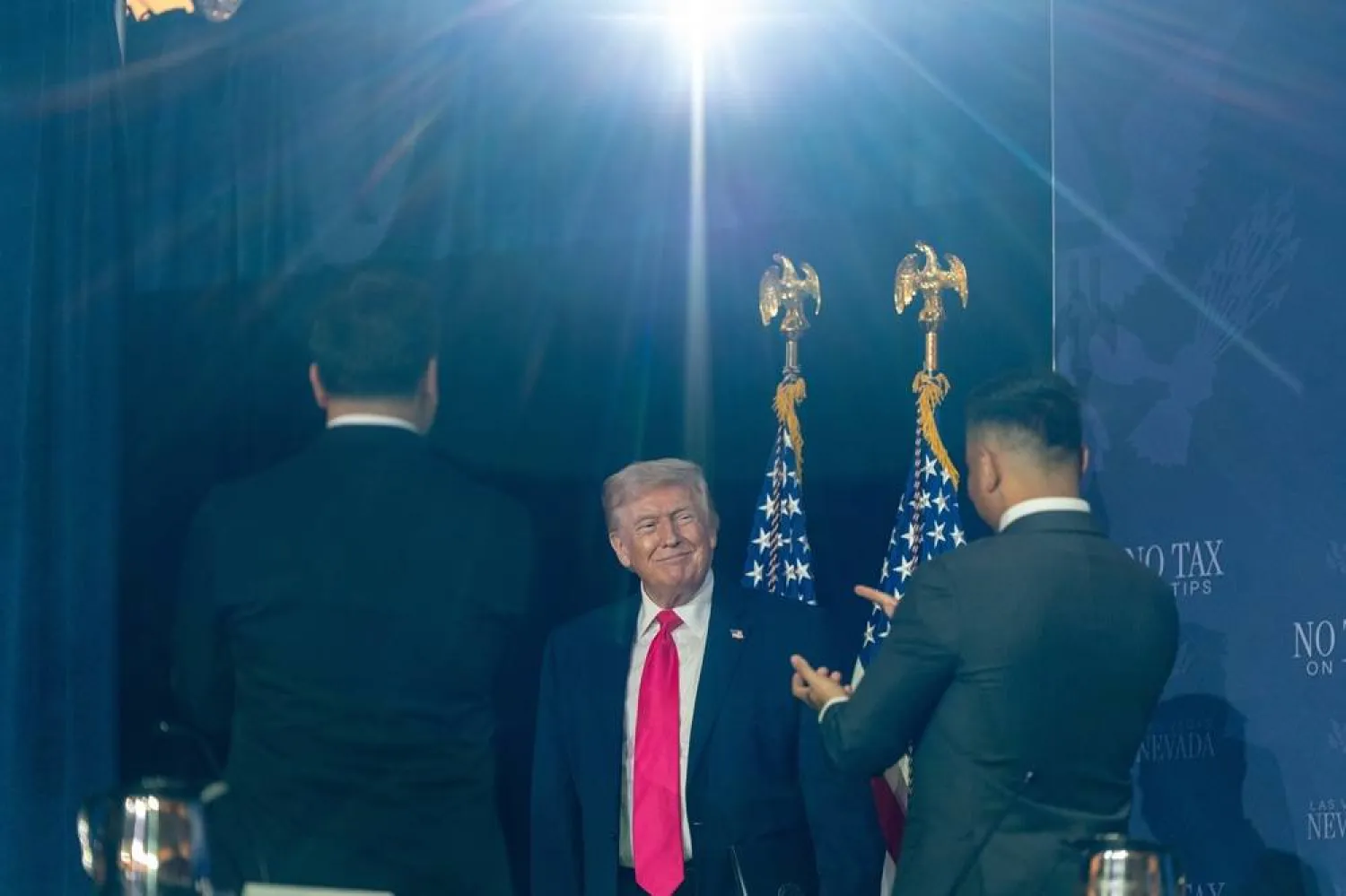
 President Donald Trump arrives for a roundtable event about no tax on tips, Thursday, April 16, 2026, in Las Vegas. (AP)
President Donald Trump arrives for a roundtable event about no tax on tips, Thursday, April 16, 2026, in Las Vegas. (AP)
TT

Trump Says ‘No Sticking Points’ for Iran Deal

 President Donald Trump arrives for a roundtable event about no tax on tips, Thursday, April 16, 2026, in Las Vegas. (AP)
President Donald Trump arrives for a roundtable event about no tax on tips, Thursday, April 16, 2026, in Las Vegas. (AP)

US President Donald Trump told AFP on Friday there were "no sticking points" left for a peace deal with Iran, adding that an agreement was "very close."

Trump's comments came after a series of social media posts in which he touted progress on reopening the Strait of Hormuz and ending Iran's nuclear program.

"We're very close. Looks like it's going to be very good for everybody. And we're very close to having a deal," Trump said in a brief telephone call with AFP from Las Vegas.

"The strait's going to be open, they already are open. And things are going very well."

A first round of US-Iran talks in Pakistan last weekend ended without a peace deal, but Trump has said a second round could happen soon.

Trump has said the core US demand is that Iran should never be able to develop a nuclear weapon, and he said on Thursday that Iran had agreed to turn over its stock of enriched uranium.

Asked what the remaining sticking points for a deal were, Trump replied, "No sticking points at all."

When asked why he was unable to declare a deal at this point after his string of optimistic posts, Trump said he wanted an agreement on paper.

"I don't do that, I get it in writing," Trump added.


South Korea Says North Korean Soldier in Custody after Crossing Border

File photo of North Korean soldiers at a guard post near the Demilitarized Zone (DMZ) that separates the two Koreas (Reuters)
TT

South Korea Says North Korean Soldier in Custody after Crossing Border

File photo of North Korean soldiers at a guard post near the Demilitarized Zone (DMZ) that separates the two Koreas (Reuters)

South Korea took a soldier from the North into custody after the individual crossed the heavily fortified border this week in what is believed to be a defection, South Korea's Yonhap news agency reported Wednesday.

"The military secured one North Korean soldier in the central front Tuesday night and relevant authorities are currently investigating the details," Seoul's Joint Chiefs of Staff said in a message to the media, according to Yonhap.

Tens of thousands of North Koreans have fled to South Korea since the peninsula was divided by war in the 1950s.

Most go overland to neighboring China first, then enter a third country such as Thailand before finally making it to the South.

Defections across the land border that divides the peninsula are relatively rare, as the area is densely forested, ridden with landmines and monitored by soldiers on both sides.

North Koreans are typically handed over to Seoul's intelligence agency for screening after arriving in the South.

More than 34,000 North Koreans have escaped the isolated country to the South, according to data from the Unification Ministry.

In 2024, 236 North Koreans arrived in South Korea, with women accounting for 88 percent of the total.

Pyongyang uses harsh words such as "human scum" to describe citizens who escape.


Alibaba Sues Pentagon over Blacklist Designation

The headquarters of the tech giant Alibaba (AP)
TT

Alibaba Sues Pentagon over Blacklist Designation

The headquarters of the tech giant Alibaba (AP)

Chinese tech giant Alibaba has filed a federal lawsuit against the US Defense Department for designating it a military-linked firm, with the company telling AFP on Wednesday that the labelling is "arbitrary and capricious.”

The lawsuit, filed Tuesday in San Jose federal court, contests the Pentagon's decision to include Alibaba in a list released this month of companies it says have ties to the Chinese military.

"The determinations have no basis in fact or law," the complaint said.

"Alibaba is not a Chinese military company nor part of any military-civil fusion strategy," a company spokesperson told AFP on Wednesday.

"The decision to place Alibaba on the... list is arbitrary and capricious, and we are filing a lawsuit against the Department of War to demand removal from the list," they said.

The Pentagon released the new blacklist this month of 80 companies and their subsidiaries it said were aiding the Chinese military.

The list also saw tech giant Baidu and electric vehicle firm BYD added.

Under the designation, beginning June 30, the Pentagon cannot enter into new contracts with designated companies or their controlled subsidiaries.

The designation also restricts the company's ability to retain lobbying firms in the United States, which the lawsuit argues violates First Amendment rights.

"The effect is already being felt: advocates who have represented Alibaba for years have informed the company that they can no longer do so," the complaint stated.

Alibaba said in its lawsuit it is a publicly traded e-commerce and cloud-services provider with a diverse shareholder base dominated by major American financial institutions including JPMorgan, Citigroup, and BlackRock.

China retaliated against the blacklist on Monday, imposing export controls on 10 US companies involved in defense and rare earths mining.

The feud tests bilateral relations after US President Donald Trump and Chinese counterpart Xi Jinping met in Beijing last month to stabilize ties.


Rubio Says US Will Not Accept Iranian Tolls on Hormuz

 Vessels at the Strait of Hormuz, as seen from Musandam, Oman, June 22, 2026. (Reuters)
Vessels at the Strait of Hormuz, as seen from Musandam, Oman, June 22, 2026. (Reuters)
TT

Rubio Says US Will Not Accept Iranian Tolls on Hormuz

 Vessels at the Strait of Hormuz, as seen from Musandam, Oman, June 22, 2026. (Reuters)
Vessels at the Strait of Hormuz, as seen from Musandam, Oman, June 22, 2026. (Reuters)

Washington's top diplomat insisted Tuesday that the US would not accept any attempt to impose tolls or fees on Strait of Hormuz, the key waterway where the UN said it would begin evacuating thousands of sailors stranded by the Middle East war 

The US and Iran have signed a preliminary deal to halt the war, and concluded a first round of talks in Switzerland as part of a 60-day negotiation period to settle outstanding issues like sanctions relief and the fate of Tehran's nuclear program. 

An Iranian blockade that began early in the conflict choked off maritime traffic through the Hormuz strait -- sending global oil prices surging -- but crossings have begun to rise again since the US-Iran deal was inked. 

Iran has repeatedly maintained it will retain control over the waterway, including on Tuesday, when it and Oman said in a joint statement that they would study the administration of the trade route and the costs to be charged for services provided, insisting on their sovereignty over the strait. 

But US Secretary of State Marco Rubio, kicking off a regional tour, reiterated Washington's position that such an arrangement would be unacceptable. 

"It's an international waterway. No country is allowed to charge tolls or fees on an international waterway," he said from Abu Dhabi, adding that he believed "all the countries in this region would agree". 

Tehran's top negotiator, Mohammad Bagher Ghalibaf, had earlier insisted the Strait of Hormuz "will never return" to the pre-war status quo, despite the foes agreeing to set up communication lines to keep it open. 

- Muscat meeting - 

Oman and Iran agreed on Tuesday to press on with discussions about the future administration of navigation in the Strait of Hormuz. 

In a joint statement issued after talks in Muscat, they said a joint working group involving their foreign ministries ‌would be ‌formed to continue the discussions and ‌that they ⁠would consult other ⁠littoral states and relevant parties.  

The move appears to implement a provision of the memorandum of understanding signed last week that calls for Iran to hold talks with Oman and other states on the future management of ⁠navigation and maritime services in the strait, ‌a vital waterway ‌for global oil supplies.  

The agreement was announced following a ‌visit by Speaker Ghalibaf and Foreign Minister Abbas Araqchi, who met Oman's Sultan Haitham bin Tariq and held talks with Omani Foreign Minister Badr Albusaidi.  

In the statement, Oman and ‌Iran, the two states bordering the strait, reaffirmed their commitment to ensuring ⁠safe ⁠passage through the waterway in accordance with international law while underlining sovereignty over their territorial waters.  

Since the start of the US-Israeli war against Iran in February, the strait has been largely closed to commercial shipping. The United States blockaded Iranian ports after Iran started effectively blocking the strait.  

Oman and Iran reaffirmed their commitment to the strait being a secure and open route for international navigation and to promoting maritime safety, freedom of navigation and regional stability. 

The head of the UN's International Maritime Organization, meanwhile, said it would begin evacuating more than 11,000 sailors stranded by the Hormuz blockade in cooperation with Iran, Oman and the United States, adding it had "secured the necessary safety guarantees". 

Traffic through the strait on Monday reached the highest level since the start of the war, according to two maritime tracking platforms, representing just over 40 percent of the normal peacetime level of about 120 vessels per day.
