

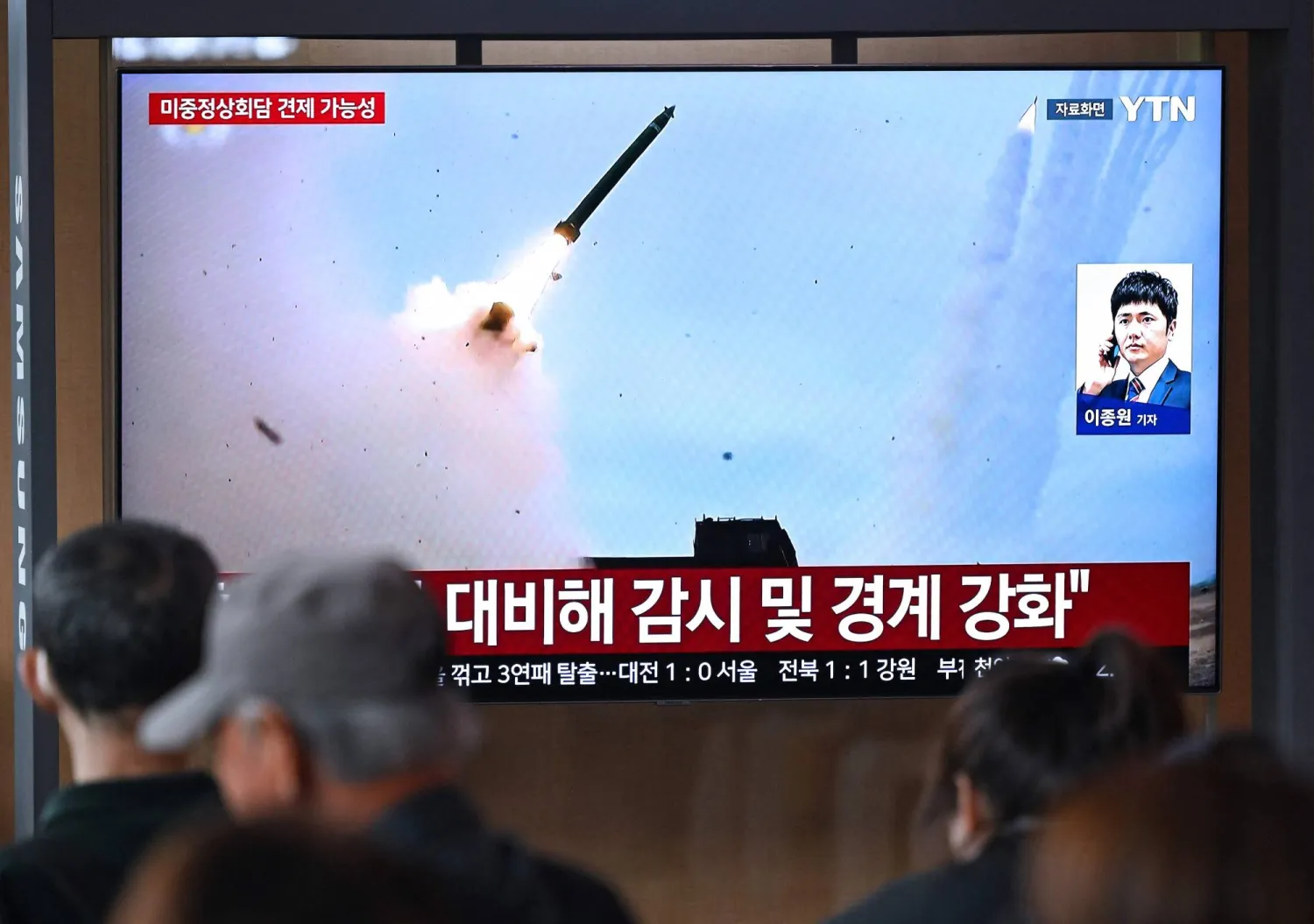

North Korea Fires Multiple Ballistic Missiles into Sea

People watch a television screen showing a news broadcast with file footage of a North Korean missile test, at a train station in Seoul on April 19, 2026. (AFP)
TT

North Korea Fires Multiple Ballistic Missiles into Sea

People watch a television screen showing a news broadcast with file footage of a North Korean missile test, at a train station in Seoul on April 19, 2026. (AFP)

North Korea test-fired multiple short-range ballistic missiles on Sunday, South Korea's military said, the latest in a recent flurry of launches by the nuclear-armed state.

The Sunday launches add to a series of weapons tests Pyongyang has carried out in recent weeks, including ballistic missiles, anti-warship cruise missiles and cluster munitions.

"Our military detected several short-range ballistic missiles fired into the East Sea from the Sinpo area of North Korea at around 6:10 am (GMT 21:10)," South Korea's Joint Chiefs of Staff said, referring to a body of water also known as the Sea of Japan.

"The missiles flew approximately 140 kilometers (86.9 miles), and South Korean and US intelligence authorities are conducting a detailed analysis of their exact specifications," it added.

Seoul is maintaining a "firm combined defense posture" with the United States -- a security ally that stations about 28,000 troops in the South to help it defend against military threats from the North -- and will "respond overwhelmingly to any provocation", it said.

South Korea's presidential office said it held an emergency security meeting over the launches.

Analysts said the tests signaled Pyongyang's latest rejection of attempts by Seoul to repair strained ties.

Among them was an expression of regret from Seoul over civilian drone incursions into the North in January, a gesture initially described as "very fortunate and wise behavior" by Kim Yo Jong, the powerful sister of the North Korean leader.

But this month, a senior North Korean official described the South as "the enemy state most hostile" to Pyongyang, reviving a label previously used by leader Kim Jong Un.

North Korea is subject to multiple United Nations sanctions banning its nuclear weapons development and use of ballistic missile technology, restrictions it has repeatedly flouted.

- Two more destroyers -

Earlier in April, North Korean leader Kim Jong Un oversaw tests of strategic cruise missiles launched from a naval warship, with official photos showing him watching the firings flanked by military officials.

Those tests were carried out from the Choe Hyon, one of two 5,000-ton destroyers in the North's arsenal, both launched last year as Kim Jong Un seeks to ramp up the country's naval capabilities.

The North is also building two more 5,000-ton class destroyers to add to its fleet.

A South Korean lawmaker said this month that North Korea appeared to be speeding up construction of a destroyer at the western port city of Nampo.

Citing satellite imagery from a US-based intelligence firm, Yoo Yong-won of the opposition People Power Party said North Korea was "accelerating the naval forces' modernization on the back of military assistance from Russia".

North Korea has sent ground troops and artillery shells to support Russia's invasion of Ukraine, and observers say Pyongyang is receiving military technology assistance from Moscow in return.



Police Charge 3rd Suspect in Melbourne Synagogue Arson Allegedly Directed by Iran

People gather outside the Adass Israel Synagogue, Dec. 9, 2024, after a firebombing in Melbourne, Australia. (Con Chronis/AAP Image via AP)
TT

Police Charge 3rd Suspect in Melbourne Synagogue Arson Allegedly Directed by Iran

People gather outside the Adass Israel Synagogue, Dec. 9, 2024, after a firebombing in Melbourne, Australia. (Con Chronis/AAP Image via AP)

Police charged a third suspect on Friday with an arson attack on a Melbourne synagogue that was allegedly directed by Iran.

The 20-year-old man was one of three masked offenders who broke into the Adass Israel Synagogue, doused the interior with flammable liquid then set it alight in the early hours of Dec. 6, 2024, a police statement alleged.

The fire caused extensive damage to the synagogue and a worshipper sustained minor injuries.

The Victorian Joint Counter Terrorism Team, which brings together federal and state police with a spy agency, charged the man, who has not been named, with offenses including arson.

He was charged in a Melbourne jail where he was already being held in custody on unrelated offenses. According to The Associated Press, police declined to elaborate on those offenses.

His co-accused Giovanni Laulu, 21, was arrested in July last year and another suspect, Younes Ali Younes, 20, was arrested a month later.

Prime Minister Anthony Albanese last year accused Iran’s Revolutionary Guard of directing the synagogue fire and an arson attack two months earlier at a Sydney kosher eatery, Lewis’ Continental Kitchen.

Mike Burgess, director-general of the Australian Security Intelligence Organization, the nation’s main domestic spy agency, said the Revolutionary Guard used a “complex web of proxies to hide its involvement” in both antisemitic attacks.

Iran’s ambassador to Australia and another three Iranian diplomats were expelled. Tehran has denied Australia’s allegations.

Australian Federal Police Assistant Commissioner Peter Crozier told reporters on Friday that investigators were working with international partners in the continuing investigation.

Police were also investigating whether the three alleged arsonists knew who ordered the attack.

“They may not actually be aware of the people who are directing or the principals of these investigations. That remains a key line of inquiry for us,” Crozier said.

Victoria Police Acting Assistant Commissioner Paul O’Halloran said police had informed the local Jewish community of the third arrest before the news was made public.

“Our heart goes out to them. Again, this brings back this terrible incident,” O’Halloran said.

“People deserve the right to feel safe and be safe in their community and particularly at their place of worship. Today's charges are a strong testament to this,” he added.

The latest suspect will make his first court appearance on the new charges next week.

The Australian government has established a public inquiry to investigate a rise in antisemitism across the country, including the killing of 15 people when two gunmen opened fire on a Sydney Hanukkah celebration in December.


WSJ: Pentagon Tells US Lawmakers it Needs $80 Billion for Iran War and other Bills

US Secretary of Defense Pete Hegseth attends a briefing held with Chairman of the Joint Chiefs of Staff General Dan Caine (not pictured), amid the US-Israeli conflict with Iran, at the Pentagon in Washington, D.C., U.S., March 31, 2026. REUTERS/Jonathan Ernst
TT

WSJ: Pentagon Tells US Lawmakers it Needs $80 Billion for Iran War and other Bills

US Secretary of Defense Pete Hegseth attends a briefing held with Chairman of the Joint Chiefs of Staff General Dan Caine (not pictured), amid the US-Israeli conflict with Iran, at the Pentagon in Washington, D.C., U.S., March 31, 2026. REUTERS/Jonathan Ernst

The US Department of Defense needs $80 billion to cover costs from the Iran war as well as other non-war-related bills, Deputy Defense Secretary Stephen Feinberg told lawmakers in phone calls this week, the Wall Street Journal reported on Thursday, citing people familiar with the matter.

A full US supplemental request, which will include money for the Pentagon ‌as well as ‌non-defense priorities such as farm ‌and disaster ⁠relief, could be ⁠sent to lawmakers in the coming days, the newspaper added. Reuters could not immediately verify the report.

The White House and Pentagon were not immediately available for comment outside business hours when contacted by Reuters.

The Iran war has ⁠cost around $25 billion, a Pentagon ‌official told Reuters in April ‌providing the first official estimate of war costs.

However, the ‌full cost of the conflict, which ‌Trump began alongside Israel on February 28, has remained an open question on Capitol Hill and an initial $200 billion request for additional funding met stiff opposition ‌from lawmakers.

White House budget director Russell Vought told a hearing in April ⁠of the ⁠House of Representatives Budget Committee that he had no estimate for the cost of the war, as he defended Trump's request for a $1.5 trillion annual military budget.

The proposed budget reflects Republican priorities ahead of November’s midterm elections, where the party is trying to keep control of Congress but is facing growing voter anxiety over rising living costs, high energy prices and the financial burden of the Iran war.


Ebola Claims More Than 200 Lives in DR Congo

Volunteers of the Democratic Republic of Congo Red Cross wearing personal protective equipment carry the body of an Ebola virus disease victim from the morgue of the Rwampara health center, Ituri Province, Democratic Republic of Congo, on June 8, 2026. (AFP)
TT

Ebola Claims More Than 200 Lives in DR Congo

Volunteers of the Democratic Republic of Congo Red Cross wearing personal protective equipment carry the body of an Ebola virus disease victim from the morgue of the Rwampara health center, Ituri Province, Democratic Republic of Congo, on June 8, 2026. (AFP)

The Ebola outbreak in the Democratic Republic of Congo has claimed more than 200 lives in its first month and is the worst known outbreak at this stage, Africa’s Centers for Disease Control and Prevention (CDC) said on Thursday.

It showed that the country had recorded 875 confirmed Ebola cases, including 202 deaths, with a case fatality rate of 23%. A total of 67 recoveries had been reported, while 379 patients were in isolation or hospitalized.

The outbreak is concentrated in Congo’s eastern province of Ituri, which accounts for more than 90% of the cases.

Africa CDC official Wessam Mankoula told a media briefing that contact tracing remains an issue due to the area’s remoteness and ongoing insecurity in Ituri province.

“Due to security challenges and the difficult access of response teams from the CDC, WHO and other partners... We are still far from controlling the situation of this outbreak,” he added.

This week, a Red Cross official warned that the deadly Ebola outbreak in the DR Congo has yet to peak and could take a year to contain.

“We ⁠are afraid that this could last one year to end this disease,” Bruno Michon, operations manager for the International Federation of Red Cross and Red Crescent Societies, told reporters by video link from eastern Congo.

This 17th Ebola disease outbreak is caused by the rare Bundibugyo virus, which has no approved vaccines or treatments.

The northeastern DRC provinces—Ituri, North Kivu, and South Kivu—have long been gripped by conflict and mass displacement, severely complicating the response to the ongoing Ebola epidemic.

Also, the response has been hampered by a lack of treatment centers and by community resistance to stringent hygiene measures. Health officials said that, over a month since the outbreak was declared on May 15, the true scale was still unknown.

Cases have also spread across the border to Uganda, where 19 confirmed cases have been reported and two people have died.