


Humanoid Robots Race Past Humans in Beijing Half-Marathon, Showing Rapid Advances

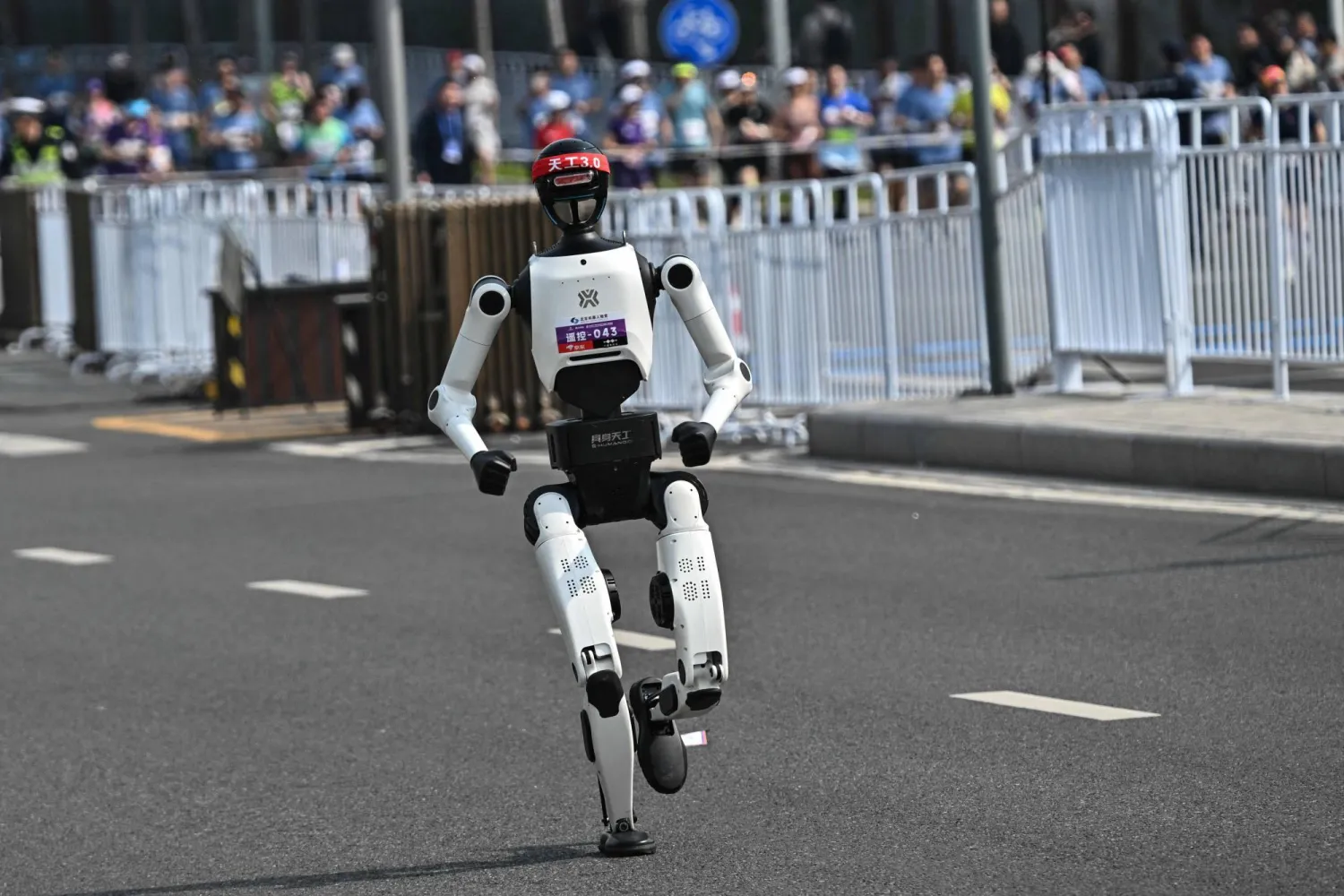
 A robot runs in the second Beijing E-Town Half Marathon and Humanoid Half Marathon in Beijing on April 19, 2026. (AFP)
A robot runs in the second Beijing E-Town Half Marathon and Humanoid Half Marathon in Beijing on April 19, 2026. (AFP)
TT

Humanoid Robots Race Past Humans in Beijing Half-Marathon, Showing Rapid Advances

 A robot runs in the second Beijing E-Town Half Marathon and Humanoid Half Marathon in Beijing on April 19, 2026. (AFP)
A robot runs in the second Beijing E-Town Half Marathon and Humanoid Half Marathon in Beijing on April 19, 2026. (AFP)

Dozens of Chinese-made humanoid robots showed off their fast-improving athleticism and autonomous navigation skills as they whizzed past human runners in a half-marathon race in Beijing on Sunday, highlighting the sector's rapid technical advances.

The race's inaugural edition last year was riddled with mishaps, and most robots were unable to finish. Last year's champion robot recorded a time of 2 hours 40 minutes, more than double the time of the human winner of the conventional race.

This year's contrast was stark. Not only had the number of participating teams increased from 20 to more than 100, but several robot frontrunners were noticeably faster than professional athletes, beating the human winners by more than 10 minutes.

Unlike last year, nearly half of the robot entrants navigated the tougher terrain autonomously instead of being directed by remote control during the 21-km (13-mile) race. The robots and ‌12,000 men and ‌women ran in parallel tracks to avoid collisions.

The winning robot, developed by Chinese ‌smartphone ⁠brand Honor, finished ⁠the race in 50 minutes and 26 seconds, several minutes faster than the half-marathon world record set by Ugandan runner Jacob Kiplimo in Lisbon last month.

Teams from Honor, a Huawei spin-off, took the three podium spots, all self-navigated and posting world-record-beating times. Du Xiaodi, an Honor engineer on the winning team, said its robot was in development for a year, fitted with legs 90 to 95 cm (35 to 37 inches) long to mimic elite human runners and liquid cooling technology used in its smartphones.

Du said the sector remained in a nascent phase, but he was confident humanoids would eventually reshape many industries, including ⁠manufacturing.

"Running faster may not seem meaningful at first, but it enables technology transfer, ‌for example, into structural reliability and cooling, and eventually industrial applications," Du ‌said.

ROBOTICS IMPROVEMENTS

Spectators largely viewed the variety of humanoids of different sizes and gaits on display as evidence of China's improvements in ‌robotics.

"The humanoid robots' running posture I saw was really quite impressive... considering that AI has only been developing for ‌a short time, I'm already very impressed that it can achieve this level of performance," said Chu Tianqi, a 23-year-old engineering student at Beijing University of Posts and Telecommunications.

"The future will definitely be an AI era. If people don't know how to use AI now, especially if some are still resistant to it, they will definitely become obsolete," he said.

Another spectator, 11-year-old schoolboy Guo Yukun, ‌said after watching the race, he was inspired to pursue a university degree in robotics in the future.

Guo said he takes regular classes in robotics theory and ⁠programming at his elite Beijing ⁠school, and is part of his school's team for the International Olympiad in Informatics, a global programming competition for high schoolers.

ECONOMICALLY VIABLE APPLICATIONS

While economically viable applications of humanoid robots mostly remain in a trial phase, the half-marathon's showcasing of these machines' physical prowess highlights their potential to reshape everything from dangerous jobs to battlefield combat.

However, Chinese robotics firms are still struggling to develop the AI software that would enable humanoids to match the efficiency of human factory workers.

Experts said the skills on display during the half-marathon, while entertaining, do not translate to the widespread commercialization of humanoid robots in industrial settings, where manual dexterity, real-world perception and capabilities beyond small-scale, repetitive tasks are crucial.

China is seeking to become a global powerhouse in this frontier industry, and it has enacted a wide range of policies from subsidies to infrastructure projects to cultivate local firms.

The country's most-watched TV show, the annual CCTV Spring Festival gala, in February showcased China's push to dominate humanoid robots and the future of manufacturing.

That included a lengthy martial arts demonstration where over a dozen Unitree humanoids performed sophisticated fight sequences waving swords, poles and nunchucks in close proximity to human children performers.



AI Can Outpace Cybersecurity Norms 'in Months', Says Spy Alliance

FILE PHOTO: AI (Artificial Intelligence) letters and robot hand miniature in this illustration taken, June 23, 2023. REUTERS/Dado Ruvic/Illustration/File Photo
TT

AI Can Outpace Cybersecurity Norms 'in Months', Says Spy Alliance

FILE PHOTO: AI (Artificial Intelligence) letters and robot hand miniature in this illustration taken, June 23, 2023. REUTERS/Dado Ruvic/Illustration/File Photo

The most advanced artificial intelligence models are improving quickly enough to outsmart prevailing cybersecurity know-how within months, the Five Eyes spy agency alliance has warned.

The risk posed by AI-enhanced hacking is in the spotlight, after US startup Anthropic said in April that its cutting-edge Mythos models had unprecedented abilities to find software vulnerabilities, reported AFP.

The security agencies of Britain, the United States, Australia, Canada and New Zealand urged governments and businesses to act swiftly to prepare themselves as AI evolves.

"The rapid pace of frontier AI development means cyber risk assumptions can become outdated in months, not years," said a joint statement dated Monday.

AI "lowers barriers for malicious actors and increases the speed and complexity of attacks", the Five Eyes advisory said.

"Breaches will occur. Preparedness helps you contain them quickly and prevent escalation into major operational and financial crises."

To improve cyber defenses, organizations should integrate AI tools into their security operations, update old systems and limit access to critical systems among other steps, they said.

Anthropic this month suspended access to Mythos 5 and a restricted version called Fable 5 to comply with a US national security order.

Just days after publicly launching Fable 5, the company said it had received a government directive banning all foreign nationals from accessing the two models.

The intervention is striking for a White House that has otherwise pushed to loosen AI oversight -- even moving to block states from writing their own rules.


Indian Startup Head Appointed as New WhatsApp Boss

The WhatsApp logo is seen in this illustration taken, August 22, 2022. (Reuters)
TT

Indian Startup Head Appointed as New WhatsApp Boss

The WhatsApp logo is seen in this illustration taken, August 22, 2022. (Reuters)

Meta has tapped Indian fintech founder Kunal Shah as the new head of WhatsApp, as the US tech giant seeks ways to monetize the messaging app's massive user base.

The announcement, made Monday night, was accompanied by news that Meta would also lead a $900 million funding round in Shah's consumer finance firm CRED.

"Kunal built CRED into one of India's most important technology companies," Meta chief Mark Zuckerberg said in a statement.

"He brings the kind of builder mentality and global perspective that will serve him well in running the world's biggest messaging app."

Shah, a serial entrepreneur and influential figure in India's fintech world, started CRED in 2018 after selling an earlier payments startup to Indian e-commerce giant Snapdeal for roughly $400 million.

He is also one of India's most prolific angel investors, according to data tracker Tracxn, with the local financial press often reporting how Shah agrees to seed funding pitches within minutes of hearing them.

But over the last few years, Shah has focused on building CRED -- which got its start by offering rewards to customers for timely credit card payments.

Since then, the company has aggressively expanded into offering wealth management, insurance and lending services to its 17 million users.

This experience is likely to help WhatsApp as it seeks new revenue streams that go beyond the core advertising business of Meta, which also runs Facebook and Instagram.

While India is WhatsApp's largest market -- with over half a billion users, according to 2021 government figures -- analysts say it has largely missed the chance to build an equally popular payments service.

In May, the messaging app offered businesses in India the ability to use artificial intelligence for services including responding to customers at all hours or booking appointments.

Shah acknowledged the scope for future growth, saying in a statement that the gap between "WhatsApp today and its full potential is massive".

India's startup ecosystem also celebrated Shah's appointment -- the latest example of an Indian-born executive becoming the leader of a Silicon Valley company.

Sajith Pai of Blume Ventures, an early stage Indian start-up backer said Shah was getting an "even bigger canvas to paint his bold brushstrokes in".

"Great news for everyone in the Indian startup ecosystem, and for India!"


Wikipedia Won’t Let AI Edit Articles, Co-founder Says

 The artificial intelligence AI acronym at the 10th edition of the VivaTech technology startups and innovation fair in Paris, France, June 18, 2026. (Reuters)
The artificial intelligence AI acronym at the 10th edition of the VivaTech technology startups and innovation fair in Paris, France, June 18, 2026. (Reuters)
TT

Wikipedia Won’t Let AI Edit Articles, Co-founder Says

 The artificial intelligence AI acronym at the 10th edition of the VivaTech technology startups and innovation fair in Paris, France, June 18, 2026. (Reuters)
The artificial intelligence AI acronym at the 10th edition of the VivaTech technology startups and innovation fair in Paris, France, June 18, 2026. (Reuters)

Wikipedia does not trust artificial intelligence enough to let it play a direct role in editing articles on its platform, co-founder Jimmy Wales told AFP on Monday.

The problem of AI "hallucinations" -- in which fabricated output is confidently presented -- has been reduced with newer AI models but remains "very, very bad", Wales said on the sidelines of a climate action week event in London.

He added, however, that AI agents could prove useful in alerting Wikipedia's community of millions of editors to certain niche news that would otherwise be missed.

"We would not let it edit directly because you can't really trust it enough," he said.

Artificial intelligence platforms, meanwhile, rely on Wikipedia's content to answer users' questions.

That has contributed to an overall growth in visitors to the site from AI bots, while human traffic has dropped eight percent.

Wales, who sits on the board of trustees at the Wikimedia Foundation, which operates Wikipedia, described the fall in human traffic as "meaningful" but "not a disaster," for the online encyclopedia, which ranks among the 10 most visited websites in the world.

The site, created in 2001, depends on donations from users so its business model does not directly rely on traffic.

Wales encouraged AI companies to "pay their fair share", because "hammering us with millions of requests costs real money," in the cost of running servers.

Wikipedia has already been "very successful" in signing agreements with several tech giants, the founder said.

"We're starting to block the ones who aren't behaving themselves, but we'll see how that goes."