


Trump Says US Negotiators Will Head to Pakistan on Monday for Talks with Iran

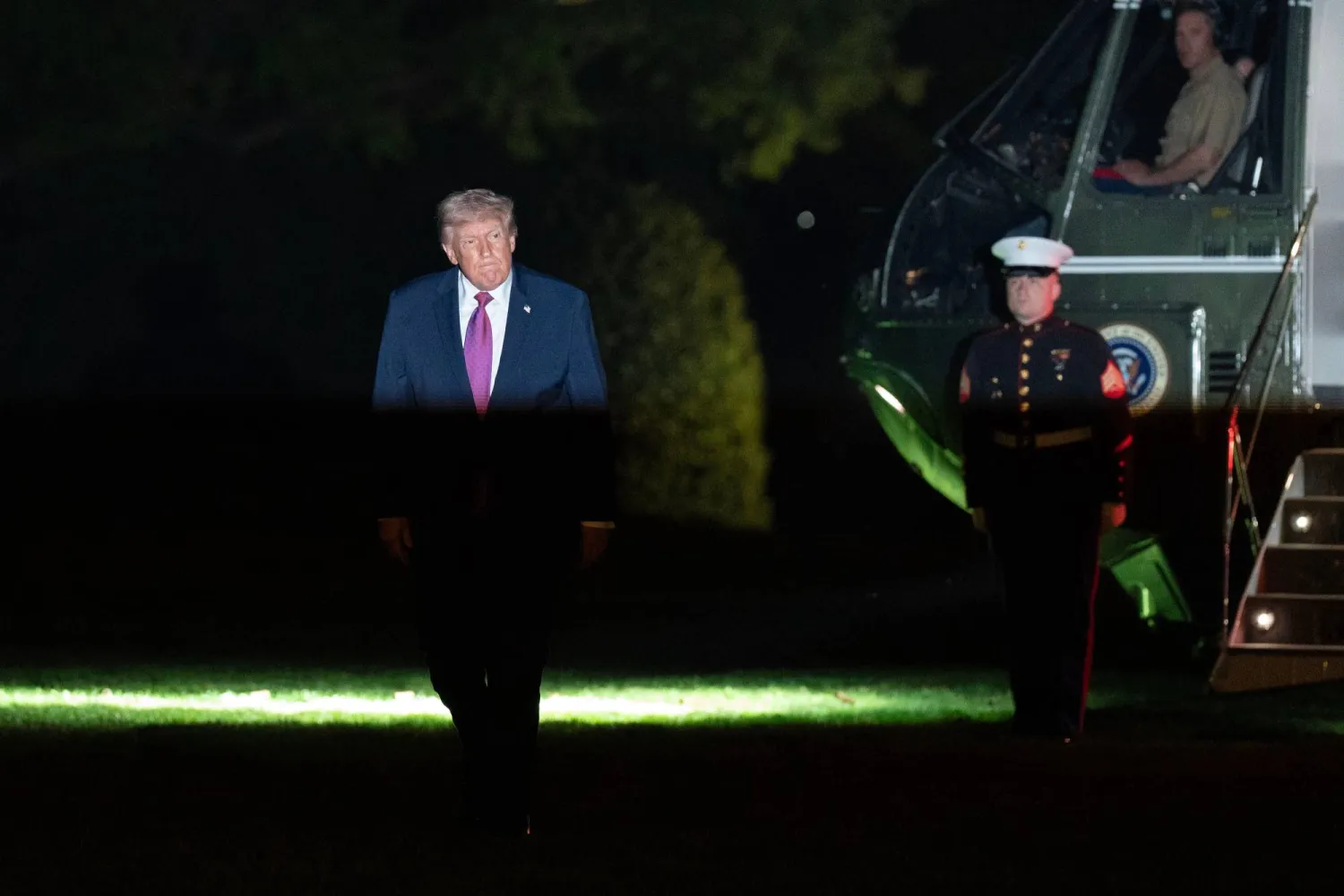
 President Donald Trump walks on the South Lawn upon his arrival to the White House, Friday, April 17, 2026, in Washington. (AP)
President Donald Trump walks on the South Lawn upon his arrival to the White House, Friday, April 17, 2026, in Washington. (AP)
TT

Trump Says US Negotiators Will Head to Pakistan on Monday for Talks with Iran

 President Donald Trump walks on the South Lawn upon his arrival to the White House, Friday, April 17, 2026, in Washington. (AP)
President Donald Trump walks on the South Lawn upon his arrival to the White House, Friday, April 17, 2026, in Washington. (AP)

President Donald Trump said US negotiators will head to Pakistan on Monday for another round of talks with Iran, raising hopes of extending a fragile ceasefire set to expire by Wednesday even as Washington and Tehran remain in a standoff over the Strait of Hormuz.

Iran did not immediately confirm the talks but its chief negotiator, parliament speaker Mohammed Bagher Qalibaf, said in an interview aired on state television late Saturday that “there will be no retreat in the field of diplomacy,” while acknowledging a wide gap remained between the sides.

The White House said Vice President JD Vance, who led the first round of historic face-to-face talks last weekend, would lead the delegation to Pakistan with envoys Steve Witkoff and Jared Kushner.

Pakistani authorities began tightening security in Islamabad. A regional official involved in the efforts said mediators were finalizing preparations and US advance security teams were already on the ground. The official spoke on condition of anonymity because they weren’t authorized to discuss preparations with the media.

Iran on Saturday said it had received new proposals from the United States. It was unclear whether either side had shifted stances on issues that derailed the last round of negotiations, including Iran’s nuclear enrichment program, its regional proxies and control over the Strait of Hormuz.

Trump's announcement repeated his threats against Iranian infrastructure that have drawn widespread criticism and warnings of war crimes. If Iran doesn't agree to the US-proposed deal, "the United States is going to knock out every single Power Plant, and every single Bridge, in Iran,” he wrote.

Iran says transits of the Strait of Hormuz are ‘impossible’

Ships remained unable to transit the critical waterway amid threats from Iran and a US blockade on ships heading to and from Iranian ports. Roughly one-fifth of the world’s oil trade normally passes through the strait, and the global energy crisis threatened to deepen as the war is now in its eighth week.

Iranian officials earlier on Sunday held firm that ships wouldn't pass while the US blockade remained in effect. “It is impossible for others to pass through the Strait of Hormuz while we cannot,” Qalibaf said.

In his post about talks, Trump accused Iran of violating the ceasefire by firing at ships transiting the strait. Iran has called the US blockade a violation, and foreign ministry spokesperson Esmaeil Baqaei on Sunday called it an “act of aggression.”

Iran had announced the strait’s reopening after a 10-day truce between Israel and the Iranian-backed Hezbollah group in Lebanon took hold on Friday. But Iran said it would continue enforcing its restrictions there after Trump said the US blockade “will remain in full force” until Tehran reaches a deal with the United States.

After a brief uptick in transit attempts on Saturday, Iran fired on two India-flagged merchant ships that were forced to turn around, leading India to summon Iran's ambassador over the “serious incident.” India noted that Iran earlier let several India-bound ships through.

For Tehran, the strait’s closure — imposed after the US and Israel launched the Iran war on Feb. 28 during talks over Tehran’s nuclear program — is perhaps its most powerful weapon, inflicting political pain on Trump. For the United States, the blockade squeezes Iran’s already weakened economy by denying it long-term cash flow.

The war has killed at least 3,000 people in Iran, more than 2,290 in Lebanon, 23 in Israel and more than a dozen in Gulf Arab states. Fifteen Israeli soldiers in Lebanon and 13 US service members throughout the region have been killed.

Since most supplies to US military bases in the Gulf region come through the strait, “Iran is determined to maintain oversight and control over traffic through the strait until the war fully ends,” Iran’s Supreme National Security Council said late Saturday. That means Iran-designated routes, payment of fees and issuance of transit certificates.

The council has recently acted as Iran’s de facto top decision-making body.

Pakistan presses on diplomacy

Pakistani Foreign Minister Ishaq Dar, who spoke by phone with Iran’s Foreign Minister Abbas Araghchi on Sunday, has said his country was working to “bridge” differences between the US and Iran.

Iranian Deputy Foreign Minister Saeed Khatibzadeh on Saturday told The Associated Press that the US is “risking the whole ceasefire package" with its blockade.

Khatibzadeh said Iran won't hand over its stock of 970 pounds (440 kilograms) of enriched uranium to the United States, calling the idea “a nonstarter.”

The deputy minister didn't address other proposals for the enriched uranium, saying only that “we are ready to address any concerns.”



Rubio Says US Will Not Accept Iranian Tolls on Hormuz

 Vessels at the Strait of Hormuz, as seen from Musandam, Oman, June 22, 2026. (Reuters)
Vessels at the Strait of Hormuz, as seen from Musandam, Oman, June 22, 2026. (Reuters)
TT

Rubio Says US Will Not Accept Iranian Tolls on Hormuz

 Vessels at the Strait of Hormuz, as seen from Musandam, Oman, June 22, 2026. (Reuters)
Vessels at the Strait of Hormuz, as seen from Musandam, Oman, June 22, 2026. (Reuters)

Washington's top diplomat insisted Tuesday that the US would not accept any attempt to impose tolls or fees on Strait of Hormuz, the key waterway where the UN said it would begin evacuating thousands of sailors stranded by the Middle East war 

The US and Iran have signed a preliminary deal to halt the war, and concluded a first round of talks in Switzerland as part of a 60-day negotiation period to settle outstanding issues like sanctions relief and the fate of Tehran's nuclear program. 

An Iranian blockade that began early in the conflict choked off maritime traffic through the Hormuz strait -- sending global oil prices surging -- but crossings have begun to rise again since the US-Iran deal was inked. 

Iran has repeatedly maintained it will retain control over the waterway, including on Tuesday, when it and Oman said in a joint statement that they would study the administration of the trade route and the costs to be charged for services provided, insisting on their sovereignty over the strait. 

But US Secretary of State Marco Rubio, kicking off a regional tour, reiterated Washington's position that such an arrangement would be unacceptable. 

"It's an international waterway. No country is allowed to charge tolls or fees on an international waterway," he said from Abu Dhabi, adding that he believed "all the countries in this region would agree". 

Tehran's top negotiator, Mohammad Bagher Ghalibaf, had earlier insisted the Strait of Hormuz "will never return" to the pre-war status quo, despite the foes agreeing to set up communication lines to keep it open. 

- Muscat meeting - 

Oman and Iran agreed on Tuesday to press on with discussions about the future administration of navigation in the Strait of Hormuz. 

In a joint statement issued after talks in Muscat, they said a joint working group involving their foreign ministries ‌would be ‌formed to continue the discussions and ‌that they ⁠would consult other ⁠littoral states and relevant parties.  

The move appears to implement a provision of the memorandum of understanding signed last week that calls for Iran to hold talks with Oman and other states on the future management of ⁠navigation and maritime services in the strait, ‌a vital waterway ‌for global oil supplies.  

The agreement was announced following a ‌visit by Speaker Ghalibaf and Foreign Minister Abbas Araqchi, who met Oman's Sultan Haitham bin Tariq and held talks with Omani Foreign Minister Badr Albusaidi.  

In the statement, Oman and ‌Iran, the two states bordering the strait, reaffirmed their commitment to ensuring ⁠safe ⁠passage through the waterway in accordance with international law while underlining sovereignty over their territorial waters.  

Since the start of the US-Israeli war against Iran in February, the strait has been largely closed to commercial shipping. The United States blockaded Iranian ports after Iran started effectively blocking the strait.  

Oman and Iran reaffirmed their commitment to the strait being a secure and open route for international navigation and to promoting maritime safety, freedom of navigation and regional stability. 

The head of the UN's International Maritime Organization, meanwhile, said it would begin evacuating more than 11,000 sailors stranded by the Hormuz blockade in cooperation with Iran, Oman and the United States, adding it had "secured the necessary safety guarantees". 

Traffic through the strait on Monday reached the highest level since the start of the war, according to two maritime tracking platforms, representing just over 40 percent of the normal peacetime level of about 120 vessels per day. 


Tehran Gets Three-Day Holiday for Ali Khamenei Funeral

An Iranian man walks past a banner depicting slain supreme leader Ali Khamenei at Valiasr Square in Tehran on June 15, 2026. (AFP)
TT

Tehran Gets Three-Day Holiday for Ali Khamenei Funeral

An Iranian man walks past a banner depicting slain supreme leader Ali Khamenei at Valiasr Square in Tehran on June 15, 2026. (AFP)

Iran announced Tuesday three days of public holidays in the capital Tehran for late supreme leader Ali Khamenei's funeral ceremonies, state television reported.

"The farewell ceremony and prayers for the martyred leader's body will be held on Saturday and Sunday, July 4th and 5th, in Tehran's Grand Mosalla, and the funeral will be held on Monday, July 6th, and Tehran province will be off for these three days," Iranian Revolutionary Guards Corps (IRGC) commander Hassan Hassanzadeh, in charge of the ceremonies, was quoted as saying.

Earlier, state media said Tehran would be on holiday on July 4 and 5, while the rest of the country will join it on July 6.

Tehran authorities expect an attendance of around 20 million.

The northern city of Qom will also host a tribute on July 7.

Ali Khamenei will be laid to rest on July 9 in the northeastern city of Mashhad, his birthplace.

These two cities will also observe public holidays.

Neighboring Iraq has scheduled ceremonies for July 8.

The funeral was originally planned for March but was postponed due to the war in the Middle East, which was triggered by the US-Israeli attacks in February that killed Khamenei.

Ali Khamenei's son Mojtaba succeeded his father as supreme leader in early March, becoming the third person to hold the position since the regime was established in 1979.

Mojtaba Khamenei was wounded in the bombing that killed his father and other officials. He has not been seen in public since his appointment and communicates solely through official statements.


China’s Newest Aircraft Carrier Sails Through the Taiwan Strait

In this photo released by Xinhua News Agency, China's third conventionally powered aircraft carrier, the Fujian, conducts a maiden sea trial on May 7, 2024. (Ding Ziyu/Xinhua via AP, File)
TT

China’s Newest Aircraft Carrier Sails Through the Taiwan Strait

In this photo released by Xinhua News Agency, China's third conventionally powered aircraft carrier, the Fujian, conducts a maiden sea trial on May 7, 2024. (Ding Ziyu/Xinhua via AP, File)

China’s newest and most powerful of its three aircraft carriers sailed through the Taiwan Strait on Tuesday, the Taiwanese defense ministry said, a day after Taiwan began a five-day military exercise on responding to a Chinese attack.

The Fujian carrier first sailed through the narrow body of water separating China and Taiwan in a trial run last September. It later transited the strait for the first time as a fully commissioned military vessel in December.

China claims the self-governed island as part of its territory and has not ruled out the use of force to bring it under Beijing's control. China regularly sends navy vessels and war planes towards Taiwan in military exercises that have become more frequent in recent years to where they now occur almost daily.

Taiwan on Monday kicked off its own five-day exercise to support its response in case of a possible Chinese military invasion.

The US Navy sends warships through the strait periodically, as do some of its allies, in a warning to Beijing against any attempt to use force to establish its claim to the island.

The Fujian was commissioned in November 2025. It is world’s largest nonnuclear-powered warship, according to the US Naval Institute, and is considered more advanced than China's other two carriers, the Shandong and the Liaoning.