


Israeli Army Brings in Demolition Contractors to Raze Dozens of Lebanese Villages

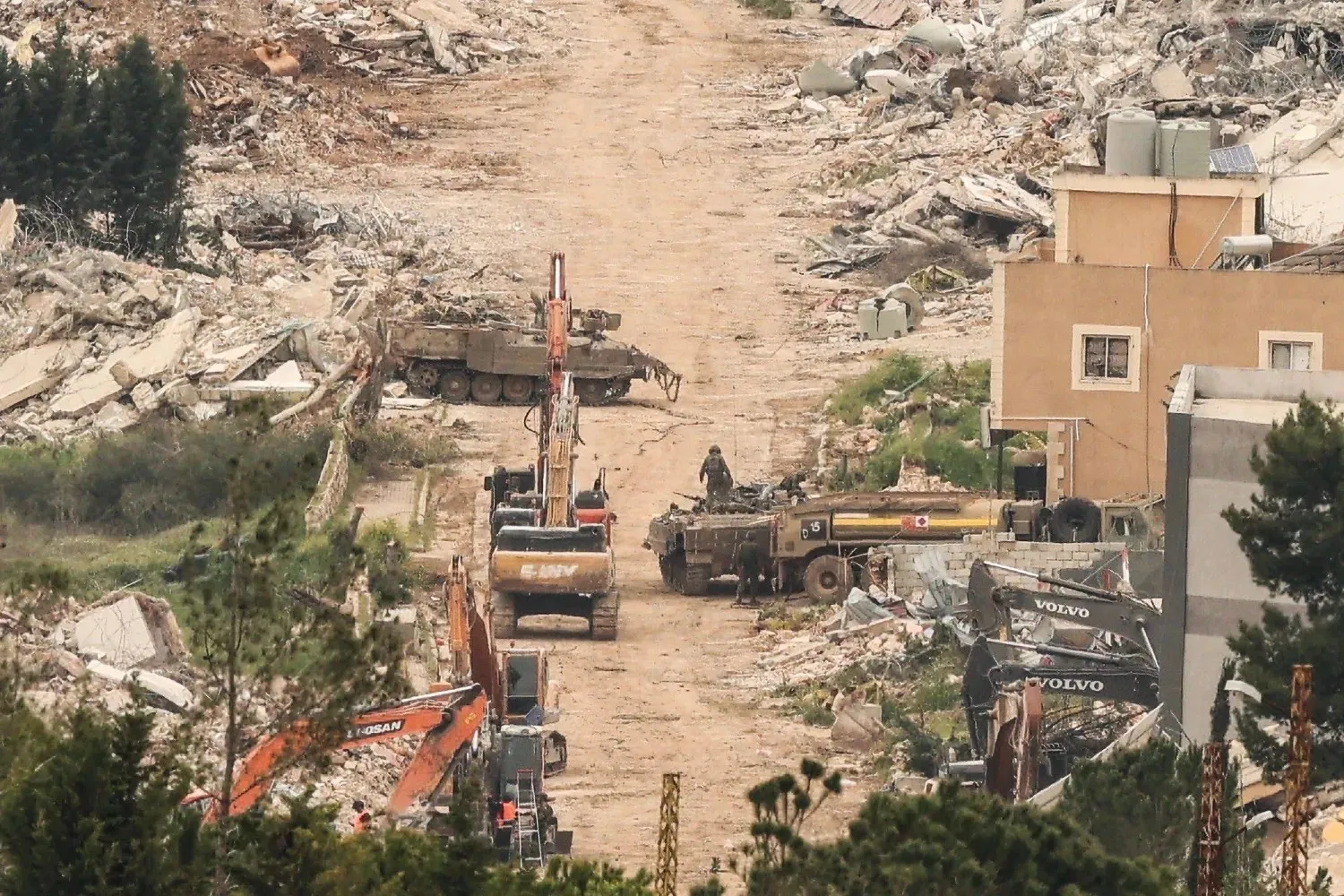
Israeli military vehicles and armored units in front of destroyed buildings in southern Lebanon on April 15. (AFP)
TT

Israeli Army Brings in Demolition Contractors to Raze Dozens of Lebanese Villages

Israeli military vehicles and armored units in front of destroyed buildings in southern Lebanon on April 15. (AFP)

The Israeli army is using the ceasefire period to accelerate large-scale destruction in areas it occupies in southern Lebanon, which have been largely emptied of residents displaced by the conflict, according to local accounts.

Working around the clock across an area estimated at more than 800 square kilometers — about 8 percent of Lebanon’s territory — Israeli forces are systematically flattening buildings.

Confronted with the scale of the task and racing against time, the military engineering corps has enlisted private sector “demolition contractors,” some with experience in Gaza, to carry out operations in dozens of villages.

Using heavy machinery, including bulldozers and D9 units, they have begun what sources describe as a coordinated clearing campaign.

The occupied zone stretches from the Litani River to the internationally recognized border and has been divided into three sectors.

The first is a “total destruction” zone running along the entire Lebanese border strip, from the expanded Shebaa Farms area and the town of Khiam in the east, through Deir Siryan, to the coastal town of Bayyada in the west. Its depth ranges from about 3 kilometers at its narrowest point near Odaisseh to as much as 10 kilometers near Khiam.

This area is referred to by the Israeli army as the “yellow belt,” in reference to a similarly named line in Gaza. Civilian presence is effectively prohibited, with entry posing a serious risk to life.

The second sector extends from the “yellow belt” to the Litani River. Israeli forces have positioned this line along hilltops and elevated terrain to maintain direct visual oversight of the river corridor, despite advanced surveillance capabilities. Armed presence is banned in this zone, and civilian presence is strongly discouraged.

The area remains highly volatile, with Israeli troops on constant alert.

Reports indicate sporadic resistance operations, as well as the presence of minefields and ambushes. Tactics developed by Hezbollah since the 2006 war are being employed here. Most Israeli casualties reported in this area — 12 killed and around 30 wounded — occurred in this sector, which has also seen fire reach as far as the Tyre region.

The third sector extends from the Litani River northward to the Zahrani River. While not officially designated as occupied, it is subject to continuous aerial and maritime surveillance.

Israel believes Hezbollah uses this area as a launching ground for operations, including short- and medium-range rocket fire. Drones are reported to operate overhead day and night. Israeli assessments indicate that more than half of the roughly 8,000 rockets and shells fired from Lebanon originated from this zone.

Israeli military doctrine since Oct. 7, 2023, calls for layered security zones along each front — Lebanon, Syria and Gaza — including a fortified area inside Israel, a no-go “security belt” inside enemy territory, and a broader demilitarized zone.

Within Israel’s far-right leadership, some officials have embraced this approach as a precursor to expanding territorial control. Finance Minister Bezalel Smotrich has called for further expansion and the establishment of Israeli military bases elsewhere in the region.

On the ground, Israeli forces appear intent on consolidating control over the “yellow belt” by erasing all structures above and below ground, from homes to schools and public buildings, a strategy critics say is aimed at preventing displaced residents south of the Litani from returning, or ensuring they find nothing left if they do.

The army also faces domestic criticism, particularly from residents of northern Israel, who say it has failed to provide adequate security despite months of fighting. Israeli officials argue that such operations could help secure longer-term calm on the northern front through a political agreement.

The Haaretz newspaper quoted a senior officer as saying the goal is “not a return to rounds of fighting, but achieving long-term security,” adding that Hezbollah has been significantly weakened compared with its position before Oct. 7, 2023.



Political Stalemate Opens Door to Re-elections in Iraqi Kurdistan

New Generation party leader Shaswar Abdulwahid (NRT Channel)
TT

Political Stalemate Opens Door to Re-elections in Iraqi Kurdistan

New Generation party leader Shaswar Abdulwahid (NRT Channel)

The stagnant situation in the Kurdistan Region is stirring towards the formation of a new government, a process delayed for nearly two years since the elections in October 2024; however, the task may prove difficult due to skirmishes between two camps of rival parties vying for greater influence within the anticipated ministerial lineup.

Despite the presence of emerging parties like the New Generation in the alliance map, the Kurdistan Democratic Party (KDP), led by Masoud Barzani, and the Patriotic Union of Kurdistan (PUK), led by Bafel Talabani, still control the political tempo in the Kurdish region of Iraq.

A KDP leader stated that "the continued failure to form a government brings the factions closer to the option of re-elections", while the rival front demands the position of Prime Minister in the region and an equal share of government positions, according to politicians and activists.

Both the PUK and the New Generation are betting on an alliance that, so far, secures about 38 seats, bringing them close to the KDP's 39 seats, out of the one hundred seats that make up the Kurdistan Region Parliament.

Given this numerical equation, the numerically smaller parties in parliament play the role of a "kingmaker" that can tip the scales for one of the two fronts over the other, leading to an absolute majority (51 seats), which fuels the political squabbles and maneuvers active in the public sphere these days.


Regional Turmoil Fuels Growing Defense Cooperation Between Egypt, Türkiye

An Egyptian-Turkish joint air exercise hosted at Egyptian air bases this month (Egyptian military spokesman) 
TT

Regional Turmoil Fuels Growing Defense Cooperation Between Egypt, Türkiye

An Egyptian-Turkish joint air exercise hosted at Egyptian air bases this month (Egyptian military spokesman) 

Egypt and Türkiye have stepped up military cooperation in recent months through a series of joint exercises, the launch of a high-level military dialogue in Cairo, and the signing of a “framework military agreement” four months ago, against the backdrop of escalating regional tensions.

Türkiye’s Ministry of National Defense announced Thursday that the Turkish, Egyptian and Azerbaijani air forces are conducting their first trilateral air exercise in Turkish airspace. The announcement came days after the conclusion of a separate Egyptian-Turkish air drill. The Turkish Armed Forces also said that Chief of the General Staff Gen. Selcuk Bayraktaroglu held talks with Egyptian officials in Cairo on Thursday.

Military officers and analysts told Asharq Al-Awsat that the expanding defense partnership is primarily intended as a deterrent amid regional instability. They said it is part of the broader Egyptian-Turkish rapprochement and reflects growing coordination on key regional issues.

Relations between Cairo and Ankara have steadily improved after years of estrangement. The two countries reinforced ties by establishing a Strategic Cooperation Council, which held its second meeting in Cairo in February during President Recep Tayyip Erdogan’s visit to Egypt. The meeting produced several cooperation agreements, including a framework military accord.

Alongside closer political coordination, defense ties have expanded through a series of joint exercises. According to Türkiye’s Defense Ministry, the trilateral drill will run through July 3 and is designed to enhance operational capabilities while testing new technical and tactical procedures for air operations.

The exercise follows a bilateral Egyptian-Turkish air drill held at Egyptian air bases from June 11 to 21, involving multirole fighter aircraft of various types.

Military cooperation has also expanded beyond air operations. Egypt and Türkiye conducted the Sea of Friendship naval exercise in the Mediterranean in September 2025, while Turkish and Egyptian special forces held joint training in Ankara from April 21 to 29, 2025.


Maj. Gen. Nasr Salem, former head of the Egyptian Armed Forces Reconnaissance Department, and advisor at the Nasser Military Academy for Postgraduate Studies, said joint exercises serve several strategic objectives, including exchanging expertise and enhancing combat readiness.

Salem told Asharq Al-Awsat that the intensified Egyptian-Turkish drills also send a deterrent message in light of regional turmoil by demonstrating the capabilities and preparedness of both militaries to confront threats to their national security and strategic interests. “The principle of military deterrence,” he stated, “is that if you want to prevent war, you must prepare for it.”

In parallel with the exercises, Egypt and Türkiye held a high-level military dialogue attended by Egyptian Armed Forces Chief of Staff Lt. Gen. Ahmed Fathi Khalifa, Bayraktaroglu, and senior military officials from both countries, Türkiye’s Defense Ministry said.

Political analyst Taha Oghlu, who specializes in Turkish affairs and international relations, described Egyptian-Turkish ties as undergoing “an unprecedented rapprochement.” He said cooperation now extends beyond diplomacy to encompass deepening military and defense ties, reflected in joint exercises and the launch of the military dialogue.

Speaking to Asharq Al-Awsat, Oghlu said the defense partnership is driven by shared interests and growing coordination on Libya, Syria, Gaza, and the Iran war. He added that instability across the Middle East — particularly the war in Gaza and the crisis in southern Lebanon — has accelerated the rapprochement.

The two countries have also intensified diplomatic contacts. Most recently, Turkish Foreign Minister Hakan Fidan visited Cairo last week for talks with his Egyptian counterpart Badr Abdelatty on bilateral ties. He also joined a meeting of the regional quartet comprising the foreign ministers of Egypt, Türkiye, Saudi Arabia, and Pakistan to discuss regional developments.

Oghlu said Azerbaijan’s participation in the latest exercise sends a clear signal that Egyptian-Turkish defense cooperation is acquiring broader strategic and geographic dimensions that extend beyond the Eastern Mediterranean and could help reshape the region’s security outlook.


Lebanon President Says Israel Deal First Step to Restoring Sovereignty

 Israeli and Lebanese flags hang in a memorial site on the border with Lebanon in northern Israel, Saturday, June 27, 2026 after Israel and Lebanon sign a framework agreement, described as a first step toward peace following months of conflict between Israel and the Lebanese group Hezbollah. (AP)
Israeli and Lebanese flags hang in a memorial site on the border with Lebanon in northern Israel, Saturday, June 27, 2026 after Israel and Lebanon sign a framework agreement, described as a first step toward peace following months of conflict between Israel and the Lebanese group Hezbollah. (AP)
TT

Lebanon President Says Israel Deal First Step to Restoring Sovereignty

 Israeli and Lebanese flags hang in a memorial site on the border with Lebanon in northern Israel, Saturday, June 27, 2026 after Israel and Lebanon sign a framework agreement, described as a first step toward peace following months of conflict between Israel and the Lebanese group Hezbollah. (AP)
Israeli and Lebanese flags hang in a memorial site on the border with Lebanon in northern Israel, Saturday, June 27, 2026 after Israel and Lebanon sign a framework agreement, described as a first step toward peace following months of conflict between Israel and the Lebanese group Hezbollah. (AP)

Lebanese President Joseph Aoun said a deal signed with Israel on Friday was a first step towards fully restoring his country's sovereignty after the latest war between Israel and the Iran-backed Hezbollah.

"The framework agreement signed today is a first step" that will enable Lebanese "to return to their fully liberated lands, and to their certainly rebuilt homes... under the sovereignty of the Lebanese state that has no partner in its sovereignty over its land and people," Aoun said according to a statement released by his office.

"We swear to continue to work until this is fully achieved. There will be no more occupation, prisoners, subordination or tutelage," he added.

Lebanese Prime Minister Nawaf Salam said the agreement "aims to achieve Israel's withdrawal from all Lebanese territory, restore state sovereignty over it" and see the return of displaced Lebanese.

"I look forward to the blessed moment when Israel begins to withdraw -- so that our dear people can return to their homes with safety and dignity -- and to the launch" of reconstruction efforts, Salam added, according to a statement.

Israel and Lebanon signed a framework agreement in Washington on Friday following several days of talks to secure an end to fighting between Israel and Iran-backed Hezbollah, though both sides framed the deal as an initial step.

"Today we've taken the first step in what will be a difficult journey, without a doubt, but an important and an essential and a necessary one," US Secretary of State Marco Rubio said before the agreement was inked.

Rubio added that the agreement ‌establishes ⁠a clear process ⁠to restore Lebanon's sovereignty, disarm Hezbollah and dismantle ⁠its infrastructure.

Hezbollah supporters block the old airport road in the southern suburbs of Beirut, with burning tires to protest against the trilateral agreement that was signed between the US, Israel and Lebanon on June 27, 2026. (AFP)

In a later statement he said that the US would facilitate the implementation of the deal through a trilateral "Military Coordination ‌Group for Lebanon" ‌and that Washington would commit significant resources, including an immediate $100 million in humanitarian assistance in coordination with ‌the ⁠UN.

Rubio added that ⁠the US reaffirmed its intent to improve the capabilities of the Lebanese Armed Forces "to more effectively establish sovereignty throughout Lebanese territory" with more than $30 million in funds under existing US authorities and appropriations.

Hezbollah warning

Hezbollah lawmaker Hassan Fadlallah warned that Lebanese officials who signed the agreement with Israel could not enforce the deal without sparking a civil war.

Lebanese "authorities will be unable to impose the implementation of the agreement signed in Washington unless they go, with American support, to civil war," said Fadlallah, whose party has long rejected the direct Israel-Lebanon talks.

He added that "what happened in Washington is an attempt to disrupt the Islamabad path, and without the resistance (Hezbollah) nothing will pass," referring to the initial agreement between the US and Iran on halting the Middle East war, which includes Lebanon.

After the announcement of the agreement, Hezbollah supporters took to the streets of Beirut late Friday in protest.

The state-run National News Agency (NNA) reported that "Hezbollah supporters rode motorbikes through the streets of Beirut" including central areas and along a road leading to the airport "in protest at the framework agreement announced between Lebanon and Israel".

Footage circulating on local outlets and social media showed hundreds of Hezbollah supporters on motorbikes and mopeds roaming Beirut's southern suburbs, the group's stronghold, before they headed to the heart of the capital.