

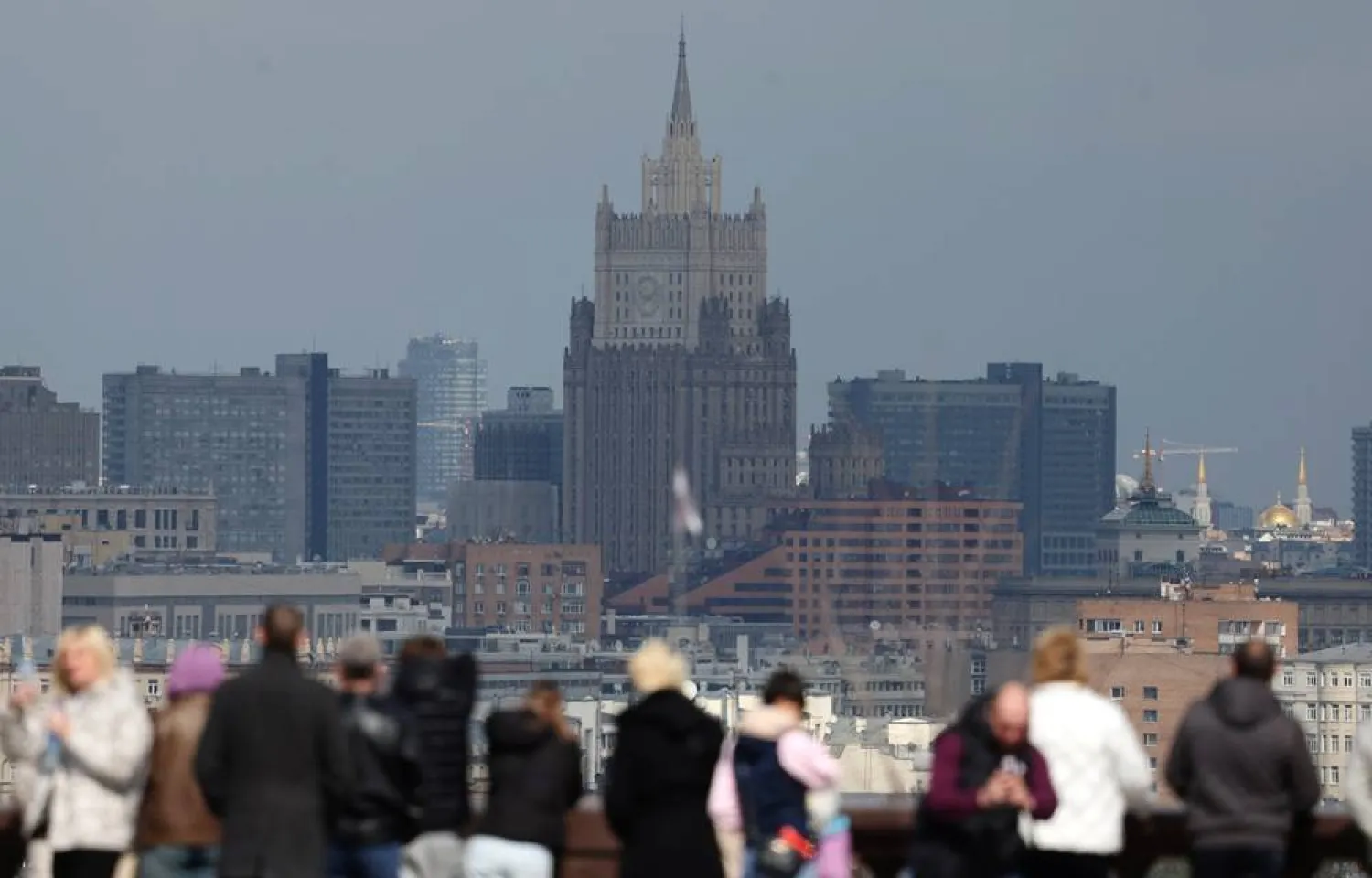

Russia Arrests German Woman in Alleged Bomb Plot

People visit the observation deck at Vorobyovy gory (Sparrow Hills) with the main building of the Ministry of Foreign Affairs of Russia in the background during a spring day in Moscow, Russia, 17 April 2026. (EPA)
TT

Russia Arrests German Woman in Alleged Bomb Plot

People visit the observation deck at Vorobyovy gory (Sparrow Hills) with the main building of the Ministry of Foreign Affairs of Russia in the background during a spring day in Moscow, Russia, 17 April 2026. (EPA)

Russia said Monday it had arrested a German woman found with a homemade bomb in her backpack in what it alleged was a Ukrainian-hatched plot to blow up a security services facility in the south.

Russia has arrested dozens of people throughout the four-year war, mostly its own citizens, on allegations of working for Ukraine to carry out sabotage attacks.

There has been a string of high-profile arrests of Western citizens since Moscow ordered its troops into Ukraine -- typically on espionage charges that are widely seen as baseless, with those detained later swapped in exchange for Russians jailed abroad.

Detentions of Western citizens for carrying out or preparing actual attacks are much rarer.

The FSB security agency said the woman, born in 1969, had been dragged into the alleged plot by a citizen from a Central Asian country, who was working on orders from Ukraine.

She was detained and found with an improvised explosive device in her bag in the Caucasus city of Pyatigorsk, the FSB said.

The FSB said it had "prevented a terrorist attack planned by the Kyiv regime against a law enforcement facility in the Stavropol region, involving a German citizen born in 1969," the agency said in a statement.

The FSB said the device -- which contained an explosive charge equivalent to 1.5 kilograms (three pounds) of TNT -- was supposed to be detonated remotely, killing the German woman.

The blast was prevented by electronic jamming, the FSB added.

- 'Radical ideology' -

A man from an unidentified Central Asian state, born in 1997 and "a supporter of radical ideology", was found and arrested near the targeted site, it added.

The pair face life in prison on terrorist charges.

There was no immediate reaction to the allegations in Kyiv or Berlin.

Video footage of the purported arrest published on state media showed armed Russian security agents approach the woman, who was lying face down dressed in all black in a car park.

Another video showed masked plainclothes agents pulling a man into a station, followed by a controlled explosion of the backpack.

Russia has previously accused Ukraine of working with fundamentalists to carry out terror attacks inside Russia, without providing evidence.

Officials initially alleged that the perpetrators of a 2024 massacre at a concert hall on the outskirts of Moscow that killed 150 people were ISIS members in coordination with Ukraine.

ISIS claimed responsibility for that attack, making no reference of any Ukrainian involvement, for which no evidence was presented by Moscow and which Kyiv denies.




China Warns Middle East at ‘Critical Juncture’ After Trump Extends Ceasefire

 13 April 2026, China, Beijing: Guo Jiakun, spokesman for the Chinese Foreign Ministry, speaks to journalists. (dpa)
13 April 2026, China, Beijing: Guo Jiakun, spokesman for the Chinese Foreign Ministry, speaks to journalists. (dpa)
TT

China Warns Middle East at ‘Critical Juncture’ After Trump Extends Ceasefire

 13 April 2026, China, Beijing: Guo Jiakun, spokesman for the Chinese Foreign Ministry, speaks to journalists. (dpa)
13 April 2026, China, Beijing: Guo Jiakun, spokesman for the Chinese Foreign Ministry, speaks to journalists. (dpa)

China warned on Wednesday that the situation in the Middle East was at a "critical juncture" after US President Donald Trump extended a ceasefire to allow Iran more time to negotiate.

Trump indefinitely pushed back the end of the two-week truce on Tuesday with Tehran yet to respond but he said a US blockade of Iran's ports would continue.

"The current regional situation stands at a critical juncture transitioning between war and peace; the paramount priority remains to make every effort to prevent a resumption of hostilities," Chinese foreign ministry spokesman Guo Jiakun told a news briefing.

Guo did not comment directly on the ceasefire when asked about it, adding only that Beijing would continue to play a "constructive" role.


Extreme Heat Threatens Global Food Systems, UN Agencies Warn

Emmanuel, a worker at the Fasoranti farm, harvests cocoa pods in Akure, Ondo State, Nigeria, 20 April 2026. (EPA)
TT

Extreme Heat Threatens Global Food Systems, UN Agencies Warn

Emmanuel, a worker at the Fasoranti farm, harvests cocoa pods in Akure, Ondo State, Nigeria, 20 April 2026. (EPA)

Extreme heat is pushing global agrifood systems to the brink, threatening the livelihoods and health of more than a billion people, according to a new report by the UN's food and weather agencies.

The United Nations Food and Agriculture Organization (FAO) and the World Meteorological Organization (WMO) said heatwaves are becoming more frequent, intense and prolonged, damaging crops, livestock, fisheries and forests.

"Extreme heat is rewriting the script on what farmers, fishers and foresters can grow and when they can grow. In some cases it is even dictating if they can still work," said Kaveh Zahedi, ‌head of ‌FAO's climate change office.

"At its core, this report ‌is ⁠telling us that ⁠we face a very uncertain future," he told Reuters.

Recent climate datasets show global warming is accelerating, with 2025 ranking among the three hottest years on record, triggering more frequent and severe weather extremes.

Acting as a risk multiplier, extreme heat intensifies droughts, wildfires and pest outbreaks and sharply cuts crop yields once critical temperature thresholds are breached.

RISKS ESCALATE RAPIDLY AS TEMPERATURES PUSH HIGHER

The report said higher temperatures ⁠are shrinking the safety margin that plants, animals and ‌humans rely on to function, with yields for ‌most major crops falling once temperatures exceed about 30 degrees Celsius (86 degrees Fahrenheit).

Zahedi cited ‌Morocco, where six years of drought were followed by record heatwaves. "This led ‌to a fall in cereal yields by over 40%. It decimated the olive and citrus harvest. Basically, those harvests failed," he said.

Marine heatwaves are also becoming more frequent, depleting oxygen levels in water and threatening fish stocks. In 2024, 91% of the world's ‌oceans experienced at least one marine heatwave, the report said.

Risks rise sharply as warming accelerates. The intensity of extreme ⁠heat events is ⁠expected to roughly double at 2 degrees Celsius of warming and quadruple at 3 degrees, compared with 1.5 degrees, the report said.

Zahedi said every one-degree rise in average global temperatures cuts yields of the world's four major crops - maize, rice, soya, and wheat - by about 6%.

The FAO and WMO said piecemeal responses were inadequate and called for better risk governance and early-warning weather systems to help farmers and fishers take preventive action.

"If you can get the data into the farmers' hands, they can adjust when they plant, they can adjust what they plant, they can adjust when they harvest," Zahedi said.

But the report said adaptation alone is not enough, arguing the only lasting solution to the growing threat of extreme heat is ambitious, coordinated action to curb climate change.


Russian Drones Strike Ukraine’s Odesa Port, Kill Railway Worker in South, Deputy PM Says

Rescuers work at the site of a Russian drone strike as port infrastructure was hit, amid Russia's attack on Ukraine, in Odesa region, Ukraine April 22, 2026. (Press service of the State Emergency Service of Ukraine in Odesa region/Handout via Reuters)
TT

Russian Drones Strike Ukraine’s Odesa Port, Kill Railway Worker in South, Deputy PM Says

Rescuers work at the site of a Russian drone strike as port infrastructure was hit, amid Russia's attack on Ukraine, in Odesa region, Ukraine April 22, 2026. (Press service of the State Emergency Service of Ukraine in Odesa region/Handout via Reuters)

Russian drones attacked infrastructure in Ukraine's Black Sea Odesa port overnight, Deputy Prime Minister Oleksiy Kuleba said on Wednesday.

Berths, warehouses, railway infrastructure and port operators' facilities were damaged in the assault, Kuleba ‌wrote on Telegram.

The ‌hold of a ‌cargo ⁠ship was also ⁠hit, causing a fire Ukraine's seaports authority said.

According to preliminary information no one was hurt in the attack, and the port was still ⁠operating, the authority said ‌on Telegram.

Russia has ‌repeatedly targeted maritime export routes ‌more than four years after its ‌invasion of Ukraine, striking ports vital to foreign trade and the wartime economy.

Kuleba said a Russian ‌drone attack at a sorting yard at the Zaporizhzhia-Live ⁠station ⁠in the southern Zaporizhzhia region killed an assistant train driver. The train driver was hospitalized, he added.

The Ukrainian air force said Russia had launched 215 drones at the country since 6 p.m. (1500 GMT) on Tuesday, and 189 had been downed or neutralized.