

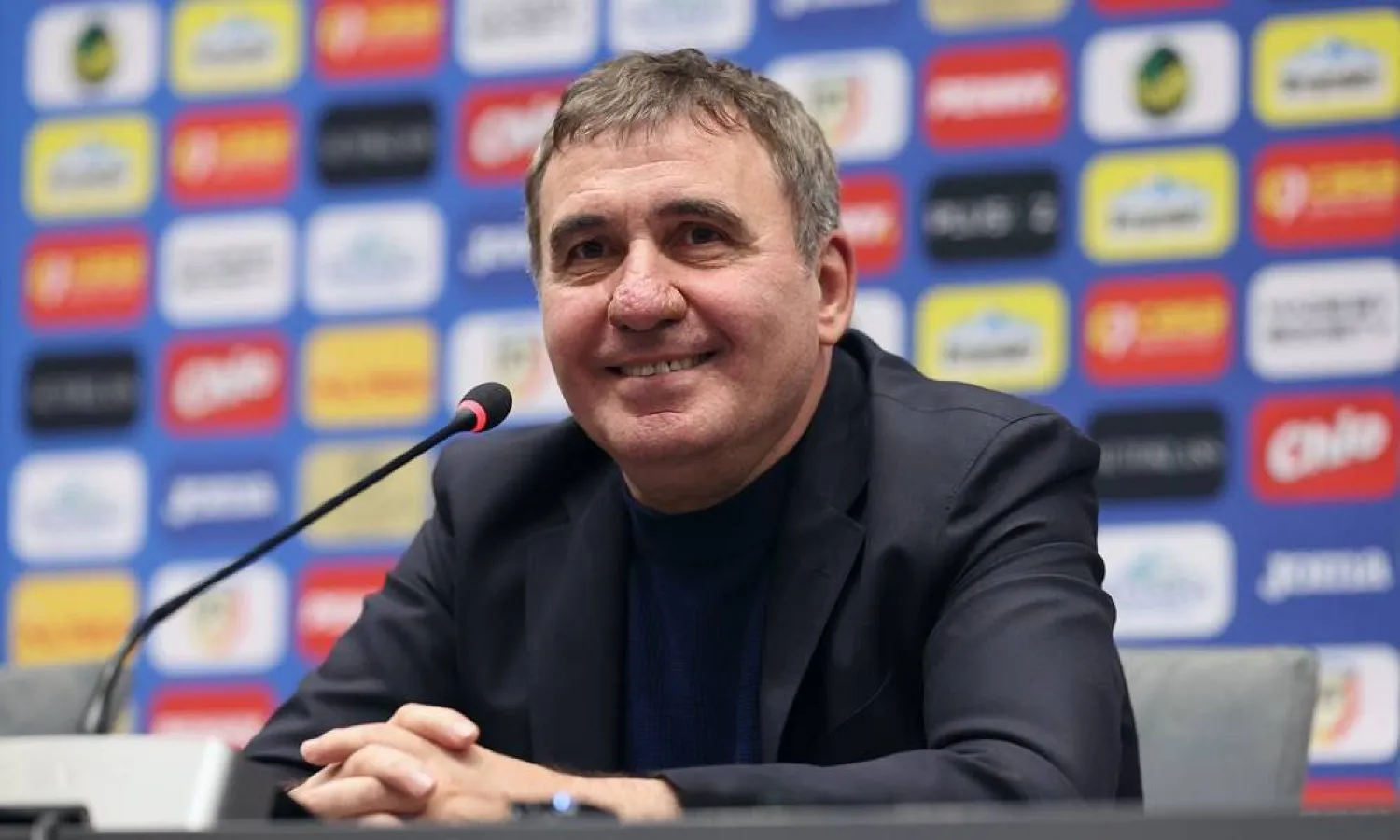

Romania Great Gheorghe Hagi Returns for Second Stint as National Team Coach After Lucescu’s Death

Gheorghe Hagi attends a press conference after being appointed as the new manager of the Romanian national team, in Bucharest, Romania, April 20, 2026. (EPA)
TT

Romania Great Gheorghe Hagi Returns for Second Stint as National Team Coach After Lucescu’s Death

Gheorghe Hagi attends a press conference after being appointed as the new manager of the Romanian national team, in Bucharest, Romania, April 20, 2026. (EPA)

Romania great Gheorghe Hagi has been hired as national team coach for the second time. He was appointed to replace Mircea Lucescu, who died two weeks ago.

The 61-year-old Hagi is widely regarded as Romania’s greatest ever football player, having led the country to the World Cup quarterfinals in 1994. He also played for Barcelona and Real Madrid as a creative attacking midfielder.

His first stint as Romania coach was in 2001 and lasted three months, ending after failing to get the team through the playoffs for the 2002 World Cup.

Hagi has since coached clubs in Romania and Türkiye, including Galatasaray and Steaua Bucharest, but is back in charge of the No. 56-ranked national team, which will not be at the World Cup in the United States, Canada and Mexico.

The Romanians lost to Türkiye in the playoffs, after which Lucescu fell ill and stepped down as coach. He died April 7, at the age of 80.

“It is an honor and a great responsibility to represent Romania once again, as I did as a player,” Hagi said in a statement released by Romania’s football federation.

“I am convinced,” he added, “that we can achieve beautiful things. I hope that the performances I had as a player, I will also have as a coach. I am convinced that we can become the best.”

Romania last played at the World Cup in 1998. It reached the round of 16 at the European Championship in 2024, losing to the Netherlands.

Hagi’s first games in charge will be friendlies against Georgia and Wales in June. Romania is in a Nations League group with Sweden, Bosnia and Herzegovina, and Poland starting in September.

He has signed a contract through to the 2030 World Cup, with the task of “bringing the national team back into the elite of world football,” the federation said.

Federation president Răzvan Burleanu said his organization has made “several attempts over time” to get Hagi to become coach again.



Algeria and Austria Clash Revives Memories of the ‘Disgrace of Gijon’

Algeria face Austria on Saturday, 44 years on from the "Disgrace of Gijon". (Getty Images/AFP)
TT

Algeria and Austria Clash Revives Memories of the ‘Disgrace of Gijon’

Algeria face Austria on Saturday, 44 years on from the "Disgrace of Gijon". (Getty Images/AFP)

When Algeria and Austria meet in their last group game in Kansas City on Saturday, it will not only be key to both countries’ hopes of progressing at the World Cup but will also revive memories of one of the tournament’s darkest moments.

The only previous time the sides shared a group, Austria were accused of conniving with West Germany to ensure both teams advanced in the tournament and Algeria were eliminated.

The game was later dubbed the "Disgrace of Gijon" after the Spanish city where the 1982 World Cup proved an eventful debut for the North Africans, who upset West Germany in their first match with a shock 2-1 victory.

There were 24 teams in the tournament for the first time in ‌1982, divided into ‌six groups of four with the top two advancing to a second ‌round ⁠of group matches.

Algeria ⁠lost their second group game to Austria and beat Chile 3-2, leaving them with four points from their three games at a time when two points were awarded for a win.

NEIGHBORS CONTRIVED RESULT TO BOTH GO THROUGH

The group concluded 24 hours later in Gijon with Austria playing neighbors West Germany and a 1-0 win for the Germans would send both sides through.

West Germany went ahead after 10 minutes through Horst Hrubesch, after which both teams passed the ball around with no intention of adding to the score and contrived a ⁠result that squeezed Algeria out on goal difference.

“Even though we had somewhat ‌expected it, we were all angry, outraged and stunned,” said ‌Rabah Madjer, Algeria’s former African Footballer of the Year.

“That two major football nations could agree to eliminate a small ‌country like Algeria, playing in its first World Cup and just emerging on the international stage, ‌was shocking.”

German sports magazine Kicker described the proceedings as “after about 20 minutes, the attacking intensity faded”.

“The Austrians, for their part, made no effort to exploit the additional space going forward. Suddenly, nobody seemed interested in playing serious football anymore. What followed was an endless exchange of passes, with few challenges and almost no urgency. Possession was ‌lost mainly through misplaced passes.”

French daily L’Equipe said there should have been 22 red cards shown to the players of both sides.

SPECTATORS WAVED WHITE ⁠SCARVES TO PROTEST

Spanish spectators ⁠waved white scarves in a traditional sign of disapproval while on Austrian television, commentator Robert Seeger told his viewers: "Turn it off!"

German defender Paul Breitner, a World Cup winner in 1974, saw little wrong.

"The public is stupid if it doesn't understand that qualification was all that mattered here,” he said, and FIFA ruled the teams were within their rights to play as passively as they did, in response to an Algerian protest.

The Germans won their three-team second-round group, ahead of England and hosts Spain, and advanced to the semi-finals, where they beat France on penalties before losing to Italy in the final. Austria finished behind France in their second group.

A direct result of the "Disgrace of Gijon" was FIFA changing the rule to ensure the final matches in World Cup group stages are played simultaneously to prevent teams having advance knowledge of what they require to advance and the possibility of manufacturing the outcome of games.

“Many people apologized afterwards. It's good to acknowledge the harm you've caused, but it didn’t change anything for us,” Madjer said.


Ghana Draw Cools England Hype and Revives Familiar Questions

 England head coach Thomas Tuchel listens to the national anthem ahead the World Cup Group L soccer match between England and Ghana in Foxborough, Mass., near Boston, Tuesday, June 23, 2026. (AP)
England head coach Thomas Tuchel listens to the national anthem ahead the World Cup Group L soccer match between England and Ghana in Foxborough, Mass., near Boston, Tuesday, June 23, 2026. (AP)
TT

Ghana Draw Cools England Hype and Revives Familiar Questions

 England head coach Thomas Tuchel listens to the national anthem ahead the World Cup Group L soccer match between England and Ghana in Foxborough, Mass., near Boston, Tuesday, June 23, 2026. (AP)
England head coach Thomas Tuchel listens to the national anthem ahead the World Cup Group L soccer match between England and Ghana in Foxborough, Mass., near Boston, Tuesday, June 23, 2026. (AP)

Thomas Tuchel's England were riding a wave of optimism at the World Cup after their opening 4-2 demolition of Croatia, but Tuesday's 0-0 draw against Ghana served as a reminder that progress at major tournaments is not always straightforward.

The victory over Croatia had showcased England at their best, with fluid attacking football, goals and a sense that Tuchel's methods were taking hold.

Against Ghana, however, they encountered an entirely different challenge. Carlos Queiroz's side defended deep, remained organized and physical, and frustrated England for much of the ‌night as they ‌emerged with a valuable point.

England remain top of Group L ‌and ⁠are still firmly ⁠on course for the knockout stages, but the stalemate raised fresh questions about whether Tuchel's side possess the creativity and variety required to break down stubborn opponents.

Ghana appeared content to sit back and absorb pressure, surrendering possession but denying England space in dangerous areas.

"It is difficult to find a way through when someone plays a 4-5-1 and completely deep and is committed to it," Tuchel said afterwards. "They celebrated a 0-0 like a win. You cannot ⁠lose your head about it."

For all of England's dominance on the ‌ball, the Three Lions struggled to create clear ‌chances. Harry Kane, who scored twice in the opening victory over Croatia, was largely isolated and ‌tightly marked.

His frustration was summed up in stoppage time when he blazed his shot ‌over the bar from six yards after Nico O'Reilly's header had struck the crossbar.

The performance also reignited debate about England's attacking options. Anthony Gordon again struggled before being replaced by Bukayo Saka, whose introduction injected some urgency and unpredictability into England's play, forcing a save from Ghana goalkeeper ‌Benjamin Asare late on.

Marcus Rashford may also be pushing for greater involvement after England's lack of penetration against a compact defense.

Declan ⁠Rice and Elliot Anderson ⁠provided control but little creativity in midfield, allowing Ghana to remain comfortable for long stretches.

Rice insisted there was no cause for concern.

"We have one more group game to top the group, so we have to be positive," he said.

England's emphatic win over Croatia had sparked talk of momentum, belief and the possibility that Tuchel's new-look side might be finding its stride early.

Ninety minutes against Ghana quickly cooled that enthusiasm.

For the fourth major tournament in succession, England failed to win their second group game, exchanging the exhilaration of a four-goal display for a frustrating stalemate.

The surge of optimism generated by the Croatia victory has been checked, at least temporarily.

And while England remain well-placed to reach the knockout stages, the sense of optimism that followed their opening performance has been replaced by familiar questions about flare, consistency and whether they can break down organized opposition when space is at a premium.


Infantino: World Cup Hydration Breaks Purely Sporting, Not Commercial

Soccer Football - FIFA World Cup 2026 - Group K - Colombia v DR Congo - Estadio Guadalajara, Guadalajara, Mexico - June 23, 2026 Colombia coach Nestor Lorenzo gives instructions to his players during a hydration break REUTERS/Raquel Cunha
TT

Infantino: World Cup Hydration Breaks Purely Sporting, Not Commercial

Soccer Football - FIFA World Cup 2026 - Group K - Colombia v DR Congo - Estadio Guadalajara, Guadalajara, Mexico - June 23, 2026 Colombia coach Nestor Lorenzo gives instructions to his players during a hydration break REUTERS/Raquel Cunha

FIFA president Gianni Infantino has defended the introduction of hydration breaks at the World Cup, insisting that for football's governing body they are driven purely by sporting considerations and not commercial interests.

Mandatory three-minute breaks, introduced in the 22nd and 67th minutes of every match at the tournament, have drawn criticism from players, coaches and fans since the opening round of fixtures.

The breaks, introduced to help players cope with high temperatures across North America, have opened up additional advertising windows for broadcasters, Reuters reported.

This has fueled debate over their impact on the game, with some viewers complaining about being exposed to commercials during the three-minute stoppages.

"There is no ⁠additional revenue for ⁠FIFA, as all commercial agreements were signed well in advance. So, this is not a financial issue for us. For us, it is purely a sporting matter," Infantino said in a statement on Wednesday.

The breaks allow coaching staff to give in-game tactical instructions, a shift critics say disrupts match momentum and fundamentally alters the nature ⁠of the game.

England manager Thomas Tuchel said the additional break "interrupts and changes the identity of the football match,” while Uruguay coach Marcelo Bielsa said dividing matches into shorter segments takes away the fundamental characteristic of the game.

Spain coach Luis de la Fuente and Netherlands captain Virgil van Dijk have supported the intent behind the rule in extreme heat, but questioned the need for it in cooler conditions and at covered venues.

"The main reason is the heat, but we also have to understand that in a competition like the (FIFA) ⁠World Cup, played ⁠over 39 days, with teams potentially playing eight matches in those 39 days, having a moment to rest is extremely important,” Infantino said.

"What matters even more to us is ensuring that all teams, in every match, are playing under the same conditions.

"It's very difficult to accept that a coach might have the opportunity to influence a match by making adjustments simply because it's hotter, while in another match, where the temperature is slightly lower, the same coach doesn’t have the same opportunity."

Infantino added that the breaks had not reduced the intensity of matches, suggesting players were able to maintain a high level of performance throughout games.