


Some 7,900 People Died on Migration Routes in 2025, Says UN

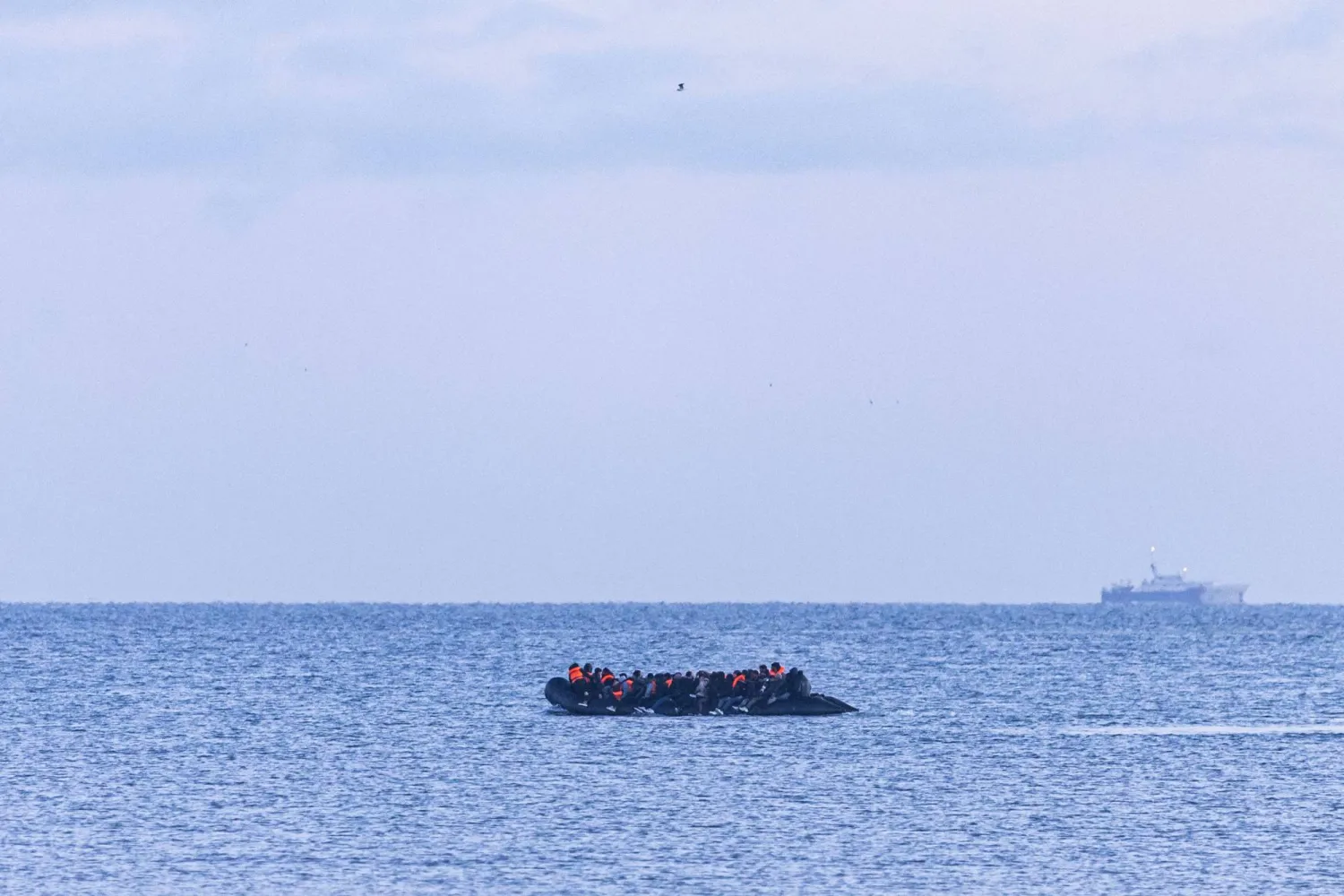
 Migrants attempt to cross the English Channel in a smuggler's boat off the coast of Gravelines, northern France, on April 14, 2026. (AFP)
Migrants attempt to cross the English Channel in a smuggler's boat off the coast of Gravelines, northern France, on April 14, 2026. (AFP)
TT

Some 7,900 People Died on Migration Routes in 2025, Says UN

 Migrants attempt to cross the English Channel in a smuggler's boat off the coast of Gravelines, northern France, on April 14, 2026. (AFP)
Migrants attempt to cross the English Channel in a smuggler's boat off the coast of Gravelines, northern France, on April 14, 2026. (AFP)

Around 7,900 people died or disappeared on migration routes in 2025, taking the total dead and missing since 2014 beyond 80,000, the United Nations' migration agency said Tuesday. 

The UN's International Organization for Migration said people were being forced into dangerous, irregular journeys when safe pathways were out of reach, and urged countries to find the political will to save more lives on migration routes. 

"The deaths or disappearance of nearly 7,900 people were documented on global migration routes worldwide in 2025," the IOM said. 

The IOM's Missing Migrants Project "has documented more than 80,000 deaths and disappearances during migration since 2014," the agency said. 

"While these figures represent only the lowest boundary of the true number of affected people, they nonetheless underscore the need for urgent action to end migrant deaths and address the complex needs of families left behind," said the IOM. 

The IOM said the 7,904 deaths and disappearances documented in 2025 "mark a continuation and escalation of a global failure to end these preventable deaths". 

"2025 was marked by an unprecedented level of aid cuts and restriction of information on dangerous irregular routes, rendering more and more missing migrants invisible," it said. 

Meanwhile, "an even more hidden population" of at least around 340,000 family members were estimated to be directly affected by the "ongoing crisis of missing migrants". 

They are having to deal with the psychological, social, legal and economic impacts of having a relative whose disappearance remains unresolved, the agency said. 

The IOM said the May 2026 International Migration Review Forum was a chance to change the dynamics. 

"Sustained political will is needed to save lives on migration routes worldwide and make visible the families most impacted by these preventable losses," the agency. 


Denmark Aims to Send Rejected Migrants to ‘Return Hubs’ by 2027

Denmark's then Defense Minister Morten Bodskov speaks ahead of a NATO Defense Ministers meeting in Brussels, Belgium, February 16, 2022. (Reuters)
TT

Denmark Aims to Send Rejected Migrants to ‘Return Hubs’ by 2027

Denmark's then Defense Minister Morten Bodskov speaks ahead of a NATO Defense Ministers meeting in Brussels, Belgium, February 16, 2022. (Reuters)

Denmark said Friday it was ready to send rejected asylum seekers to 'return hubs' as of 2027, as it hosted talks with four EU countries on the creation of migrant detention centers outside Europe.

"On the Danish side, we expect to be ready to send the first foreigners to a partner country by the end of next year," Danish Migrations Minister Morten Bodskov said in a statement.

He was meeting with his German, Dutch, Austrian and Greek counterparts on Friday in Copenhagen on the creation of deportation centers outside the European Union.

"This is an important step towards a more efficient asylum and migration system," Bodskov said.

"We do not accept that foreigners staying illegally in Denmark should be rewarded because of our difficulties in returning them."

In June, the European Parliament approved tougher migration rules granting authorities much broader detention powers, and allowing for the creation of 'return hubs'.

The idea has been severely criticized by human rights groups.

The partner country or countries have not been disclosed, but Uganda and Rwanda in particular are seen as possibilities.

Britain abandoned a scheme to deport undocumented migrants to Rwanda, while Italian-run facilities to process migrants in Albania have faced legal challenges and a slow uptake.


Cyprus Ferry Toll Rises to 12 as Two More Bodies Found

Motor boats take part in a search operation for people missing two days after a ferry disaster off the coast of Cyprus, near the port of Kyrenia in the Turkish-occupied northern part of Cyprus, Tuesday, Sept. 1, 2026. (AP)
TT

Cyprus Ferry Toll Rises to 12 as Two More Bodies Found

Motor boats take part in a search operation for people missing two days after a ferry disaster off the coast of Cyprus, near the port of Kyrenia in the Turkish-occupied northern part of Cyprus, Tuesday, Sept. 1, 2026. (AP)

The death toll from a ferry accident off northern Cyprus rose to 12 on Friday after rescuers found the bodies of two women, with another 16 people still missing, officials said.

The FiloJet ferry was carrying 267 people when it capsized shortly after departing from Kyrenia port on the northern shore of the divided island around midday on Sunday.

Rescuers managed to pull 239 people to safety, giving an initial count of eight dead and 20 missing with officials saying they believed they had gone down with the ship.

Round-the-clock rescue efforts have since recovered the bodies of four more victims, the latest two on Friday morning, raising the toll to 12, according to authorities in the Turkish Republic of Northern Cyprus (TRNC), which is only recognized by Ankara.

"The bodies of two more people have been recovered," TRNC prime minister Unal Ustel wrote on X, indicating both were women.

"Search operations are continuing 24/7 in order to reach our 16 missing people," he said as a team of specialist divers and naval drones probed the wreckage which is lying at a depth of 514 meters (1,686 feet).

Since Wednesday morning, two specialist Turkish naval vessels equipped with underwater drones have been working to find the remaining victims.

Before the latest bodies were found, officials said the eight dead were all Turkish nationals, indicating that 18 of the 20 missing were also Turkish while the last two were from northern Cyprus.

They have not given any further details about the nationalities of the two four bodies recovered since Wednesday night.

So far, investigators have been unable to retrieve the ferry's voyage data recorder (VDR) -- its "black box" -- which should give a clearer indication of what led to the ferry capsizing.

The ferry's captain and eight others were remanded in custody on Monday on charges of negligent homicide, and returned to the court in Kyrenia -- Girne in Turkish -- for a second hearing on Thursday.

At that hearing, police investigators said the catastrophe could have been avoided had the captain reduced speed and carefully turned back to port when the ferry started taking on water, media reports said.


Davutoglu Investigated for ‘Insulting’ Turkish President

Davutoglu speaks in the Turkish parliament. (File photo - Future Party on X)
TT

Davutoglu Investigated for ‘Insulting’ Turkish President

Davutoglu speaks in the Turkish parliament. (File photo - Future Party on X)

The Ankara Chief Public Prosecutor’s Office has opened an investigation into former Turkish Prime Minister and Foreign Minister Ahmet Davutoglu on suspicion of insulting President Recep Tayyip Erdogan.

The prosecutor’s office said Thursday it launched the investigation on its own initiative under Article 299/1 of the Turkish Penal Code over remarks deemed insulting to the president that circulated on social media.

An old video resurfaced Wednesday showing Davutoglu speaking with villagers while he was leader of the opposition Future Party, which announced on July 30 that it would dissolve and withdraw from politics. Insulting the president is punishable by up to four years in prison under Turkish law.

In the video, Davutoglu criticized Erdogan without naming him.

“Unlike the ministers who came after me, I did not earn a single penny illicitly,” he said. “I told them not to make illicit gains, but they did. They added billions to their billions, amassed ill-gotten gains and enriched their entourage.”

He added: “He appointed his son-in-law [Berat Albayrak, former energy and natural resources minister and treasury and finance minister] as a minister, enriched his relatives and handed Türkiye over to five contractors.”

A political science academic known as “the professor” within the ruling Justice and Development Party (AKP), Davutoglu served as an adviser to former President Abdullah Gul and later to Erdogan when he was prime minister before becoming foreign minister.

He succeeded Erdogan as AKP leader after Erdogan was elected president in 2014, when Türkiye’s parliamentary system barred presidents from belonging to political parties. Davutoglu resigned as party leader in 2016 amid differences with Erdogan over the management of the party and country.

He left the AKP in 2019 as their differences deepened and founded the Future Party. On July 30, he unexpectedly announced plans to dissolve it and withdraw from party politics, citing Türkiye’s “corrupt political climate.”

Davutoglu said the decision was “not a surrender or an abandonment of politics,” but an attempt to maintain an “ethical distance” from the political sphere.

He criticized Türkiye’s presidential system, citing a weakened separation of powers and ineffective checks and balances, and identified corruption, lack of merit, polarization and declining trust in the judiciary among the country’s main problems.

Davutoglu also warned that anger over authoritarianism, corruption, income inequality, restrictions and violations of the law could produce a “retaliatory counter-government” as polarization spreads from politics into society.

The Future Party was formally dissolved at a general congress on August 22. Political circles in Ankara said Davutoglu’s decision followed failed merger talks with the right-wing New Welfare and Felicity parties.
