Russia, North Korea Connect Road Bridge Ahead of Summer Opening

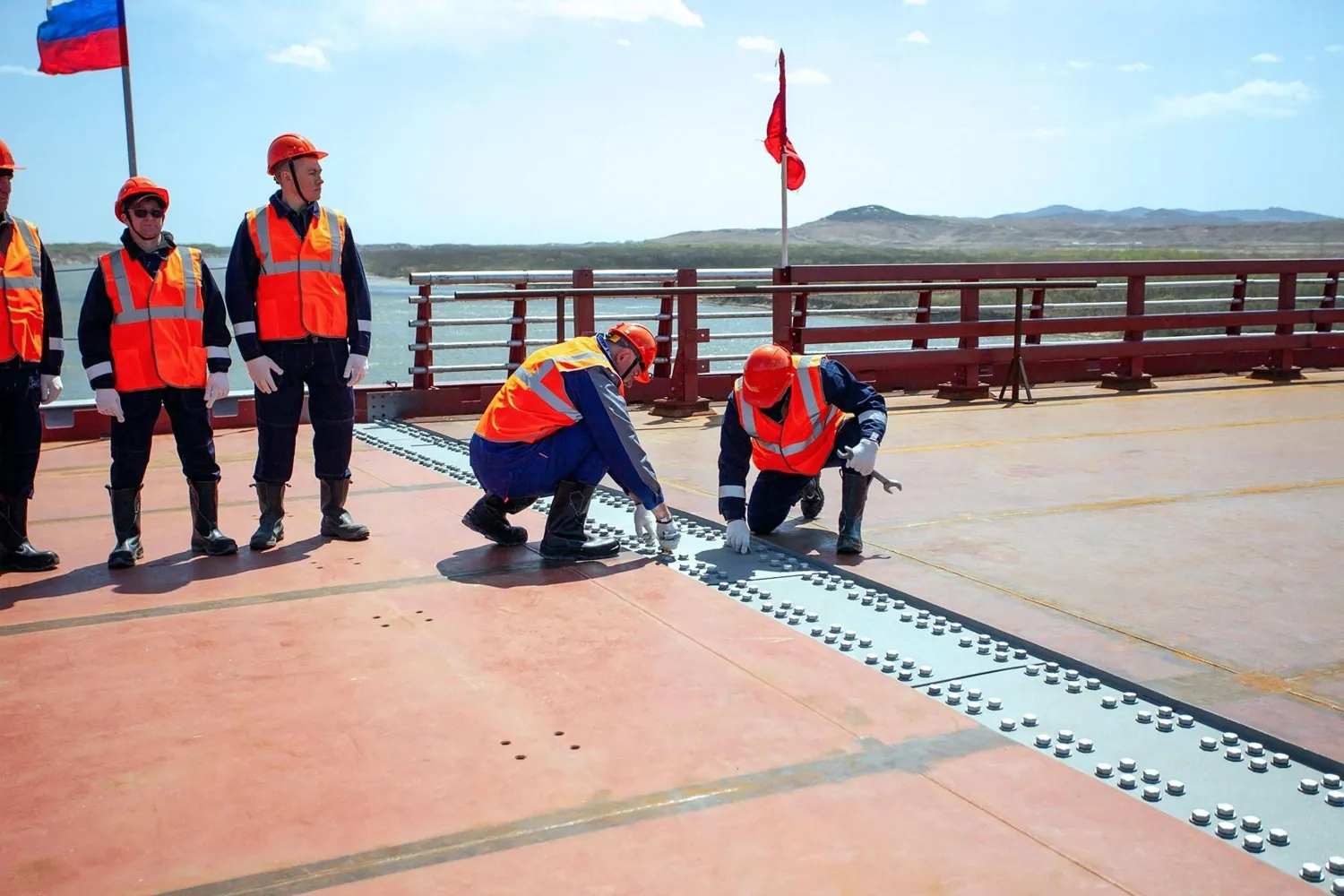
This handout image released by the Russian Transport Ministry on April 21, 2026, shows a ceremony marking the connection of the two sides of the new Russia-North Korea road bridge over the Tumen River, set to open this summer. (Handout / Russian Transport Ministry / AFP)
TT

Russia, North Korea Connect Road Bridge Ahead of Summer Opening

This handout image released by the Russian Transport Ministry on April 21, 2026, shows a ceremony marking the connection of the two sides of the new Russia-North Korea road bridge over the Tumen River, set to open this summer. (Handout / Russian Transport Ministry / AFP)

Russia and North Korea held a ceremony Tuesday to mark the joining of the first road bridge connecting the countries, set to open for traffic this summer, Moscow said.

Ties between the two heavily sanctioned countries have surged amid Russia's war on Ukraine, with Moscow and Pyongyang deepening economic, political, cultural and military links.

South Korea warned last week that Chinese and Russian support was helping revive the North Korean economy, which has struggled for years under sweeping international sanctions, almost complete international isolation and huge military investment.

Moscow's foreign ministry said the opening of the bridge would "become a truly landmark stage in Russian-Korean relations. Its significance goes far beyond a purely engineering task."

The bridge, which crosses the Tumen River that marks the border between the two countries, will be able to handle up to 300 vehicles and 2,850 people a day, Russia's transport ministry said.

Russia and North Korea inked a defense treaty in 2024 that calls for military support in the case of either country being attacked.

Pyongyang that year sent thousands of troops to Russia to support its war on Ukraine. They were deployed to the western Kursk region to held fend off a months-long counter-offensive by Kyiv's troops.

Several senior Russian officials have visited North Korea recently, including the interior minister, currently in the country.

Russia's foreign ministry said the bridge would help "develop trade, economic and humanitarian exchanges" between Russia's Far East and North Korea.

North Korea does not publish official data on the size of its economy.

Its nominal gross domestic product was equivalent to about $30 billion in 2024, according to Seoul's official estimate -- a tiny fraction of the South Korean economy, one of the most developed in the world.

North Korea has long faced shortages. A famine in the mid-1990s killed hundreds of thousands of people, and reports indicate that the Covid-19 pandemic also pushed many into extreme hunger.


FBI Offers $200,000 Reward to Catch Ex-Air Force Specialist Wanted on Espionage Charges in Iran

An FBI seal is displayed on a podium before a news conference at the field office in Portland, Ore., Jan. 16, 2025. (AP)
TT

FBI Offers $200,000 Reward to Catch Ex-Air Force Specialist Wanted on Espionage Charges in Iran

An FBI seal is displayed on a podium before a news conference at the field office in Portland, Ore., Jan. 16, 2025. (AP)

The FBI is offering a $200,000 reward for information leading to capture and prosecution of a former US Air Force counterintelligence specialist who defected to Iran in 2013 and was later charged with revealing classified information to the Tehran government.

Monica Elfriede Witt, 47, was indicted by a federal grand jury in February 2019 on charges of espionage, including transmitting national defense information to the government of Iran. She remains at large.

Witt “allegedly betrayed her oath to the Constitution more than a decade ago by defecting to Iran and providing the Iranian regime National Defense Information and likely continues to support their nefarious activities,” Daniel Wierzbicki, special agent in charge of the FBI Washington Field Office’s Counterintelligence and Cyber Division, said in a news release Wednesday.

“The FBI has not forgotten and believes that during this critical moment in Iran’s history, there is someone who knows something about her whereabouts.”

It wasn't immediately known why the FBI was bringing attention to Witt's case. The United States and Iran have been at war since Feb. 28.

Witt served in the Air Force between 1997 and 2008, where she was trained in the Farsi language and was deployed overseas on classified counterintelligence missions, including to the Middle East. She later found work as a Defense Department contractor.

The Texas native defected to Iran in 2013 after being invited to two all-expense-paid conferences in the country that the Justice Department says promoted anti-Western propaganda and condemned American moral standards.

Before that, Witt had been warned by the FBI about her activities, but told agents that she would not provide sensitive information about her work if she returned to Iran, prosecutors said.

According to the indictment, Witt placed at risk "sensitive and classified US national defense information and programs,” the news release said.

“Witt allegedly intentionally provided information endangering US personnel and their families stationed abroad. She also allegedly conducted research on behalf of the Iranian regime to allow them to target her former colleagues in the US government,” it said.


South Korea to Investigate Ship Debris from Hormuz Attack

 This undated handout photograph released by South Korea's Foreign Ministry on May 10, 2026, shows a damaged part of the South Korean cargo ship HMM Namu docked at a port in Dubai. (Handout / South Korean Foreign Ministry / AFP)
This undated handout photograph released by South Korea's Foreign Ministry on May 10, 2026, shows a damaged part of the South Korean cargo ship HMM Namu docked at a port in Dubai. (Handout / South Korean Foreign Ministry / AFP)
TT

South Korea to Investigate Ship Debris from Hormuz Attack

 This undated handout photograph released by South Korea's Foreign Ministry on May 10, 2026, shows a damaged part of the South Korean cargo ship HMM Namu docked at a port in Dubai. (Handout / South Korean Foreign Ministry / AFP)
This undated handout photograph released by South Korea's Foreign Ministry on May 10, 2026, shows a damaged part of the South Korean cargo ship HMM Namu docked at a port in Dubai. (Handout / South Korean Foreign Ministry / AFP)

Debris from a fire-damaged cargo ship said to have been attacked by unidentified aircraft in the Strait of Hormuz arrived in South Korea on Friday for investigation, the foreign ministry said.

Iran has largely blocked shipping through the vital strait since conflict broke out with the United States and Israel on February 28 and Washington blockaded Tehran's ports.

HMM Namu was struck by "two unidentified aircraft" on May 4, hitting the outer plate of the vessel's port-side ballast tank near the stern and causing a fire in the engine room, Seoul, a US ally, said at a press briefing on Sunday.

The Panama-flagged cargo vessel, operated by South Korean shipping firm HMM Co., had arrived in Dubai last week for investigation.

Its debris "arrived in South Korea by air following consultations with the UAE government" on Friday, Seoul's foreign ministry said in a statement.

The vessel debris is "scheduled to undergo detailed analysis by a specialized institution", it added without providing further detail.

Seoul said the aircraft involved in the attack "were captured on CCTV footage, but there are limitations in identifying the exact type, launch origin and physical size of the objects".

A senior government official told local media this week that the "likelihood that the (attacking) entity was someone other than Iran is low."

Tehran has denied responsibility, with its embassy in Seoul posting a statement on its website in the days following the attack, saying it "firmly rejects and categorically denies any allegations regarding the involvement" of its forces.

Seoul strongly condemned the attack and said it hopes to identify those behind it through a thorough investigation.

South Korea, Asia's fourth-largest economy, relies heavily on Middle Eastern fuel imports, most of which transited through the Strait of Hormuz during peacetime.

As a major petrochemicals producer and refiner, the closure has forced South Korea to impose a fuel price cap for the first time in nearly 30 years.


Ministers Adopt New Interpretation of Migrants’ Rights in European Legal System

Participants attend the opening session of the 135th Ministerial Session of the Committee of Ministers of the Council of Europe in Chisinau, Moldova, Friday, May 15, 2026. (AP)
TT

Ministers Adopt New Interpretation of Migrants’ Rights in European Legal System

Participants attend the opening session of the 135th Ministerial Session of the Committee of Ministers of the Council of Europe in Chisinau, Moldova, Friday, May 15, 2026. (AP)

European ministers adopted ‌a new interpretation of the European Convention on Human Rights on Friday that could facilitate some migrant deportations, including to third country "return hubs", but which critics say will weaken human rights protections.

The declaration comes amid complaints from member states in recent years that the European Court of Human Rights has prevented governments from forcibly removing foreign nationals convicted of crimes or refused asylum seekers.

The declaration adopted at the annual session of the Council of Europe's Committee of ministers in Moldova qualifies the rights under article 3 and article 8 of the convention, which relate to protection ‌from torture and ‌inhuman and degrading treatment and the right to ‌a ⁠private and family ⁠life.

It approves cooperation with third countries on immigration, including on "return hubs", provided that the countries respect the human rights convention.

It states that prohibition from torture and inhuman or degrading treatment is absolute, but that "the assessment of the minimum level of severity of the ill-treatment that constitutes inhuman or degrading treatment or punishment is relative and depends on all the circumstances ⁠of the case".

Veronika Fikfak, Professor of Human Rights ‌and International Law at University College London, ‌said that the declaration's interpretation of article 3 was a significant development and would ‌dilute protections from torture.

"It says (prohibition of torture and inhuman or ‌degrading treatment) is absolute, but then they use words to balance and offer a relative interpretation, but this is inconsistent with the heart of Article 3 - an absolute right cannot contain any element of relativity or balance," she said.

On ‌article 8, the declaration said states can expel foreign nationals in spite of their right to a ⁠private and ⁠family life so long as it is balanced with a legitimate aim, such as national security, and that the European Court of Human Rights would require "strong reasons" to override a state's decision.

The 46-member Council of Europe was set up after World War Two to uphold human rights and the rule of law.

Council of Europe Secretary General Alain Berset welcomed the declaration and said it would guide the work of the council and of national authorities and domestic courts.

"We have been able to bring together countries across Europe, with different views and experiences to agree a common position on how the system should work best, notably in the challenging context of migration," he said in a statement.