

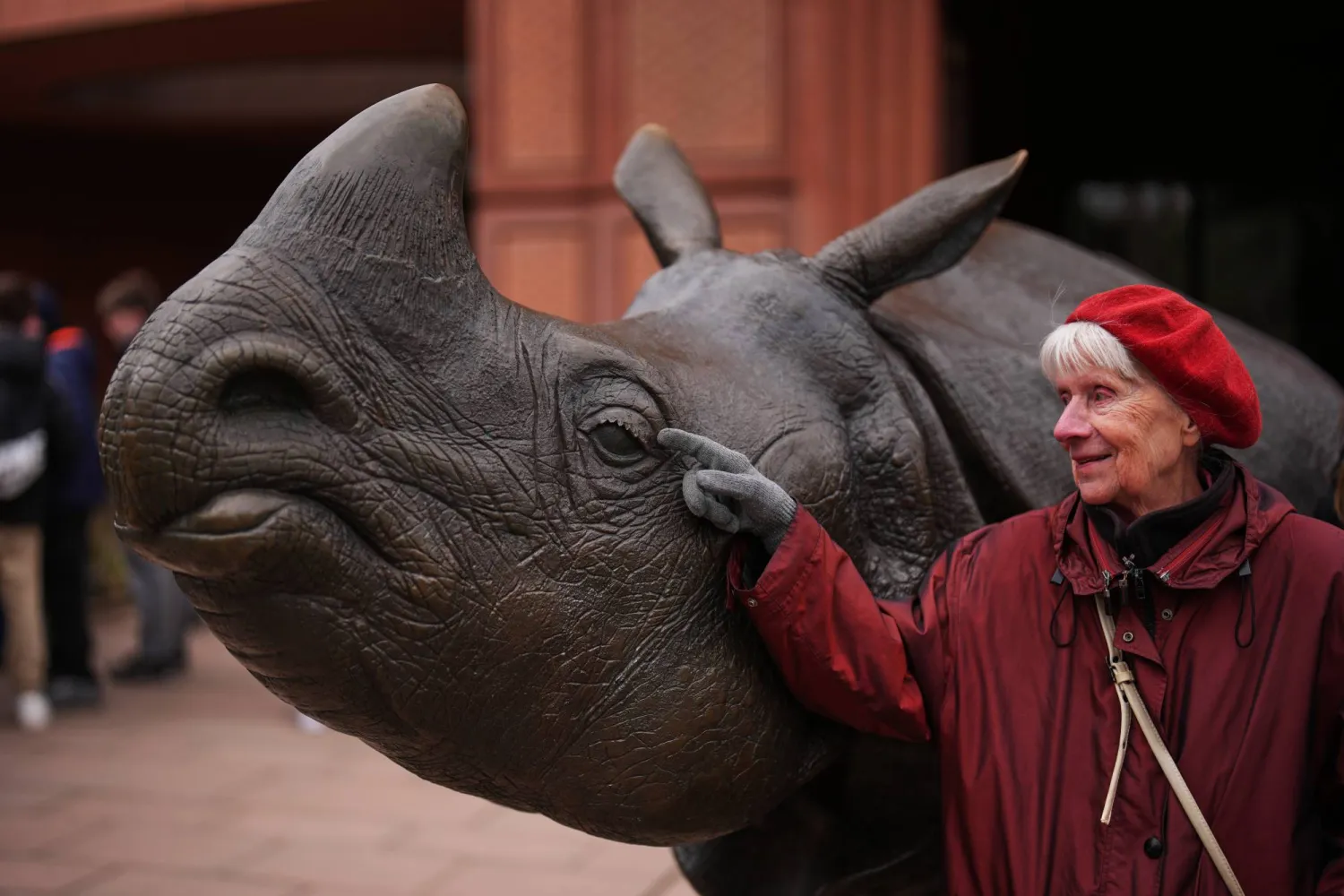

Specialized Tour at Berlin Zoo Brings Joy to People Living with Dementia

Monika Jansen, 85, touches a sculpture of a rhino as she takes part in a guided tour for people with dementia organized by Malteser Deutschland, part of the international Catholic aid organization Malteser Order of Malta, at the Zoo in Berlin, Germany, Thursday, March 26, 2026. (AP Photo/Markus Schreiber)
TT

Specialized Tour at Berlin Zoo Brings Joy to People Living with Dementia

Monika Jansen, 85, touches a sculpture of a rhino as she takes part in a guided tour for people with dementia organized by Malteser Deutschland, part of the international Catholic aid organization Malteser Order of Malta, at the Zoo in Berlin, Germany, Thursday, March 26, 2026. (AP Photo/Markus Schreiber)

Christel Krueger peered through thick glass and murky water at the Berlin Zoo, staring in awe at a mother hippopotamus and her child sleeping on a sandbar.

Krueger, 86, and her daughter were on a specialized zoo tour last month for people who live with dementia that was organized by Malteser Deutschland, part of the international Catholic aid organization Malteser Order of Malta.

On the tour with Krueger, Ingrid Barkow watched from her wheelchair as the elephants roamed their habitat, while Monika Jansen balanced on her tiptoes to get a better view of a rhinoceros.

“When I get home, I’ll still be thinking about it,” said Jansen, 85. “Maybe even at night, while I’m sleeping and dreaming about it.”

The three women are among roughly 1.6 million people living with dementia in Germany, according to the Office of the National Dementia Strategy. The figure is expected to rise to 2.8 million by 2050.

Museums and other cultural institutions across the globe have added specialized, barrier-free tours and guides to their repertoire in recent years, some made possible by advances in technology.

These include sign-language tours for people who are deaf and hard of hearing, touch-based events for those with blindness or low vision and programs for people on the autism spectrum.

The Berlin chapter of Malteser Deutschland last year designed a cultural program in the capital catering to people with dementia.

“People with dementia aren’t very visible in our society. It’s still a major taboo subject, yet it actually affects a great many people and it’s important that they continue to be at the heart of society," project coordinator Christine Gruschka said. "They have a right to participate, just like everyone else.”

Millions of people around the globe have some form of dementia, a progressive loss of memory, reasoning, language skills and other cognitive functions.

People can experience changes in personality, emotional control and even visual perception. Alzheimer’s is the most widely recognized type, but there are many others, with their own symptoms and underlying biology.

Malteser Berlin's tours for people with dementia occur at the zoo, the Museum of Natural History, Britzer Garden and Charlottenburg Palace, with hopes of expanding to other locations.

“‘Normal’ tours — so-called normal tours — are often too fast, too loud, with too many people and too many distractions," The Associated Press quoted Gruschka as saying. "That’s why we’ve made it our goal to create programs specifically for people with dementia: Where they still feel seen, where they feel comfortable, and where they can still show that they’re still here and can still be part of it.”

Dementia-specific tours are key for caregivers and families Krueger, Jansen and Barkow followed Malteser Berlin tour coordinator Carola Tembrink around the Berlin Zoo, accompanied by their daughters and a caregiver.

Tembrink skipped the majority of the zoo's vast offerings to focus on the hippo, rhino and elephant habitats so the participants would not get too tired or overwhelmed.

“The zoo is a wonderful place for tours like this because almost everyone who grew up in Berlin has been here as a child," Tembrink said. "And especially for people with dementia, childhood memories are often still present — they just need to be jogged a bit — and that happens naturally when they see the animals, smell the air as they enter the zoo, or when they go into the rhino house and catch a different scent.”

For the caregivers and families, the tours are a lifeline. During long and sometimes frustrating days of caring for someone with dementia, a specialized tour lets them connect with others who understand the journey.

Krueger was formally diagnosed last year with dementia, but her daughter, Kerstin Hoehne, said the symptoms appeared more than two years ago.

“What’s nice is that it’s also with, let’s say, like-minded people, that you’re not alone, but that you have a sense of belonging because everyone else might have the same problem,” Hoehne said.

Barkow's daughter, Manuela Grudda, said the tour brought them closer together. Grudda pushed Barkow's wheelchair through the zoo, her hands caressing her mother's shoulders or pointing out the animals.

“I can’t really communicate with her in a normal way, of course, but I see that when I show her something, she looks at it, she’s paying attention, and that’s important,” Grudda said. “And it just makes me happy that she’s not just in her own world, but also in this one.”



‘Fingerprints’ of Black Hole’s Event Horizon Detected for First Time

An actual image of the black hole where scientists looked for a ring of light, which is matter and radiation circling at extreme speeds around a region of darkness representing the black hole. (Event Horizon Telescope collaboration)
TT

‘Fingerprints’ of Black Hole’s Event Horizon Detected for First Time

An actual image of the black hole where scientists looked for a ring of light, which is matter and radiation circling at extreme speeds around a region of darkness representing the black hole. (Event Horizon Telescope collaboration)

Scientists have detected the "fingerprints" of a black hole's event horizon -- the boundary from which nothing can escape -- for the first time, according to research published on Wednesday.

The discovery was made by studying ripples in space-time called gravitational waves that were created when two black holes violently smashed into each other.

A black hole's event horizon is known as the "point of no return" because not even light can avoid being swallowed into its darkness.

This has made them incredibly difficult to learn anything about.

However, there is one event of such cataclysmic violence that it could offer a chance to glimpse this extreme phenomenon -- when two black holes merge into one.

When this cosmic death spiral occurs, it shoots gravitational waves across the universe which scientists have been detecting for the last decade.

For the new research published in Nature, an international team of researchers analyzed data from the strongest gravitational wave ever recorded, known as GW250114, detected by the LIGO observatory in January 2025.

By isolating the last burst of waves -- known as "direct waves" -- from this black hole merger, the scientists said they were able to extract information from closer to an event horizon than ever before.

"This black hole horizon concept normally appears in science fiction," lead study author Sizheng Ma of the Perimeter Institute for Theoretical Physics in Canada told AFP.

"But now we are really able to touch the region around the horizon with gravitational data," he added.

"Sometimes I cannot believe this is really happening."

- Causing a stir -

The last stage of two black holes merging is like a spoon stirring a glass of water, Sizheng Ma explained.

The resulting swirl in space creates the ripple of gravitational waves that travel at the speed of light in all directions.

If the metaphorical spoon is stirring close enough to the black hole's event horizon, "this offers us a chance to decode the physics around that region", Sizheng Ma said.

By supporting the theory of general relativity, the results "proved that Einstein was correct again," he added.

The scientists emphasized that more research was needed to decipher what can be gleaned about event horizons using this method.

But they did detect information about how black holes twist space around themselves as they rotate -- a phenomenon known as "frame dragging".

"This is similar to pushing a glass into a table and twisting it, so that the tablecloth winds up around it," Maximiliano Isi, a gravitational wave astrophysicist at Columbia University, told AFP.

In the future, the team of scientists hope to find signs of tiny changes known as quantum fluctuation.

"In this way, we can really probe this near horizon region to look for a new physics," including searching for a deviation from general relativity, Sizheng Ma said.

- Reaction mixed -

Experts not involved in the study urged caution.

Francesco Sannino, an Italian theoretical physicist who studies black holes, told AFP it was "compelling analysis" but needed to be checked by other researchers.

Still, it was "striking" that the scientists were able to show that gravitational waves carried the event horizon's "fingerprints," he said.

The astrophysicist Isi described the work as "tantalizing".

"More generally, understanding the physics of black holes and their mergers is important as it might shed light on how space and time are woven together at a more fundamental level," he told AFP.

Sean McWilliams, an astrophysicist at West Virginia University, was skeptical that the gravitational wave frequency analyzed by the scientists was actually "dictated" by the event horizon.

For this reason, "the actual observed signal doesn't really tell us anything about the horizon or the other properties directly related to it", he told AFP.

Sizheng Ma said McWilliams's statement was "not correct," suggesting he had conflated two different aspects in the paper.

"There is often considerable resistance and criticism in the early stages of promoting a new concept," he said, adding he is working on another paper to "clarify these confusions and possible misinterpretations".


Asteroid Zooming Past Earth on Saturday Visible to Stargazers

FILE PHOTO: A nighttime view of Earth, derived from satellite images taken daily over the past decade, capturing human activity on the planet through the emissions of artificial light, is seen in this image released on April 8, 2026. Michala Garrison/NASA Earth Observatory/Handout via REUTERS
TT

Asteroid Zooming Past Earth on Saturday Visible to Stargazers

FILE PHOTO: A nighttime view of Earth, derived from satellite images taken daily over the past decade, capturing human activity on the planet through the emissions of artificial light, is seen in this image released on April 8, 2026. Michala Garrison/NASA Earth Observatory/Handout via REUTERS

A large asteroid that will zoom harmlessly past Earth on Saturday will be visible to stargazers using a small telescope or large binoculars, the European Space Agency announced Wednesday.

The asteroid will come within 2,560,000 kilometers of Earth at 1114 GMT on Saturday, which is more than six times the distance between the Earth and the Moon.

Called (152637) 1997 NC1, the asteroid will be speeding along at nearly nine kilometers a second, posing no threat to Earth as any chance of an impact has been ruled out.

Discovered in 1997, the asteroid is estimated to be between 750 and 1,650 meters wide, according to calculations based on how much sunlight it reflects.

However other estimates suggest it could be smaller, AFP quoted the ESA as saying in a statement.

"A close approach to Earth by an object this size only occurs every few years, although this time the bright nearby Moon might impede its observability at closest approach," Juan Luis Cano of the ESA's Planetary Defense Office said in a statement.

For stargazers with telescopes or binoculars, the asteroid will be visible in parts of the Northern Hemisphere as it approaches, almost everywhere as it speeds past Earth, and only from the Southern Hemisphere as it departs.

But this depends if people are in areas of the world where the sky is dark enough as it passes.


Think Tank: Singapore, Indonesia, Malaysia and Brunei Face High Risk of Severe Haze this Year

People stop by a cafe with murals painted on its facade in the Arab Street district of Singapore on June 16, 2026. (Photo by Roslan RAHMAN / AFP)
TT

Think Tank: Singapore, Indonesia, Malaysia and Brunei Face High Risk of Severe Haze this Year

People stop by a cafe with murals painted on its facade in the Arab Street district of Singapore on June 16, 2026. (Photo by Roslan RAHMAN / AFP)

Singapore, Indonesia, Malaysia and Brunei face a high risk of severe haze this year due to hot and dry weather conditions, biofuel demand and economic pressures, a research institute said Wednesday.

The Singapore Institute of International Affairs said it was the second time it had issued a red risk rating since launching its Haze Outlook report in 2019. The previous red risk rating was in ⁠2023, Reuters reported.

Here are some ⁠details:

August to September is the peak danger period for haze in the Southeast Asian region, driven by the El Niño and Indian Ocean Dipole weather phenomena, the report said.

The ⁠return of El Niño is expected to create a longer and stronger dry season at a time when fire preparedness could be adversely affected by economic uncertainty and cost pressures.

The SIIA said rising costs of fertilizer and fuel as a result of the Iran war could lead to unsustainable activity such as the use ⁠of ⁠fire rather than machinery to clear land and dispose of waste.

Land use could also intensify as demand for biofuels rises due to energy supply disruptions.

"This trend will continue even if the US-Iran agreement holds, as countries now want energy independence," said SIIA associate director Khor Yu-Leng.

ASEAN cooperation and sustainable land management will be critical to reducing risks, the report said.