

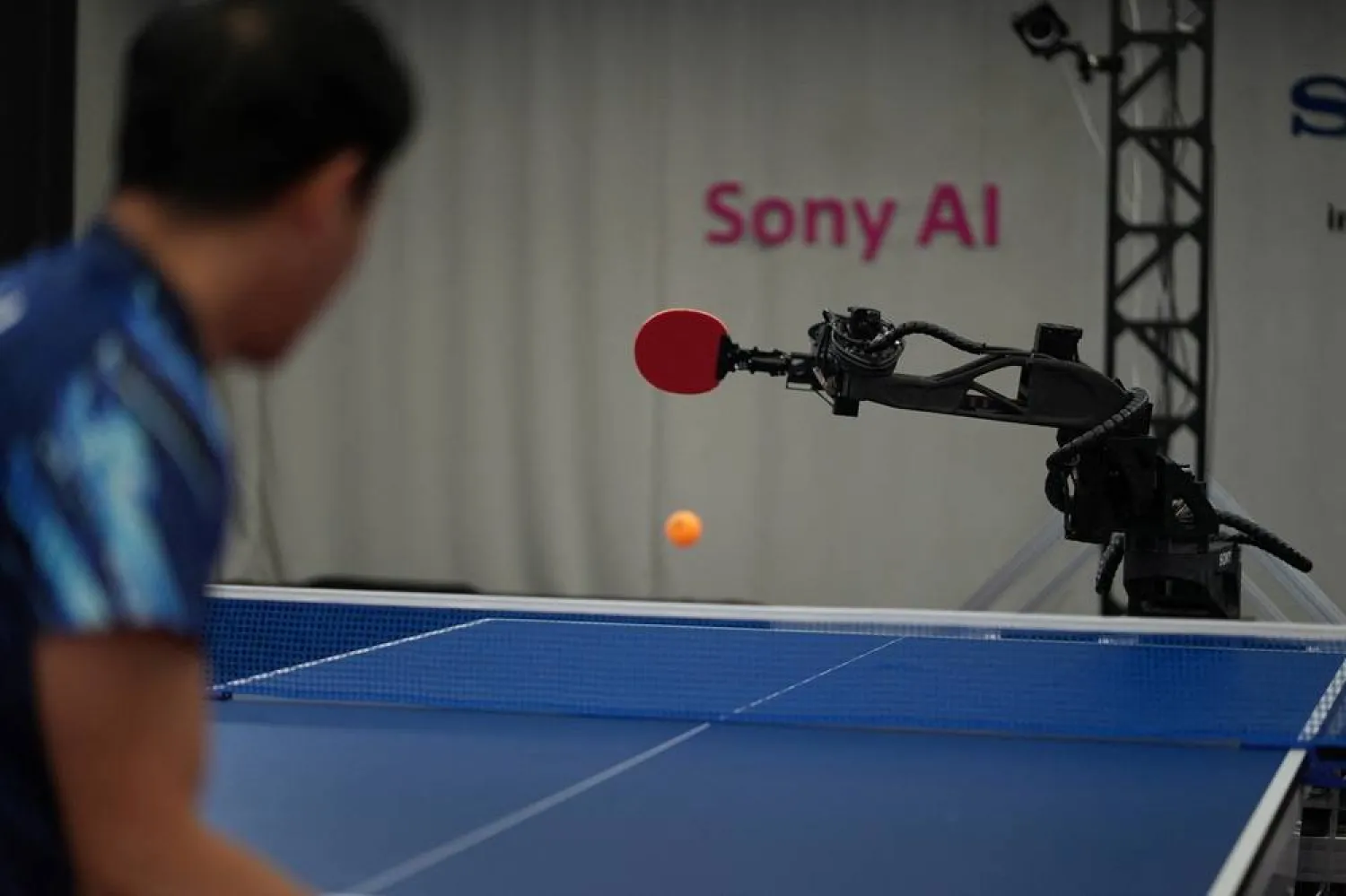

Ping-Pong Robot Ace Makes History by Beating Top-Level Human Players

Sony AI autonomous robot Ace returns a shot back against its human opponent, table tennis player Yamato Kawamata, during a match in December 2025, as seen in this photograph released on April 22, 2026. (Sony AI/Handout via Reuters)
TT

Ping-Pong Robot Ace Makes History by Beating Top-Level Human Players

Sony AI autonomous robot Ace returns a shot back against its human opponent, table tennis player Yamato Kawamata, during a match in December 2025, as seen in this photograph released on April 22, 2026. (Sony AI/Handout via Reuters)

An autonomous robot ping-pong player dubbed Ace has achieved a milestone for AI and robotics in Tokyo by competing against and sometimes defeating top-level human players at table tennis, a feat that could presage an array of other applications for similarly adept robots.

Ace, created by the Japanese company Sony's AI research division, is the first robot to attain expert-level performance in a competitive physical sport, one that requires rapid decisions and precision execution, the project's leader said. Ace did so by employing high-speed perception, AI-based control and a state-of-the-art robotic system.

There have been various ping-pong-playing robots since 1983, but until now they were unable to rival highly skilled human competitors. Ace changed that with its performances against human elite-level and professional players in matches following the rules of the International Table Tennis Federation, the sport's governing body, and officiated by licensed umpires.

"Unlike computer games, where prior AI systems surpass human experts, physical and real-time sports such as table tennis remain a major open challenge due to their requirements for fast, precise and adversarial interactions near obstacles and at the edge ‌of human reaction ‌time," said Peter Dürr, director of Sony AI Zurich and leader for Sony AI's project Ace.

The ‌project's ⁠goal was not ⁠only to compete at table tennis but to develop insights into how robots can perceive, plan and act with human-like speed and precision in dynamic environments, Dürr said.

"The success of Ace, with its perception system and learning-based control algorithm, suggests that similar techniques could be applied to other areas requiring fast, real-time control and human interaction - such as manufacturing and service robotics, as well as applications across sports, entertainment and safety-critical physical domains," said Dürr, lead author of a study describing Ace's achievements published on Wednesday in the journal Nature.

In matches detailed in the study, Ace in April 2025 won three out of five versus elite players and lost two matches against professional players, the top skill level in the ⁠sport. Sony AI said that since then Ace beat professional players in December 2025 and last ‌month.

Companies worldwide are making advances with robots. On Sunday, for instance, robots outran human ‌runners in a half-marathon race in Beijing.

'A BLUR TO THE HUMAN EYE'

AI systems already have excelled in digital domains in strategy games such as ‌chess and Go and at complex video games.

While video games take place in simulated environments, table tennis requires rapid decision-making, precise ‌physical execution and continuous adaptation to an unpredictable opponent, Dürr said. The ball moves at high speeds with complex spins and trajectories, pushing humans and robots to operate at the limits of sensing, prediction and motor control, Dürr said.

Ace's architecture integrates nine synchronized cameras and three vision systems to track a spinning ball with exceptional accuracy and speedy processing time.

"This is fast enough to capture motion that would be a blur to the human eye," Dürr ‌said.

The researchers developed a custom robot platform featuring eight joints. This was, Dürr said, the minimum number necessary to execute competitive shots: three for the racket's position, two for its orientation ⁠and three for the shot's speed ⁠and strength.

Mayuka Taira, a professional table tennis player who lost a match to Ace last December, said in comments provided by Sony AI that the robot's strengths "are that it is very hard to predict, and it shows no emotion."

"Because you can't read its reactions, it's impossible to sense what kind of shots it dislikes or struggles with, and that makes it even more difficult to play against," Taira said.

Rui Takenaka, an elite-level player who has won and lost matches against Ace, said in comments provided by Sony AI: "When it came to my serve, if I used a serve with complex spin, Ace also returned the ball with complex spin, which made it difficult for me. But when I used a simple serve - what we call a knuckle serve - Ace returned a simpler ball. That made it easier for me to attack on the third shot, and I think that was the key reason why I was able to win."

Ace has room for improvement, Dürr said.

"Ace has a superhuman ability to read the spin of incoming balls, and superhuman reaction time. As it learns to play not from watching humans play, but is trained by itself in simulation, it also reacts differently from human players and creates surprising situations," Dürr said. "At the same time, professional human athletes are very good at adapting to their opponent and finding weaknesses, which is an area that we are working on."



Abu Dhabi AI Institute Releases Fully Open-Source Models With Training Data, Code

A view of the UAE capital, Abu Dhabi (Asharq Al-Awsat)
TT

Abu Dhabi AI Institute Releases Fully Open-Source Models With Training Data, Code

A view of the UAE capital, Abu Dhabi (Asharq Al-Awsat)

Abu Dhabi-based research institute IFM on Thursday released six artificial intelligence models together with the data and methods used to build them, challenging an industry trend toward increasingly secretive AI development.

The K2 Horizon release includes model weights, training data, code, methodologies and intermediate checkpoints, allowing researchers to retrace the models' development process and reproduce results, IFM founder Eric Xing told Reuters.

The move goes beyond the "open-weight" approach used by some Chinese developers, which make models available for download but provide limited insight into how they were built, and contrasts with the more closed development practices of companies such as OpenAI and Anthropic, which neither release their models for download nor disclose the data and techniques behind them.

"Our goal with this release is to establish a reference point for what a truly open model release can look like," Xing said.

He said the release was also intended to show policymakers, regulators and public-interest advocates that "openness and competitive performance are not mutually exclusive."

The launch forms part of the UAE's push to establish itself as a global AI hub.

The model family ranges from one designed for smartwatches and other constrained devices to a 375-billion-parameter system for enterprise deployments.


Nvidia to Buy Hugging Face for $13 billion in Big Bet on Open AI Models

Nvidia's logo at its headquarters in Santa Clara, California (AFP)
TT

Nvidia to Buy Hugging Face for $13 billion in Big Bet on Open AI Models

Nvidia's logo at its headquarters in Santa Clara, California (AFP)

Nvidia will buy popular developer platform Hugging Face for $12.93 billion, betting that support for open AI models will drive future demand even as its biggest customers develop their own chips to reduce reliance on the semiconductor giant.

Shares of the company were slightly higher after the deal on Thursday, which ranks among its biggest.

The deal will cement Nvidia as a central player in the market for open models that users can freely download, run and customize, unlike the closed systems built by OpenAI and Anthropic.

Nvidia has already played an active role in backing the open AI industry with its widely used Nemotron model. Acquiring Hugging Face will give it direct access to a platform developers use to collaborate, test and share tools, potentially providing valuable insight and data that could help it narrow the technology gap with top American and Chinese labs.

Demand for open-weight models has surged from businesses balking at the steep bill of deploying the technology, with Chinese companies such as DeepSeek and Z.ai emerging as crucial players with models that can match the best from the US in tasks, including generating computer code at a lower cost.

That surge has fueled fears that some American firms could become reliant on Beijing's models even as both countries race to dominate a technology they see as crucial to their future.

"Hugging Face will remain an open platform for the entire AI ecosystem," Nvidia CEO Jensen Huang said, adding that his company's chips would not be required to build on or deploy through Hugging Face.

Under the deal, Nvidia will pay about $11.9 billion to Hugging Face investors, while offering an equity-based retention program of up to $1 billion for employees who join Nvidia.

The two companies already work together to help developers use Nvidia's computing services on the platform.

For Nvidia, building up open source may help it cushion a demand slowdown from customers such as Meta, OpenAI and Microsoft, which are developing their own AI chips to cut reliance on its costly and supply-constrained processors.

Hugging Face has also been in the news recently after a hack by rogue AI agents that escaped OpenAI's testing environment. Beyond hosting AI models, it offers datasets, software libraries and cloud services used to build and deploy AI applications.

The New York-based startup, which is backed by Intel , Advanced Micro Devices and Amazon, was founded in 2016 by French entrepreneurs Clément Delangue, Julien Chaumond and Thomas Wolf.


Robot Brings Cashier and Service-Host Functions to LEAP 2026

LEAP 2026 is showcasing an emerging Saudi experience in artificial intelligence (AI) and robotics through a robot named RoboNex, designed to combine cashier and service-host functions in the restaurant and café sector. (SPA)
TT

Robot Brings Cashier and Service-Host Functions to LEAP 2026

LEAP 2026 is showcasing an emerging Saudi experience in artificial intelligence (AI) and robotics through a robot named RoboNex, designed to combine cashier and service-host functions in the restaurant and café sector. (SPA)

LEAP 2026 is showcasing an emerging Saudi experience in artificial intelligence (AI) and robotics through a robot named RoboNex, designed to combine cashier and service-host functions in the restaurant and café sector. The robot interacts with customers in real time, takes their orders and provides smart recommendations, the Saudi Press Agency said on Thursday.

The robot’s development took place in Saudi Arabia, starting with structural design and component engineering and progressing to controller programming, AI algorithms, voice-processing systems and real-time interaction. It was also integrated with point-of-sale systems and electronic payment gateways.

The robot can handle sales transactions and take customer orders, while recommending additional products based on items already in the shopping basket. It can display specified discounts and promotional offers during the purchasing journey.

The presence of robots at LEAP 2026 highlights the growing adoption of AI and robotics across industries, as these technologies move beyond experimental concepts toward real-world applications in business, services and retail.