

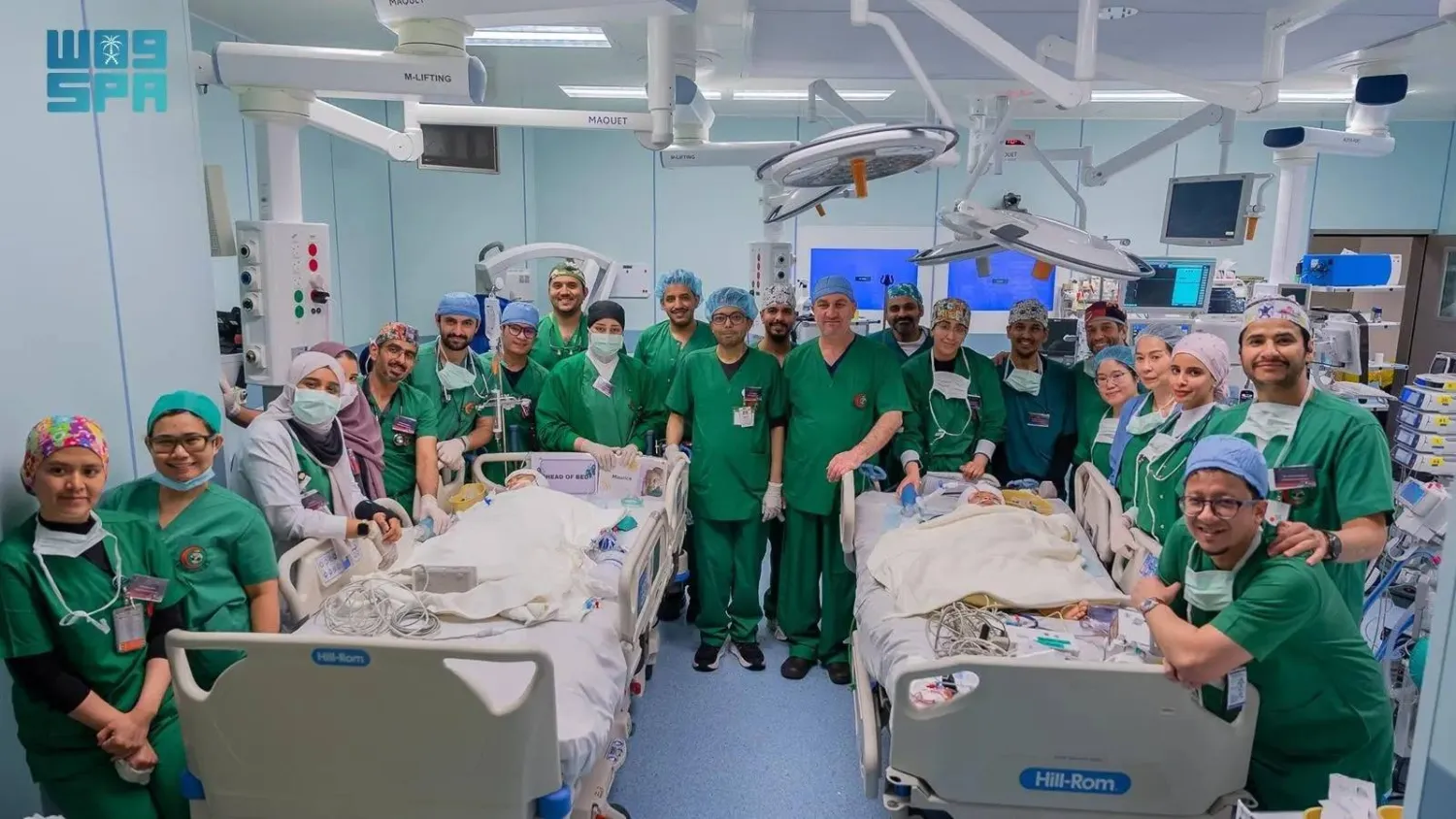

Saudi Team Successfully Separates Filipino Conjoined Twins in Highly Complex Surgery

The operation was conducted at King Abdullah Specialist Children’s Hospital in King Abdulaziz Medical City of the Ministry of National Guard in Riyadh. SPA
TT

Saudi Team Successfully Separates Filipino Conjoined Twins in Highly Complex Surgery

The operation was conducted at King Abdullah Specialist Children’s Hospital in King Abdulaziz Medical City of the Ministry of National Guard in Riyadh. SPA

The specialized medical and surgical team of the Saudi Conjoined Twins Program achieved on Thursday a new medical milestone by successfully separating the Filipino conjoined twins Klea and Maurice Ann following a highly complex surgical procedure, considered among the most challenging cases worldwide.

The operation was conducted at King Abdullah Specialist Children’s Hospital in King Abdulaziz Medical City of the Ministry of National Guard in Riyadh.

Advisor at the Royal Court, Supervisor General of the King Salman Humanitarian Aid and Relief Center (KSrelief), and head of the medical and surgical team of the Saudi Conjoined Twins Program Dr. Abdullah Al Rabeeah stated the Filipino twins were separated after 12 hours and 45 minutes from the start of anesthesia.

This marks the completion of the third stage, with the fourth and fifth stages remaining, which are expected to take several more hours and will include reconstruction, cosmetic procedures, and cranial closure.

He added that the operation was carried out with the participation of 30 consultants, specialists, and nursing and technical staff across multiple disciplines, including anesthesia, intensive care, advanced imaging, plastic surgery, and other supporting specialties, ensuring the highest levels of precision and safety throughout all stages of the procedure.

Al Rabeeah noted that this marks the third separation of conjoined twins from the Philippines and the 70th case within the Saudi Conjoined Twins Program, which spans more than 35 years.

The program has covered 27 countries and evaluated 157 cases worldwide, underscoring the Kingdom’s leading role in this rare medical specialty, under the direct support and patronage of Custodian of the Two Holy Mosques King Salman bin Abdulaziz Al Saud and Prince Mohammed bin Salman bin Abdulaziz Al Saud, Saudi Crown Prince and Prime Minister.

Al Rabeeah expressed, on behalf of himself and all members of the medical and surgical team, his deepest gratitude to the Kingdom’s leadership for the continuous support and close follow-up provided to the program.

He also extended his thanks to the surgical team, led by pediatric neurosurgery consultant Dr. Moutasem Azzubi, as well as to all members of anesthesia, plastic surgery, nursing, and technical teams for their efforts, which contributed to the success of the operation and the safety of the twins.

He affirmed that this achievement reflects the Kingdom’s noble humanitarian mission and its position as a global center of excellence in this field.

For their part, the twins’ family expressed their appreciation and gratitude to the Custodian of the Two Holy Mosques and the Crown Prince for the high-quality medical care provided, praising the tremendous efforts exerted by the medical team to ensure the success of the operation.



58-year-old Woman Killed in Bear Attack in Poland

22 April 2026, US, Seattle: Juniper, a Coastal Alaskan Brown Bear pictured on Earth Day at the Woodland Park Zoo. Photo: Shane Srogi/ZUMA Press Wire/dpa
TT

58-year-old Woman Killed in Bear Attack in Poland

22 April 2026, US, Seattle: Juniper, a Coastal Alaskan Brown Bear pictured on Earth Day at the Woodland Park Zoo. Photo: Shane Srogi/ZUMA Press Wire/dpa

A 58-year-old woman was killed by a bear in Southeastern Poland on Thursday, Pawel Giba, press officer for the District State Fire Service Headquarters in Sanok, told AFP.

A report received by the fire department "indicated that in the village of Plonna a woman was allegedly attacked by a bear," he said.

The report was filed by the woman's son.

Three fire squads and police were dispatched to the scene, but "did not proceed with first aid measures due to the extent of the woman's bodily injuries," he added.

Their arrival was delayed by "the difficult terrain and the lack of precise location details".

Upon their arrival, paramedics pronounced the woman dead at the scene.

Currently, "securing activities are underway," and a prosecutor is arriving in the area, according to the spokesman.

Poland has a population of about 100 brown bears, 80 percent of them in Poland's mountainous Bieszczady region, where the latest attack took place, according to Polish government data from 2024.

However, fatal attacks remain extremely rare with the last fatal bear attack in Poland in 2014, according to local media.


Mass Poisoning Suspected as 18 Wolves Die in Italian National Park

FILE PHOTO: Ten wolves were released in a wolf wildlife park in Saint Martin Vesubie, southern France, December 16, 2004. REUTERS/Eric Gaillard/File Photo
TT

Mass Poisoning Suspected as 18 Wolves Die in Italian National Park

FILE PHOTO: Ten wolves were released in a wolf wildlife park in Saint Martin Vesubie, southern France, December 16, 2004. REUTERS/Eric Gaillard/File Photo

Italian authorities are investigating the deaths of at least 18 wolves and several other wild animals found in recent days in a national park, in what conservation groups say is one of the worst attacks on wildlife in Italy.

The carcasses were discovered across several locations in and around the Abruzzo, Lazio and Molise National Park, a mountainous area in the center of the country long regarded as a stronghold for Italy's recovering wolf ⁠population.

The national park's ⁠authorities said the animals were most likely killed by poisoned bait, raising concerns for public safety as well as biodiversity, Reuters reported.

"The scale of what is happening is devastating," it said in a statement, expressing its "deep grief and disbelief".

Environment Minister Gilberto Pichetto Fratin described the killings as "horrendous", adding that he had ordered ⁠Italy's forestry police to intensify inspections in an effort to identify those responsible.

"The ministry is particularly attentive and sensitive to the protection of a species that is so important for the balance of our ecosystem," he said in a statement.

Italy's protected wolf population has rebounded in recent decades after being driven close to extinction in the 20th century. A 2020-21 census suggested there were around 3,300 wolves nationwide.

However, in some rural areas, farmers complain of attacks on livestock.

Angelo Bonelli, a lawmaker with the ⁠opposition Greens ⁠and Left Alliance party, accused the government of failing to stand up to the hunting lobby, seen as close to right-wing parties in the ruling coalition.

"Swift investigations, tighter controls and exemplary sanctions are needed," he said.

Environment group Legambiente said three foxes and a buzzard had also been found dead in the same region, reinforcing fears of widespread, illegal poisoning.

"This is... an unprecedented attack on protected wildlife," it said in a statement.

Prosecutors in the nearby city of Sulmona have opened an investigation. Authorities have also urged local communities to report suspicious activity as tests continue to determine the exact cause of death.


Scientists Trace Latest Interstellar Comet's Home to a Cold, Isolated Corner of the Milky Way

FILE - This image, provided by NASA, shows the interstellar comet 3I/Atlas captured by the Hubble Space Telescope on Nov. 30, 2025, about 178 million miles (286 million kilometers) from Earth. (NASA, ESA, STScI, D. Jewitt (UCLA), M.-T. Hui (Shanghai Astronomical Observatory), J. DePasquale (STScI) via AP, File)
TT

Scientists Trace Latest Interstellar Comet's Home to a Cold, Isolated Corner of the Milky Way

FILE - This image, provided by NASA, shows the interstellar comet 3I/Atlas captured by the Hubble Space Telescope on Nov. 30, 2025, about 178 million miles (286 million kilometers) from Earth. (NASA, ESA, STScI, D. Jewitt (UCLA), M.-T. Hui (Shanghai Astronomical Observatory), J. DePasquale (STScI) via AP, File)

The comet that rambled past us from another star last year likely originated in a cold, isolated corner of the galaxy that had yet to gel into its own solar system, astronomers reported Thursday.

Comet 3I/Atlas is only the third interstellar visitor to be confirmed and quite possibly the oldest. Scientists estimate it could be up to 11 billion years old, more than twice as old as the sun.

A team led by the University of Michigan used the ALMA observatory in Chile’s Atacama Desert to examine the comet last fall. The errant but harmless iceball was discovered last summer, giving NASA and the European Space Agency plenty of time to aim multiple space telescopes at it as it zoomed past Mars in October and made its closest approach to Earth in December. It's now well past Jupiter on its way out of our solar system for good, still visible only to the professionals.

In the study, scientists said they detected extremely high amounts of deuterium, or heavy hydrogen, in the comet's water. That suggests that the comet originated in a place considerably colder — before the star of this solar system even formed — than our own cosmic neighborhood, said the University of Michigan's Teresa Paneque-Carreno.

While our sun may have been surrounded by other newborn stars as it was forming, she noted, this comet's home star could have been more of a loner, leading to less heating and colder conditions.

The findings were published in Nature Astronomy.

The comet's precise place of origin is still unknown. Observations by the Hubble Space Telescope put the size of its nucleus somewhere between a quarter-mile and 3.5 miles (440 meters and 5.6 kilometers). It's hurtling away at 137,000 mph (220,000 kph).

Linking all these “puzzle pieces together may give an idea to how the planet-forming conditions were at these early times,” the Associated Press quoted Paneque-Carreno as saying in an email.

The first known interstellar object to stray into our celestial backyard — Oumuamua — was discovered by a telescope in Hawaii in 2017. Comet 2I/Borisov followed in 2019, named for the Crimean amateur astronomer who first spotted it.