Main Suspect in Syria's Tadamon Massacre Arrested, Ministry Sayshttps://english.aawsat.com/arab-world/5266004-main-suspect-syrias-tadamon-massacre-arrested-ministry-says
Main Suspect in Syria's Tadamon Massacre Arrested, Ministry Says
Amjad Yousef - Syria's Interior Ministry
Syria's Interior Ministry said on Friday it had arrested the main suspect in the 2013 Tadamon massacre, one of the worst acts of violence attributed to the former government of Bashar al-Assad, in which 288 civilians were killed.
The ministry released footage of Amjad Yousef’s arrest in the Al-Ghab Plain area of Hama province in western Syria, near his hometown. Yousef had been hiding there since the overthrow of Assad at the end of 2024, a security source told Reuters.
Yousef, 40, a former member of military intelligence under Assad, was thrust into the spotlight in April 2022 when the UK's Guardian newspaper published videos provided by two academics that they said showed him forcing blindfolded civilians to run towards a pit in the Tadamon neighborhood of southern Damascus before shooting them.
Annsar Shahoud, a researcher at the University of Amsterdam Holocaust and Genocide Center and one of the academics, spent four years documenting the massacre.
Posing as an online fangirl, Shahoud gained Yousef's trust and ultimately obtained his confessions both on video and audio recording.
Reuters was unable to reach Yousef for comment as he has been taken into custody.
The massacre is one of the most egregious documented incidents of violence attributed to the Assad government during the 14-year bloody war that began in 2011.
After Assad's fall at the end of 2024, civilians, media outlets and international organizations went to the site of the massacre to inspect it and interview witnesses. Locals refer to the site as "Amjad Yousef's Pit". It has been marked on Google Maps as "The Site of the Tadamon Massacre".
Ahmed Adra, a Tadamon resident and a member of the neighborhood committee, said victims' families had been celebrating in the streets since morning.
"We will take white roses and plant them at the site of the massacre and tell the victims that their memory is alive and that justice is being served," he told Reuters.
Shahoud said she now felt safe with Yousef in custody, but added the path to justice in Syria was unclear and did not include all perpetrators.
"I feel safe now, despite the distance, because I always felt for years that this person was after me," she told Reuters.
Three French Nationals Jailed for Life in Iraq for ISIS Tieshttps://english.aawsat.com/arab-world/5335136-three-french-nationals-jailed-life-iraq-isis-ties
Three French Nationals Jailed for Life in Iraq for ISIS Ties
Police officers gather in Baghdad's Tahrir Square on October 25, 2026. (Photo by AHMAD AL-RUBAYE / AFP)
Three French nationals were sentenced to life in prison in Iraq on Thursday for belonging to ISIS, with their lawyers and French embassy representatives present at the hearing, a court statement said.
The three were among 47 French ISIS suspects transferred from detention facilities in northeast Syria to Iraq last year, Reuters reported.
On Tuesday, six French nationals from the same group were sentenced to life in prison and a seventh to 15 years for belonging to the militant group.
ISIS seized large parts of Iraq and Syria in 2014 before being driven from its so-called self-declared “caliphate” by a US-led coalition and local forces in 2019. Many of its fighters were detained, but remnants of the organization continue to operate.
The United States announced in January that it was completing the transfer of ISIS detainees from Syria to Iraq amid concerns about the security of their detention facilities after Kurdish-led forces lost control of parts of the region.
Türkiye Renews Offer to Sign Maritime Boundaries Agreement with Egypthttps://english.aawsat.com/arab-world/5335009-t%C3%BCrkiye-renews-offer-sign-maritime-boundaries-agreement-egypt
Türkiye Renews Offer to Sign Maritime Boundaries Agreement with Egypt
From a meeting between Erdogan and Sisi in Ankara (File - Turkish Presidency)
Türkiye has once again expressed willingness to sign a maritime boundary delimitation agreement with Egypt that would "serve the common interests of both countries," despite Cairo's firm rejection of the Turkish-Libyan memorandum of understanding on maritime jurisdiction zones signed in late 2019 and ratified by Libya's House of Representatives last week.
A Turkish Defense Ministry official said that the Libyan parliament's approval of the memorandum signed between Türkiye and Libya on October 20 represented “an important development supporting our approach based on international law, the principles of equity, and respect for the legitimate rights and interests of the coastal states concerned."
Responding to a question during the ministry's weekly press briefing regarding objections to the memorandum, the official reiterated Türkiye's readiness to conclude a maritime delimitation agreement with Egypt "in line with mutual interests."
He added that, according to Turkish estimates, if Egypt were to sign such an agreement with Türkiye, it would gain an additional maritime area of more than 15,000 square kilometers compared with a potential agreement with Greece.
He stressed that Türkiye would continue to protect its legitimate rights and interests in the Eastern Mediterranean within the framework of international law while contributing to regional peace, security, and stability.
Turkish Effort to Preserve Relations
The official's remarks echoed comments previously made by Turkish Defense Minister Yasar Guler, who said that an agreement with Egypt would grant Cairo an additional 15,000 square kilometers of maritime jurisdiction in the Eastern Mediterranean.
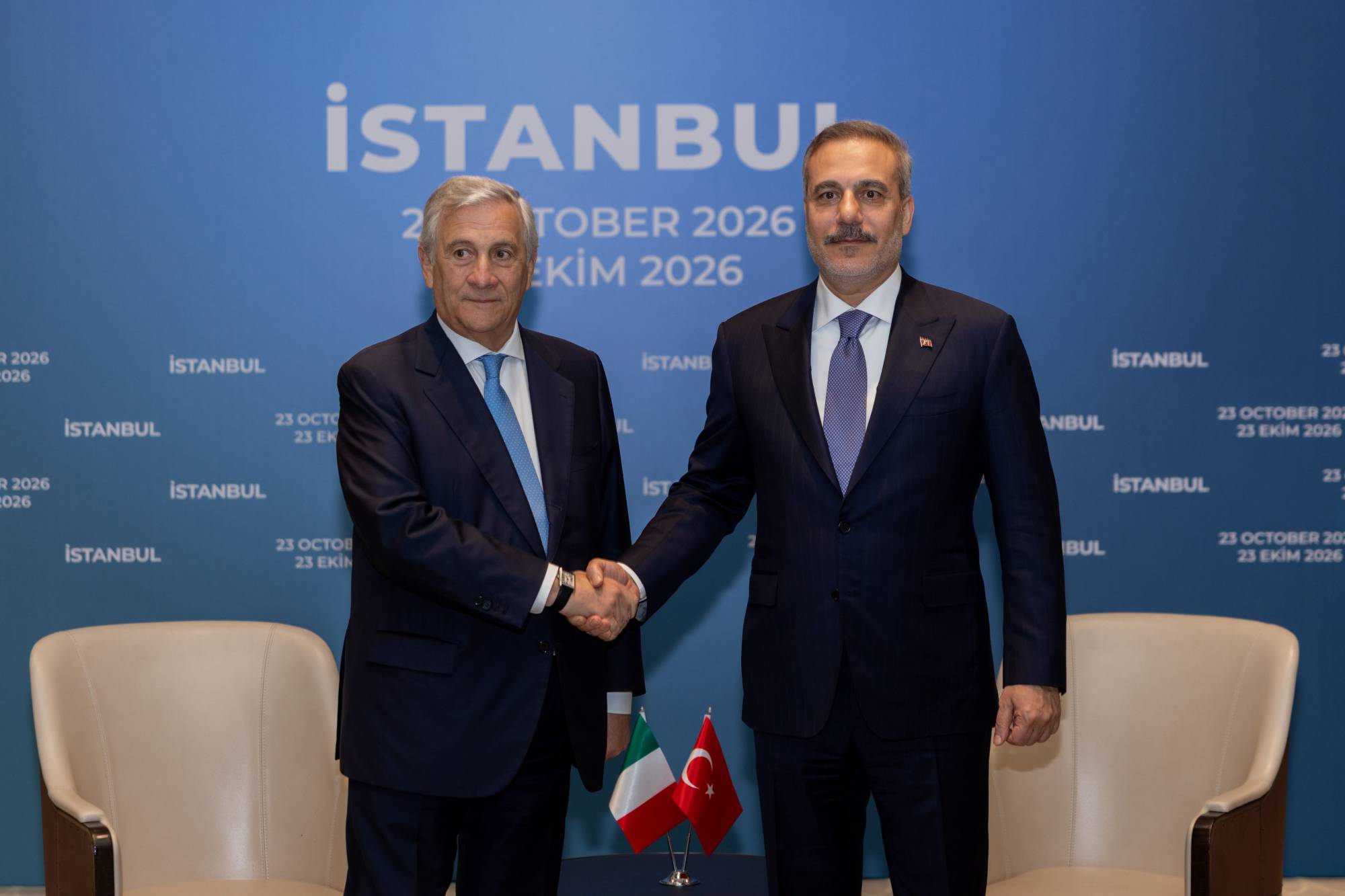
From Fidan's meeting with his Italian counterpart Antonio Tajani on the sidelines of the Istanbul meeting last week (Turkish Foreign Ministry)
During a Euro-Middle East meeting held in Istanbul last Friday and attended by the foreign ministers of Saudi Arabia, Egypt, Türkiye, Pakistan, Germany, Britain, and France, as well as Italian Foreign Minister Antonio Tajani, Egyptian Foreign Minister Badr Abdelatty reaffirmed Cairo's categorical rejection of Libya's parliamentary ratification of the Turkish-Libyan memorandum.
Abdelatty stated that the ratification would have "no legal effect" on Egypt.
Türkiye refrained from publicly criticizing Egypt's position, whether through official channels or media outlets, including those critical of the government.
Türkiye has sought to continue improving relations with Egypt and avoid another diplomatic dispute. This approach was reflected in remarks by President Recep Tayyip Erdogan following a cabinet meeting on Monday, when he stressed that Ankara does not seek to harm any party in the Eastern Mediterranean, advocates dialogue with all countries in the region, and intends to maintain relations with all influential actors in Libya.
Overtures to Greece
Following Libya's ratification of the Turkish-Libyan memorandum, Greece sent a letter to UN Secretary-General Antonio Guterres reiterating its objections.
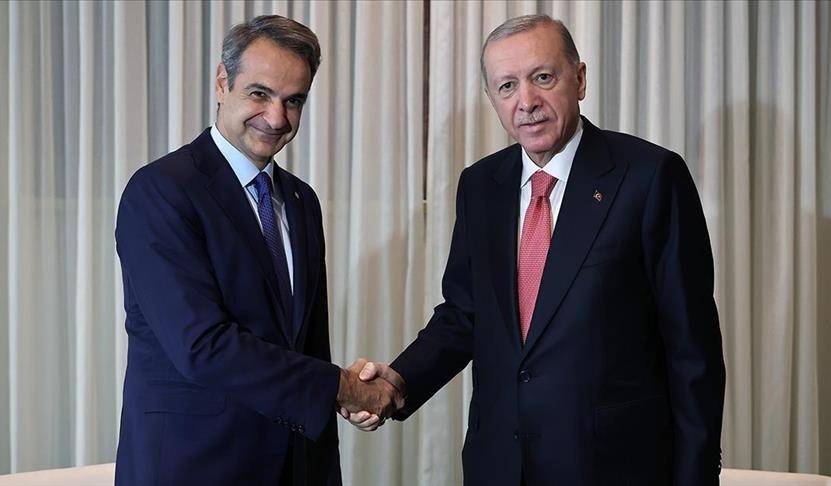
Meeting between Erdogan and Mitsotakis on the sidelines of the UN General Assembly meetings in 2024 (Turkish Presidency)
Athens argued that the ratification does not alter the memorandum's legal status, cannot create new legal obligations for third countries, conflicts with the 1982 UN Convention on the Law of the Sea (which Ankara has not signed), and lacks a valid legal foundation because of the geographical configuration of the coastlines between Türkiye and Libya.
Meanwhile, Turkish Foreign Minister Hakan Fidan revealed in Brussels last week that Erdogan had made an energy-related proposal to Greek Prime Minister Kyriakos Mitsotakis during the UN General Assembly meetings in September.
Erdogan reportedly suggested that Greece purchase electricity from Türkiye rather than spend more than €2 billion in European funds to transport electricity over a distance of 2,000 kilometers to Cyprus.
The proposal referred to the "Great Sea Interconnector" project, which aims to link Greece, Cyprus, and Israel through an undersea electricity cable in the Eastern Mediterranean, a project Türkiye insists requires its approval.
According to Fidan, Erdogan told Mitsotakis: "It would be better to buy electricity from Türkiye, which is only 70 miles away from you. We can also supply you with water, electricity, and natural gas."
A New Eastern Mediterranean Equation
For Italy, the ratification of the Turkish-Libyan memorandum has raised political and economic concerns, particularly regarding Türkiye's expanding influence in Libya and its implications for Italian interests in the Eastern Mediterranean.
From Fidan's meeting with his Italian counterpart Antonio Tajani on the sidelines of the Istanbul meeting last week (Turkish Foreign Ministry)
Some political circles in Rome have questioned whether Italy moved too quickly in supporting US-backed efforts to unify Libya under a framework that could place Saddam Haftar at the head of the Presidential Council.
They argue that such a course could strengthen ties between eastern Libya and Türkiye, a direct competitor to Italy in Libya, particularly after Italy's support for Khalifa Haftar helped increase Russia's influence there.
Türkiye has also floated the possibility of negotiations involving Egypt, Italy, and Libya as part of what observers describe as an effort to establish a new framework for the Eastern Mediterranean, one that could undermine the model promoted by Greece, Israel, and Cyprus.
Turkish political analyst Ahmet Erdi Ozturk noted that despite Egypt's continued objections, Cairo's ongoing direct contacts with both Ankara and Libya suggest that diplomatic options have not yet been exhausted.
He pointed in particular to a phone conversation last Saturday between Egyptian intelligence chief Major General Hassan Rashad and Libyan Prime Minister Abdul Hamid Dbeibeh, during which Dbeibeh expressed readiness to discuss Egypt's concerns regarding maritime jurisdiction.
Ozturk also cited Fidan's proposal for talks involving Türkiye, Egypt, Italy, and Libya as part of the same diplomatic context.
Ozturk adding that it would not be surprising if Greece and Israel eventually adjusted their positions as circumstances change.
1,400 Killed in Two Months as Yemen’s Dhamar Pays the Price of Houthi Attritionhttps://english.aawsat.com/arab-world/5334996-1400-killed-two-months-yemen%E2%80%99s-dhamar-pays-price-houthi-attrition
1,400 Killed in Two Months as Yemen’s Dhamar Pays the Price of Houthi Attrition
A previous exhibition of photographs of fallen fighters staged by the Houthis in Dhamar (X).
Yemen's Houthis have lost more than 1,400 fighters from Dhamar province in just two months, local sources said, exposing a mounting human toll as the group steps up recruitment and turns photographs of its dead into tools for mobilizing fresh fighters.
The Iran-aligned group has staged exhibitions of fallen fighters across Dhamar, about 100 km south of Sanaa, and its 12 districts, seeking to turn mounting battlefield losses into recruitment opportunities and replenish its depleted ranks.
Informed local sources told Asharq Al-Awsat that the fighters were killed on several fronts, particularly in Taiz, Dhalea, Jawf, the western coast and Marib.
The sources said the exhibitions and funeral processions sweeping the province offered a stark picture of the group's losses, even as it continued sending more local men to the front lines to replace those killed.
In recent days, the Houthis have intensified exhibitions displaying photographs of their dead across Dhamar as part of an annual week commemorating fallen fighters.
The group has used the events to reinforce its recruitment rhetoric and normalize death on the battlefield, rather than confront the heavy human cost of its military campaigns and the suffering they have inflicted on Yemeni families, the sources said.
Streets turned into memorials
In Dhamar city, the Houthis have transformed neighborhoods, main streets, schools, mosques and government buildings into open-air galleries displaying photographs of hundreds of dead fighters, including children and minors, according to local sources.
The exhibitions have spread to Wisab al-Ali, Anis, Duran Anis, Wisab al-Safil, Maghrib Anis, Jabal al-Sharq, Jahran, Mayfa'at Anis, Al-Hada, Al-Manar and Utmah, where tents and displays bearing photographs of the dead have become part of the group's broader mobilization campaign.
The scale of the displays underscores the extent of the losses and the group's efforts to channel them into its military and recruitment agenda, the sources said.
The photographs extend beyond frontline fighters to people involved in general mobilization, recruitment and security operations, as well as government employees, education workers and students whom the Houthis had sent into battle.
But the campaign has struggled to attract public support.
Local sources said the Houthis had pressured residents in several parts of Dhamar to organize group visits to the exhibitions, only to face what they described as "lackluster" attendance despite attempts to compel participation.
Funeral processions and fresh recruits
Alongside the exhibitions, the Houthis have continued staging funeral processions, filling streets, neighborhoods and alleyways across Dhamar with photographs of their dead and sectarian slogans.
The campaign seeks to project an image of widespread public mobilization, even as residents face pressure to participate while grappling with severe economic hardship.
Activists from Dhamar said the surge in memorial exhibitions laid bare the scale of the group's human losses.
Rather than acknowledge the toll on families and communities, they said, the Houthis were exploiting their annual commemorations to renew recruitment efforts, particularly among minors and public employees under their authority.
The activists warned that turning the dead into recruitment symbols risked fueling further losses, as more young men were sent to the front lines to fill the gaps left by fallen fighters.
Such efforts, they said, threatened to deepen families' suffering and keep the province trapped in a relentless cycle of battlefield deaths.
Meanwhile, as millions in Houthi-controlled areas struggle with worsening living and humanitarian conditions, informed Yemeni sources estimated that the group had spent billions of Yemeni rials on printing photographs, mounting exhibitions and organizing related events across its territory.
The dollar trades at 535 Yemeni rials, according to the exchange rate cited in the original report.
The spending comes as families struggle to afford basic necessities amid deepening poverty and declining purchasing power.
The expenditures highlight the group's priorities: pouring substantial resources into propaganda and recruitment campaigns while living standards deteriorate and residents struggle to meet their most basic needs.
لم تشترك بعد
انشئ حساباً خاصاً بك لتحصل على أخبار مخصصة لك ولتتمتع بخاصية حفظ المقالات وتتلقى نشراتنا البريدية المتنوعة