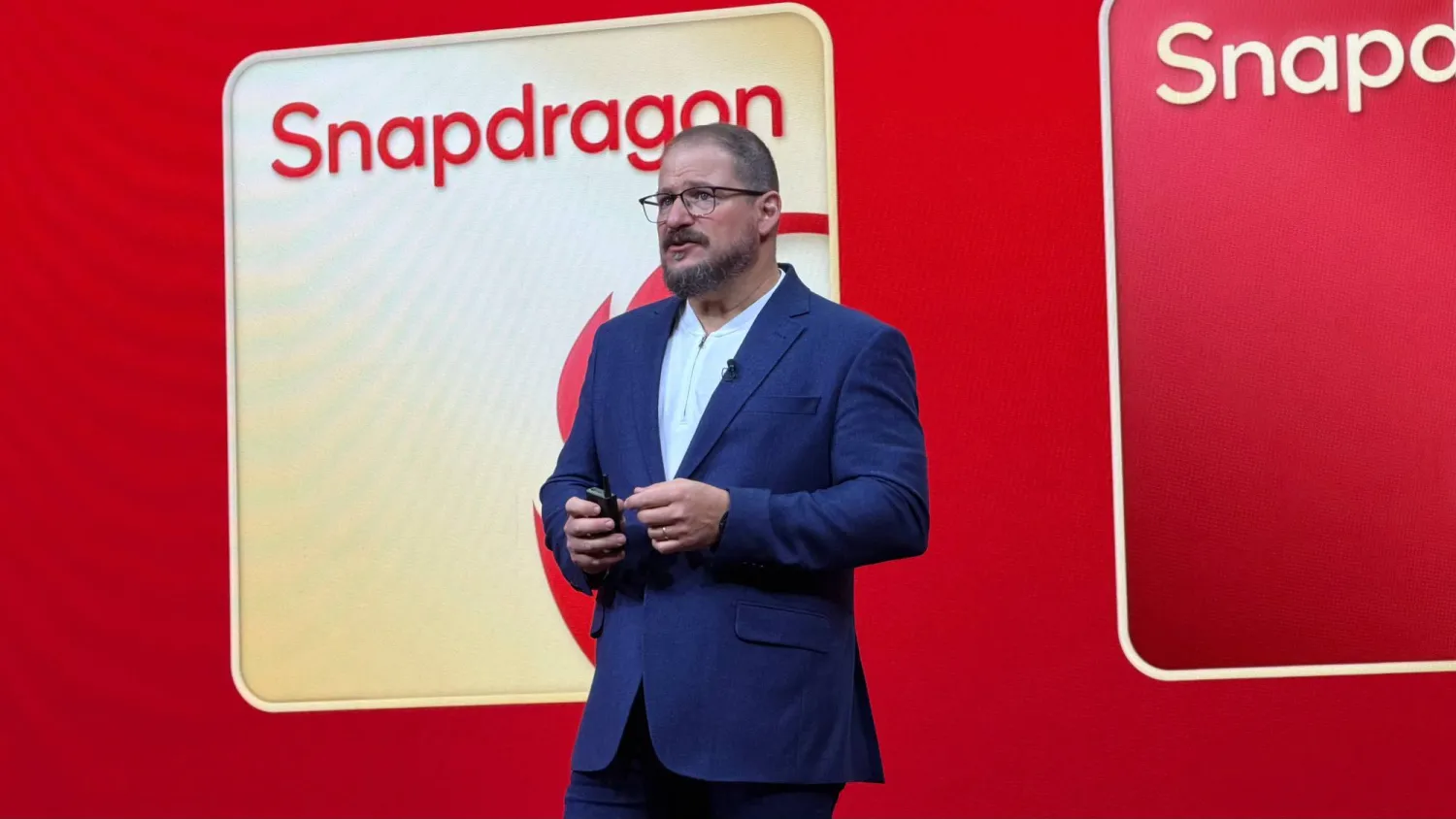
Qualcomm's journey into AI data centers did not begin with one of the major cloud computing companies in the United States, but with a Saudi company. Cristiano Amon, Qualcomm's chief executive officer, revealed this during an exclusive interview with Asharq Al-Awsat on the sidelines of the Snapdragon Summit 2026 in Hawaii. He said HUMAIN was the company's first customer when Qualcomm began developing its vision and products for entering the data center market.
But the relationship Amon describes does not stop at that project. Today, it extends to AI-powered PCs, industrial AI with Aramco, local engineering and automotive technologies, while he sees future opportunities in robotics and other fields in which the company has not traditionally had the same depth of involvement.
Amon said Qualcomm's current projects in Saudi Arabia are "just the beginning," pointing to "many intersections" between what Qualcomm is trying to build and the Kingdom's drive to adopt new technologies and invest early in trends reshaping the computing markets.
A Partnership with the Kingdom Without Limits
Amon wants Qualcomm's presence in Saudi Arabia to go beyond the concept of a market where the company sells technology and toward a broader role in building capabilities. Following the opening of its engineering center in Riyadh and the expansion of its research and development presence, Qualcomm is positioning the Kingdom as a regional hub, while seeking engineers specializing in AI, semiconductors, and modern computing platforms.
Amon added that the range of opportunities is not limited to the company's current projects in data centers, PCs, and the industrial sector. He identified robotics and automotive technologies as two additional areas and said he sees no "limit" to the opportunities for partnership with the Kingdom.
These efforts form part of a broader network of cooperation involving HUMAIN, Aramco, KAUST, and other Saudi partners, reflecting the expansion of Qualcomm's relationship with the Kingdom across multiple layers of the technology value chain, from research and engineering to infrastructure, hardware, and industrial applications.
From Language to the Physical World
One of the areas Amon believes will drive the next phase is what he calls "physical AI." Unlike models focused primarily on language, these systems interact with the physical world through sensor data, images, and signals generated by equipment and industrial environments, enabling their use in factories, energy, robotics, and vehicles.
This is where Amon connects Qualcomm's collaboration with Aramco to "AI at the edge," in which data is analyzed close to where it is generated rather than relying continuously on a remote data center. He also points to applications involving Saudi Arabia's Ministry of Interior, smart cities, and computer vision, as well as Qualcomm's work with Aramco on private 5G networks for industrial environments.
He believes that having intelligence locally is particularly important for industrial operations spread across remote sites, where reliability and response time become system requirements rather than merely performance improvements.
He considers industrial automation and robotics likely to be among the key drivers of physical AI, placing the industrial sector alongside consumer markets among the growth areas Qualcomm is targeting.
The Car as Another Computing Platform
This trend intersects with the automotive sector, which has become an increasingly important part of Qualcomm's strategy. Amon pointed to Ceer, the Saudi electric vehicle company that uses Qualcomm technologies, as part of his vision of the vehicle becoming a "connected computer on wheels."
Computing inside a vehicle is no longer limited to entertainment or navigation. It now extends to the digital cockpit, control of vehicle functions, software-defined vehicles, driver assistance systems, and autonomous driving. Amon said Qualcomm is on track to become the largest semiconductor technology supplier to the automotive industry, noting that it works with automakers across multiple vehicle categories.
He believes AI agents are particularly well suited to vehicles. Drivers can interact with them by voice, while the systems can use cameras, sensors, and real-time context to understand what is happening inside and around the vehicle. In Amon's view, the car thus becomes an extension of the same concept that brings together the phone, PC, glasses, and earbuds: several different devices, with personal intelligence able to move across them according to context.
Why Has the Middle East Become More Important?
When Asharq Al-Awsat asked why the Middle East has become more important to Qualcomm than it was several years ago, Amon pointed to Saudi Arabia's desire to become a technology hub, invest in the industries of the future, and diversify its economy. He emphasized that this aligns with Qualcomm's own trajectory, as the company was once more heavily focused on the smartphone market before beginning to expand into new markets.
In Saudi Arabia specifically, Amon linked the relationship to the Kingdom's willingness to bet early on Qualcomm's new direction. He again cited HUMAIN's position as the company's first customer in its data center initiative, saying this had created a "bond of trust" and a desire to pursue this journey together. He added that the relationship was among the reasons Qualcomm decided to increase its resources and focus in the region.
When the Phone Starts Working Without You
At the Snapdragon Summit, the other part of the discussion shifted from markets to the device itself. Amon explains the transition to the "AI phone" through a simple idea: in the past, when a person was not using their phone, the device would wait. In the age of AI agents, however, the phone can continue working even when the user is not looking at the screen, because an agent can carry out a task, conduct a search, or interact with applications on the user's behalf.
This means the phone is now expected to serve two parties simultaneously: the user and the AI agents the user has authorized to perform tasks. Amon says this requires fundamental changes to processor design, computing capacity, memory, and power requirements.
Among the products Qualcomm announced this year are processors capable of reaching peak speeds of 5 GHz, a speed Amon said can be achieved while maintaining all-day battery life. The highest-end platform can also run models with more than 30 billion parameters directly on the device.
Qualcomm says the Snapdragon 8 Elite Extreme Gen 6 supports Mixture of Experts models with more than 30 billion parameters, along with 50 percent more shared memory. The company also introduced two premium-tier platforms this year for the first time, rather than offering only one option.
But Amon does not believe the current limits will remain sufficient for long. He spoke of the future need for dedicated AI accelerators and more tightly integrated computing and memory technologies as the demands of AI agents increase rapidly.
The "AI Phone"
From an economic perspective, Amon believes these capabilities could create a new device upgrade cycle. Rather than buying a new phone solely for a better camera, longer battery life, or higher performance, consumers may have a new reason to upgrade when the AI capabilities available on newer devices become sufficiently different from those of previous generations.
He said the industry is waiting for the transition from today's smartphones to "AI phones," which he expects will create demand for new categories and experiences. He believes the pace of the smartphone market, in which Qualcomm has become accustomed to developing a new generation every year, has given the company an ability to adapt to the current speed of AI development and bring this pattern of innovation to other markets.
Personal Intelligence That Is Not Tied to a Single Device
Amon takes the definition of the future of personal computing beyond the phone. When Asharq Al-Awsat asked whether Qualcomm wants Snapdragon to become the computing layer through which a single personal intelligence moves across a user's devices, he said that was "a good way" to describe the direction.
The company calls this "connected intelligence everywhere." Snapdragon is present in phones, smart glasses, and digital cockpits in vehicles, while the platform is expanding into new categories such as smart pendants, jewelry, and audio devices. Amon added that future mobility will not be about a single device, but about a collection of devices that all become points of interaction for AI agents.
Audio Devices
The same trend is also emerging in audio devices. At the summit, Qualcomm unveiled the Snapdragon Sound Elite Gen 2 platform, designed to move earbuds and wearables beyond audio playback toward becoming persistent interfaces for personal AI.
The company says the platform delivers up to twice the on-device AI capabilities of the previous generation while consuming up to 40 percent less power. It also supports direct connections to cloud services over Wi-Fi without always requiring the connection to pass through the phone. Targeted applications include intelligent assistants, translation, transcription, and contextual understanding, across categories ranging from traditional earbuds to audio glasses and new wearable devices.
The same concept is reflected in the announcement of "Googlebook," a new category of laptops powered by the Snapdragon X Elite platform and designed around "Gemini Intelligence." Qualcomm says devices from Dell and HP will be among the first products in this category, with support for native Android applications and integration between the PC and phone, alongside on-device AI capabilities.
The Equation of Trust and Reduced Friction
Personal intelligence that follows a user across multiple devices needs to know a great deal about that person, and this is where one of the most sensitive issues emerges. Amon places the success of this experience at the intersection of two closely linked factors: trust and reduced friction.
If an agent does not understand the user's context, it will not be useful enough, and the person may find it easier to perform the task themselves. Conversely, users will not provide that context to an agent unless they trust how it accesses, stores, and uses their data.
Amon says consumers should have the ability to determine which information can be sent to cloud services and which information they want to keep on the device, along with a permissions system defining what the agent can access. According to Amon, Qualcomm is working to build these mechanisms into the platform so that users can determine where their data is stored and grant the appropriate permissions.
He emphasizes that this need for privacy and control, alongside processing speed, is one reason on-device AI is important alongside the cloud. Amon does not present this as a problem that has already been solved. He said explicitly that he does not believe the industry has all the answers yet.
From Personal Memory to Sovereignty
This leads to a broader concept of sovereign AI. Cristiano Amon does not see sovereignty as being limited to how governments manage defense systems, financial services, or public-sector functions. In his view, it can also extend to citizens' data and their ability to control the portions of that data they want to make available to AI agents.
He believes these questions create greater opportunities for sovereign models that combine local data center capabilities with intelligence operating on devices. This is also the context in which he places Qualcomm's cooperation with HUMAIN.
When the Agent Acts on the User's Behalf
The security challenge becomes more complex when an agent does not merely know information but begins using the user's credentials and interacting with external services on the user's behalf. Amon believes this calls for new levels of continuous authentication to ensure that the agent is genuinely acting for the authorized individual, with a greater role for biometrics and for storing credentials and sensitive information within secure areas.
This also includes what he described as the user's "personal memory map," which itself needs to be protected. He emphasizes that an important part of these safeguards must be supported at the hardware level rather than remaining merely a software layer added on top of the system. He links this to the security mechanisms built into Snapdragon platforms.
The Device and the Cloud Growing Together
Despite Qualcomm's focus on on-device AI, Amon does not expect devices to replace the cloud. He points to today's mobile applications as an example: users generally do not know, and do not need to know, which part of an application runs on the device and which part runs in a data center.
He expects AI to work in much the same way, with tasks moving seamlessly between the device and the cloud depending on the service required, performance, privacy, and the permissions set by the user.
He added that he wants a future in which users have clear authority over these choices, even if the process of distributing workloads itself remains transparent to them. Amon also rejects the idea that increasing computing power on devices will reduce demand for data centers. He says the two "grow together." Some functions need to take place locally, while other tasks require the greater capabilities of the cloud.
As the number of agents increases and they are used repeatedly throughout the day, total demand for computing at both ends could increase rather than simply shifting the workload from one place to another.
The Ceiling for Computing Has Not Yet Been Defined
This also helps explain Qualcomm's decision to offer two platforms in the Snapdragon 8 Elite flagship tier for the first time. A traditional flagship smartphone is still expected to deliver a better camera, higher performance, longer battery life, and advanced gaming experiences, but some agent-based applications are beginning to introduce a new level of demand for computing power.
Amon said the industry is now moving from "smartphones" to "AI phones" and does not yet know where the upper limit of computing power required by new applications will lie. He added that AI companies and users "want more computing," which is why the company is still testing how far this demand can extend.
The Test of Success
Qualcomm's CEO does not measure the success of the company's bet on the agent era by processor speed or by the number of models that can run on a device. When Asharq Al-Awsat asked what would constitute evidence that the strategy had succeeded over the next three years, he identified three indicators.
The first would be a shift in daily usage from an application-centered model toward one in which people increasingly rely on agents to complete tasks. The second would be the distribution of the personal computing experience across more devices, with glasses, watches, pendants, and other personal AI categories becoming more widespread. The third would be the emergence of a clear upgrade cycle in which consumers begin saying they need a new "AI phone," in the same way previous technological shifts drove users toward new generations of devices.
Ultimately, however, the success of this vision will depend on an equation that has not yet been resolved. The more an agent knows about a user, the more useful it becomes. The more permissions it receives, the more sensitive the questions surrounding privacy, security, and control become.
Between the desire to make AI operate continuously in the background and the need to keep decisions and data under the user's control, Amon believes the industry is still at the beginning of defining the boundaries that people will actually accept.