


US Imposes Sanctions on Chinese ‘Teapot’ Refinery for Buying Iranian Oil

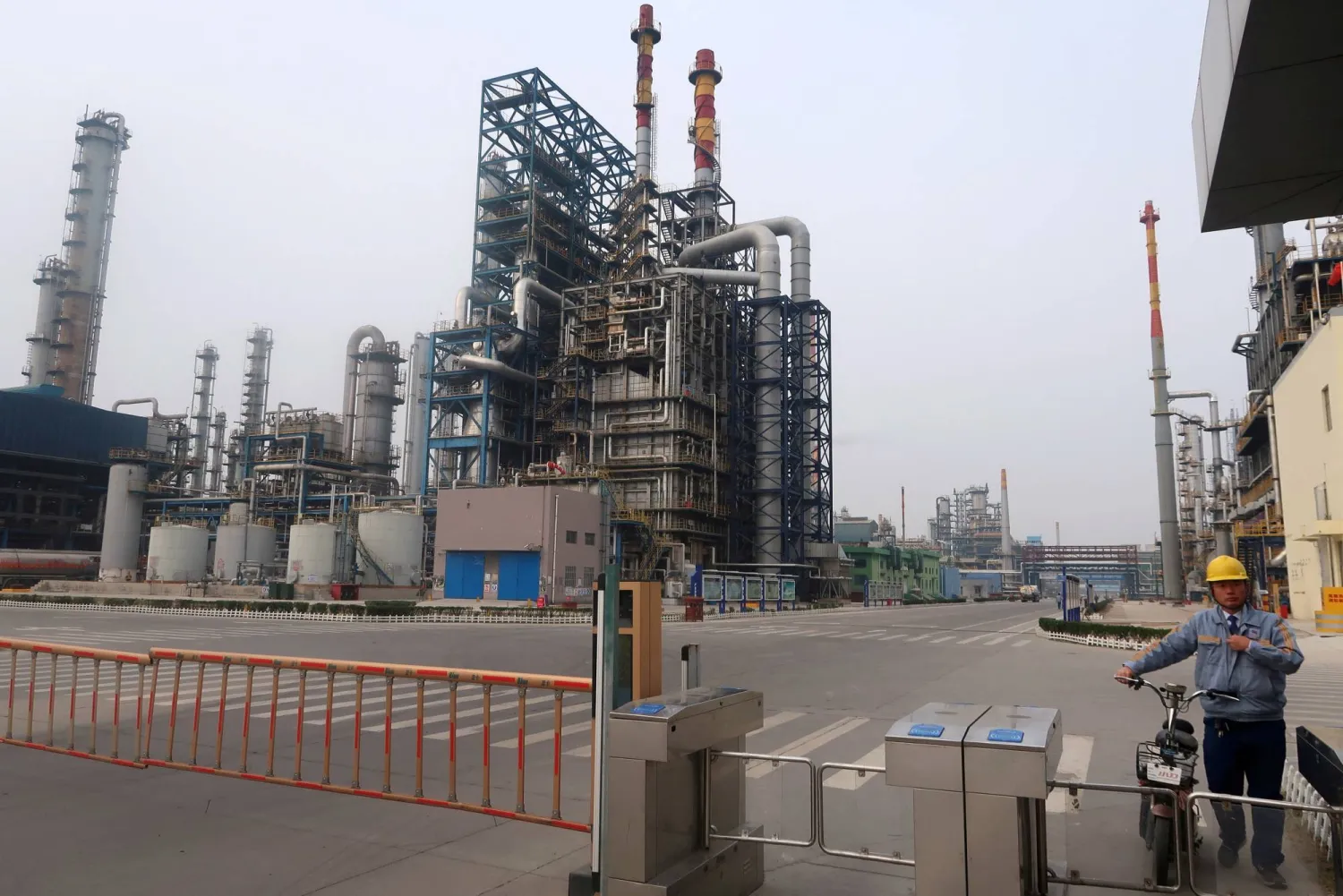
A view of an oil refinery in China's Shandong province. (Reuters)
TT

US Imposes Sanctions on Chinese ‘Teapot’ Refinery for Buying Iranian Oil

A view of an oil refinery in China's Shandong province. (Reuters)

The Trump administration said on Friday it had imposed sanctions on an independent "teapot" refinery in China for buying billions of dollars' worth of Iranian oil, as Washington and Tehran head into another round of peace talks over the weekend.

The Treasury Department targeted Hengli Petrochemical (Dalian) Refinery, which it said is one of Iran's largest customers of crude oil and petroleum products. The department's Office of Foreign Assets Control said it also imposed sanctions on about 40 shipping companies and vessels that operate ‌as part of Iran's ‌shadow fleet.

China has said it opposes "illegal" unilateral sanctions.

On Friday, ‌its ⁠embassy in Washington ⁠said normal trade should not be harmed and called on Washington to stop "abusing" sanctions to target Chinese companies.

"We call on the US to stop politicizing trade and sci-tech issues and using them as a weapon and a tool and stop abusing various kinds of sanction to hit Chinese companies," a spokesperson for the Chinese embassy said in a statement.

The Trump administration last year imposed sanctions on teapots Hebei Xinhai Chemical Group, Shandong Shouguang Luqing Petrochemical and Shandong ⁠Shengxing Chemical.

That created some hurdles for the refiners, including difficulties receiving ‌crude and having to sell refined products under different ‌names. Teapots account for a quarter of Chinese refinery capacity, operate with narrow and sometimes ‌negative margins and have been squeezed recently by tepid domestic demand.

CHINA BUYS MOST SHIPPED IRANIAN ‌OIL

The US sanctions, which block US assets of those designated and prevent Americans from doing business with them, have deterred some larger independent refiners from buying Iranian oil. China buys more than 80% of Iran's shipped oil, 2025 data from analytics firm Kpler showed.

Sanctions experts have long said, however, ‌that the independent refineries are somewhat immune to the full effect of US sanctions as they have little exposure to the ⁠US financial system. Imposing ⁠sanctions on Chinese banks that help facilitate the purchases would have a larger effect on purchases of Iranian oil, they say.

Treasury Secretary Scott Bessent said the US is imposing a "financial stranglehold" on the Iranian government.

"Treasury will continue to constrict the network of vessels, intermediaries, and buyers Iran relies on to move its oil to global markets," Bessent said.

Bessent told reporters at the White House on April 15 that Treasury has written to two Chinese banks and "told them that if we can prove that there is Iranian money flowing through your accounts, then we are willing to put on secondary sanctions."

The teapot refiners recently have had to buy Iranian oil at premiums to international Brent oil prices after Washington's temporary waiver of sanctions on Iranian oil at sea raised expectations that India might buy more of the oil. The US last week allowed the waiver to expire.



Swedish Fighters Intercept Russian Jets near Border

A general view of the Swedish capital Stockholm (Reuters)
TT

Swedish Fighters Intercept Russian Jets near Border

A general view of the Swedish capital Stockholm (Reuters)

Sweden said Saturday it had scrambled two pairs of JAS 39 Gripen fighter jets a day earlier to intercept two Russian combat aircraft flying over the Baltic Sea near its airspace, reported AFP.

The two incidents occurred Friday in the southern and northern parts of the Baltic Sea. NATO fighter jets also took off "to maintain security in the shared airspace," Sweden's military said in a statement.

Swedish airspace was not violated in connection with the incidents, it said.

"The Russian actions are serious and constitute a recurring pattern of behavior that threatens both our territorial integrity and security," Vice Admiral Ewa Skoog Haslum, the armed forces' chief of joint operations, said in the statement.

Sweden joined NATO in March 2024.

Tensions over the Baltic Sea have risen sharply since Russia's full-scale invasion of Ukraine in 2022.


Military Transport Plane Crashes in India, Casualties Unknown

Military Transport Plane Crashes in India, Casualties Unknown
TT

Military Transport Plane Crashes in India, Casualties Unknown

Military Transport Plane Crashes in India, Casualties Unknown

A Russian-made Indian military transport plane crashed on Saturday while landing at an air force station in the country's remote northeast, the military said in a statement.

"An IAF An-32 aircraft met with an accident today while landing at Jorhat. A court of inquiry is being constituted, to ascertain the cause of the accident," the statement said, without giving any details about causalities.

News channel NDTV broadcast images of the crash site, showing a thick black plume of smoke and the aircraft apparently broken into pieces, said AFP.


US Deports Iranian Pro-democracy Activist to Central African Republic

A general view shows a part of the capital Bangui, Central African Republic, February 16, 2016. REUTERS/Siegfried Modola Purchase Licensing Rights
TT

US Deports Iranian Pro-democracy Activist to Central African Republic

A general view shows a part of the capital Bangui, Central African Republic, February 16, 2016. REUTERS/Siegfried Modola Purchase Licensing Rights

The United States has deported an Iranian pro-democracy activist to Central African Republic, her lawyer said on Friday, describing it as a "super dangerous" transfer to a country with which the activist has no connection.

The Iranian American Legal Defense Fund (IALDF) said on Thursday that three Iranian women who fled persecution were at risk of deportation, including one who had converted to Christianity.

In the end, only the activist was on the flight which took off from Louisiana on Thursday night, said her lawyer, Emily Trostle, while not ruling out that the others could potentially be deported later.

The plane landed in Bangui, the capital of Central African Republic, shortly before 10 p.m. local time (2100 GMT), after a stop in Ghana's capital Accra, according to the ICE Flight Monitor managed by ‌Human Rights First.

It ‌was not immediately clear where the deportees would be housed or how long ‌they ⁠would be able ⁠to stay in Central African Republic.

"They have absolutely no connection to this place. In all of my filings I submitted tons of information about how this was super dangerous," Trostle told Reuters.

"These individuals are being removed from the United States and abandoned in a country where they have no status, no connection and no support network. We fear they will ultimately be forced to return to the countries they originally fled," Trostle said. 

The US State Department and Central African Republic's presidency did not immediately respond to requests for comment about the deportations to Central African Republic.  

⁠The US Department of Homeland Security said last week that all deportees would receive ‌full due process.  

Ghana and Central African Republic have signed deals ‌with President Donald Trump's administration to take in third-country deportees who in many cases secured legal protections from US courts so that ‌they could not be repatriated.  

The United States has used the deals — including with Central African Republic's ‌neighbor Democratic Republic of Congo, which is facing an Ebola outbreak — to deport people it cannot legally send home. 

The Trump administration has said the deals are lawful. Rights groups and advocates have said that the details of the deals are opaque and many of the deportees are ultimately repatriated. 

RISK OF REPATRIATION 

The IALDF said the Iranians facing deportation had their asylum claims denied ‌because of a rule requiring that asylum seekers first apply in countries they transit through before reaching the US. A federal court in California vacated that rule ⁠in May. 

The group said ⁠deporting Iranians to Central African Republic was "a potentially fatal action," citing security issues in the country and the risk that they would be sent back to Iran. 

President Faustin-Archange Touadera signed peace deals last year with several rebel groups. Others were weakened as Russian mercenaries and troops from Rwanda were deployed to shore up Touadera's government as well as UN peacekeepers. 

Ali Rahnama, interim executive director at the IALDF, said the Russian presence in Central African Republic was concerning because Russia had close intelligence ties with Iran. The US and Israel launched strikes on Iran on February 28, starting a now three-month-old war. 

Trump said in April that he thought that the Iranian people should rise up against the government in Tehran if a ceasefire were declared, but understood that it was too dangerous for them to do so. 

It was unclear how many people would be deported to Central African Republic on the first flight. 

An official briefed on the matter told Reuters on Thursday it was expected to transport about 20 people, including Syrians and Afghans. The official said hundreds of migrants could ultimately be deported there under the deal.