


The Threat of Light Pollution Puts World’s Darkest Skies in the Atacama Desert at Risk

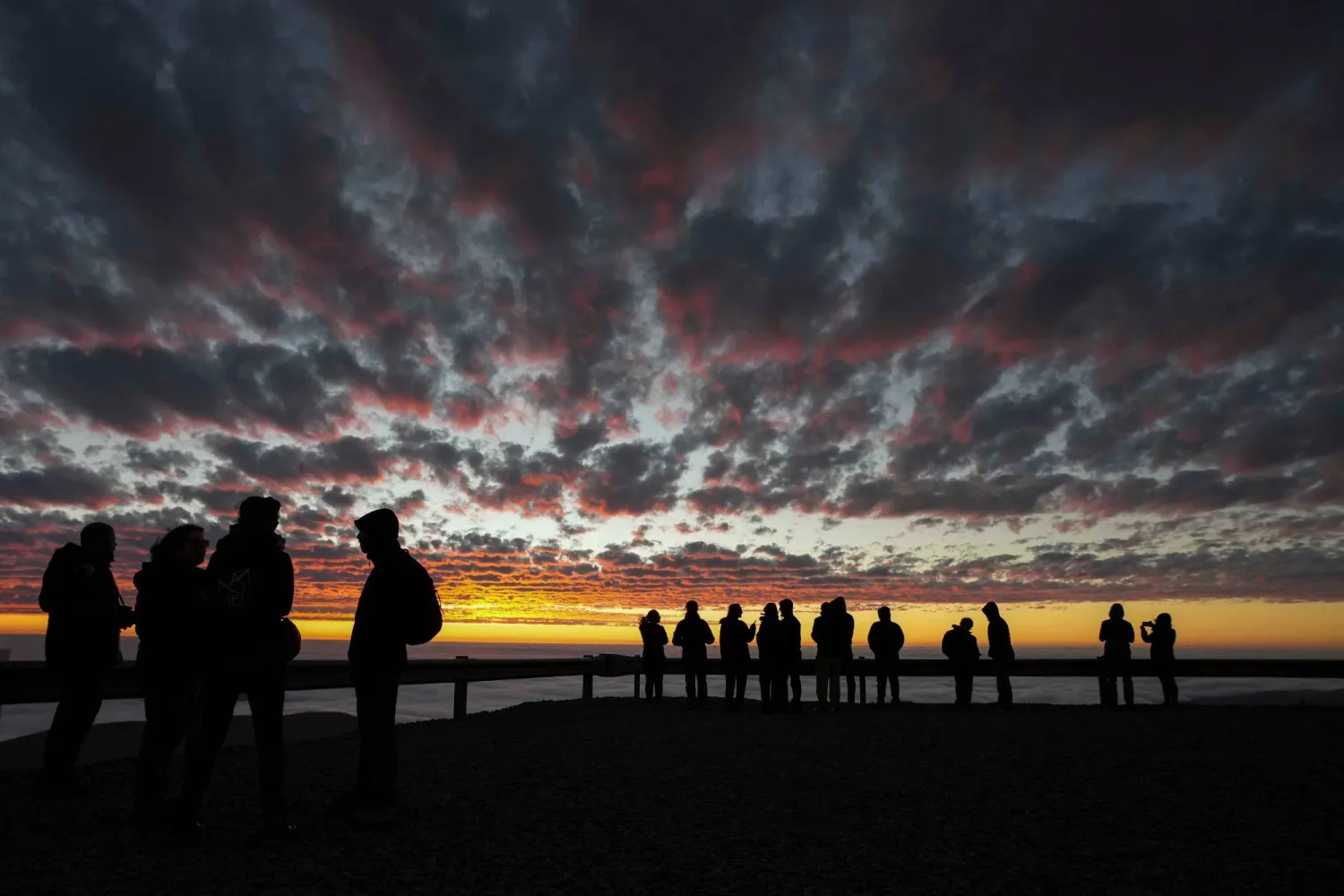
Astronomers are silhouetted against the sunset sky at Paranal Observatory in the Atacama Desert, Chile, Tuesday, April 14, 2026. (AP Photo/Esteban Felix)
TT

The Threat of Light Pollution Puts World’s Darkest Skies in the Atacama Desert at Risk

Astronomers are silhouetted against the sunset sky at Paranal Observatory in the Atacama Desert, Chile, Tuesday, April 14, 2026. (AP Photo/Esteban Felix)

It takes a moment for the eyes to adjust. A faint spark appears in the darkness; then another, brighter one. Soon, stars, planets and entire constellations emerge. Before long, a whole galaxy stretches across the sky, visible to the naked eye.

In Chile’s Atacama Desert, the night sky feels infinite. Considered the driest place on Earth, its darkness is also one of the clearest windows to the universe.

A rare combination of dry climate, high altitude and, crucially, isolation from urban light pollution, makes the Atacama an unrivaled hub for world-class astronomy and home to the world’s largest ground-based astronomical projects.

“The conditions in the Atacama Desert are unique in the world,” said Chiara Mazzucchelli, president of the Chilean Astronomical Society. “There are more than 300 clear nights per year, meaning no clouds and no rain.”

But the world's darkest skies may be at risk.

Last year, the desert became a battleground between scientists and an energy firm proposing a green power complex just kilometers (miles) from the Paranal Observatory. Managed by the European Southern Observatory, ESO, the site also is the future home to what is to be the most powerful optical telescope ever built.

Although the energy project was canceled in January following a massive appeal from astronomers, physicists and Nobel laureates, it exposed deep concerns that existing sky preservation laws are lax, outdated and unclear. Since then, several environmental regulations have come under review, including one from Chile's science ministry targeting protected astronomical zones.

“We are working to ensure the new criteria are strict enough to guarantee that there will be no impact on astronomical areas,” said Daniela González, director of the Cielos de Chile Foundation, a nonprofit founded in 2019 to protect the quality of Chile’s night skies.

The best skies The Associated Press spent three days visiting the Paranal facilities in the heart of the so-called Photon Valley. In this high-altitude corridor, several observatories operate side by side using some of the most sophisticated instruments ever engineered.

“Many of these large facilities are located in Chile, and ESO's telescopes in particular are the most powerful astronomical facilities on the planet,” said Itziar de Gregorio-Monsalvo, the intergovernmental organization’s representative in Chile.

Paranal is one of nearly 30 astronomical sites in northern Chile, most of which are managed by international organizations. Every year, the Atacama Desert draws thousands of astronomers and scientists from around the world to investigate the origins of the universe.

"We are lucky to be here,” said Julia Bodensteiner, an assistant professor at University of Amsterdam, noting that the chances of being selected as a visiting astronomer at Paranal are just 20% to 30%.

Walking across the Atacama's rocky, uneven terrain is no easy task. At altitudes exceeding 3,000 meters (10,000 feet), oxygen becomes a luxury, while scorching days give way to relentlessly cold nights. But for space observation and exploration, these more than 105000 square kilometers (40,500 square miles) of desert are the perfect setting.

The exceptional conditions of the Atacama have enabled some of the most ambitious astronomical projects ever conceived, like the Extremely Large Telescope, ELT — a $1.5 billion endeavor by ESO scheduled for completion in 2030.

With 798 mirrors and a light-gathering area of nearly 1000 square meters (a quarter of an acre) , the ELT will be 20 times more powerful than today’s leading telescopes and 15 times sharper than NASA's Hubble Space Telescope.

All the data compiled at these observatories play a fundamental role not only for life on Earth, but also for the possibilities of its development beyond our planet. Preserving these research spots is essential.

With the ELT, said ESO astronomer Lucas Bordone, “we should be able to see Earth-like planets in what we call the habitable zone, so basically the planets which are candidates towards life.”

Darkness under threat Twenty years ago, the Atacama Desert was "an ocean of darkness,” recalled Eduardo Unda-Sanzana, director of the Astronomy Center at the University of Antofagasta. “It was just you and the universe.”

Over the years, however, the landscape has changed drastically.

Driven by urban sprawl, industrial development, and the arrival of mining and wind farms, the desert has become a coveted territory where balance is not always easy to reach.

In Paranal, specialists live like moles in an underground residence designed to keep their presence almost undetectable. Windows must remain covered, hallways stay dark, and any outside movement is guided only by flashlight. Even the faintest light can interfere with the telescopes.

The announcement last year of an imminent green energy project sent shockwaves through the international scientific community. Experts pressured authorities to protect Chile’s night sky from the proposed site, which was slated for construction just 10 kilometers (6 miles) from Paranal.

The case raised the alarms due to its impacts, such as increased light pollution, micro-vibrations and dust, as well as greater atmospheric turbulence. These conditions would make astronomical activities unviable.

“If you place the ELT next to a city, it doesn’t matter that its diameter is 40 meters long. It’s just the same as having a tiny telescope,” Gregorio-Monsalvo said.

Although the company canceled the project in late January, scientists warn that without new, updated regulations, similar projects could be proposed at any moment.

“Despite all the media hype in 2025, we find ourselves exactly where we were last year,” said Unda-Sanzana, who is also part of a ministerial advisory commission that recently delivered recommendations to Chile’s government following the incident.

There is no shortage of precedents. The first international heliophysics observatory in Chile — a major solar station operated by the US Smithsonian Institution in the early 20th century — was forced to shut down operations in 1955 due to environmental pollution caused by the expansion of mining activity in the area.

“We’ve had 70 years to learn from history and avoid repeating those same mistakes,” Unda-Sanzana said.



Inside ‘7 Dogs,’ the Biggest Arab Film Production

Karim Abdel Aziz and Ahmed Ezz behind the scenes during filming (production company)
TT

Inside ‘7 Dogs,’ the Biggest Arab Film Production

Karim Abdel Aziz and Ahmed Ezz behind the scenes during filming (production company)

The makers of “7 Dogs” set out to do more than produce an action film to international standards. Their aim was to deliver a visual spectacle shaped by Saudi Arabia’s General Entertainment Authority, built on a strategic vision for a transcontinental thriller with Hollywood-level technical standards, while preserving a Middle Eastern identity and cultural voice.

The film, which opened in Cairo on Friday evening in the presence of its makers, was written by Egyptian screenwriter Mohamed el-Dabbah, who was tasked with turning the Entertainment Authority’s ambitious vision into a fully developed screenplay.

El-Dabbah did not write a conventional chase story. He built a fast-paced, dramatic structure driven by escalating events and centered on the infiltration of an international criminal network, requiring a coherent narrative that could sustain the film’s heavy visual and action momentum.

The decisive moment that moved the project from concept to production came during the 2024 global tour for “Bad Boys: Ride or Die.”

During that period, Belgian-Moroccan directors Adil El Arbi and Bilall Fallah visited Riyadh and held a lengthy meeting with adviser Turki Alalshikh, chairman of Saudi Arabia’s General Entertainment Authority. Their talks focused on the major advances in Saudi Arabia’s film infrastructure.

The meeting reviewed Riyadh’s growing logistical capabilities and its ability to attract major global productions. Alalshikh then presented the idea for the film, drawing an immediate and enthusiastic response from the directing duo, who saw it as a chance to apply their experience in American cinema to a new production environment.

Riding the momentum of their film’s record commercial success at the Saudi and global box office, the directors became convinced that regional audiences were eager for action films made with a global sensibility.

A large-scale production partnership was formed to provide the financial and technical resources needed to carry out the project without restrictions or creative compromise.

To give the film its international scope, producer Ivan Atkinson was brought in as the project’s logistical maestro. His first task was to build a creative front by recruiting department heads with extensive experience in big-budget filmmaking, ensuring that every technical detail met contemporary Hollywood standards.

Among them was renowned production designer Paul Kirby, known for creating complex architectural spaces and adapting them to serve the drama.

Atkinson also brought in the global stunt and fight design team 87eleven, the celebrated group behind the combat identity of the “John Wick” franchise, giving the film a decisive edge in its action sequences.

The directors approached the script through rhythm. They wanted a visual experience with the pace and dynamism of modern video games. That choice pushed the editing and cinematography teams toward extremely fast movement, with a highly flexible camera designed to keep viewers alert as they follow the layers of the international conspiracy.

According to the film’s crew, preparatory workshops began in Riyadh months before filming.

The screenplay went through detailed technical reviews by el-Dabbah, the directors and the fight team to balance the characters’ human drama with the film’s action. The aim was to ensure the chases and explosions served the dramatic line rather than felt forced into the story.

Adil and Bilall’s artistic vision centered on breaking the stereotype of Middle Eastern action films that rely on easy visual solutions. They insisted on shooting the dangerous scenes with rough realism, which required the cast to undergo long, demanding physical training so they could perform complex fight movements themselves under the supervision of Hollywood stunt experts.

Sela Studios helped clear the logistical hurdles by providing advanced filming, lighting and lens equipment, including tools that had not previously been used in the region.

That production support allowed cinematographer Robrecht Heyvaert to create a visual identity that blends the warm colors of the East with the cooler, contemporary palette of modern global action cinema, according to sources from the production company.

The chemistry between El Arbi and Fallah important. The two worked in close coordination, with one focusing on the actors and dramatic performance while the other concentrated on visual design, camera movement and special effects.

The arrangement helped maintain a fast and efficient production flow on crowded, detail-heavy sets.

Early preparations required complex schedules to manage the movement of international stars and coordinate their filming dates in Riyadh. The logistics team created a flexible system that accommodated the project's evolving demands, allowing principal photography to begin on schedule amid enthusiasm and strict professional discipline from all parties involved.

The General Entertainment Authority placed government and security facilities at the filmmakers’ disposal, allowing them to close key areas and film complex car chases on open streets. That regulatory flexibility demonstrated that Riyadh can offer not only closed studios but also entire urban spaces ready to serve as stages for large-scale action scenes.

In the film, 7 Dogs is not presented as a conventional gang. It is written as a complex cross-border intelligence and criminal entity, an octopus-like network of businessmen and influential figures running globalized organized crime from distant locations. That makes it an invisible threat that cannot easily be tracked by traditional security methods.

The main dramatic trigger is the organization’s creation of a highly dangerous synthetic drug called Pink Lady. The lethal compound is not just a product for sale. It drives the plot, turning the conflict from a local criminal case into a major security threat that mobilizes international security agencies and INTERPOL.

To confront the network, Egyptian INTERPOL officer Khaled Al Azazi, played by Ahmed Ezz, launches a wide-ranging intelligence operation to infiltrate the organization from within.

His investigation leads him to a fragile lead, a professional transcontinental criminal named Ghali Abu Dawood, played by Karim Abdel Aziz. Ghali has close ties to The Seven Dogs’ pillars, making him the only one who can bring down the destructive network.

The disciplined officer and the elusive criminal are forced into an uneasy alliance. The stark contrast between a man who represents the law and another who embodies pragmatism and life outside it creates a tense dynamic marked by suspicion, shifting loyalties and deep psychological conflict throughout the journey.

Alongside Karim Abdel Aziz and Ahmed Ezz, the cast includes international names such as Monica Bellucci, Giancarlo Esposito, Bollywood star Salman Khan, Sanjay Dutt, Max Huang, Tara Emad, Nasser Algassabi, and Sayed Ragab. The geographic and cultural diversity of the cast reflects the organization’s reach across continents.

Bellucci plays Julia, the luxurious and dark European face of the organization. The character combines extreme elegance with absolute cruelty, creating a striking visual contrast with the Eastern characters.

The participation of Salman Khan as Johar and Sanjay Dutt as Ranjit adds strong visual and action energy to the film’s Asian track. Their screen presence is used in large-scale action scenes marked by violent combat, turning the Mumbai segment into an action climax tied to the broader dramatic arc.

Saudi actor Nasser Algassabi brings a local flavor and Gulf depth to the film’s web of international relationships.

His character serves as the logistical link in the region. Egyptian actress Tara Emad plays a young intelligence operative working in the shadows to support Khaled, alongside Jessica, played by Lebanese actress Sandy Bella, a member of the INTERPOL team.


China Set for Latest Space Launch, with Hong Kong Astronaut Aboard

Astronauts for China's Shenzhou-23 space mission Lai Ka-ying (L), Zhu Yangzhu (C) and Zhang Zhiyuan (R) wave during a press conference before the launch of the mission at the Jiuquan Satellite Launch Center in the Gobi desert in Jiuquan, in northwestern China's Gansu province on May 23, 2026. (Photo by CNS / AFP) / China OUT
TT

China Set for Latest Space Launch, with Hong Kong Astronaut Aboard

Astronauts for China's Shenzhou-23 space mission Lai Ka-ying (L), Zhu Yangzhu (C) and Zhang Zhiyuan (R) wave during a press conference before the launch of the mission at the Jiuquan Satellite Launch Center in the Gobi desert in Jiuquan, in northwestern China's Gansu province on May 23, 2026. (Photo by CNS / AFP) / China OUT

A Hong Kong astronaut will join a Chinese space mission for the first time as part of a three-person crew launching on Sunday, as Beijing edges closer to its goal of landing people on the Moon.

The Tiangong space station -- crewed by teams of three astronauts that are typically rotated every six months -- is the crown jewel of China's space program, boosted by billions in state investment in a bid to catch up with the United States and Russia.

The Shenzhou-23 mission will blast off at 11:08 pm (1508 GMT) on Sunday from the Jiuquan Satellite Launch Center in northwestern China, carrying three astronauts to the space station, China Manned Space Agency (CMSA) spokesman Zhang Jingbo told reporters on Saturday.

The team comprises Lai Ka-ying, hailed by state media as Hong Kong's first astronaut, Zhu Yangzhu and Zhang Zhiyuan, AFP quoted the spokesman as saying.

Hong Kong's Chief Executive John Lee congratulated Lai on passing "the rigorous selection and training process.”

Flight engineer Zhu, who participated in the Shenzhou-16 mission in 2023, will be the commander.

"This is a ... test of our physical and psychological endurance, emergency response capabilities, coordination and teamwork, as well as our ability to work and live in orbit," Zhu told reporters.

"As mission commander, what I have thought about most is how to make thorough preparations in every aspect and how to lead the team in successfully completing the flight mission with zero mistakes and zero errors."

The mission's primary objectives are to "continue carrying out space science and application work, conduct astronauts' extravehicular activities and cargo transfer in and out of the cabin", the CMSA's Zhang told reporters.

One of the astronauts will remain on the station for a year, he added, without specifying who.
"Arranging for an astronaut to carry out a one-year in-orbit residency experiment is by no means a simple matter of adding together two six-month missions in terms of duration," Zhang said.

The one-year space residency, Zhang said, will collect data on astronauts on longer-duration spaceflights and test health support capabilities.

China is "steadily" building operational experience for "sustained occupation" of its Tiangong space station, and year-long missions are an important step towards future lunar and potentially deep-space ambitions, said Macquarie University's Richard de Grijs.

"A year in orbit pushes both hardware and humans into a different operational regime compared with the shorter Shenzhou missions of the program's earlier phases," the professor of physics and astronomy told AFP.

Beijing's space program, the third to put humans in orbit, has also landed robotic rovers on Mars and the Moon.

China has ramped up plans to achieve its "space dream" under President Xi Jinping.

Beijing says it aims to send a crewed mission to the Moon by 2030, with the goal of constructing a base on the lunar surface.

The CMSA said on Saturday it would "make every possible effort and strive tirelessly" to achieve that goal.


AI Will Help Make a Nobel Prize-Winning Discovery Within a Year

A robot holding a medicine box at the simulated pharmacy of the Beijing Humanoid Robot Innovation Center (EPA)
TT

AI Will Help Make a Nobel Prize-Winning Discovery Within a Year

A robot holding a medicine box at the simulated pharmacy of the Beijing Humanoid Robot Innovation Center (EPA)

An AI system will work with humans to make a Nobel prize-winning discovery within 12 months and tradespeople will be helped by bipedal robots in two years, according to the co-founder of Anthropic.

Jack Clark described a “vertiginous sense of progress” in the technology and made a series of predictions, including that companies run solely by AIs would be generating millions of dollars in revenue within 18 months, and that by the end of 2028, AI systems would be able to design their own successors, according to The Guardian.

In a lecture at Oxford University on Wednesday, he also said there remained plausible scenarios in which the technology had “a non-zero chance of killing everyone on the planet” and that it was “important to clearly state that that risk hasn’t gone away.”

Anthropic’s most popular model is called Claude, but it recently launched a version called Mythos that proved alarmingly capable at exploiting cybersecurity weaknesses.

Clark told students it would be better if humans could slow the development of the technology “to give ourselves more time as a species” to deal with the implications of its powers.

But he said this wouldn’t happen, in the breakneck development “by a variety of actors and a variety of countries, locked in a competition with one another, where commercial and geopolitical rivalries are often drowning out the larger existential-to-the-species aspects of the technology being built.” This was “not ideal,” he said.

Clark is one of the most senior figures at Anthropic, which was established by AI researchers who quit the rival firm OpenAI over disagreements on safety.

The $900 billion company has been accused by Donald Trump’s White House and other AI accelerationists of “fear-mongering” to encourage regulation that could cement its competitive position.

Anthropic disputes this, and Clark said many people appeared to be in denial about AI’s progress.

He said he wanted to encourage humanity to prepare for a technology that would “soon be more capable than all of us collectively.”

Comparing the failure to prepare for AI to the failure to prepare for pandemics such as COVID, he said: “If we stand by and let synthetic intelligence multiply, then we’ll eventually be forced into reactivity.”

Critics of the frontier AI companies such as Anthropic, OpenAI and Google fear over-reliance on their few AI models – which have been backed by huge amounts of profit-seeking capital – could create a “single point of failure” in global systems.