


A 5-Step Approach to 'Dismantling Iraqi Militias'

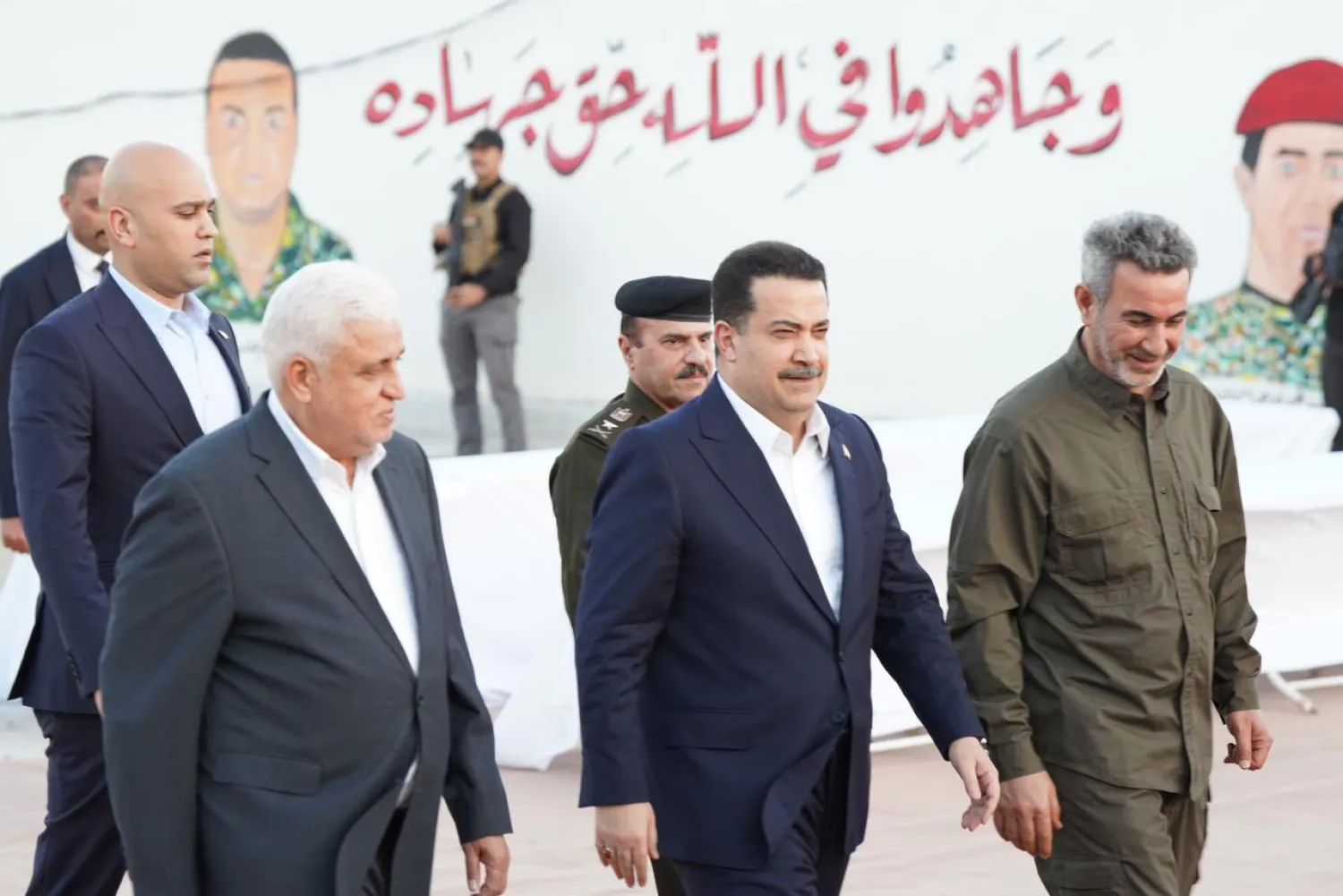
PM Mohammed Shia Al-Sudani, head of the Popular Mobilization Forces Faleh Al-Fayyad, and PMF's chief of staff Abu Fadak (government media)
TT

A 5-Step Approach to 'Dismantling Iraqi Militias'

PM Mohammed Shia Al-Sudani, head of the Popular Mobilization Forces Faleh Al-Fayyad, and PMF's chief of staff Abu Fadak (government media)

Despite continuous American demands for the Iraqi authorities to curb and dismantle factions, observers noted that the meetings of the leaders of the Coordination Framework have not been tackling this issue.

This could threaten the loss of American support for the new government, while experts propose a 5-step approach to resolve the matter.

The American insistence on dismantling armed factions has become recently highly clear through a series of punitive measures, beginning with a $10 million reward for information leading to the leader of Kataib Hezbollah, Abu Hussein Al-Hamidawi, then placing seven factions on sanctions and terrorism lists, and finally a similar reward for information about Abu Alaa Al-Wala'i, leader of Kataib Sayyid al-Shuhada.

Contrary to the discourse that escalated about three months ago regarding the necessity of disarming factions and restructuring the Popular Mobilization Forces (PMF), the Coordination Framework forces remain silent, despite the factions' actual involvement in the war with Iran and their missile attacks inside Iraqi territory and abroad on some Arab Gulf states.

War undermined efforts

A leading source from the Coordination Framework states that the war launched by the United States and Israel against Iran "undermined what could be called efforts to integrate the factions."

The source confirms to Asharq Al-Awsat that "the Coordination Framework had indeed begun preliminary discussions on mechanisms for addressing the issue, but the war ... provided the appropriate pretext for the factions to refuse to disarm, considering that the war represents an existential threat to them."

The source points out that "the leaders of the Coordination Framework recognize the seriousness and magnitude of the risks posed by American demands, but they are forced to ignore them due to pressure from the factions and the Iranian actor," indicating that "some forces and figures that possess armed factions have a genuine desire to integrate their elements into the army and restructure the PMF, but they appear incapable of taking any action due to the regional developments and the stalled efforts to form a government."

Dismantling the Funding System

Writer and political researcher Dr. Basil Hussein believes that dismantling the factions is linked to what he calls the "funding system."

He told Asharq Al-Awsat that the Coordination Framework forces are “a fragile coalition where disparate interests intersect.”

He points out that "armed factions are not merely an executive arm in the hands of political parties; rather, they are often the backbone upon which these parties are built economically, politically, and socially."

He further states that "any serious attempt to dismantle the factions will inevitably mean dismantling the entire funding system, which amounts to political suicide for anyone who undertakes it. Therefore, such efforts will always remain incomplete and selective, avoiding any harm to the core structure upon which the militias' influence rests."

In addition to these reasons, Hussein believes that "dismantling the factions is not a purely Iraqi decision; rather, it relates to the Iranian vision that has long viewed these factions as a cornerstone of Tehran's forward defense strategy.”

He adds that "when American pressure on the factions intensifies and their room for maneuver narrows, they will reluctantly bend rather than willingly, resorting to a superficial solution that masks their facade without touching their essence. They may change their name while retaining their structure, and formally dissolve into state institutions while maintaining their networks, weapons, and loyalties outside any actual oversight."
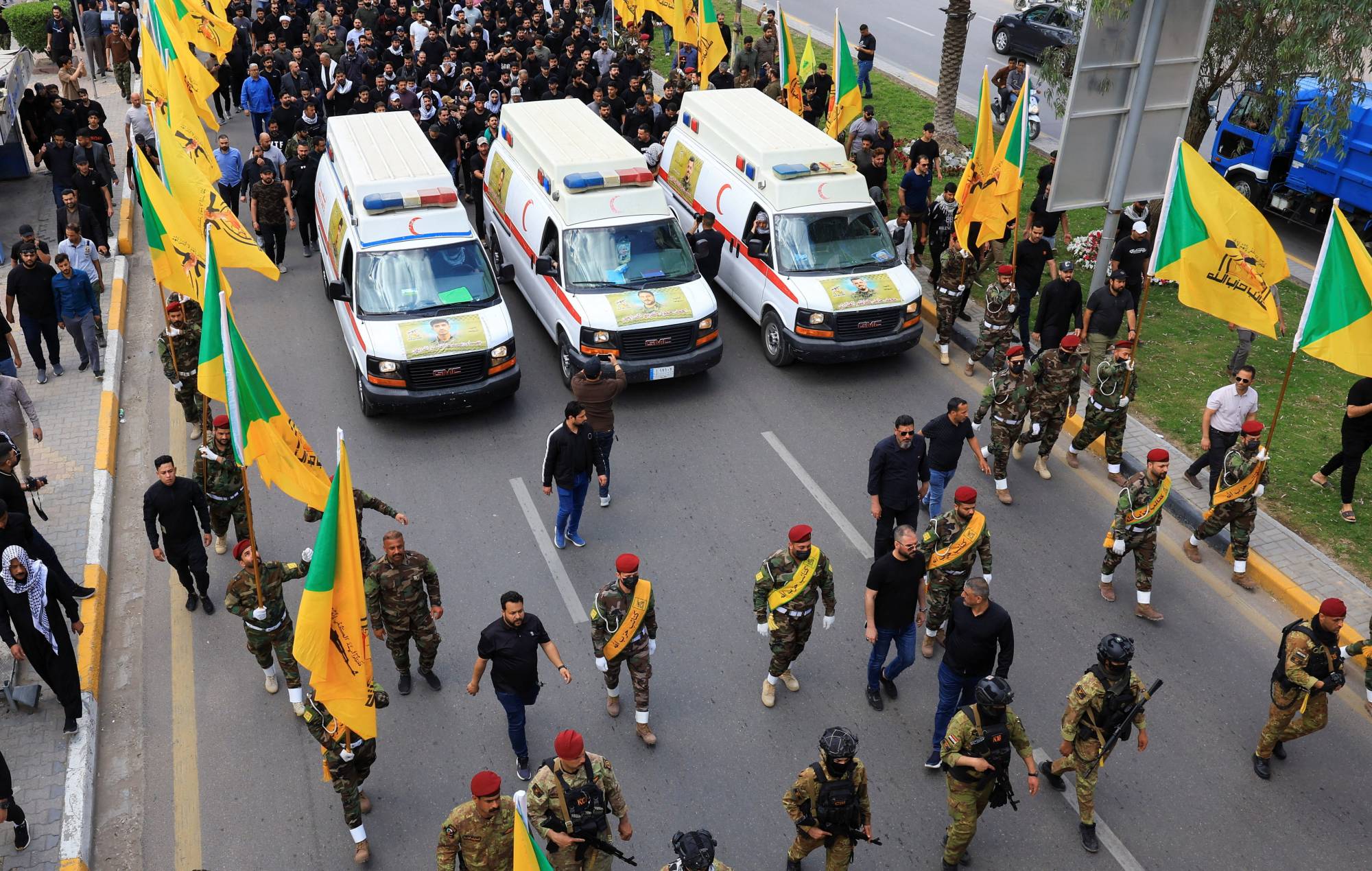
Mourners attend the funeral of fighters with Iraq’s Popular Mobilisation Forces who were killed in an airstrike, in Baghdad, Iraq, April 8, 2026. REUTERS/Thaier Al-Sudani

5 Steps to a Solution

For his part, Firas Elias, Professor of Political Science at the University of Mosul and a specialist in Iranian studies, proposes an approach that includes five steps that would help dismantle the factions.

He believes that the future of armed factions in Iraq will directly depend on the future of the war between Tehran and Washington, as they "will be directly affected by the outcome of this war."

Elias tells Asharq Al-Awsat that "discussing practical ways to deal with armed factions requires developing a new approach for the post-war phase. The practical method is not (immediate dismantling), but rather a gradual re-engineering of power through the state."

Elias anticipates that if the Framework forces succeed in forming a government, and under American pressure, they may move along five paths: "First: separating the PMF as an official body from the factions as political-military arms, establishing that the PMF, which receives salaries from the state, is exclusively subject to the Commander-in-Chief, while any formation that retains independent decision-making or external affiliation is treated as an entity outside the state."

The second move involves "controlling money before weapons. The most effective approach is to audit salaries, contracts, crossings, companies, economic offices, and transfers. When informal resources are cut off, the factions become less capable of maneuvering."

In the third path, Elias expects "restructuring leadership by changing sensitive positions within the PMF Commission, transferring some brigades to distant sectors away from the borders, integrating selected units into the army or Federal Police, and retiring undisciplined leaders or assigning them to symbolic positions."

The Iraqi expert adds a fourth path related to "dismantling from within, not through confrontation. The government may differentiate between three types: factions amenable to integration, factions requiring political containment, and completely resistant factions. The approach to dealing with them would be piecemeal: incentives for the disciplined, isolation for the resistant, and legal pressure on those involved."

He concludes with the fifth path, which concerns "transforming American pressure into internal political leverage. The Framework might tell the factions: either adhere to state discipline, or face sanctions, financial isolation, and security measures that affect everyone. Here, American pressure becomes a tool in the hands of the government, not merely an external threat."

Despite these five paths, Elias believes that "the 'Framework will not dismantle the factions in one stroke, because they are part of its political structure. However, it may work to gradually strip them of their military and financial independence, while retaining the PMF designation in a disciplined, institutional manner."



‘Death Boats’: Clandestine Boatbuilding Thrives Along Migration Routes from Libya

A workshop making boats for irregular migration after a raid in Libya (Special Tasks Department of the Interior Ministry in western Libya)
TT

‘Death Boats’: Clandestine Boatbuilding Thrives Along Migration Routes from Libya

A workshop making boats for irregular migration after a raid in Libya (Special Tasks Department of the Interior Ministry in western Libya)

Boats used to carry irregular migrants from Libya to Europe have become part of a clandestine market growing alongside people smuggling.

Smugglers are gradually moving from boats brought in from abroad to vessels built in Libya and outfitted specifically for sea crossings, security officials and rights advocates say.

Libyan authorities regularly announce the discovery of clandestine workshops or factories making boats for irregular migration, widely known as “death boats.”

The raids point to continued smuggling activity in coastal areas across both western and eastern Libya.

Photographs released over the years by security agencies on both sides of the country offer a glimpse of the workshops. Often abandoned or secluded sites, they contain wooden planks, engines and manufacturing equipment, as well as finished boats and others still under construction.

In some cases, security agencies have burned seized boats and components after raids to prevent their reuse in migrant smuggling.

The workshops are scattered across coastal cities near departure points for irregular migration, according to monitoring by the Benghazi Center for Migration Studies.

Some are carpentry shops or simple premises near the coast that have been converted to boatbuilding, the center’s head, Tarek Lamloum, told Asharq Al-Awsat.

In Zuwara, for example, authorities found a coastal property that had been turned into a workshop for wooden boats.

Earlier this September, authorities found two facilities making migration boats in Tobruk, in the east, and Sirte, along with boats and manufacturing equipment.

Similar sites had previously been raided in western Libya, including Tajoura in Tripoli, Khoms and al-Qawiya. Authorities found two facilities in Misrata last year.

Boats of every type

The discoveries, stretching from Misrata and greater Tripoli in the west to Sirte and Tobruk in the east, show that local boatbuilding continues across a wide area. They also come as migration routes and smuggling methods have changed in recent years.

Lamloum pointed to workshops concentrated in eastern Libya, particularly in Tobruk, Bir al-Ashhab and areas near the Egyptian border. Some wooden boats have historically been linked to Egypt, he said, whether through the boats themselves or the workers and expertise used to build them.

As the migration route from eastern Libya toward Crete and Greece expanded, local boatbuilding workshops also appeared in the region. Boats, including inflatable craft and locally made vessels, are smuggled from western to eastern Libya, reaching Tobruk and nearby departure points.

The market is therefore not a collection of separate local markets, Lamloum said. An internal supply network connects different parts of Libya and provides the boats and equipment needed for crossings.

He said his assessment draws on accounts from people who made the sea journey, as well as UN reports and published investigations into migration and smuggling routes.

Vessels used for the crossings include wooden and fiberglass boats, inflatable craft and old fishing boats bought for reuse. In recent years, boats built specifically for migration journeys have also appeared.

Their quality varies widely, and some are made cheaply without the standards required for fishing boats or ordinary seagoing vessels.

Their sizes and capacities vary too. Some carry dozens of people, while larger wooden boats can hold far more. “There is no single model that can be described as the Libyan migration boat,” Lamloum said.

Harsh crossings

Since the fall of former President Moammar al-Gaddafi’s government in 2011, Libya has remained both a destination and a transit country for migrants. Its role in Mediterranean migration routes to Europe subsequently grew.

About 936,000 migrants were in Libya in January and February, according to the latest figures from the International Organization for Migration’s Displacement Tracking Matrix.

As the smuggling of irregular migrants expanded, the boats themselves became a commodity in that economy.

A security source told Asharq Al-Awsat that a well-made wooden boat costs about 50,000 Libyan dinars, or roughly $5,000, without an engine. Lamloum agreed with the estimate, taking exchange rates and the cost of materials and engines into account.

Migrants and refugees often describe harsh crossings. Boats are frequently unseaworthy or overcrowded, increasing the risks for those aboard.

Mohamed K., a 25-year-old Egyptian who later settled in Italy and regularized his legal status, still remembers a journey he made on one of the boats years ago.

“The wooden boat was falling apart. There were about 85 people aboard, packed together without room to stand, and everyone was waiting either to arrive or to die at any moment,” he told Asharq Al-Awsat.

Departures from Tobruk and its surroundings toward Italy increased from mid-2022, sometimes using large vessels carrying 400 people or more, according to the Global Initiative Against Transnational Organized Crime.

As controls on those journeys tightened, smugglers changed tactics in late 2023, turning to smaller boats that were harder to detect, the organization said.

Related businesses, including supplying and outfitting boats and transporting them to departure points, flourished alongside the smuggling trade.

“There are those who finance, those who build, those who import boats and engines, those who transport them between cities, those who provide the captain and those who secure the departure point,” Lamloum said.

“It is no longer simply a smuggler buying a boat from a fisherman,” he said. “We are now looking at a supply chain and an entire economy linked to migration journeys.”


Morocco Votes for a New Parliament

A woman casts her vote at a polling station in Rabat, Morocco, 23 September 2026. (EPA)
TT

Morocco Votes for a New Parliament

A woman casts her vote at a polling station in Rabat, Morocco, 23 September 2026. (EPA)

Moroccans voted for a new parliament Wednesday in an election shaped by mounting frustration among young people, high unemployment despite a thriving economy and demands for better schools, hospitals and housing.

Voter turnout in the election for the 395-seat House of Representatives was 38%.

The vote was the first since youth-led protests nearly a year ago and a mass attempt by migrants to cross Morocco’s northern border into the Spanish territory of Ceuta that left dozens dead. It will determine the next prime minister and the makeup of the government, which will serve alongside a powerful monarchy that retains broad authority over strategic affairs.

Results are expected Thursday.

The next government will oversee billions of dollars in investment as Morocco prepares to co-host the 2030 FIFA World Cup, prompting some to describe it as the “World Cup government.” The new political leadership will also face pressure to address everyday concerns, including jobs, wages and the cost of living.

Othmane Mouden, a Casablanca businessman in his late 30s, believes elections are the only way Moroccans can make their voices heard.

“Protesting like the Gen Z youth will not bring any change,” he said on his way to the polling station. “You can only claim your rights through the polls.”

Voters chose among 7,288 candidates from 27 political parties. Since no single party is expected to obtain an absolute majority, the winner will need to negotiate with others to form a governing coalition.

The Moroccan Constitution requires the king to appoint the head of government from the party that wins the most seats in legislative elections.

One possibility for prime minister is Faouzi Lakjaa, president of Morocco’s soccer federation, who recently joined the PAM party and has been buoyed by Morocco’s recent soccer achievements.

Another is Fatima-Zahra Mansouri, 50, mayor of Marrakech and minister of urban planning, who would be Morocco’s first female prime minister.

As ballot stations opened in Casablanca and Rabat, voters of various ages formed small but continuous lines to cast their ballots.

Jamal Aamar, a 63-year-old retired banker, came to vote for the Federation of the Democratic Left, a left-wing coalition. Aamar said participating in the election allows his voice to be heard.

“If you boycott, you will leave others an empty seat,” he said.

Caterer Bader Eabram, 24, said Morocco's strong performance in recent World Cups and other soccer championships is driving some voters' choices, and providing hope.

“We’re all really eager to host the World Cup. It’s a great country,'' he said. ‘’We can do anything.''


Son of Israel’s Ambassador to US Critically Injured in Ramming Attack in the Occupied West Bank

23 September 2026, Beit Horon: Israeli security forces inspect the scene, where a Palestinian man was shot and killed after ramming his car into Maccabim checkpoint and seriously wounding an officer, near the West Bank Jewish settlement of Beit Horon. (dpa)
TT

Son of Israel’s Ambassador to US Critically Injured in Ramming Attack in the Occupied West Bank

23 September 2026, Beit Horon: Israeli security forces inspect the scene, where a Palestinian man was shot and killed after ramming his car into Maccabim checkpoint and seriously wounding an officer, near the West Bank Jewish settlement of Beit Horon. (dpa)

The son of Israel's ambassador to the United States was gravely injured in a ramming attack in the occupied West Bank on Wednesday.

Neria Leiter, a reservist in Israel's military, “needs a miracle," Ambassador Yechiel Leiter said in a social media post. Leiter's older son, Moshe Yedidya Leiter, who also served in Israel's military, was killed in Gaza just days after the Hamas-led Oct. 7, 2023 attack, which triggered the war in Gaza.

According to the military and law enforcement, a Palestinian man rammed his car into a security checkpoint Wednesday afternoon near the settlement of Beit Horon, seriously wounding the officer.

Israeli forces at the scene then “opened fire at the terrorist as he attempted to flee” and killed him. More military forces were deployed in the aftermath in the area, which is crossed by a major highway connecting Jerusalem to Tel Aviv.

A paramedic with the Magen David Adom emergency service said the injured officer was unconscious when crews arrived at the scene and was evacuated to a hospital in Jerusalem.

The suspect was identified as Mahmoud Suleiman, according to the Palestinian Health Ministry.

Israel's Prime Minister Benjamin Netanyahu and President Isaac Herzog both sent wishes for Leiter's recovery. A social media post by Herzog described Leiter as “fighting for his life."

Netanyahu visited Leiter's family at the hospital Wednesday night before departing for the UN General Assembly in New York. The Iran war, which Israel launched together with the United States on Feb. 28, is a major focus of the gathering of world leaders.

Earlier this week, an Israeli man was killed in a shooting attack in the West Bank, which has experienced a surge in deadly violence since the war in Gaza began. Recent months have seen marked increases in attacks by settlers on Palestinians, evictions from Palestinian towns, Israeli military operations, as well as several Palestinian attacks on Israelis.

The latest violence is happening in the middle of the Jewish High Holy Days, just after Yom Kippur, the Day of Atonement, which is widely considered the holiest day in the Jewish calendar.

In mid-April, Ambassador Leiter was a central figure in the first direct diplomatic talks in decades between Israel and Lebanon in Washington. In late June, Leiter, Lebanon’s ambassador to the US, and Secretary of State Marco Rubio announced a framework agreement between Israel and Lebanon that was described as a first step toward peace following months of renewed conflict between Israel and the Lebanon-based, Iran-backed Hezbollah group.