
Trump Says Iran Can Call if it Wants to Talk, as Iranian Envoy Returns to Pakistan

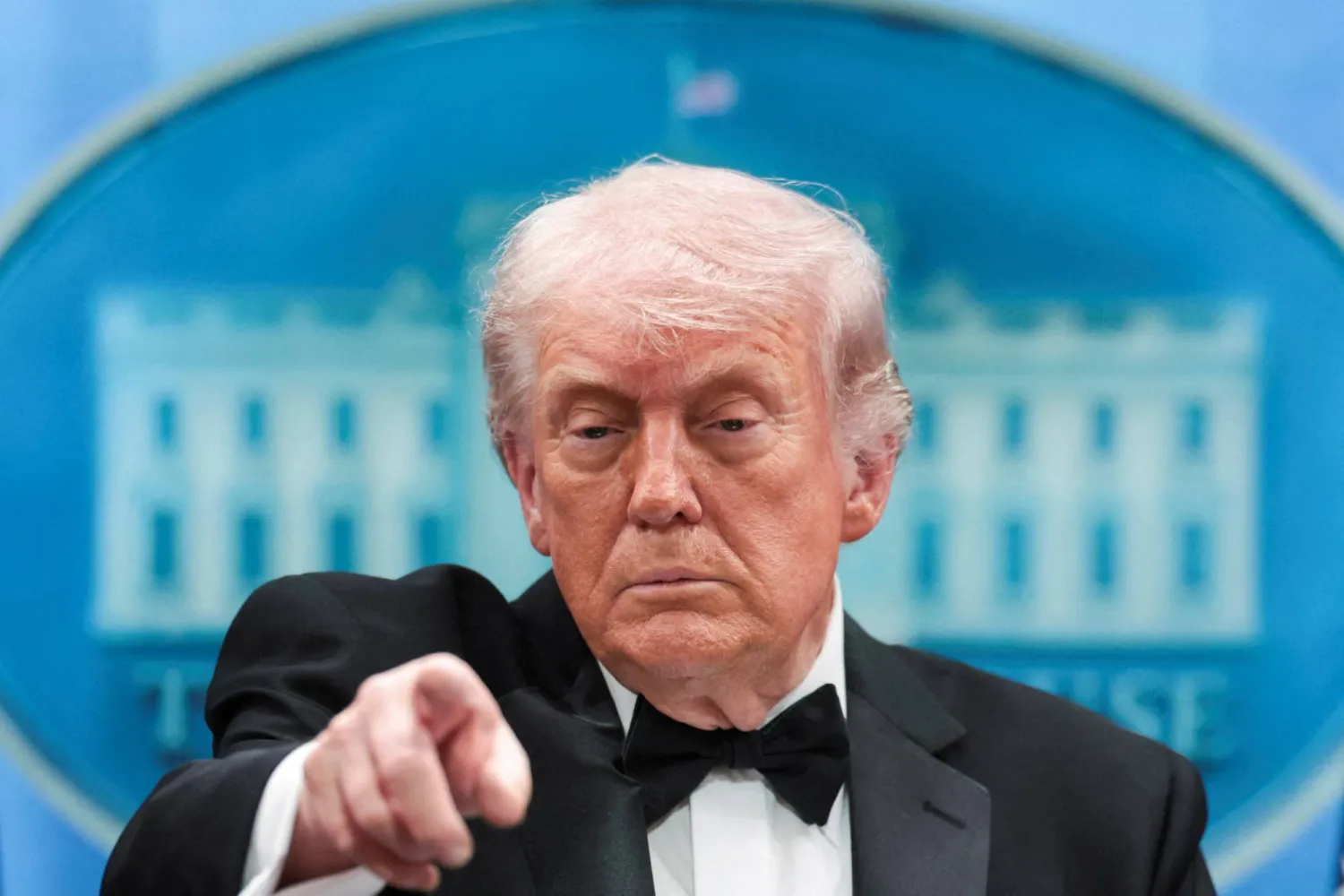
US President Donald Trump takes questions from media at a press briefing at the White House, in Washington, D.C., US, April 25, 2026. REUTERS/Jonathan Ernst
TT

Trump Says Iran Can Call if it Wants to Talk, as Iranian Envoy Returns to Pakistan

US President Donald Trump takes questions from media at a press briefing at the White House, in Washington, D.C., US, April 25, 2026. REUTERS/Jonathan Ernst

President Donald Trump said on Sunday that Iran can reach out to the United Stated if it wants to negotiate an end to the war between the two countries.

"If they ⁠want to talk, they ⁠can come to us, or they can call us. You know, there is a telephone. We ⁠have nice, secure lines," Trump said in an interview on Fox News' "The Sunday Briefing."

"They know what has to be in the agreement. It's very simple: they cannot have a nuclear weapon, otherwise there's no reason to meet," Trump said.

Iran has long demanded Washington acknowledge its right to enrich uranium, which Tehran says ⁠it only seeks ⁠for peaceful purposes but which Western powers and Israel say is aimed at building nuclear weapons.

Although a ceasefire has paused full-scale fighting in the conflict, which began with US-Israeli strikes on Iran on February 28, no agreement has been reached on terms to end a war that has killed thousands, driven up oil prices, fueled inflation and darkened the outlook for global growth.

Tehran has largely closed the Strait of Hormuz, which normally carries a fifth of global oil shipments, while Washington has imposed a blockade of Iran's ports.

Trump canceled a trip by his envoys Steve Witkoff and Jared Kushner to Pakistan on Saturday, dealing a new ⁠setback ⁠to peace prospects after Iranian Foreign Minister Abbas Araghchi departed Islamabad after speaking only to Pakistani officials.

Araghchi flew to Oman - another mediator in the war - where he met the country's leader, Haitham ⁠bin Tariq al-Said, on Sunday.

They discussed security in the strait and Araghchi called for a regional security framework free of outside interference, according to Iran's foreign ministry.

Araghchi later returned to Islamabad, Iranian state media reported. Pakistani government sources said he would hold talks with the country's leadership before heading to Moscow.

Iran's semi-official Tasnim news agency reported that Araghchi's talks with Pakistani officials would include "implementing a new legal regime over the Strait of Hormuz, receiving compensation, guaranteeing no renewed military aggression by warmongers, and lifting the naval blockade."

The talks would be unrelated to Iran's nuclear program, the report said.

Speaking in Florida before being rushed out of the White House Correspondents' Association dinner in Washington when a man opened fire nearby, Trump said he cancelled his envoys' visit due to too much travel and expense for what he considered an inadequate Iranian offer.

Iran "offered a lot, but not enough," Trump said.


Washington Zigzags Between Rolling Out More Sanctions, Extending Waiver in Iran’s War

US Treasury Secretary Scott Bessent at the end of a Senate Appropriations Financial Services and General Government Subcommittee hearing on President Trump's fiscal year 2027 budget request for the Department of the Treasury, on Capitol Hill in Washington, DC, US, April 22, 2026. (Reuters)
TT

Washington Zigzags Between Rolling Out More Sanctions, Extending Waiver in Iran’s War

US Treasury Secretary Scott Bessent at the end of a Senate Appropriations Financial Services and General Government Subcommittee hearing on President Trump's fiscal year 2027 budget request for the Department of the Treasury, on Capitol Hill in Washington, DC, US, April 22, 2026. (Reuters)

Alan Rappeport and Ephrat Livni*

With oil prices in mind, the administration of US President Donald Trump has deployed a haphazard approach to sanctions on Russia and Iran.

Treasury Secretary Scott Bessent declared in mid-April that the United States would not extend a waiver allowing the sale of Russian oil. Two days later, on a Friday evening, the Treasury Department quietly issued another 30-day reprieve.

Ukraine’s President Volodymyr Zelensky condemned the waiver, saying that “every dollar paid for Russian oil is money for the war.” Senate Democrats called the 180-degree reversal a “shameful” decision.

Then, on Friday, Bessent told The Associated Press that the United States did not plan to renew the waiver for sales of Russian oil another time. The current waiver ends on May 16.

The about-face on Russian oil sanctions underscored the haphazard state of US statecraft as the Trump administration confronts the fallout from the war it and Israel started with Iran.

While the United States could once use its financial might to cripple the economies of adversaries, countries such as Russia and Iran have been using their leverage in energy markets to fight back. That has forced the Treasury Department, which oversees the US sanctions program, to improvise.

The Trump administration rolled out a blitz of sanctions on Friday, targeting 40 shipping firms and vessels that it identified as part of Iran’s so-called shadow fleet of oil tankers as it broadened its efforts to cripple the Iranian economy.

The administration also imposed sanctions on an independent Chinese refinery, Hengli Petrochemical Refinery, which is one of Iran’s largest customers for crude oil and other petroleum products.

At a Senate hearing last week, Bessent said that the decision to extend the Russia license came after developing countries lobbied him to keep more Russian oil on the market while they were in Washington for the spring meetings of the International Monetary Fund and World Bank.

“It was my belief we would not do it,” Bessent said, but added that poor countries have been struggling with the global shortfall of oil.

The White House and Treasury Department had no comment on whether the decision to continue easing the Russia sanctions came directly from Trump.

The sanctions relief has been filling Russia’s coffers with, by some estimates, as much as $200 million per day, undermining years of work by the US and Western allies that aimed to make it harder for Moscow to pay for its war in Ukraine.

“You don’t have to read ‘The Art of War’ to know that helping your adversaries gain money while you’re at war is a terrible idea,” Senator Chris Coons, Democrat of Delaware, said while questioning Bessent at the hearing on Wednesday. “No country has profited more from this war than Russia,” Coons added, noting that the country’s revenues also help support Iran militarily.

The strategy toward Iran has been equally muddled. The United States last month granted a 30-day exemption allowing the sale of Iranian oil, arguing that it would help curb global oil prices while preventing the Iranians from profiting by blocking the Strait of Hormuz.

But this month, the Trump administration changed course, letting the sanctions exemption expire and embarking on Operation Economic Fury, with new sanctions on Iran. The US military also extended its blockade on vessels coming in and out of Iranian ports to the waters of the wider world.

Bessent has likened the initiative to a financial bombing campaign.

Last week, he and Trump emphasized the economic pressures they are putting on Iran. They have argued that Iran will be unable to store any more oil in a matter of days and will be forced to shut its wells, leading to the wells’ possible eventual failure and driving economic collapse.

“It is a kind of whiplash in terms of policy,” said Jennifer Kavanagh, a senior fellow and director of military analysis at Defense Priorities, a foreign policy think tank in Washington. “This whole back and forth is evidence the Trump administration did not expect this to last this long.”

Previously, “the primary vector of pressure” was military action, and the expectation seemed to be that bombing would force Iran to capitulate, she said.

But as fighting has dragged on, raising the stakes of the war, the notion of military escalation became less palatable and Trump had already “escalated rhetorically to the maximum,” with his threat to wipe out Iranian civilization before a ceasefire, she said, leading to the focus on economics.

Iran complicated the US sanctions strategy by blocking the Strait of Hormuz, engaging in economic warfare by military means.

An analysis from Lloyd’s List, the shipping intelligence firm, noted that there are “signs of disruption to Iran’s shadow fleet operations” amid the global US blockade, with some tankers turning, diverting or pausing since its imposition. But vessel-tracking information also showed other Iran-linked tankers were actively sailing.

On Thursday, the Pentagon said US military forces stopped and boarded a second sanctioned tanker carrying oil from Iran in the Indian Ocean, following a similar interdiction on Tuesday.

“But blockades are not quick fixes,” Kavanagh said. She has argued that Iran can probably withstand the pressure because they work slowly.

The global blockade raises legal and operational questions because it has no geographical boundaries. And the United States can only seize so many ships, suggesting the practical impact could be “marginal,” she argued, while at the same time degrading the US reputation as an upholder of the international order, since many countries view such seizures as piracy.

Edward Fishman, a fellow at the Council on Foreign Relations, said that the haphazard use of sanctions by the United States reflects how economic and military warfare are merging. “We don't have a playbook for this kind of economic warfare, which may help explain some of the fumbling by the United States,” Fishman said.

*The New York Times


King Charles’ Visit to US to Proceed After Washington Shooting

President Donald Trump and Britain's King Charles III review the Guard of Honor after the arrival at Windsor Castle in Windsor, England, Wednesday, Sept. 17, 2025.(AP)
TT

King Charles’ Visit to US to Proceed After Washington Shooting

President Donald Trump and Britain's King Charles III review the Guard of Honor after the arrival at Windsor Castle in Windsor, England, Wednesday, Sept. 17, 2025.(AP)

King Charles' state visit to the US will go ahead as planned on Monday despite a shooting at a White House dinner attended by President Donald Trump, Buckingham Palace said after discussions with US officials.

Charles and his wife, Queen Camilla, are due to arrive on Monday for a four-day state visit, but questions arose after a man opened fire on security personnel near the White House Correspondents' Association dinner on Saturday, prompting Secret Service agents to rush Trump from the venue.

"I think it's great; he'll be very safe," Trump said in an interview on ‌CBS News' "60 Minutes.The ‌White House grounds are really safe."

Trump also said there ‌was ⁠no indication from ⁠authorities that there were additional threats to himself or other officials.

US authorities believe the shooting likely targeted the president and administration officials, acting US Attorney General Todd Blanche said.

Blanche also said he was confident Charles would be safe during this week's visit to the US.

The four-day trip - which is to include a private meeting with Trump and an address to Congress marking 250 ⁠years since US independence — is intended to reinforce the strained US-British ‌relationship amid differences over the Iran ‌war.

KING AND QUEEN LOOKING FORWARD TO VISIT

"Following discussions on both sides of ‌the Atlantic through the day, and acting on advice of government, we ‌can confirm the state visit by their majesties will proceed as planned," a Buckingham Palace spokesperson said.

"The king and queen are most grateful to all those who have worked at pace to ensure this remains the case and are looking forward ‌to the visit getting underway tomorrow."

A palace source said there might be small operational changes to one or ⁠two engagements.

Earlier, ⁠the spokesperson said Charles was being kept fully informed of developments and was relieved that Trump, his wife and all guests had been unharmed.

Charles and Camilla have also privately reached out to Trump and his wife - first lady Melania Trump - to express their sympathies, a palace source said.

British senior minister Darren Jones said earlier on Sunday that the government would continue to cooperate closely with US security services ahead of Charles' visit and that extensive discussions already under way would continue in the coming days.

"In respect of His Majesty's visit to the United States next week ... our security services obviously remain in close cooperation in advance of that," Jones told Sky News.


Iran Foreign Minister Arrives in Russia as US Talks Remain Stalled

16 March 2018, Austria, Vienna: Abbas Araghchi, Then Deputy Foreign Minister of Iran, gives an interview in Vienna. (dpa)
TT

Iran Foreign Minister Arrives in Russia as US Talks Remain Stalled

16 March 2018, Austria, Vienna: Abbas Araghchi, Then Deputy Foreign Minister of Iran, gives an interview in Vienna. (dpa)

Iran's foreign minister arrived in Russia on Monday as peace efforts between Tehran and Washington hung in the balance, following a flurry of regional diplomacy and the collapse of planned talks in Pakistan.

Abbas Araghchi arrived in Saint Petersburg, the Iranian Foreign Ministry said on Telegram, where he is expected to meet with Russian President Vladimir Putin.

It comes after Araghchi visited Oman between trips to Pakistani capital Islamabad, as mediators push to keep peace talks between Tehran and Washington alive.

On Saturday, US President Donald Trump scrapped a planned trip to Islamabad by his envoys Steve Witkoff and Jared Kushner.

In a sign that efforts were ongoing, the Fars news agency said Iran had sent "written messages" to the Americans via mediator Pakistan outlining red lines, including nuclear issues and the Strait of Hormuz.

Fars said the messages were not part of formal negotiations, however.

US media outlet Axios reported on Sunday that Iran had sent a new proposal to reopen the Strait of Hormuz and end the war, with nuclear negotiations postponed for a later stage, citing a US official and two other sources with knowledge of the matter.

Iranian state news agency IRNA cited the report without denying it.

A ceasefire in the US-Israeli war with Iran has so far held, but its economic shockwaves have continued to reverberate globally.

Iran has sealed off the strait, cutting flows of oil, gas and fertilizer and sending prices soaring, raising fears of food insecurity in developing countries. At the same time, a US blockade of the strait is in place.

Hopes for a second round of talks in Pakistan had centered on the planned visit by Witkoff and Kushner, but Trump cancelled the trip after Iranian state television said Araghchi had no plans to meet US officials there.

On Sunday, Trump told Fox News that if Iran wanted the talks, "they can come to us, or they can call us".

Trump faces domestic pressure as fuel prices rise following Iran's closure of Hormuz, with midterm elections due in November. Polls show the war is unpopular among Americans.

- Safe transit -

Asked whether cancelling signaled renewed fighting, Trump said: "No, it doesn't mean that."

On Saturday, Araghchi met Pakistan's military chief Asim Munir, Prime Minister Shehbaz Sharif and Foreign Minister Ishaq Dar, before travelling to Oman and returning to Islamabad.

He later left for Russia for talks with senior officials, his ministry said.

Russian and Iranian state media confirmed Araghchi's talks with Putin, citing officials from their respective governments.

Araghchi himself posted on X that the talks in Oman had focused on ensuring safe transit through Hormuz, "to benefit of all dear neighbors and the world".

"Our neighbors are our priority," he added.

Iran's Revolutionary Guards said they had no intention of lifting their blockade, which has roiled energy markets.

"Controlling the Strait of Hormuz and maintaining the shadow of its deterrent effects over America and the White House's supporters in the region is the definitive strategy of Iran," the Guards said on their official Telegram channel.

The United States has imposed a blockade of Iranian ports in retaliation.

- Israel strikes Lebanon -

Israel and Hezbollah traded blame over violations of the fragile ceasefire in Lebanon, with Prime Minister Benjamin Netanyahu saying the military was "vigorously" targeting the Iran-backed group as both sides claimed new attacks.

Hezbollah drew Lebanon into the Middle East war on March 2 by firing rockets at Israel to avenge the death of Iran's supreme leader Ali Khamenei, with Israel responding with strikes and a ground invasion.

But claims that both sides have breached a 10-day ceasefire agreed earlier this month have continued.

Netanyahu told Sunday's weekly cabinet meeting that Hezbollah's actions were "dismantling the ceasefire" while Hezbollah said it would respond to Israeli violations and its "continued occupation".

Lebanon's health ministry said Israeli strikes on the country's south on Sunday killed 14 people, including two women and two children, and wounded 37.

The state-run National News Agency reported that Israeli warplanes had struck after evacuation warnings in Kfar Tibnit.

An Israeli strike on Zawtar al-Sharqiyah, another of the flagged villages, destroyed a mosque and another religious building, the news agency said.

Israel, which reported a soldier killed in combat in south Lebanon, says it can act against "planned, imminent or ongoing attacks".

"This means freedom of action not only to respond to attacks...but also to pre-empt immediate threats and even emerging threats," Netanyahu said.