


Stage Set for Elon Musk’s Court Battle with OpenAI

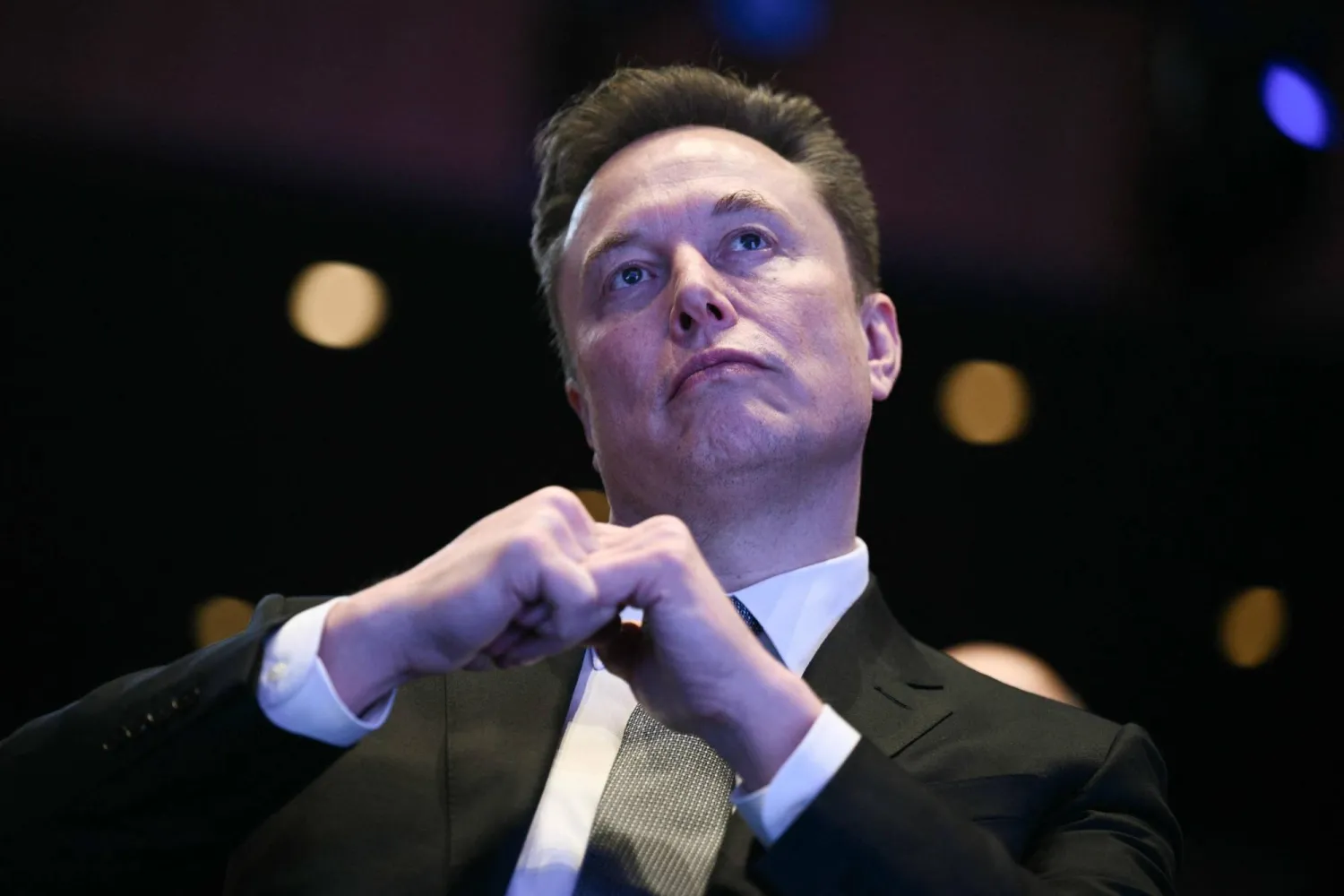
Elon Musk looks on as US President Donald Trump speaks at the US-Saudi Investment Forum at the John F. Kennedy Center for the Performing Arts in Washington, DC on November 19, 2025. (AFP)
TT

Stage Set for Elon Musk’s Court Battle with OpenAI

Elon Musk looks on as US President Donald Trump speaks at the US-Saudi Investment Forum at the John F. Kennedy Center for the Performing Arts in Washington, DC on November 19, 2025. (AFP)

Elon Musk's lawsuit accusing high-profile artificial intelligence company OpenAI of betraying its non-profit mission heads for trial on Monday with the selection of jurors.

The legal clash in a courtroom across the bay from San Francisco pits the world's richest person against a startup Musk once backed and now competes with in the booming AI sector.

OpenAI's ChatGPT is a formidable rival to the chatbot Grok, made by Musk's xAI lab.

While Musk's lawsuit is part of a feud between him and OpenAI Chief Executive Sam Altman, it spotlights a debate as to whether AI should ultimately serve to benefit a privileged few or society as a whole.

Court filings lay out how Altman convinced Musk to back OpenAI in 2015, acting as a co-founder for a non-profit lab whose technology "would belong to the world."

Musk pumped millions of dollars into the lab, which he subsequently left.

However, OpenAI established a commercial subsidiary as it needed hundreds of billions of dollars for data centers to power its technology.

Microsoft has poured billions of dollars into OpenAI and its CEO Satya Nadella is among those slated to testify at the trial.

Musk argues in his lawsuit that he was deceived about OpenAI's mission being altruistic.

San Francisco-based OpenAI has countered in court filings that its break-up with Musk was due to his quest for absolute control rather than its nonprofit status.

"This case has always been about Elon generating more power and more money for what he wants," OpenAI said in a recent X post. "His lawsuit remains nothing more than a harassment campaign that's driven by ego, jealousy and a desire to slow down a competitor."

The startup noted that days after Musk entered the AI race in 2023 he called for a six-month moratorium on development of advanced AI.

The judge presiding over the trial will decide by mid-May -- guided by an advisory jury's findings -- whether OpenAI broke a promise to Musk in a drive to lead in AI or just smartly rode the technology to glory.

Along with calling for OpenAI to be forced to revert to a pure nonprofit, Musk's suit urges the ouster of Altman and co-founder Greg Brockman, who is startup president.

Musk, who had sought as much as $134 billion in damages, has since renounced any personal benefit, pledging to redirect any award to the OpenAI nonprofit. Judge Yvonne Gonzalez Rogers has reserved the right to determine any remedies herself, without the jury's input.

OpenAI now has a hybrid governance structure giving its nonprofit foundation control over a for-profit arm.

Musk, who gutted the trust and safety team at Twitter after buying the social media platform that he renamed X, faces the challenge of convincing a jury and a judge that the company behind ChatGPT was built on a lie.



Robot Brings Cashier and Service-Host Functions to LEAP 2026

LEAP 2026 is showcasing an emerging Saudi experience in artificial intelligence (AI) and robotics through a robot named RoboNex, designed to combine cashier and service-host functions in the restaurant and café sector. (SPA)
TT

Robot Brings Cashier and Service-Host Functions to LEAP 2026

LEAP 2026 is showcasing an emerging Saudi experience in artificial intelligence (AI) and robotics through a robot named RoboNex, designed to combine cashier and service-host functions in the restaurant and café sector. (SPA)

LEAP 2026 is showcasing an emerging Saudi experience in artificial intelligence (AI) and robotics through a robot named RoboNex, designed to combine cashier and service-host functions in the restaurant and café sector. The robot interacts with customers in real time, takes their orders and provides smart recommendations, the Saudi Press Agency said on Thursday.

The robot’s development took place in Saudi Arabia, starting with structural design and component engineering and progressing to controller programming, AI algorithms, voice-processing systems and real-time interaction. It was also integrated with point-of-sale systems and electronic payment gateways.

The robot can handle sales transactions and take customer orders, while recommending additional products based on items already in the shopping basket. It can display specified discounts and promotional offers during the purchasing journey.

The presence of robots at LEAP 2026 highlights the growing adoption of AI and robotics across industries, as these technologies move beyond experimental concepts toward real-world applications in business, services and retail.


DeepFest Highlights Saudi Arabia’s Next Phase of AI Adoption on Third Day

Chief Strategy Officer of the Saudi Data and AI Authority (SDAIA) Abdullah Alkhodairi said Saudi Arabia is moving toward adopting an AI-first approach. (SPA)
TT

DeepFest Highlights Saudi Arabia’s Next Phase of AI Adoption on Third Day

Chief Strategy Officer of the Saudi Data and AI Authority (SDAIA) Abdullah Alkhodairi said Saudi Arabia is moving toward adopting an AI-first approach. (SPA)

Chief Strategy Officer of the Saudi Data and AI Authority (SDAIA) Abdullah Alkhodairi said Saudi Arabia is moving toward adopting an AI-first approach as he opened the third day of DeepFest 2026, held alongside LEAP 2026.

Alkhodairi said Saudi Arabia is ushering in a new phase in which AI is considered from the outset when designing services and products. This approach helps boost productivity, improve quality and resource efficiency, and deliver better outcomes for society and the economy, the Saudi Press Agency reported on Thursday.

Alkhodairi said the designation of 2026 as the Year of Artificial Intelligence has set a clear direction for Saudi Arabia to make AI a powerful driver of development, competitiveness, and innovation.

He noted that more than 80% of employees covered by Stanford University’s latest AI Index Report in Saudi Arabia regularly use AI in their daily work. This means the challenge is shifting from raising awareness and encouraging experimentation to turning this widespread adoption into sustainable institutional value.

Alkhodairi said an AI-first approach does not mean using AI everywhere or putting technology ahead of people, but rather “putting value before technology,” applying AI where it offers a genuine advantage and choosing the most appropriate solution when AI is not the best option.


Nvidia Boss Presses G20 Ministers to Build AI Infrastructure

Nvidia CEO Jensen Huang speaks during the G20 Innovation Ministerial on September 2, 2026 in Chapel Hill, North Carolina. (Getty Images/AFP)
TT

Nvidia Boss Presses G20 Ministers to Build AI Infrastructure

Nvidia CEO Jensen Huang speaks during the G20 Innovation Ministerial on September 2, 2026 in Chapel Hill, North Carolina. (Getty Images/AFP)

Nvidia chief Jensen Huang urged G20 ministers on Wednesday to build more data centers to support the artificial intelligence revolution, and warned that leaders who talk up the technology's dangers risk leaving their countries behind.

Huang made the plea on the second day of a G20 meeting in North Carolina, where the Trump administration has corralled top AI executives to pitch their vision to ministers from the world's leading economies.

"In the end, what every single country will have to recognize is that (AI) is infrastructure, just as it's water, roads, electricity, the internet," Huang told ministers at the event.

"Every single country needs to build infrastructure so that you can support your own local economy," he said.

Nvidia is the key company behind the generative AI frenzy that has catapulted it to become the world's most valuable publicly traded company.

The company's graphics processing units (GPUs), housed in specially built data centers going up across the world, are the key components for training AI models.

Such facilities provide "the digital intellectual capacity to support your researchers and students and society and industries and startups," he said.

Huang pushed back on notions that AI posed a threat to jobs, one of the fears that has fueled public opposition to the technology.

"The idea that somehow all the jobs are going to be eliminated or removed -- that's just nonsense," Huang told the G20 technology ministers.

Work would be redefined rather than eliminated, he argued.

"The tasks are going to be automated, but our jobs' purpose remain," he said.

He warned that countries would suffer if leaders "talk about the technology with fear, with uncertainty."

"The worst outcome is that you don't take advantage of it, that you are left behind. That is the single worst outcome," Huang said.

Huang also urged governments not to overregulate the technology, echoing similar comments by Elon Musk a day earlier.

"Don't regulate hypothetical theoretical harm, regulate actual and pragmatic harm," Huang said.

His appearance was moderated by US Commerce Secretary Howard Lutnick, who called Huang an "American treasure."

"Your company is leading us in a path that none of us, when we were young, ever dreamed possible," Lutnick said.

The meeting came amid a growing backlash against the construction of AI data centers in the United States, an issue that has taken on political weight as the country heads toward midterm elections in November.

President Donald Trump on Monday attacked opponents of artificial intelligence data centers, saying they would end up "backwards and poor."